How to Choose the Right Welding Fume Extractor for Your Workshop

Welding fume is generated whenever metals, coatings, fluxes, and other materials are heated to welding temperatures. The amount and composition of the fume can vary significantly depending on the welding process, material, consumables, production volume, and working environment.

Choosing a welding fume extractor therefore requires more than simply selecting a machine based on airflow or motor capacity. The extraction method, capture distance, number of welding stations, filtration technology, operator movement, and workshop layout all influence whether a system will provide effective welding fume extraction.

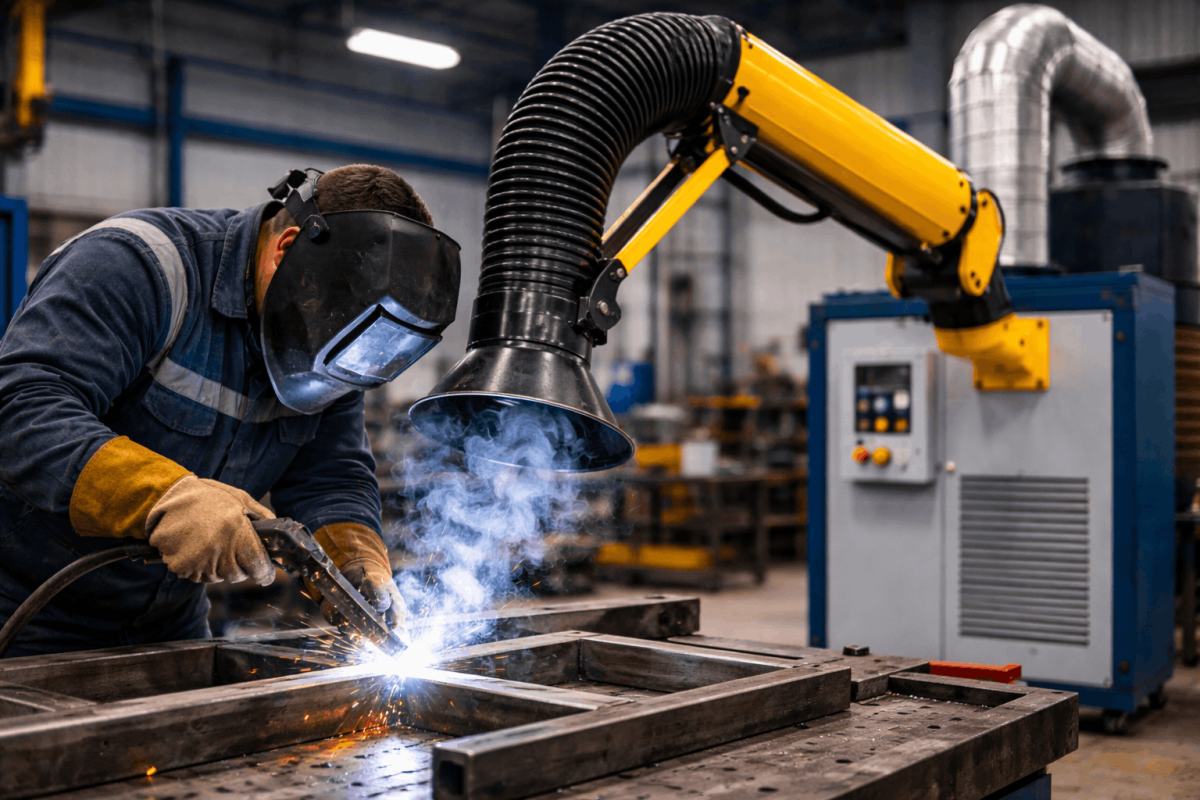
For a small fabrication shop, a portable source-capture unit may be appropriate. A production facility with several permanent welding stations may require a centralized extraction system. In some applications, an extraction arm positioned close to the arc may be more practical than a large general ventilation system.

This guide explains the key factors to consider when selecting a welding fume extractor for your workshop.

Why Choosing the Right Welding Fume Extractor Matters

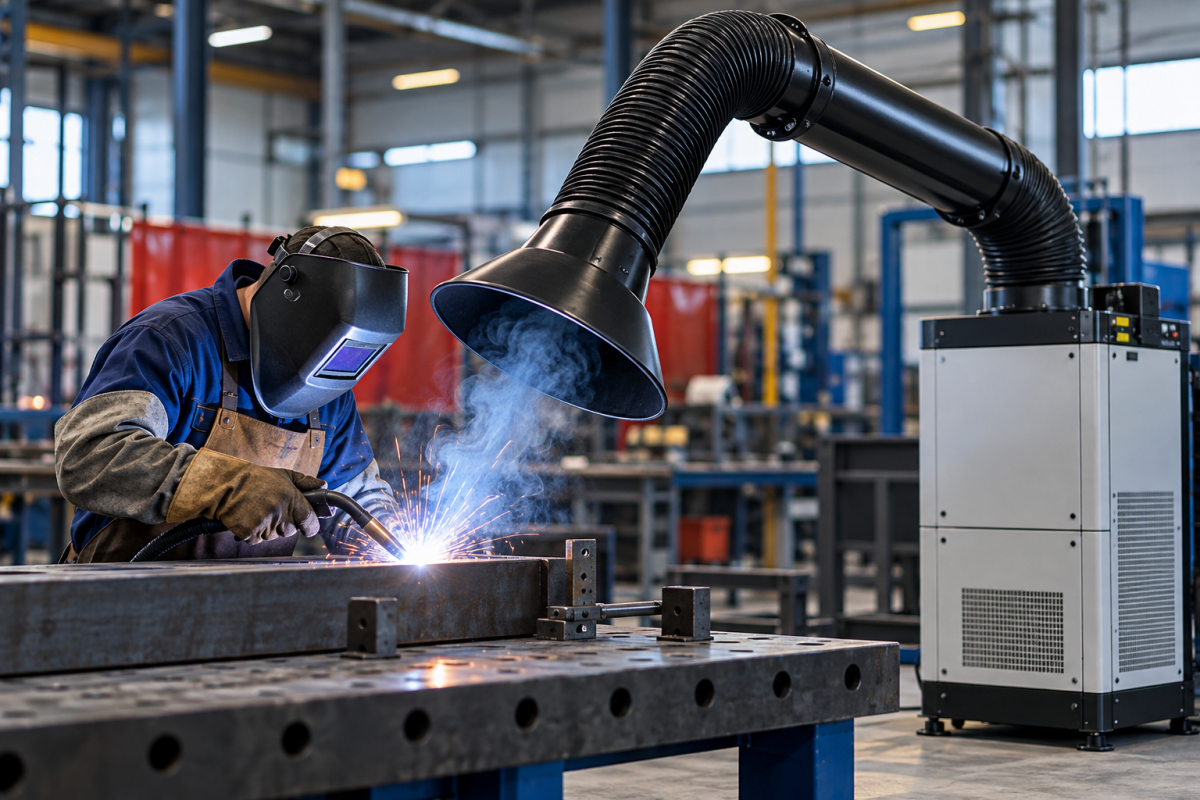
Welding fumes should ideally be captured at or close to their source, before they disperse throughout the workplace.

Once fumes rise away from the welding arc and mix with the surrounding air, capturing them becomes more difficult. A system may then require substantially more airflow to control the same contaminant.

Effective welding fume extraction is therefore based on two fundamental principles:

  1. Capture the fume as close to the source as practical.
  2. Move the captured fume through an appropriately designed filtration system.

This is why simply choosing an extractor with a high airflow rating does not necessarily guarantee effective fume control.

A properly selected system should match the actual welding operation rather than relying on airflow alone.

8 Factors to Consider When Choosing a Welding Fume Extractor

1. Identify the Welding Processes Used

Start by identifying the welding processes carried out in your workshop.

Common processes include:

  1. MIG/MAG welding
  2. TIG welding
  3. Stick or SMAW welding
  4. Gas welding
  5. Flux-cored arc welding
  6. Robotic welding
  7. Plasma cutting and related thermal processes

Each process can produce different levels and characteristics of fume.

For example, a workshop carrying out occasional TIG welding on small components has very different extraction requirements from a fabrication facility performing continuous MIG welding on large structures.

The type of consumable, welding current, shielding gas, base material, and production rate can also influence fume generation.

Your welding fume extractor should therefore be selected after understanding the actual welding processes rather than simply specifying a standard machine for every application.

2. Consider the Material Being Welded

The material being welded is another important consideration.

Common materials include:

  1. Mild steel
  2. Stainless steel
  3. Aluminium
  4. Galvanized steel
  5. Painted or coated metals
  6. Special alloys

The base material itself can affect the composition of the welding fume. Coatings, paints, plating, oils, and surface treatments can also introduce additional contaminants during welding.

This makes material identification an important part of the extraction-system design process.

For example, welding stainless steel requires different consideration from welding untreated mild steel because the composition of the fume can differ.

Before specifying an industrial fume extractor, identify not only the metal being welded but also any coatings or treatments present on the workpiece.

3. Decide Where the Fume Should Be Captured

One of the most important decisions is the capture method.

The objective is to capture the fume before it spreads into the operator’s breathing zone or the wider workshop.

Common approaches include:

Extraction Arms

A movable extraction arm can be positioned near the welding operation.

This approach is useful where:

  1. Welding takes place at fixed or semi-fixed stations
  2. Operators need flexibility
  3. The workpieces vary in size
  4. Individual workstations can accommodate extraction arms

The hood should be positioned as close to the welding point as practical without interfering with the welding operation.

The further the hood is from the source, the greater the challenge of capturing the rising fume effectively.

Portable Extraction Units

Portable systems can be useful where welding takes place at multiple locations.

They can be moved between work areas and are particularly relevant to workshops where permanent ducting is impractical.

Centralized Extraction Systems

A centralized system can serve multiple welding stations through a common extraction network.

This can be appropriate for:

  1. Production facilities
  2. Fabrication plants
  3. Multiple permanent welding booths
  4. Workshops with several extraction points

The ductwork, fan capacity, extraction points, and number of simultaneous users must be engineered as a system.

4. Determine the Number of Welding Stations

The number of welding stations directly affects the design of the extraction system.

A workshop with one welding station does not have the same requirements as a facility with 10, 20, or more stations.

However, the number of stations alone should not determine the required extractor capacity.

You also need to establish:

  1. How many stations operate simultaneously?
  2. How long does each station operate?
  3. Are all welding processes the same?
  4. Are extraction arms used at every station?
  5. Is the system centralized or individual?
  6. Are some stations used only occasionally?

For example, a centralized system serving eight welding stations should be designed based on the expected simultaneous operating conditions rather than simply multiplying a nominal airflow figure by eight.

This is where professional system design becomes important.

5. Evaluate Operator Movement and Workpiece Size

The ideal extraction solution for a small welding bench may not work for heavy fabrication.

Consider how operators actually move around the workpiece.

Small Components

For small components at fixed workstations, a close-positioned extraction arm may provide practical source capture.

Large Fabricated Structures

For large structures, the welder may move around the workpiece continuously.

In such situations, keeping a fixed extraction hood close to every welding point can be difficult.

The system may therefore need a different configuration, such as:

  1. Multiple extraction points
  2. Movable extraction arms
  3. Flexible extraction arrangements
  4. A combination of source capture and appropriate general ventilation

The extraction system should accommodate the production process rather than forcing the production process to work around the extraction equipment.

6. Look at the Required Airflow and Static Pressure

Airflow is one of the specifications buyers commonly focus on when selecting a welding fume extractor.

However, airflow alone is not enough.

A system has to deliver the required airflow at the actual operating conditions of the extraction network.

Static pressure losses can occur because of:

  1. Duct length
  2. Duct diameter
  3. Bends and elbows
  4. Branches
  5. Filters
  6. Extraction arms
  7. Hoods
  8. Dampers
  9. Other components in the system

A fan rated for a particular airflow under one pressure condition may deliver considerably less airflow when connected to a restrictive duct system.

Therefore, the selection process should consider both:

Required airflow + required static pressure

rather than choosing equipment solely on the basis of the largest CFM or m³/hr number.

This becomes especially important when designing centralized welding fume extraction for multiple stations.

7. Select the Appropriate Filtration Technology

Once the fume has been captured, it needs to be treated appropriately before the cleaned air is handled according to the system design.

Different filtration technologies are available for industrial fume extraction.

The appropriate technology depends on the contaminant characteristics and application.

For example, electrostatic filtration can be used in certain welding and industrial fume applications because the particles can be electrically charged and collected on collector plates.

Powertech’s FumeKiller range uses electrostatic filtration for applications including welding and soldering fumes, with configurations also positioned for certain oil-mist applications.

The company’s published product information describes filtration performance in the range of 90–98% for applicable systems and refers to very fine particle filtration capability. These figures should be understood as product/system specifications rather than universal performance guarantees for every welding application.

For applications where additional gaseous contaminants or odours need consideration, an activated-carbon post-filter can also be incorporated into suitable configurations.

The key point is that filtration technology should be selected based on the actual contaminant and process, not simply on a headline efficiency percentage.

8. Consider Maintenance Requirements

A welding fume extractor is only useful when it continues to operate effectively.

Maintenance should therefore be considered before purchasing the system.

Ask:

  1. How is the filtration system cleaned?
  2. How frequently does it need servicing?
  3. How is collected contamination removed?
  4. How easy is it to access the filter or collector?
  5. Are replacement components readily available?
  6. How is airflow performance checked?
  7. What indicators show that maintenance is required?

The maintenance requirements can vary considerably between filtration technologies.

A system that appears inexpensive initially may have higher operating or maintenance requirements over its lifetime.

When comparing systems, look beyond the purchase price and consider the total operating requirements.

Source Capture vs General Workshop Ventilation

One of the most important distinctions when designing a welding fume control system is the difference between source capture and general ventilation.

General ventilation attempts to dilute and remove contaminated air from the wider workspace.

Source capture attempts to remove the contaminant before it disperses.

For welding, source capture is generally the more direct approach because the contaminant can be intercepted close to where it is generated.

This does not mean general ventilation has no role.

A well-designed workshop may require both:

Source capture + appropriate general ventilation

The exact combination depends on the welding processes, building layout, production conditions, and extraction design.

Should You Choose a Portable or Centralized Welding Fume Extractor?

There is no single configuration that suits every workshop.

Requirement Portable System Centralized System
Small number of welding stations Suitable May be unnecessary
Frequently changing work locations Useful Less flexible
Multiple permanent stations Limited Suitable
Large production facility Application dependent Often considered
Permanent ducting Usually minimal Required
Multiple extraction points Limited by design Suitable
Expansion of welding stations Depends on unit Can be engineered for expansion

The decision should be based on the production environment rather than simply the number of machines.

For example, a fabrication shop with several welding stations but highly mobile workpieces may require a different solution from an electronics or manufacturing facility with fixed production stations.

When Does a Workshop Need an Industrial Fume Extractor?

An industrial fume extractor becomes particularly relevant when welding is a regular part of production rather than an occasional maintenance activity.

Factors that may indicate the need for an engineered extraction solution include:

  1. Multiple welding stations
  2. Continuous or high-volume welding
  3. Large fabrication areas
  4. Multiple operators welding simultaneously
  5. Limited natural ventilation
  6. Welding of coated or treated metals
  7. Production processes where welding fumes are consistently generated
  8. Requirements for controlled workplace air quality

For larger facilities, the solution may involve multiple source-capture points connected to a centralized filtration system.

Common Mistakes When Choosing a Welding Fume Extractor

Choosing Based Only on Airflow

A higher airflow number does not automatically mean better fume capture.

The hood position, capture distance, system pressure, duct design, and filtration system all matter.

Placing the Extraction Hood Too Far Away

Source capture becomes increasingly difficult as the distance between the hood and welding point increases.

The extraction hood should be positioned as close to the source as practical while allowing the operator to work safely and efficiently.

Ignoring the Welding Process

A system designed for occasional welding may not be suitable for continuous production welding.

The welding process and production volume should form part of the initial equipment specification.

Treating All Welding Fumes as the Same

Different materials, coatings, consumables, and welding processes can produce different contaminants.

Filtration should therefore be selected based on the application.

Forgetting Future Expansion

If the workshop is expected to add welding stations, increase production, or change its manufacturing process, the extraction system should be evaluated with those potential changes in mind.

Retrofitting ductwork and filtration capacity later can be more complicated than considering expansion during the initial design.

A Practical Checklist for Selecting a Welding Fume Extractor

Before contacting an equipment supplier, collect the following information:

Welding Process

  1. MIG/MAG
  2. TIG
  3. Stick
  4. Flux-cored
  5. Robotic
  6. Other processes

Materials

  1. Mild steel
  2. Stainless steel
  3. Aluminium
  4. Galvanized/coated materials
  5. Other alloys

Production

  1. Number of welding stations
  2. Number of simultaneous operators
  3. Hours of welding per shift
  4. Number of shifts
  5. Continuous or intermittent welding

Workplace

  1. Workshop dimensions
  2. Ceiling height
  3. Workstation arrangement
  4. Operator movement
  5. Workpiece dimensions
  6. Existing ventilation

Extraction

  1. Fixed or mobile extraction
  2. Extraction arm requirements
  3. Number of extraction points
  4. Proposed duct arrangement
  5. Required airflow
  6. Static pressure requirements

Filtration

  1. Type of welding fume
  2. Required filtration technology
  3. Filter/collector maintenance
  4. Potential requirement for additional filtration stages

Providing this information allows an extraction-system supplier to recommend equipment based on the actual application rather than relying on a generic machine specification.

Powertech Welding Fume Extraction Solutions

Powertech Pollution Controls provides industrial air pollution control solutions for applications including welding and soldering fume extraction.

Its FumeKiller range uses electrostatic filtration and is available in configurations designed for different industrial applications. For workshops with multiple welding stations, the extraction system can be designed around the number of extraction points, operating conditions, and workshop layout.

Powertech also provides fume extraction arms for source capture, allowing fumes to be captured close to the point of generation.

For example, Powertech has documented a welding application involving eight welding stations and a FumeKiller FK3600VEM, demonstrating how a multi-station welding environment can be approached through an engineered extraction system rather than treating every workstation as an isolated application.

The appropriate equipment, however, depends on the specific welding process, material, workstation configuration, and operating conditions.

Final Thoughts

Choosing a welding fume extractor is fundamentally an application-engineering decision.

The right system depends on more than the size of the workshop or the advertised airflow of an extraction unit. You need to consider the welding process, materials, production volume, operator movement, number of stations, capture method, airflow, static pressure, filtration technology, and maintenance requirements.

For many workshops, the starting point should be source capture: identify where the welding fume is generated and determine how it can be captured as close to that point as practical.

From there, the extraction and filtration system can be designed around the actual operating conditions.

A properly specified welding fume extraction system can provide a more controlled approach to managing welding fumes while fitting into the way the workshop actually operates.

If you are planning a new welding fume extraction system or upgrading an existing one, the best starting point is to evaluate your welding processes, number of stations, workpiece sizes, and workshop layout before selecting the equipment.

Looking for a welding fume extraction solution for your workshop? Contact Powertech Pollution Controls to discuss your application and determine the appropriate extraction and filtration configuration.
Benefits of a Portable Weld Fume Extractor

Introduction

Welding fumes contain fine metal particles and gases that are generated whenever metals are joined using processes such as MIG, TIG, Stick, or Flux-Cored Arc Welding. In many fabrication shops, repair facilities, maintenance departments, and construction sites, welding is performed at multiple locations, making fixed extraction systems impractical. A portable weld fume extractor provides an efficient and flexible solution by capturing fumes directly at the source while allowing the extraction system to move wherever welding takes place.

Unlike centralized systems that serve fixed welding stations, portable units can be repositioned quickly between work areas. This flexibility makes them an ideal choice for workshops with changing layouts, low-to-medium production volumes, or maintenance operations where welding is performed intermittently across different locations.

Powertech’s FumeKiller portable welding fume extractors are engineered to provide effective source-capture extraction, helping manufacturers improve workplace air quality, protect operators, and maintain cleaner fabrication environments.

Key Takeaways

  1. Portable weld fume extractors capture fumes directly at the welding source.
  2. Mobile design allows easy movement between welding stations.
  3. Ideal for fabrication shops, maintenance, and repair operations.
  4. Improves air quality while reducing workshop contamination.
  5. Lower installation costs than centralized extraction systems.

What Is a Portable Weld Fume Extractor?

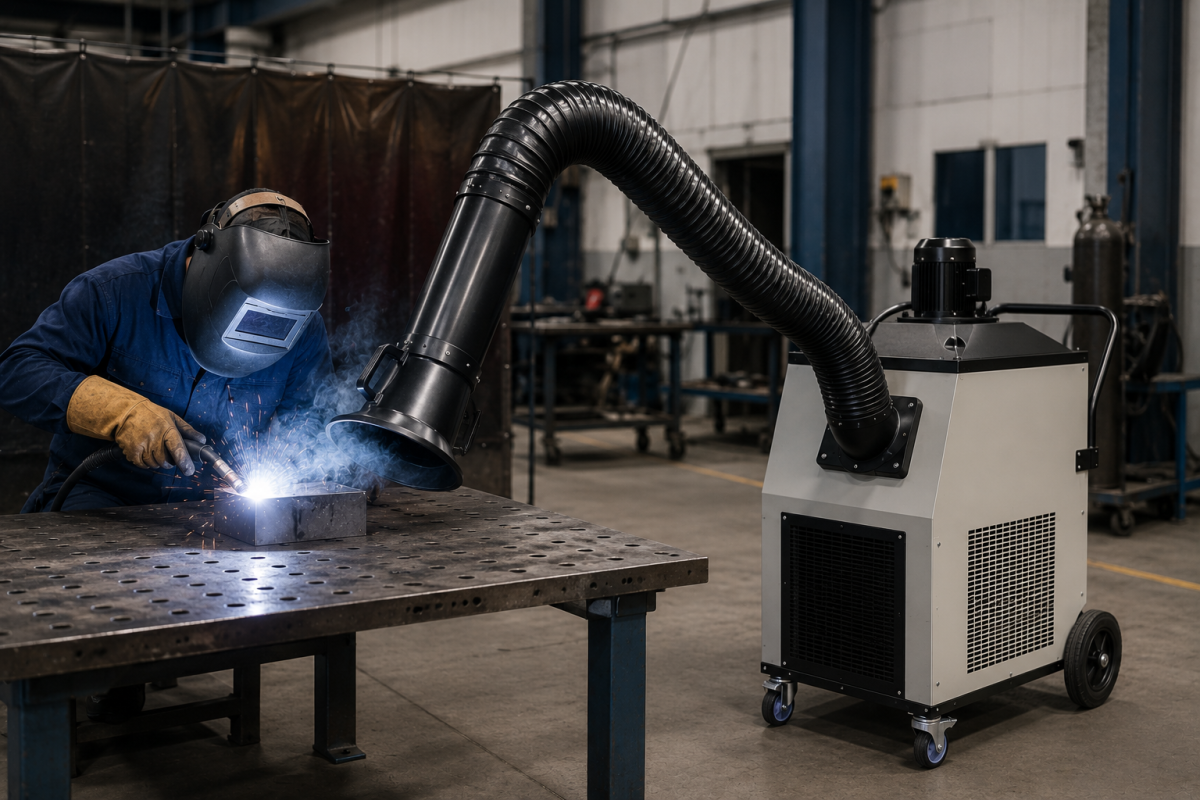
A portable weld fume extractor is a self-contained air filtration unit mounted on wheels and equipped with a flexible extraction arm. The operator positions the extraction hood close to the welding arc, where airborne fumes are captured before dispersing into the surrounding workspace.

Most systems include:

  1. Flexible extraction arm
  2. High-efficiency filtration system
  3. Industrial blower
  4. Mobile cabinet
  5. Collection filters
  6. Easy-access maintenance panels

Benefits of a Portable Weld Fume Extractor

1. Mobility

The biggest advantage is portability.

One unit can easily serve multiple welding stations by simply moving it where welding is taking place.

2. Effective Source Capture

When the extraction hood is positioned near the welding arc, fumes are captured before reaching the operator’s breathing zone.

This significantly improves extraction efficiency.

3. Lower Installation Cost

Portable units do not require:

  1. Permanent ductwork
  2. Extensive plant modifications
  3. Centralized piping
  4. Large capital investment

This makes them an economical solution for many facilities.

4. Flexible Workshop Layout

As production requirements change, the extractor can be relocated without modifying the facility.

Ideal for:

  1. Job shops
  2. Contract manufacturers
  3. Repair workshops
  4. Maintenance departments

5. Improved Workplace Air Quality

Capturing fumes directly at the source reduces airborne contaminants throughout the workshop.

Benefits include:

  1. Cleaner work environment
  2. Reduced visible welding smoke
  3. Lower dust accumulation
  4. Better operator comfort

6. Reduced Equipment Contamination

Welding fumes often settle on:

  1. Machines
  2. Electrical cabinets
  3. Tools
  4. Fixtures

Portable extraction helps minimize this contamination.

7. Increased Productivity

Operators can work at different locations without waiting for access to a fixed extraction station.

8. Easy Maintenance

Most portable systems are designed with:

  1. Accessible filters
  2. Simple servicing
  3. Quick inspections
  4. Easy filter replacement

This minimizes downtime.

9. Suitable for Expanding Businesses

Portable systems can be added gradually as production grows, making them an excellent investment for expanding fabrication shops.

Ideal Applications

Portable weld fume extractors are widely used in:

  1. Metal fabrication shops
  2. Welding repair facilities
  3. Maintenance workshops
  4. Automotive repair
  5. Agricultural equipment manufacturing
  6. Structural steel fabrication
  7. Educational welding labs
  8. Prototype manufacturing
  9. Small and medium engineering companies

Portable vs Centralized Welding Fume Extraction

FeaturePortable Weld Fume ExtractorCentralized System
MobilityExcellentFixed
Initial InvestmentLowerHigher
InstallationSimpleComplex
Best ForSmall to medium workshopsLarge production facilities
Multiple Work AreasExcellentLimited to installed ductwork
ExpansionEasyRequires duct modifications
MaintenanceIndividual unitsCentralized maintenance

Best Practices

To maximize performance:

  1. Position the extraction hood 150–300 mm (6–12 inches) from the welding arc.
  2. Inspect filters regularly.
  3. Maintain unrestricted airflow.
  4. Keep extraction arms correctly positioned.
  5. Follow scheduled maintenance procedures.

Expert Insight

From Powertech’s experience, portable weld fume extractors provide the greatest value for workshops where welding locations change throughout the day. Many facilities initially invest in portable systems before expanding to centralized extraction as production increases. For low- and medium-volume fabrication, portable source-capture extraction often delivers the best balance of performance, flexibility, and cost.

What is a portable weld fume extractor?

A portable weld fume extractor is a mobile filtration unit with a flexible extraction arm that captures welding fumes directly at the source.

What are the advantages of portable welding fume extraction?

It offers mobility, lower installation costs, improved air quality, flexible workshop layouts, and effective source-capture extraction.

Is a portable extractor suitable for multiple welding stations?

Yes. The unit can be moved between workstations, making it ideal for facilities where welding is performed in different locations.

Does a portable weld fume extractor require ductwork?

No. Most portable units are self-contained and do not require permanent ductwork or major facility modifications.

When should a centralized system be considered?

Centralized systems are generally more suitable for facilities with multiple fixed welding stations operating continuously.

Why choose Powertech’s FumeKiller portable weld fume extractor?

Powertech’s FumeKiller offers efficient source-capture extraction, robust industrial construction, low-maintenance operation, and the flexibility needed for modern fabrication and maintenance environments.

Conclusion

A portable weld fume extractor is an excellent solution for workshops that require flexible, efficient, and cost-effective welding fume control. By capturing fumes directly at the source, these systems improve workplace air quality, protect operators, reduce equipment contamination, and support cleaner manufacturing environments. For fabrication shops, maintenance departments, and growing businesses, Powertech’s FumeKiller portable welding fume extractors provide a reliable and scalable solution for effective welding fume extraction.

Welding Fume Extraction Systems in Industrial Fabrication Shops

Introduction

Welding is one of the most common fabrication processes used across industries such as automotive manufacturing, heavy engineering, structural fabrication, and equipment manufacturing. While welding enables strong and reliable metal joints, it also produces significant airborne contaminants in the form of welding fumes. These fumes consist of fine metal particles, gases, and chemical compounds that can pose serious health risks to workers if not properly controlled.

In industrial fabrication shops where welding operations are performed continuously, airborne contaminants can quickly accumulate in the work environment. Poor air quality affects worker health, reduces visibility in the workspace, and can lead to regulatory compliance issues. Controlling welding fumes is therefore a critical aspect of industrial safety and workplace engineering.

A properly designed welding fume extraction system helps capture and remove fumes at the source before they disperse into the surrounding environment. By using specialized welding fume extractor units and appropriate industrial welding ventilation, fabrication shops can significantly improve air quality, enhance worker safety, and maintain regulatory compliance. This article explains how welding fume extraction equipment works and how it is applied in industrial fabrication environments.

Key Takeaways

  1. A welding fume extraction system captures hazardous welding fumes at the source, preventing them from spreading into the work environment.
  2. Effective industrial welding ventilation improves worker safety, visibility, and compliance with occupational health regulations.
  3. Proper selection of welding fume extraction equipment depends on airflow requirements, welding process type, and workspace layout.
  4. Localized extraction systems are generally more effective than general ventilation for controlling welding fumes.

The Problem: Welding Fume Exposure in Fabrication Shops

Welding fumes are generated when metals are heated to high temperatures and vaporize. These vapors quickly cool and condense into extremely fine airborne particles that remain suspended in the air.

Without proper extraction, these contaminants accumulate in the workplace.

Causes of Welding Fume Accumulation

  1. Continuous welding operations in enclosed workshops
  2. Inadequate general ventilation systems
  3. Multiple welding stations operating simultaneously
  4. Poor positioning of extraction equipment
  5. High deposition rates from processes such as MIG and flux-cored arc welding

Workplace Impact

Poor welding fume control can negatively affect fabrication shop operations:

  1. Reduced visibility due to smoke accumulation
  2. Uncomfortable working conditions for welders
  3. Contamination of nearby workstations and equipment
  4. Increased maintenance requirements for machinery

Safety Risks

Exposure to welding fumes can lead to several health concerns, including:

  1. Respiratory irritation and lung damage
  2. Metal fume fever caused by inhalation of metal oxide particles
  3. Long-term exposure risks associated with chromium, manganese, and nickel compounds
  4. Potential neurological effects from prolonged exposure to certain metals

For these reasons, many industrial safety standards emphasize the need for effective welding fume extraction systems and engineered ventilation solutions.

How a Welding Fume Extraction System Works

A welding fume extraction system is designed to capture fumes at the point where they are generated and remove them from the worker’s breathing zone.

The system typically consists of several integrated components.

Step 1: Fume Capture

The first stage involves capturing fumes as close to the welding arc as possible.

This is commonly achieved using:

  1. Flexible extraction arms
  2. Extraction hoods
  3. Downdraft tables
  4. On-torch extraction systems

These devices position the airflow source directly near the welding area, preventing fumes from spreading.

Step 2: Air Conveyance

Once fumes are captured, they are transported through ducting or internal channels within the welding fume extractor.

A high-efficiency fan or blower generates airflow that pulls contaminated air through the system.

Step 3: Filtration

The captured air then passes through filtration stages designed to remove particulate matter.

Typical filtration methods include:

  1. Cartridge filters for fine metal particles
  2. HEPA filters or electrostaticfilters for very fine particulate capture
  3. Spark arrestors for safety protection

These filters remove hazardous particles from the air stream.

Step 4: Clean Air Discharge

After filtration, the cleaned air can either:

  1. Be returned to the workspace (recirculation systems)
  2. Be discharged outside through exhaust ducting

Proper filtration ensures that discharged air meets environmental and workplace safety standards.

Typical Airflow Requirements for Welding Fume Extraction

Airflow is one of the most important parameters in designing a welding fume extraction system. Insufficient airflow will allow fumes to escape, while excessive airflow increases energy consumption.

Welding ApplicationTypical Capture MethodRecommended Airflow (m³/hr)Typical Capture Velocity
Manual MIG weldingExtraction arm800 – 12000.5 – 1.0 m/s
TIG weldingLocal hood600 – 9000.4 – 0.8 m/s
Robotic welding cellEnclosed hood1500 – 25000.8 – 1.2 m/s
Grinding and welding stationsDowndraft table2000 – 35001.0 – 1.5 m/s

Actual airflow requirements depend on:

  1. Welding process type
  2. Distance between the arc and extraction hood
  3. Workshop layout
  4. Number of active welding stations

Proper engineering calculations are required to size the welding fume extraction equipment correctly.

Practical Industrial Applications

Automotive Manufacturing

Automotive manufacturing facilities rely heavily on robotic welding systems for assembling vehicle bodies and components.

These facilities often use centralized welding fume extraction systems connected to multiple welding stations. Enclosures and high-capacity filtration units ensure that fumes generated during robotic welding are effectively captured.

Fabrication Shops

Structural fabrication shops typically operate multiple manual welding stations. In such environments, mobile welding fume extractor units with flexible arms are commonly used.

These systems allow welders to reposition the extraction arm depending on the workpiece location, ensuring effective fume capture.

Electronics Manufacturing

Electronics manufacturing processes often involve soldering and micro-welding operations. Although the fume volumes are smaller, the particles produced can still pose health risks.

Compact extraction units are used to capture fumes generated during soldering and precision welding processes.

CNC and Equipment Manufacturing

Many CNC machine shops include welding as part of the manufacturing process for frames, fixtures, and machine components.

Local extraction systems integrated into welding stations prevent fumes from spreading into areas where precision machining operations are conducted.

Expert Insight

In many fabrication shops, welding fumes are controlled using general ventilation or ceiling exhaust fans. However, these approaches often fail to capture fumes before they reach the worker’s breathing zone.

From an engineering perspective, source capture is the most effective strategy. Positioning extraction arms within 200–300 mm of the welding arc significantly improves capture efficiency. Proper maintenance of filters and periodic airflow verification are also essential to ensure long-term performance of the welding fume extraction system.

What is a welding fume extraction system?

A welding fume extraction system is an engineered ventilation system designed to capture and filter fumes generated during welding processes before they disperse into the workplace environment.

Why is local extraction preferred over general ventilation?

Local extraction captures fumes directly at the source, preventing them from spreading into the surrounding workspace. General ventilation dilutes contaminants but does not remove them effectively.

How often should filters in welding fume extraction equipment be replaced?

Filter replacement intervals depend on welding intensity and system design. In most industrial environments, filters are inspected regularly and replaced when pressure drop exceeds recommended limits.

Can a welding fume extractor handle multiple welding stations?

Yes. Larger systems can be designed to serve multiple stations using ducting networks connected to a centralized filtration unit.

Are welding fumes hazardous even in small workshops?

Yes. Even small welding operations can produce harmful metal particles and gases. Proper industrial welding ventilation is important regardless of workshop size.

Conclusion

Welding fumes are an unavoidable by-product of metal fabrication processes, but their impact on workplace safety and air quality can be effectively controlled with proper engineering solutions. A well-designed welding fume extraction system captures fumes at the source, filters hazardous particles, and prevents contamination of the work environment. By implementing appropriate welding fume extraction equipment and maintaining proper industrial welding ventilation, fabrication shops can significantly improve worker safety, operational efficiency, and regulatory compliance. As welding operations continue to expand across manufacturing industries, investing in reliable air pollution control systems remains a critical component of modern industrial facility design.

Improving Efficiency of Welding Fume Extraction Systems

Introduction

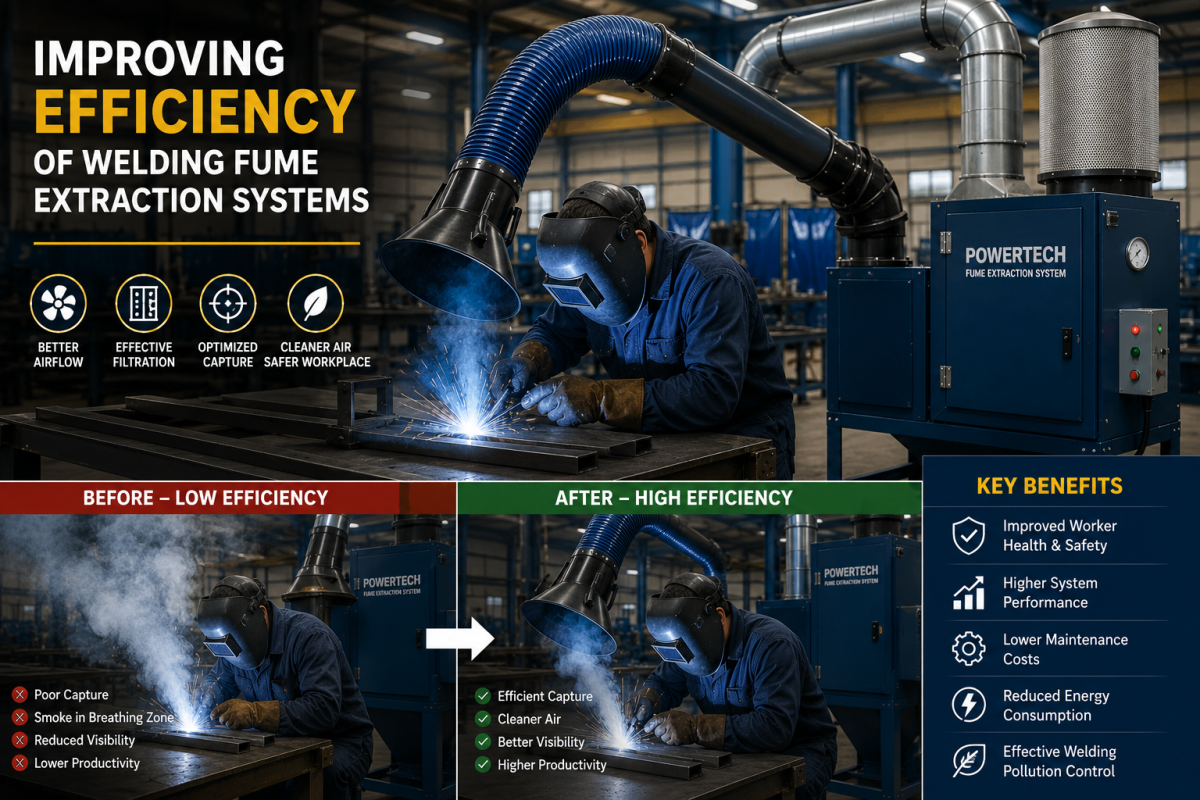
Installing a welding fume extraction system is only the first step toward maintaining clean and safe industrial environments. In many facilities, systems operate below their intended performance due to airflow imbalance, poor hood positioning, clogged filters, or improper maintenance practices. As a result, fumes escape into the workspace despite the presence of extraction equipment.

Improving the efficiency of a welding fume extractor requires a combination of proper engineering design, operational optimization, and preventive maintenance. Even small adjustments in airflow, duct layout, or extraction arm positioning can significantly enhance overall system performance.

An optimized approach to welding pollution control not only improves air quality but also reduces energy consumption and maintenance costs. With over 30 years of experience, Powertech has improved fume extraction system performance across fabrication shops, automotive manufacturing facilities, and heavy engineering industries through practical engineering-driven optimization strategies.

Key Takeaways

  1. Proper source capture is the most important factor in welding fume extraction efficiency.
  2. Airflow balancing and duct optimization significantly improve system performance.
  3. Regular maintenance prevents efficiency loss over time.
  4. Optimized systems improve both air quality and energy efficiency.

The Problem: Reduced System Efficiency

Many extraction systems gradually lose performance due to operational and maintenance issues.

Causes

  1. Incorrect extraction arm positioning
  2. Insufficient airflow at capture points
  3. Poor duct design and pressure losses
  4. Clogged or overloaded filters
  5. Lack of preventive maintenance

Workplace Impact

  1. Visible welding fumes in the workspace
  2. Reduced visibility and operator comfort
  3. Higher energy consumption
  4. Increased downtime and maintenance costs

Safety Risks

According to the Occupational Safety and Health Administration (OSHA), inadequate welding ventilation may expose workers to hazardous airborne contaminants.

The National Institute for Occupational Safety and Health (NIOSH) recommends proper ventilation and source capture methods for effective welding fume control.

Technical Explanation: How to Improve System Efficiency

Step 1: Optimize Source Capture

Effective source capture is the foundation of system efficiency.

Best Practices

  1. Position extraction arms 150–300 mm from the arc
  2. Align hood with rising fume direction
  3. Avoid airflow obstruction by the operator

Proper positioning improves capture without increasing airflow.

Step 2: Balance Airflow Across the System

Uneven airflow reduces performance in multi-point systems.

Optimization Methods

  1. Adjust dampers
  2. Measure airflow at all stations
  3. Ensure consistent suction levels

Balanced systems deliver more reliable performance.

Step 3: Improve Duct Design

Poor duct layouts increase pressure losses.

Recommended Improvements

  1. Reduce sharp bends
  2. Maintain proper duct velocity (12–17 m/s)
  3. Shorten unnecessary duct runs

Better duct design improves airflow efficiency.

Step 4: Maintain Filtration Systems

Filter condition directly affects airflow and extraction performance.

Maintenance Actions

  1. Monitor pressure drop
  2. Replace clogged filters
  3. Clean filters and ducting regularly

Delayed maintenance is a major cause of performance decline.

Step 5: Monitor System Performance

Continuous monitoring helps identify problems early.

Parameters to Monitor

  1. Airflow
  2. Static pressure
  3. Filter pressure drop
  4. Fan performance

Data-driven maintenance improves reliability.

Key Parameters Affecting Efficiency

ParameterRecommended RangeImpact
Hood distance150 – 300 mmSource capture efficiency
Capture velocity0.5 – 1.5 m/sFume control effectiveness
Duct velocity10 – 15 m/sPrevents dust settling
Filter pressure dropWithin design rangeMaintains airflow
Airflow balanceUniform across stationsConsistent performance

Practical Industrial Applications

Fabrication Shops

  1. Frequent repositioning of extraction arms
  2. Need for flexible airflow balancing

Automotive Manufacturing

  1. Centralized systems requiring precise balancing
  2. Robotic welding with consistent airflow demands

Maintenance Workshops

  1. Portable systems dependent on operator positioning

Heavy Engineering

  1. High particulate load requiring optimized filtration and airflow

Expert Insight

From Powertech’s field experience, one of the most effective ways to improve welding fume extraction efficiency is through system optimization rather than equipment replacement.

Key observations:

  1. Poor positioning often causes greater efficiency loss than insufficient airflow
  2. Regular airflow measurements reveal hidden performance issues
  3. Preventive maintenance significantly improves long-term performance

In several installations, optimizing airflow distribution and hood positioning improved system efficiency without increasing fan capacity.

How can welding fume extraction efficiency be improved?

By optimizing hood positioning, balancing airflow, improving duct design, and maintaining filters regularly.

Does higher airflow always improve performance?

No. Proper source capture and system design are equally important.

Why does system performance decline over time?

Due to clogged filters, airflow imbalance, and lack of maintenance.

How often should airflow be checked?

Regular inspections and airflow measurements are recommended.

Can existing systems be improved without replacement?

Yes. Many systems can be optimized through design corrections and maintenance.

Conclusion

Improving welding fume extraction efficiency requires a comprehensive approach that combines proper source capture, optimized airflow, effective filtration, and preventive maintenance. By focusing on fume extraction system performance and implementing engineering-driven improvements, industries can achieve better welding pollution control, improved air quality, and lower operational costs. With decades of experience, Powertech continues to help industries optimize welding ventilation systems for reliable, efficient, and long-term performance.

welding fume extractor capturing fumes at source using extraction arm

Welding Fume Extractor: How Source Capture Works in Welding

How Welding Fume Extractors Capture Fumes at the Source

Introduction

Welding operations are a critical part of industrial fabrication, but they generate hazardous fumes composed of fine metal particulates and gases. These fumes, if not effectively controlled, disperse into the work environment and expose workers to harmful contaminants. In fabrication shops where multiple welding stations operate simultaneously, this issue becomes significantly more pronounced.

Traditional ventilation methods often rely on general air dilution, which does not effectively remove contaminants from the welder’s breathing zone. As a result, airborne pollutants remain suspended and continue to pose risks to both workers and equipment.

A welding fume extractor addresses this challenge by capturing fumes directly at the point of generation. This method, known as source capture welding fumes, is far more effective than general ventilation. By using properly designed local exhaust ventilation welding systems and flexible welding extraction arm setups, industries can significantly improve air quality and maintain safer working conditions.

Key Takeaways

  • A welding fume extractor captures fumes directly at the source, preventing dispersion into the workspace.
  • Local exhaust ventilation welding is more effective than general ventilation for controlling welding fumes.
  • Proper positioning of the welding extraction arm is critical for effective fume capture.
  • Source capture systems improve worker safety, visibility, and compliance with industrial safety standards.

The Problem: Ineffective Fume Control in Welding Environments

Welding fumes are generated instantly when metals are heated, vaporized, and condensed into fine airborne particles. Without immediate capture, these particles spread rapidly across the workspace.

Causes of Poor Fume Control

  • Over-reliance on general ventilation systems
  • Incorrect placement of extraction arms
  • Insufficient airflow at the point of welding
  • Multiple welding operations in confined spaces
  • Lack of system maintenance and filter clogging

Workplace Impact

  • Smoke accumulation reducing visibility
  • Worker discomfort due to poor air quality
  • Deposition of metal particles on machinery
  • Reduced efficiency in fabrication processes

Safety Risks

  • Exposure to toxic metals such as manganese and chromium
  • Respiratory illnesses and long-term lung damage
  • Increased risk of occupational health violations
  • Reduced operator alertness in poor air conditions

These challenges highlight the importance of using a welding fume extractor designed specifically for source capture.

How a Welding Fume Extractor Captures Fumes at the Source

A welding fume extractor works by creating localized airflow that pulls contaminants away from the welding arc before they disperse.

Step 1: Positioning the Extraction Arm

The welding extraction arm is placed close to the welding arc, typically within 150–300 mm.

  • This proximity ensures immediate capture
  • Prevents fumes from entering the breathing zone
  • Improves capture efficiency significantly

Step 2: Creating Negative Pressure

The extractor unit generates suction using a high-efficiency fan.

  • Negative pressure draws fumes into the hood
  • Airflow direction is controlled toward the extractor
  • Capture velocity is maintained at required levels

Step 3: Capturing and Conveying Fumes

Once captured, fumes are drawn through the extraction arm into the system.

  • Smooth internal ducting reduces pressure losses
  • Consistent airflow ensures stable performance
  • Multiple arms can connect to a central unit

Step 4: Filtration of Contaminants

The contaminated air passes through filtration stages:

  • Pre-filters capture larger particles
  • Cartridge filters remove fine particulate matter
  • Optional HEPA filters capture ultra-fine particles

Step 5: Clean Air Discharge

After filtration:

  • Clean air is either recirculated into the workspace
  • Or safely exhausted outside the facility

This entire process ensures effective source capture welding fumes and maintains safe air quality levels.

Capture Efficiency and Airflow Guidelines

Proper airflow and capture velocity are critical for the performance of a welding fume extractor.

Parameter Recommended Range Remarks
Capture distance 150 – 300 mm Closer distance improves efficiency
Capture velocity 0.5 – 1.5 m/s Depends on welding intensity
Airflow per arm 800 – 1500 m³/hr Varies with hood size
Filter efficiency Up to 99% With multi-stage filtration
Static pressure 800 – 1500 Pa Depends on duct design

Engineering design must ensure that airflow remains consistent across all extraction points.

Practical Industrial Applications

Automotive Manufacturing

Automotive plants use robotic and manual welding extensively. Fixed extraction hoods and centralized systems ensure continuous fume capture in high-volume production environments.

Fabrication Shops

Fabrication shops rely heavily on flexible welding extraction arm systems.

  • Operators can reposition arms easily
  • Suitable for varying workpiece sizes
  • Ideal for multi-station workshops

Electronics Manufacturing

In electronics manufacturing, micro-welding and soldering produce fine fumes.

Compact welding fume extractor units provide localized extraction without affecting precision work.

CNC and Equipment Manufacturing

Welding operations in CNC shops require localized extraction to prevent contamination of precision machining areas.

Integrated systems ensure clean air without disrupting adjacent processes.

Expert Insight

One of the most common mistakes in industrial setups is placing the extraction arm too far from the welding arc. Even a small increase in distance can drastically reduce capture efficiency.

From a practical engineering standpoint:

  • Keep the extraction hood within 200 mm whenever possible
  • Avoid cross drafts that disrupt airflow
  • Regularly check airflow performance and filter condition

A well-positioned welding fume extractor can achieve significantly higher efficiency without increasing system capacity.

Frequently Asked Questions

Q. What is source capture in welding?

A. Source capture refers to capturing welding fumes directly at the point where they are generated, preventing them from spreading into the workspace.

Q. How does a welding extraction arm work?

A. A welding extraction arm positions the suction inlet close to the welding arc, allowing fumes to be drawn into the extractor system immediately.

Q. Why is local exhaust ventilation important in welding?

A. Local exhaust ventilation welding systems remove contaminants directly from the source, making them more effective than general ventilation methods.

Q. What affects the efficiency of a welding fume extractor?

A. Key factors include:

  • Distance from the welding arc
  • Airflow rate
  • Hood design
  • Filter condition

Q. Can one extractor serve multiple welding stations?

A. Yes, centralized systems can connect multiple extraction arms to a single unit, provided airflow is properly balanced.

Conclusion

Welding fumes pose a significant challenge in industrial environments, particularly in fabrication shops where continuous operations generate high volumes of airborne contaminants. General ventilation alone is not sufficient to control these fumes effectively.

A properly designed welding fume extractor provides an efficient solution by capturing contaminants at the source. Through effective local exhaust ventilation welding systems and correctly positioned welding extraction arm setups, industries can significantly improve air quality and worker safety.

Implementing source capture strategies not only enhances workplace conditions but also ensures compliance with industrial safety standards. As fabrication processes continue to evolve, investing in effective welding fume extraction solutions remains essential for maintaining a safe and efficient industrial environment.

1 2 3 … 5