Soldering Fume Extraction Systems in Electronics Manufacturing

Introduction

Electronics manufacturing processes such as manual soldering, wave soldering, and rework operations generate fumes containing flux vapors, fine particulate matter, and volatile organic compounds (VOCs). Although soldering fumes may appear less intense than welding fumes, prolonged exposure in enclosed workspaces can significantly affect indoor air quality and operator health.

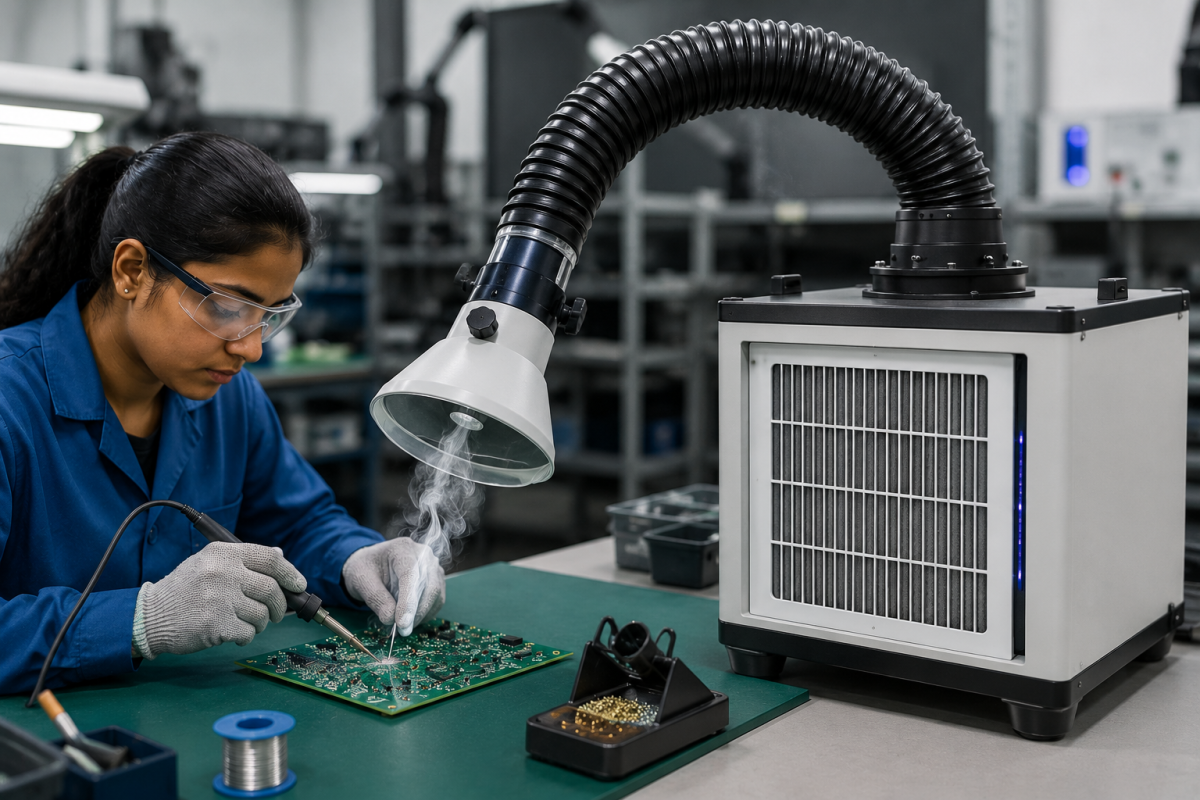
A properly designed soldering fume extractor is essential for controlling airborne contaminants directly at the source. In electronics manufacturing environments where operators work for extended durations at close proximity to soldering points, effective electronics fume extraction becomes critical for maintaining safe and productive working conditions.

Modern soldering ventilation systems are designed to capture fumes before dispersion, improving visibility, reducing odor, and minimizing exposure to hazardous substances generated during soldering operations.

With over 30 years of experience in industrial air pollution control, Powertech has implemented customized fume extraction for soldering applications across electronics assembly facilities, PCB manufacturing units, and precision production environments.

Key Takeaways

  1. A soldering fume extractor captures hazardous fumes directly at the source.
  2. Flux fumes and VOCs generated during soldering can affect indoor air quality.
  3. Proper source capture improves operator safety and process visibility.
  4. Filtration efficiency and airflow positioning are critical for effective performance.

The Problem: Soldering Fume Exposure in Electronics Manufacturing

Soldering operations generate fine fumes that often remain concentrated around operators in enclosed workstations.

Causes

  1. Flux vaporization during soldering
  2. Continuous manual soldering operations
  3. Poor ventilation in assembly areas
  4. Ineffective source capture systems

Workplace Impact

  1. Irritation of eyes and respiratory system
  2. Reduced operator comfort
  3. Accumulation of fumes in indoor environments
  4. Decreased visibility during precision work

Safety Risks

According to the Occupational Safety and Health Administration (OSHA), soldering fumes may contain harmful airborne contaminants including flux decomposition products.

The National Institute for Occupational Safety and Health (NIOSH) recommends local exhaust ventilation for soldering operations to minimize exposure.

Technical Explanation: How Soldering Fume Extraction Systems Work

Step 1: Source Capture

The extraction nozzle or hood is positioned close to the soldering point.

  1. Typical distance: 50–150 mm from source
  2. Captures fumes before dispersion

Source capture is significantly more effective than general room ventilation.

Step 2: Airflow Generation

A blower creates airflow that pulls fumes into the extraction system.

Key Requirements

  1. Stable airflow
  2. Low noise operation
  3. Consistent suction at workstation level

Step 3: Filtration Process

Modern electronics fume extraction systems often use multi-stage filtration.

Typical Filtration Stages

  1. Pre-filter for larger particles
  2. HEPA filter for fine particulate
  3. Activated carbon filter for VOCs and odors

Activated carbon filtration is especially important for flux fumes.

Step 4: Clean Air Discharge

Filtered air is either:

  1. Discharged safely
  2. Or recirculated into the workspace (depending on filtration efficiency)

Filtration Requirements for Soldering Applications

Filtration StagePurposeTypical Contaminants
Pre-filterLarger particlesDust and coarse particulate
HEPA FilterFine particulateSolder smoke and fine fumes
Activated CarbonGas adsorptionFlux vapors and VOCs
Multi-stage SystemCombined protectionMixed contaminants

Practical Industrial Applications

PCB Assembly Lines

  1. Continuous soldering operations
  2. Multiple operator stations
  3. Compact extraction systems required

Electronics Manufacturing

  1. Precision work environments
  2. Need for low-noise systems
  3. High indoor air quality requirements

Rework Stations

  1. Portable extraction arms or nozzles
  2. Flexible positioning needed

Laboratory and R&D Applications

  1. Small-scale soldering operations
  2. Benchtop fume extractors commonly used

Expert Insight

From Powertech’s experience, one of the most overlooked aspects of soldering ventilation systems is airflow positioning.

Key observations:

  1. Even high-efficiency filters underperform if source capture is poor
  2. Activated carbon filtration is critical for odor and VOC control
  3. Compact systems require careful airflow balancing to maintain suction

In several electronics manufacturing installations, optimizing nozzle placement significantly improved fume extraction for soldering without increasing airflow capacity.

Why is a soldering fume extractor necessary?

It removes harmful fumes and flux vapors generated during soldering operations.

What filters are used in soldering fume extraction systems?

Typically HEPA filters and activated carbon filters.

Can soldering fumes affect health?

Yes, prolonged exposure can irritate the respiratory system and eyes.

What is the ideal distance for source capture?

Usually between 50–150 mm from the soldering point.

Are portable soldering fume extractors effective?

Yes, when properly positioned close to the source.

Conclusion

A properly designed soldering fume extractor is essential for maintaining safe air quality in electronics manufacturing environments. By implementing effective electronics fume extraction systems and optimizing soldering ventilation systems, industries can significantly improve worker safety and indoor air quality. Effective fume extraction for soldering requires a combination of proper source capture, efficient filtration, and well-balanced airflow. With decades of experience in industrial air pollution control, Powertech continues to provide engineered solutions for electronics manufacturing environments where precision, safety, and clean air are critical.
How Soldering Fume Extractors Work

Introduction

Soldering operations in electronics manufacturing generate fumes that contain flux vapors, fine particulate matter, and volatile organic compounds (VOCs). These fumes are released directly into the operator’s breathing zone and can quickly accumulate in enclosed workspaces if not controlled effectively.

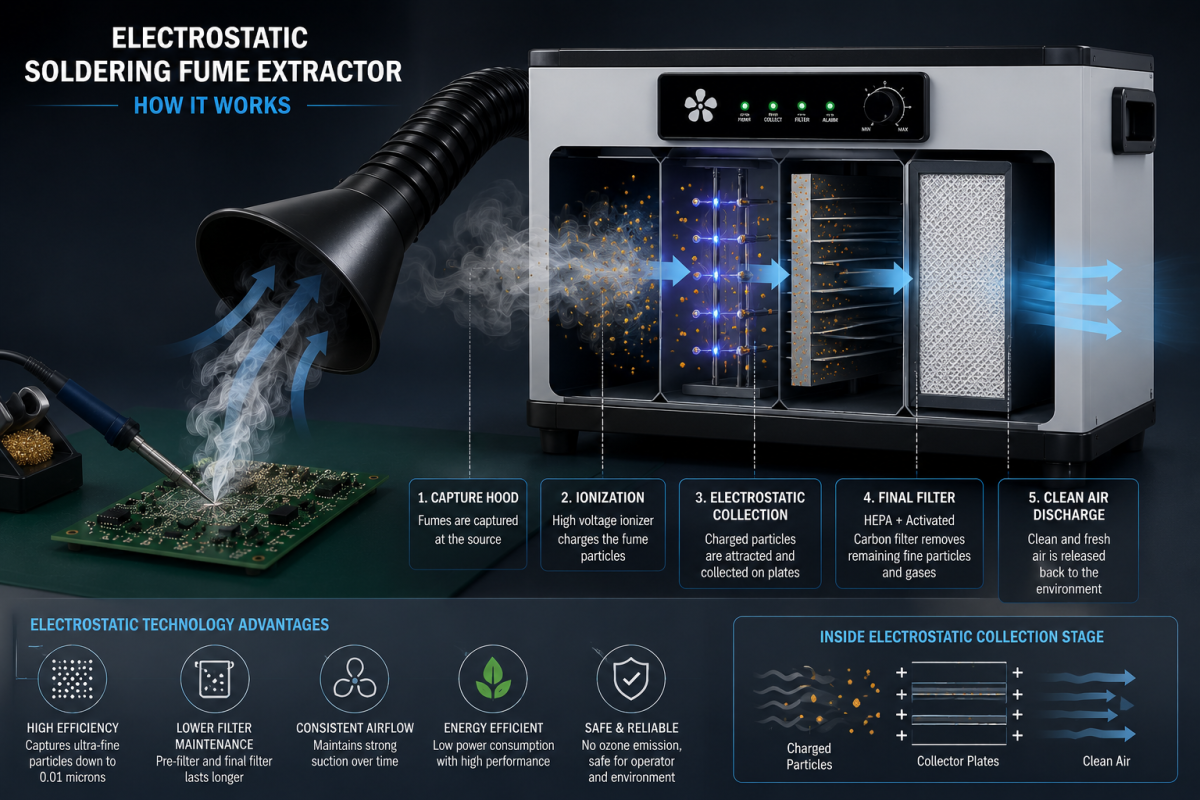
A clear understanding of how a soldering fume extractor works is essential for designing safe and efficient electronics manufacturing environments. Modern electronics fume extraction systems are engineered to capture fumes directly at the source, filter airborne contaminants, and maintain clean indoor air quality.

Unlike general ventilation systems, a solder smoke extractor focuses on localized source capture, ensuring contaminants are removed before dispersing into the workspace. Properly designed soldering ventilation equipment improves operator safety, reduces odor, and enhances productivity in electronics assembly operations.

With over 30 years of experience in industrial air pollution control, Powertech has implemented customized soldering fume extraction solutions for PCB assembly lines, electronics manufacturing facilities, and precision soldering environments.

Key Takeaways

  1. A soldering fume extractor captures fumes directly at the source.
  2. Multi-stage filtration removes particulate matter and gases.
  3. Source capture is more effective than general room ventilation.
  4. Proper airflow and nozzle positioning are critical for performance.

The Problem: Airborne Contaminants During Soldering

Soldering fumes are often underestimated because the visible smoke generated is relatively small.

Causes

  1. Heating of flux compounds
  2. Poor local ventilation
  3. Continuous soldering operations
  4. Inadequate source capture systems

Workplace Impact

  1. Odor accumulation
  2. Eye and throat irritation
  3. Reduced operator comfort
  4. Poor indoor air quality

Safety Risks

According to the Occupational Safety and Health Administration (OSHA), soldering operations can release airborne contaminants that require local exhaust ventilation.

The National Institute for Occupational Safety and Health (NIOSH) recommends source capture ventilation for soldering applications to reduce operator exposure.

Technical Explanation: How Soldering Fume Extractors Work

Step 1: Source Capture

The extraction nozzle or hood is positioned close to the soldering point.

Typical Position

  1. 50–150 mm from the source
  2. Aligned with rising fumes

This allows fumes to be captured before dispersion.

Step 2: Airflow Generation

A blower or fan generates airflow that pulls fumes into the extraction system.

Key Requirements

  1. Stable suction
  2. Low-noise operation
  3. Consistent airflow at workstation level

Step 3: Contaminant Transport

Captured fumes move through hoses or ducting into the filtration unit.

Important Factors

  1. Smooth airflow path
  2. Minimal pressure losses
  3. Proper airflow balancing

Step 4: Filtration Process

Modern electronics fume extraction systems usually use multi-stage filtration.

Typical Filtration Stages

  1. Pre-filter for larger particles
  2. HEPA filter for fine particulate matter
  3. Activated carbon filter for VOCs and odors

Activated carbon filters are essential for flux vapor control.

Step 5: Clean Air Discharge

After filtration:

  1. Clean air is discharged safely
  2. Or recirculated into the workspace (depending on filtration quality)

Components of a Solder Smoke Extractor

ComponentFunction
Extraction Hood / NozzleCaptures fumes at source
Flexible Arm / HoseDirects airflow
Blower / FanGenerates suction
HEPA FilterRemoves fine particulate
Activated Carbon FilterRemoves VOCs and odors
Housing UnitContains filtration system

Practical Industrial Applications

PCB Assembly Lines

  1. Multiple soldering stations
  2. Continuous operation
  3. Compact extraction systems used

Electronics Manufacturing

  1. Precision assembly environments
  2. Need for quiet operation and clean air

Rework Stations

  1. Flexible extraction nozzles
  2. Portable systems commonly used

Laboratories and R&D

  1. Small-scale soldering operations
  2. Benchtop extraction units preferred

Expert Insight

From Powertech’s experience, one of the most common issues in soldering ventilation is incorrect nozzle placement.

Key observations:

  1. Even high-efficiency filters fail if fumes are not captured effectively at the source
  2. Operators often position extraction nozzles too far from the soldering point
  3. Activated carbon filtration is critical for controlling odor and VOC exposure

In several electronics manufacturing installations, optimizing airflow direction and nozzle placement improved overall extraction performance significantly without increasing fan capacity.

How does a soldering fume extractor work?

It captures fumes at the source, pulls them through filters, and releases clean air back into the environment.

What filters are used in solder smoke extractors?

Typically HEPA filters and activated carbon filters.

Why is source capture important?

It prevents fumes from dispersing into the operator’s breathing zone.

Can soldering fumes be recirculated indoors?

Yes, if the filtration system is designed for safe recirculation.

What is the ideal nozzle distance?

Usually between 50–150 mm from the soldering point.

Conclusion

Understanding how a soldering fume extractor works is essential for maintaining safe and efficient electronics manufacturing environments. Properly designed electronics fume extraction systems use source capture, controlled airflow, and multi-stage filtration to effectively remove airborne contaminants. By implementing efficient solder smoke extractor systems and properly engineered soldering ventilation equipment, industries can significantly improve indoor air quality and operator safety. With decades of experience in industrial air pollution control, Powertech continues to provide engineered extraction solutions that support cleaner and safer electronics manufacturing environments.

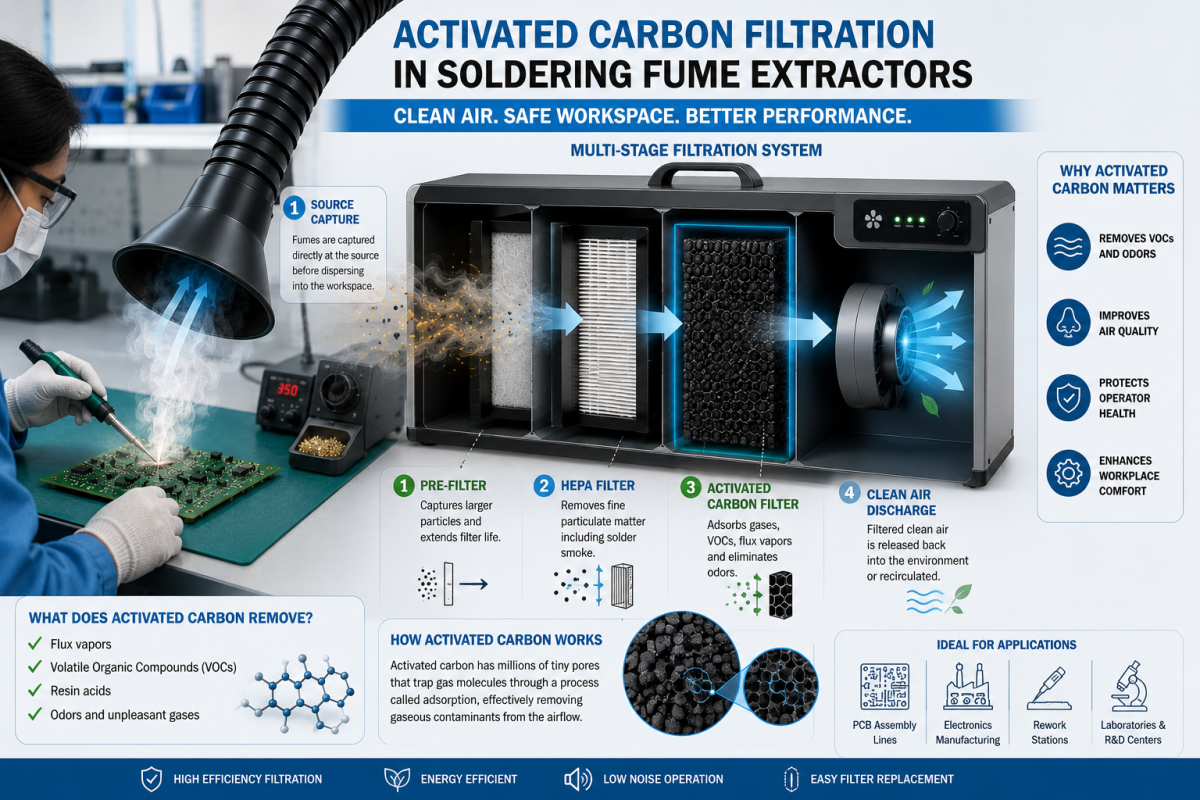
Activated Carbon Filtration in Soldering Fume Extractors

Introduction

Soldering operations in electronics manufacturing generate more than just visible smoke. When flux compounds are heated during soldering, they release volatile organic compounds (VOCs), resin vapors, odors, and fine airborne contaminants that can accumulate rapidly in enclosed workspaces. While particulate filters capture smoke particles, gaseous contaminants require a different filtration approach.

An activated carbon soldering fume extractor is specifically designed to remove gases, odors, and VOCs generated during soldering operations. Activated carbon filtration plays a critical role in modern soldering smoke filtration systems because it adsorbs contaminants that traditional particulate filters cannot capture effectively.

In electronics manufacturing environments where operators work in close proximity to soldering stations for extended durations, properly engineered electronics fume filters with activated carbon stages significantly improve indoor air quality and operator comfort.

With over 30 years of experience in industrial air pollution control, Powertech has implemented customized carbon filter soldering fumes solutions for electronics assembly lines, PCB manufacturing facilities, and precision soldering environments.

Key Takeaways

  1. Activated carbon filtration removes VOCs, odors, and flux vapors from soldering fumes.
  2. HEPA filters alone cannot effectively remove gaseous contaminants.
  3. Multi-stage filtration systems provide the best soldering smoke filtration performance.
  4. Proper airflow and filter maintenance are critical for filtration efficiency.

The Problem: Gaseous Contaminants in Soldering Fumes

Many soldering ventilation systems focus only on particulate filtration while ignoring gases and odors.

Causes

  1. Vaporization of flux compounds during soldering
  2. Release of VOCs and resin vapors
  3. Inadequate gas-phase filtration
  4. Overloaded or saturated carbon filters

Workplace Impact

  1. Persistent odors in electronics workspaces
  2. Reduced operator comfort
  3. Eye and throat irritation
  4. Poor indoor air quality

Safety Risks

According to the Occupational Safety and Health Administration (OSHA), soldering operations may release airborne contaminants that require effective ventilation and filtration.

The National Institute for Occupational Safety and Health (NIOSH) recommends local exhaust ventilation and proper filtration for soldering applications.

Technical Explanation: How Activated Carbon Filtration Works

Step 1: Source Capture

Fumes are captured directly at the soldering point using a hood or nozzle.

Typical Position

  1. 50–150 mm from source
  2. Aligned with rising fumes

Effective source capture improves overall filtration performance.

Step 2: Particulate Pre-Filtration

Before air reaches the carbon filter:

  1. Larger particles are removed
  2. Fine particulate is captured using HEPA filtration

This prevents premature carbon filter saturation.

Step 3: Activated Carbon Adsorption

The filtered air passes through activated carbon media.

How It Works

  1. Activated carbon contains millions of microscopic pores
  2. VOC molecules adhere to the carbon surface
  3. Odors and gases are adsorbed from the airflow

Activated carbon is highly effective for gas-phase filtration.

Step 4: Clean Air Discharge

After filtration:

  1. Cleaned air is discharged safely
  2. Or recirculated into the workspace if filtration efficiency is sufficient

Filtration Stages in Soldering Fume Extractors

Filtration StageFunctionContaminants Removed
Pre-filterCaptures larger particlesDust and coarse particulate
HEPA FilterRemoves fine particulateSolder smoke particles
Activated Carbon FilterAdsorbs gases and odorsVOCs and flux vapors
Multi-stage SystemCombined protectionMixed contaminants

Practical Industrial Applications

PCB Assembly Lines

  1. Continuous soldering operations
  2. High concentration of flux vapors
  3. Multi-stage filtration systems required

Electronics Manufacturing

  1. Indoor air quality is critical
  2. Odor control is important in enclosed production areas

Rework Stations

  1. Portable extractors with activated carbon filters commonly used

Laboratories and R&D

  1. Small-scale soldering operations
  2. Compact filtration systems preferred

Expert Insight

From Powertech’s experience, one of the most common mistakes in soldering smoke filtration is relying only on HEPA filtration without gas-phase filtration.

Key observations:

  1. HEPA filters remove particulate but not odors or VOCs
  2. Activated carbon performance depends heavily on airflow balance and contact time
  3. Saturated carbon filters lose adsorption efficiency rapidly

In several electronics manufacturing facilities, upgrading to properly designed activated carbon filtration systems significantly improved operator comfort and indoor air quality.

Why is activated carbon used in soldering fume extractors?

It removes gases, odors, and VOCs generated during soldering.

Can HEPA filters remove soldering odors?

No. HEPA filters remove particulate matter but not gaseous contaminants.

How often should activated carbon filters be replaced?

Replacement depends on usage and contaminant load; odor breakthrough is often a key indicator.

Are activated carbon filters necessary for electronics manufacturing?

Yes, especially in enclosed environments with continuous soldering operations.

What contaminants do carbon filters remove?

Flux vapors, VOCs, odors, and certain gaseous contaminants.

Conclusion

An activated carbon soldering fume extractor is essential for effective control of gaseous contaminants generated during soldering operations. While particulate filtration removes visible smoke, activated carbon filtration is critical for controlling odors, VOCs, and flux vapors. By implementing properly engineered soldering smoke filtration systems and high-performance electronics fume filters, industries can significantly improve indoor air quality and operator comfort. With decades of experience in industrial air pollution control, Powertech continues to provide advanced carbon filter soldering fumes solutions for electronics manufacturing environments where clean air and precision work are essential.

Improving Efficiency of Welding Fume Extraction Systems

Introduction

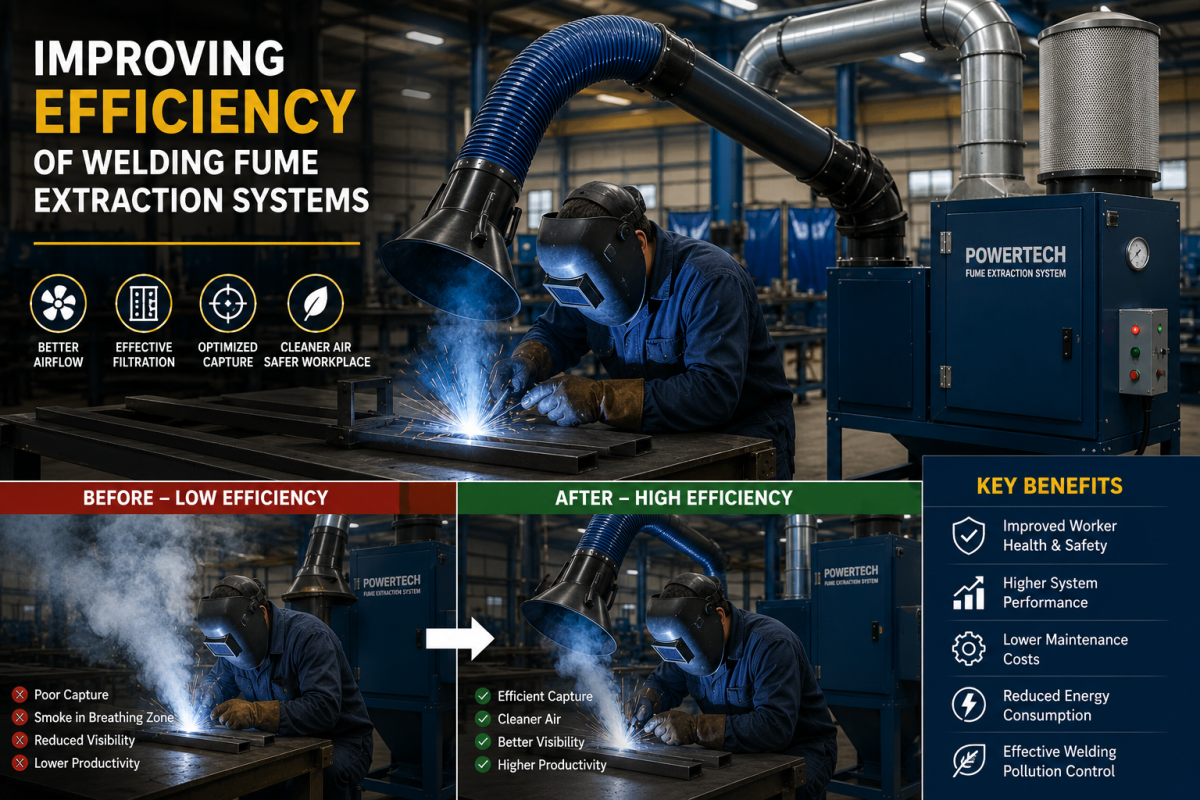
Installing a welding fume extraction system is only the first step toward maintaining clean and safe industrial environments. In many facilities, systems operate below their intended performance due to airflow imbalance, poor hood positioning, clogged filters, or improper maintenance practices. As a result, fumes escape into the workspace despite the presence of extraction equipment.

Improving the efficiency of a welding fume extractor requires a combination of proper engineering design, operational optimization, and preventive maintenance. Even small adjustments in airflow, duct layout, or extraction arm positioning can significantly enhance overall system performance.

An optimized approach to welding pollution control not only improves air quality but also reduces energy consumption and maintenance costs. With over 30 years of experience, Powertech has improved fume extraction system performance across fabrication shops, automotive manufacturing facilities, and heavy engineering industries through practical engineering-driven optimization strategies.

Key Takeaways

  1. Proper source capture is the most important factor in welding fume extraction efficiency.
  2. Airflow balancing and duct optimization significantly improve system performance.
  3. Regular maintenance prevents efficiency loss over time.
  4. Optimized systems improve both air quality and energy efficiency.

The Problem: Reduced System Efficiency

Many extraction systems gradually lose performance due to operational and maintenance issues.

Causes

  1. Incorrect extraction arm positioning
  2. Insufficient airflow at capture points
  3. Poor duct design and pressure losses
  4. Clogged or overloaded filters
  5. Lack of preventive maintenance

Workplace Impact

  1. Visible welding fumes in the workspace
  2. Reduced visibility and operator comfort
  3. Higher energy consumption
  4. Increased downtime and maintenance costs

Safety Risks

According to the Occupational Safety and Health Administration (OSHA), inadequate welding ventilation may expose workers to hazardous airborne contaminants.

The National Institute for Occupational Safety and Health (NIOSH) recommends proper ventilation and source capture methods for effective welding fume control.

Technical Explanation: How to Improve System Efficiency

Step 1: Optimize Source Capture

Effective source capture is the foundation of system efficiency.

Best Practices

  1. Position extraction arms 150–300 mm from the arc
  2. Align hood with rising fume direction
  3. Avoid airflow obstruction by the operator

Proper positioning improves capture without increasing airflow.

Step 2: Balance Airflow Across the System

Uneven airflow reduces performance in multi-point systems.

Optimization Methods

  1. Adjust dampers
  2. Measure airflow at all stations
  3. Ensure consistent suction levels

Balanced systems deliver more reliable performance.

Step 3: Improve Duct Design

Poor duct layouts increase pressure losses.

Recommended Improvements

  1. Reduce sharp bends
  2. Maintain proper duct velocity (12–17 m/s)
  3. Shorten unnecessary duct runs

Better duct design improves airflow efficiency.

Step 4: Maintain Filtration Systems

Filter condition directly affects airflow and extraction performance.

Maintenance Actions

  1. Monitor pressure drop
  2. Replace clogged filters
  3. Clean filters and ducting regularly

Delayed maintenance is a major cause of performance decline.

Step 5: Monitor System Performance

Continuous monitoring helps identify problems early.

Parameters to Monitor

  1. Airflow
  2. Static pressure
  3. Filter pressure drop
  4. Fan performance

Data-driven maintenance improves reliability.

Key Parameters Affecting Efficiency

ParameterRecommended RangeImpact
Hood distance150 – 300 mmSource capture efficiency
Capture velocity0.5 – 1.5 m/sFume control effectiveness
Duct velocity10 – 15 m/sPrevents dust settling
Filter pressure dropWithin design rangeMaintains airflow
Airflow balanceUniform across stationsConsistent performance

Practical Industrial Applications

Fabrication Shops

  1. Frequent repositioning of extraction arms
  2. Need for flexible airflow balancing

Automotive Manufacturing

  1. Centralized systems requiring precise balancing
  2. Robotic welding with consistent airflow demands

Maintenance Workshops

  1. Portable systems dependent on operator positioning

Heavy Engineering

  1. High particulate load requiring optimized filtration and airflow

Expert Insight

From Powertech’s field experience, one of the most effective ways to improve welding fume extraction efficiency is through system optimization rather than equipment replacement.

Key observations:

  1. Poor positioning often causes greater efficiency loss than insufficient airflow
  2. Regular airflow measurements reveal hidden performance issues
  3. Preventive maintenance significantly improves long-term performance

In several installations, optimizing airflow distribution and hood positioning improved system efficiency without increasing fan capacity.

How can welding fume extraction efficiency be improved?

By optimizing hood positioning, balancing airflow, improving duct design, and maintaining filters regularly.

Does higher airflow always improve performance?

No. Proper source capture and system design are equally important.

Why does system performance decline over time?

Due to clogged filters, airflow imbalance, and lack of maintenance.

How often should airflow be checked?

Regular inspections and airflow measurements are recommended.

Can existing systems be improved without replacement?

Yes. Many systems can be optimized through design corrections and maintenance.

Conclusion

Improving welding fume extraction efficiency requires a comprehensive approach that combines proper source capture, optimized airflow, effective filtration, and preventive maintenance. By focusing on fume extraction system performance and implementing engineering-driven improvements, industries can achieve better welding pollution control, improved air quality, and lower operational costs. With decades of experience, Powertech continues to help industries optimize welding ventilation systems for reliable, efficient, and long-term performance.

Filtration Technologies Used in Welding Fume Extractors

Introduction

Welding fumes consist of submicron particulate matter, metal oxides, and gaseous byproducts that are difficult to remove without properly engineered filtration systems. While capture at the source is critical, the effectiveness of a welding fume extraction system ultimately depends on how efficiently these contaminants are filtered before the air is discharged or recirculated.

Different applications require different filtration approaches based on particle size, concentration, and process conditions. Selecting the right welding fume filtration technology is essential to ensure compliance with safety standards, protect worker health, and maintain system efficiency.

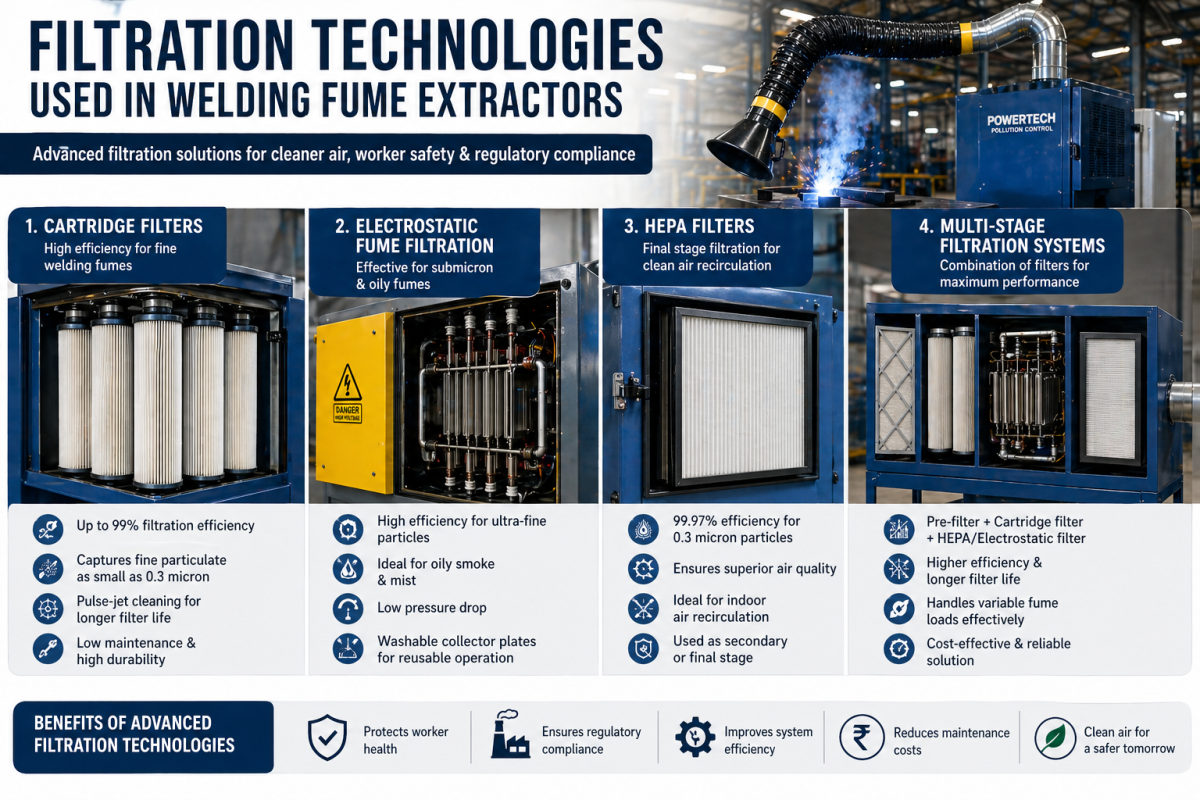
Modern extraction systems use a combination of industrial fume filters, including cartridge filters welding fumes and advanced methods such as electrostatic fume filtration, to achieve high levels of efficiency.

With over 30 years of experience, Powertech has implemented a range of filtration solutions tailored to industrial environments, ensuring reliable and consistent performance across diverse welding applications.

Key Takeaways

  1. Effective welding fume filtration requires selecting the right technology based on application.
  2. Cartridge filters are widely used for high-efficiency particulate removal.
  3. Electrostatic filtration is effective for fine and oily fumes.
  4. Multi-stage filtration systems provide optimal performance and reliability.

The Problem: Complexity of Welding Fume Filtration

Welding fumes contain a mix of particles with varying sizes and properties, making filtration challenging.

Causes

  1. Fine particulate size (often <1 micron)
  2. High temperature fumes
  3. Variation in welding processes
  4. Presence of oily or sticky particles

Workplace Impact

  1. Ineffective filtration leading to poor air quality
  2. Frequent filter clogging
  3. Increased maintenance costs
  4. Reduced system efficiency

Safety Risks

According to the Occupational Safety and Health Administration (OSHA), welding fumes can contain hazardous substances such as manganese and chromium.

The World Health Organization (WHO) highlights that exposure to fine particulate matter can lead to respiratory and cardiovascular diseases.

Technical Explanation: Types of Filtration Technologies

1. Cartridge Filters

Cartridge filters are the most widely used industrial fume filters for welding applications.

Working Principle

  1. Contaminated air passes through pleated filter media
  2. Particles are captured on the surface
  3. Clean air exits the system

Features

  1. High filtration efficiency (up to 99%)
  2. Suitable for fine particulate
  3. Pulse-jet cleaning for extended life

Applications

  1. Fabrication shops
  2. Automotive manufacturing
  3. General welding operations

2. Electrostatic Fume Filtration

Electrostatic fume filtration is used for capturing extremely fine particles and oily fumes.

Working Principle

  1. Particles are electrically charged
  2. Charged particles are attracted to collector plates
  3. Clean air is released

Features

  1. Effective for submicron particles
  2. Low pressure drop
  3. Suitable for oil mist and smoke

Applications

  1. Welding with oil-coated materials
  2. CNC machining environments
  3. High-precision industries

3. HEPA Filtration

High-Efficiency Particulate Air (HEPA) filters provide an additional level of filtration.

Features

  1. Efficiency up to 99.97% for very fine particles
  2. Used as secondary or final stage
  3. Ensures clean air recirculation

Applications

  1. Critical environments
  2. Indoor air recirculation systems

4. Multi-Stage Filtration Systems

Most industrial systems use a combination of filtration stages.

Typical Configuration

  1. Pre-filter (large particles)
  2. Cartridge filter (fine particles)
  3. HEPA or secondary filter (ultra-fine particles)

This approach improves overall efficiency and filter life.

Filtration Comparison Table

Filtration TypeEfficiencyParticle Size RangePressure DropBest Application
Cartridge FilterUp to 99%Fine particlesMediumGeneral welding
Electrostatic FilterHighSubmicron & oily fumesLowOil mist, smoke
HEPA Filter99.97%Ultra-fine particlesHighClean air recirculation
Multi-Stage SystemVery HighWide rangeVariableIndustrial applications

Practical Industrial Applications

Fabrication Shops

  1. Cartridge-based systems
  2. Moderate fume loads
  3. Flexible filtration requirements

Automotive Manufacturing

  1. Multi-stage filtration systems
  2. High-volume continuous operations
  3. Centralized systems

Maintenance Workshops

  1. Portable systems with cartridge filters
  2. Lower filtration complexity

Heavy Engineering

  1. High dust load
  2. Requires robust filter systems
  3. Frequent cleaning cycles

Expert Insight

From Powertech’s experience, one of the most common mistakes in welding fume filtration is selecting a filtration system based solely on efficiency ratings without considering operating conditions.

Key observations:

  1. High-efficiency filters can fail quickly if pre-filtration is inadequate
  2. Electrostatic systems perform best in specific applications, not all environments
  3. Multi-stage systems offer the best balance between efficiency and durability

In several installations, optimizing filter configuration has significantly reduced maintenance frequency and improved overall system performance.

What is the best filtration method for welding fumes?

Cartridge filters are widely used, but multi-stage systems provide the best overall performance.

When should electrostatic filtration be used?

For fine, oily, or sticky fumes where traditional filters may clog quickly.

Do welding fume extractors require HEPA filters?

HEPA filters are used when very high filtration efficiency or air recirculation is required.

How often should filters be replaced?

Depends on usage and dust load; monitoring pressure drop is the best method.

Can one filter type handle all applications?

No, filtration systems must be selected based on specific process requirements.

Conclusion

Effective welding fume filtration is essential for ensuring clean air, worker safety, and system efficiency. Different filtration technologies—such as cartridge filters, electrostatic fume filtration, and multi-stage systems—offer unique advantages depending on the application. A well-designed system combines appropriate filtration technologies with proper airflow and duct design to deliver optimal performance. With decades of experience in industrial fume filters, Powertech continues to emphasize tailored filtration solutions that meet the specific needs of industrial environments, ensuring reliable and long-term air pollution control.