
Introduction
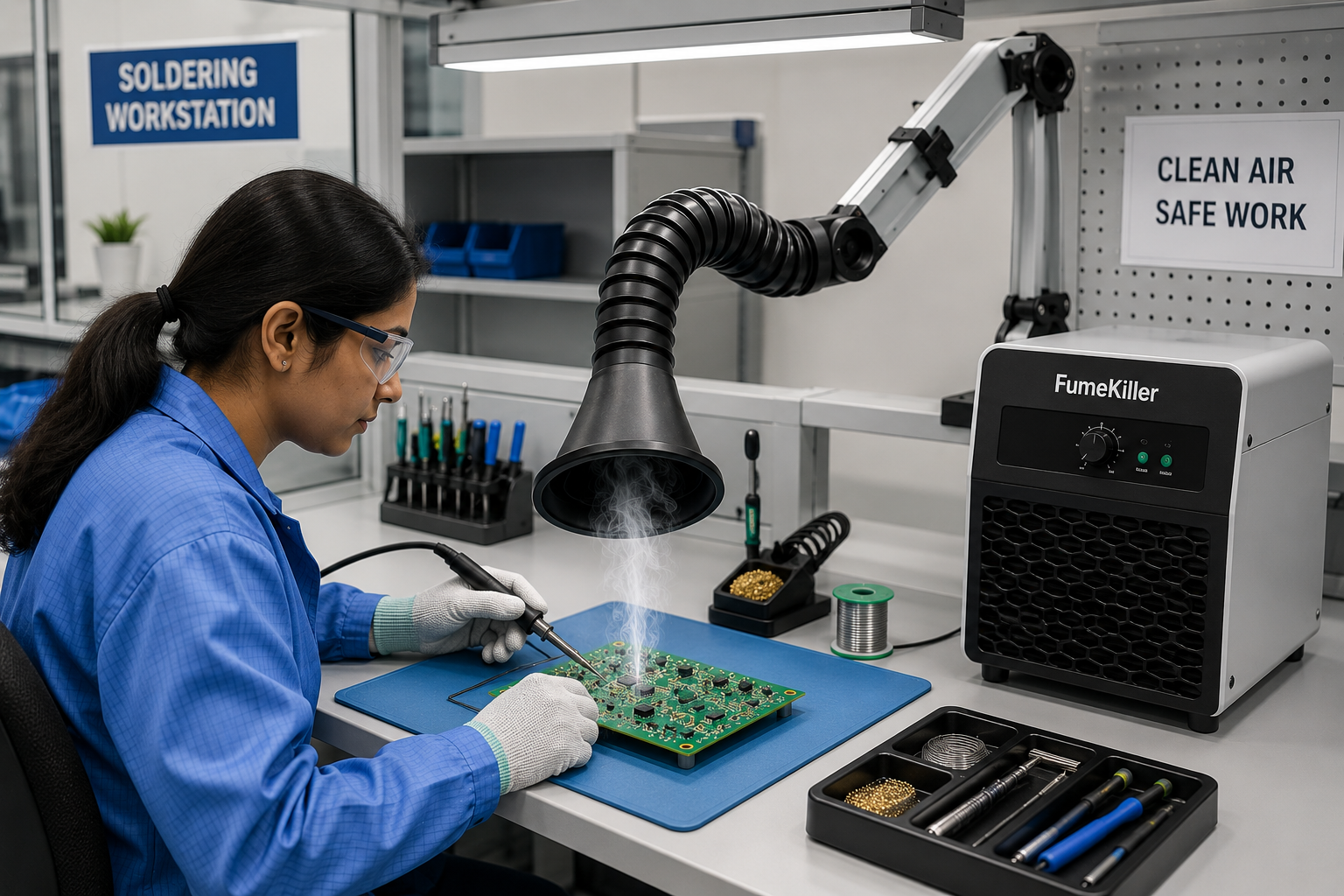
A well-designed soldering workstation is essential for maintaining operator safety, product quality, and workplace productivity in electronics manufacturing environments. While factors such as lighting, ergonomics, and tool placement often receive significant attention, ventilation is frequently overlooked despite being one of the most important elements of workstation design.
During soldering operations, flux compounds generate fumes containing fine particulate matter, volatile organic compounds (VOCs), and other airborne contaminants. Without effective soldering workstation fume extraction, these contaminants accumulate within the operator’s breathing zone, reducing air quality and operator comfort.
Proper electronics workstation ventilation integrates source capture, airflow management, filtration, and ergonomic workstation design to ensure contaminants are removed before they disperse into the surrounding environment. A well-engineered solder smoke extractor design also supports effective electronics air filtration, improving overall workplace conditions.
With over 30 years of experience in industrial air pollution control, Powertech has designed customized fume extraction solutions for electronics manufacturing facilities, PCB assembly lines, laboratories, and precision soldering applications.
Key Takeaways
- Source capture is the most effective method for controlling soldering fumes.
- Proper workstation design improves extraction efficiency and operator comfort.
- Flexible extraction arms and nozzles allow effective source capture.
- Multi-stage filtration is essential for particulate and VOC removal.
- Good workstation ventilation improves safety, visibility, and productivity.
The Problem: Poorly Ventilated Soldering Workstations
Many electronics workstations rely on general room ventilation instead of dedicated source capture systems.
Causes
- Poor extraction arm positioning
- Lack of localized ventilation
- Inadequate filtration systems
- Poor workstation layout
Workplace Impact
- Solder fumes accumulating near operators
- Eye, nose, and throat irritation
- Reduced operator comfort
- Unpleasant odors
Safety Risks
According to the Occupational Safety and Health Administration (OSHA), local exhaust ventilation is preferred for controlling airborne contaminants generated during soldering operations.
The National Institute for Occupational Safety and Health (NIOSH) recommends source capture ventilation for electronics soldering applications.
Technical Explanation: Key Elements of Workstation Design
Step 1: Source Capture Positioning
The extraction nozzle should be positioned close to the soldering point.
Recommended Distance
- 50–150 mm from source
- Positioned to capture naturally rising fumes
Correct positioning is often more important than increasing airflow.
Step 2: Workstation Layout
Equipment should be arranged to avoid obstructing airflow.
Best Practices
- Keep extraction arm clear of tools and fixtures
- Maintain easy access to the work area
- Prevent operator body position from blocking airflow
Step 3: Airflow Design
The ventilation system should maintain stable airflow without disturbing delicate electronics work.
Design Considerations
- Consistent suction
- Low noise operation
- Minimal turbulence
Step 4: Filtration System Selection
Modern soldering workstations typically use multi-stage filtration.
Typical Filtration Stages
- Pre-filter
- HEPA filter
- Activated carbon filter
This combination provides effective particulate and gas-phase filtration.
Step 5: Ergonomic Integration
A ventilation system should improve safety without affecting productivity.
Key Factors
- Flexible extraction arm movement
- Easy maintenance access
- Comfortable operator positioning
Recommended Workstation Design Features
| Component | Purpose |
|---|---|
| Flexible Extraction Arm | Source capture |
| Adjustable Hood | Precise positioning |
| HEPA Filter | Fine particulate removal |
| Activated Carbon Filter | VOC and odor removal |
| Low Noise Fan | Operator comfort |
| Compact Housing | Space efficiency |
Practical Industrial Applications
PCB Assembly Workstations
- Individual extraction arms
- Continuous soldering operations
Electronics Manufacturing
- Multiple operator stations
- Integrated ventilation systems
Rework and Repair Stations
- Portable extraction units
- Flexible workstation layouts
Laboratories and R&D
- Precision soldering applications
- Compact ventilation systems
Expert Insight
From Powertech’s experience, poor extraction arm placement is one of the most common reasons for ineffective workstation ventilation.
Key observations:
- Increasing airflow alone rarely solves ventilation issues.
- Proper nozzle placement dramatically improves source capture.
- Activated carbon filtration significantly improves operator comfort by controlling odors and VOCs.
In several electronics manufacturing facilities, workstation redesign and optimized extraction positioning improved ventilation performance without requiring larger extraction systems.
Typically between 50–150 mm from the soldering point and aligned with rising fumes.
It removes contaminants before they enter the operator’s breathing zone.
Most systems use pre-filters, HEPA filters, and activated carbon filters.
Yes, portable and bench-top systems are commonly used for electronics workstations.
Yes, poor equipment placement can obstruct airflow and reduce extraction efficiency.
Effective soldering workstation fume extraction is a critical component of electronics manufacturing workstation design. By combining proper source capture, optimized electronics workstation ventilation, efficient solder smoke extractor design, and advanced electronics air filtration, manufacturers can significantly improve workplace safety and air quality. A well-designed workstation not only protects operators but also supports productivity, comfort, and long-term operational efficiency. With decades of experience in industrial air pollution control, Powertech continues to provide engineered ventilation solutions that help electronics manufacturers create cleaner, safer, and more productive work environments.