
Introduction
Selecting the right dust collection technology is one of the most important decisions when designing an effective industrial air pollution control system. Two of the most widely used technologies are the cartridge dust collector and the baghouse dust collector. While both are designed to remove airborne particulate matter, they differ significantly in filtration media, operating principles, maintenance requirements, airflow capacity, and ideal applications.
Understanding the differences between these technologies helps manufacturers choose the most suitable industrial dust filtration solution for their process. Whether the application involves metal fabrication, woodworking, pharmaceuticals, cement, food processing, or chemical manufacturing, selecting the correct dust collector directly impacts air quality, equipment performance, maintenance costs, and overall productivity.
This dust collector comparison explains how cartridge and baghouse systems work, their advantages, limitations, and the industries where each technology performs best.
With nearly three decades of experience in industrial air pollution control, Powertech engineers customized DustBag dust collection systems based on the specific dust characteristics and airflow requirements of each application.
Key Takeaways
- Cartridge dust collectors are ideal for fine, dry dust and compact installations.
- Baghouse dust collectors are designed for high dust loads and continuous heavy-duty operation.
- Selecting the right technology depends on particle size, dust loading, airflow, and process conditions.
- Proper industrial dust filtration improves air quality, equipment reliability, and operational efficiency.
- Engineering evaluation is essential before selecting a dust collection system.
What Is a Cartridge Dust Collector?
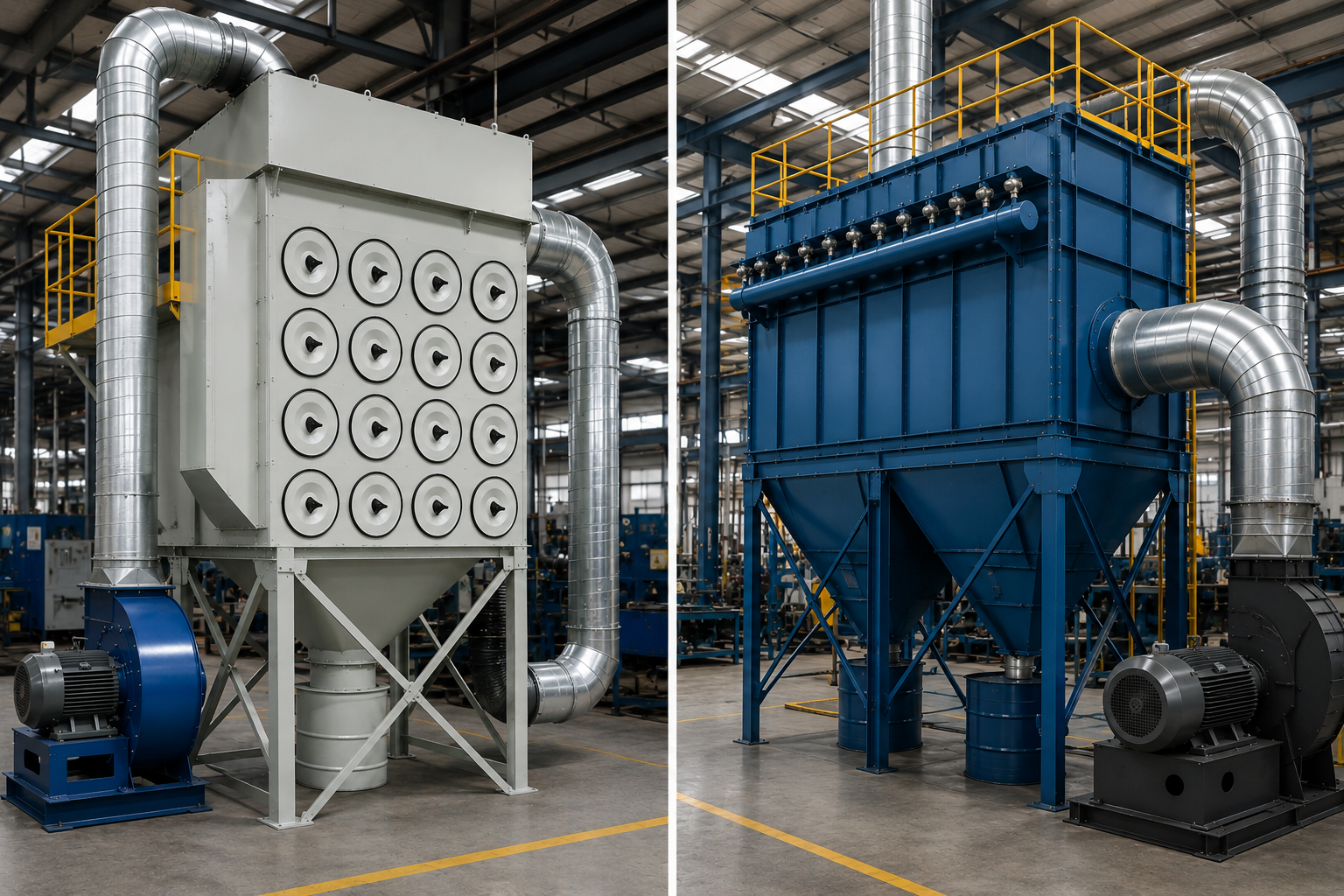
A cartridge dust collector uses pleated filter cartridges with a large filtration surface area packed into a compact housing.
Dust-laden air enters the collector, passes through the filter media, and clean air exits the system while dust particles remain trapped on the cartridge surface.
Typical Applications
- Laser cutting
- Plasma cutting
- Welding
- Pharmaceutical manufacturing
- Food processing
- Powder coating
- Fine metal dust collection
What Is a Baghouse Dust Collector?
A baghouse dust collector uses long cylindrical fabric filter bags suspended inside a large housing.
Dust accumulates on the outside of the filter bags while clean air passes through the fabric.
Periodic pulse-jet cleaning removes accumulated dust into collection hoppers.
Typical Applications
- Cement plants
- Foundries
- Steel plants
- Mining
- Mineral processing
- Woodworking
- Heavy industrial manufacturing
Cartridge vs Baghouse Dust Collectors
| Feature | Cartridge Dust Collector | Baghouse Dust Collector |
|---|---|---|
| Filter Media | Pleated cartridges | Fabric filter bags |
| Dust Type | Fine, dry dust | Fine to coarse dust |
| Airflow Capacity | Medium | High |
| Dust Loading | Moderate | High |
| Installation Space | Compact | Larger footprint |
| Maintenance | Cartridge replacement | Bag replacement |
| High Temperature Applications | Limited | Excellent |
| Heavy-Duty Industrial Use | Moderate | Excellent |
| Energy Efficiency | High | High |
| Typical Industries | Manufacturing, pharma, food | Cement, foundry, mining, heavy industry |
Advantages of Cartridge Dust Collectors
Compact Design
Pleated filters provide a large filtration area within a relatively small footprint.
High Filtration Efficiency
Excellent for capturing fine particulate generated during precision manufacturing.
Lower Air-to-Cloth Ratio
Large filter surface area improves filtration efficiency.
Easy Filter Replacement
Cartridges are generally easier to replace during scheduled maintenance.
Ideal for Indoor Installation
Compact systems integrate well into manufacturing facilities with limited space.
Advantages of Baghouse Dust Collectors
Handles Heavy Dust Loads
Suitable for continuous high-volume dust generation.
Excellent for High Temperatures
Fabric bags are available for demanding thermal applications.
Long Service Life
Properly maintained filter bags provide reliable long-term operation.
Large Airflow Capacity
Ideal for centralized dust collection serving multiple production lines.
Wide Industrial Application
Effective across numerous heavy manufacturing industries.
Choosing the Right Industrial Dust Filtration System
Several factors influence the selection between cartridge and baghouse technology.
Dust Characteristics
- Particle size
- Dust loading
- Moisture content
- Abrasiveness
Airflow Requirements
Higher airflow applications often favor baghouse systems.
Process Temperature
High-temperature processes generally require baghouse collectors with specialized filter media.
Available Installation Space
Compact facilities often benefit from cartridge systems.
Maintenance Strategy
Ease of access and filter replacement should be considered during system design.
Common Industries Using Cartridge Collectors
- Electronics manufacturing
- Pharmaceutical production
- Food processing
- Automotive component manufacturing
- Laser cutting
- Welding shops
- Powder handling
Common Industries Using Baghouse Collectors
- Cement manufacturing
- Steel plants
- Foundries
- Mining
- Woodworking
- Chemical processing
- Bulk material handling
Powertech’s Engineering Approach
Rather than recommending a single technology for every application, Powertech evaluates:
- Dust particle characteristics
- Airflow requirements
- Production process
- Operating temperature
- Dust loading
- Plant layout
- Maintenance preferences
- Future expansion plans
This engineering-first approach ensures every DustBag system is optimized for long-term performance and operating efficiency.
Expert Insight
From Powertech’s experience, many buyers focus only on filtration efficiency while overlooking dust loading, operating temperature, and maintenance requirements.
A cartridge collector may outperform a baghouse in one application, while the opposite may be true in another. The most successful installations are those where the dust collection technology is selected based on actual process conditions rather than equipment size or initial purchase cost.
A cartridge dust collector uses pleated filter cartridges to capture fine airborne dust while providing a large filtration area within a compact housing.
A baghouse dust collector uses cylindrical fabric filter bags to separate dust from the airflow, making it suitable for high dust loads and continuous industrial operation.
Cartridge dust collectors are generally preferred for fine, dry dust generated in precision manufacturing applications.
Baghouse dust collectors are typically better suited for high-volume dust generation and heavy industrial manufacturing.
Not always. The correct technology depends on airflow requirements, dust characteristics, operating temperature, and process conditions.
An engineering assessment of dust type, airflow, temperature, production process, and maintenance requirements is the most effective way to select the appropriate dust collection system.
Choosing between a cartridge dust collector and a baghouse dust collector depends on the specific requirements of the manufacturing process. While cartridge systems offer compact, high-efficiency industrial dust filtration for fine particulate applications, baghouse collectors provide exceptional performance for high dust loads, elevated temperatures, and continuous industrial operation. A professional dust collector comparison should always consider airflow, dust characteristics, process conditions, and long-term operating costs rather than equipment size alone. With decades of expertise in industrial air pollution control, Powertech designs DustBag dust collection systems that deliver reliable, customized solutions for a wide range of industrial applications.