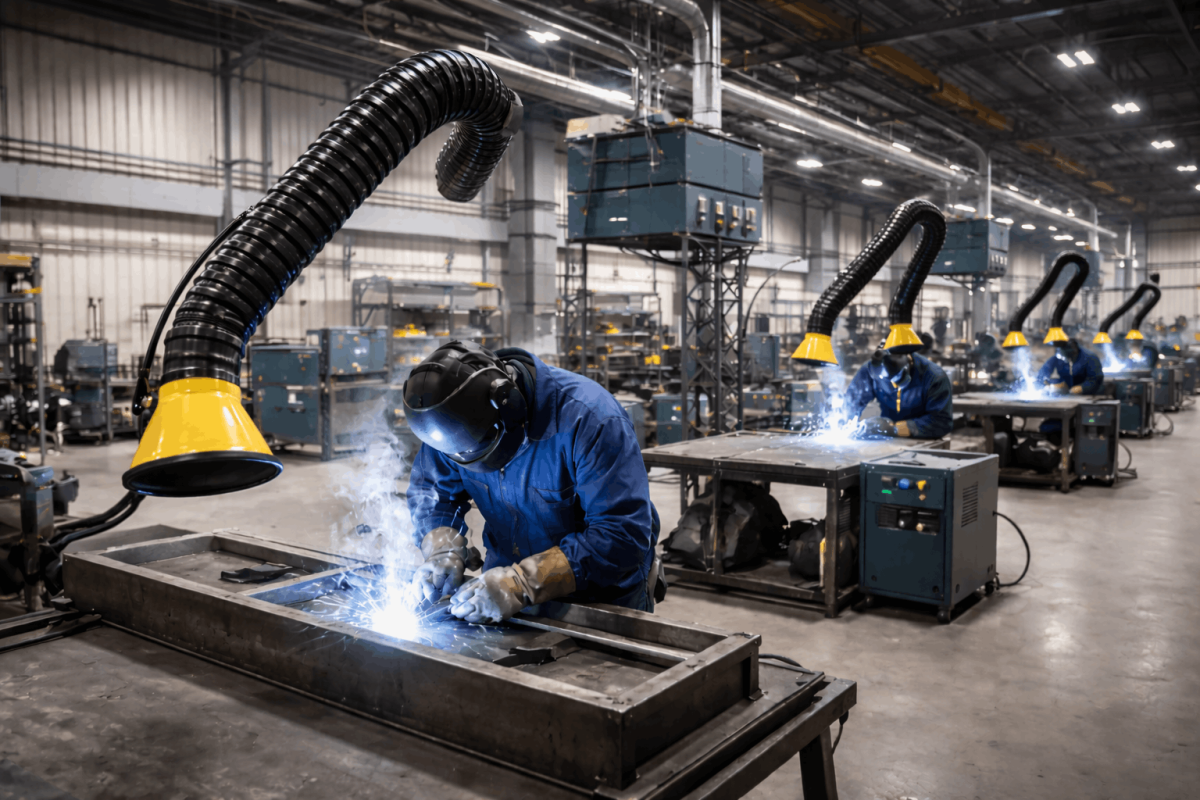
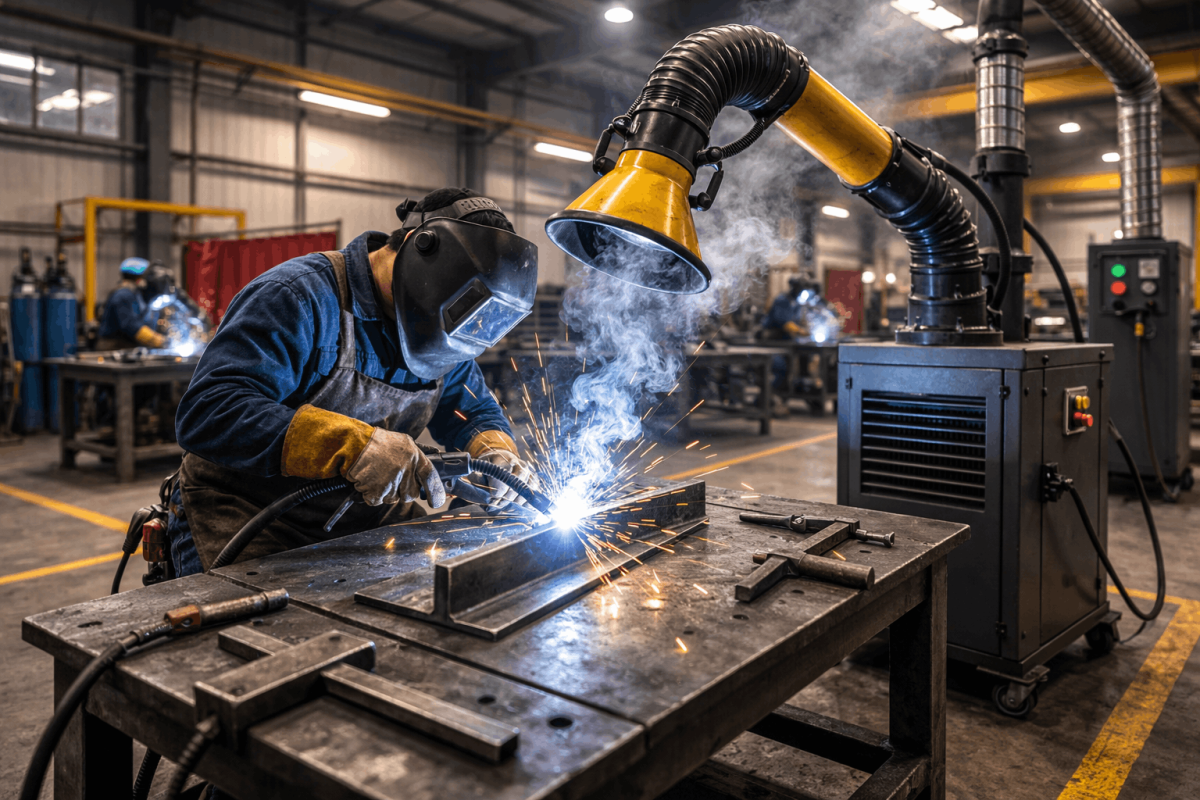
Welder using a welding fume extractor arm at a welding station in a multi-shift industrial workshop

Welding Fume Extractors for Multi-Shift Manufacturing Operations

Many factories are open 24 hours a day. To meet production goals, welding often goes on for two or three shifts. In these places, welding fume extraction systems work for long hours every day.

When equipment runs all the time, it has to work harder, keep the airflow stable, and plan for maintenance. A well-made welding fume extractor should be able to handle heavy workloads without losing efficiency.

Why Multi-Shift Welding Needs More Extraction

When welding happens over more than one shift, the extraction system has to work harder because of a number of things.

  • The time it takes to weld goes up significantly.
  • Over the course of the day, more fumes build up.
  • Filters catch more particles than they let through.
  • The equipment works for longer periods of time.

If the system is not of the required capacity, the airflow slowly drops as the filters fill up with particles. This makes it harder to capture and lets fumes spread around the welding area.

Consistent Airflow is Critical

Stable Performance of Capture

Extraction systems need to keep the airflow steady for long periods of time in places with multiple shifts. Any drop in suction makes it harder to catch fumes at the source.

When the airflow slows down, fumes start to rise into the operator’s breathing zone before they are caught.

Not Losing Performance over Time

Loss of airflow usually happens over time. People who work with it might not notice the change right away. As time goes on, the smoke around the welding arc gets thicker.

Routine checks of the airflow help find these changes early. Powertech Pollution Controls is a welding fume extractor manufacturer in Bangalore that designs systems that can handle welding all the time.

Filter Capacity becomes more Important

Filters pick up particles faster in welding shops that work in shifts.

Faster Filter Loading

When a lot of welding is going on, there are a lot of small particles in the air. In a plant with multiple shifts, filters may load much faster than they do in a plant with only one shift.

Cycles for Planned Replacement

Instead of calendar dates, maintenance teams should set filter replacement schedules based on how many hours of production there are.

This helps keep the airflow from dropping while production is going on.

Durability of Equipment is Important

Extraction units in plants that work more than one shift must work reliably for long periods of time. Some important things to think about when designing are:

  • Fans that are very efficient and made to run all the time
  • Filter housings that last.
  • Electrical parts that stay stable.
  • Easy access to filters for upkeep.

Strong construction helps make sure the system keeps working even when it’s used for a long time.

Layout of Workstations for Continuous Production

The arrangement of welding stations also affects how well extraction works.

How to Position the Hood Correctly

To quickly catch fumes, extraction arms should stay close to the welding point.

People who work in shifts must be trained on how to properly place the hood.

Avoid Airflow Interference

Cross drafts can happen when doors are open or when big fans are on. These air currents might move the fumes away from the capture zone.

Planning the direction of airflow makes the system work better.

Planning Maintenance for Operations with Multiple Shifts

Because of continuous welding, maintenance needs to be planned carefully.

Things that people do often are:

  • Checking filters at the end of every shift.
  • Checking the levels of airflow on a regular basis.
  • Cleaning the hoods and extraction arms.
  • Keeping an eye on how well the fans work

Planned maintenance can prevent sudden airflow loss during production hours.

Q&A

Q1. What is the importance of welding fume extractors in operations with more than one shift?

A. Welding makes a lot of fumes because it takes a long time. These fumes must be constantly removed by extraction systems.

Q2. Do filters wear out more quickly in facilities that have more than one shift?

A.Yes. Longer hours of operation make filters collect particles faster.

Q3.How can you keep an eye on how well the airflow is working?

A. Checking the airflow regularly and looking at the fume capture system can help you find changes in performance.

Q4. Is it possible for the same system to work for both single-shift and multi-shift operations?

A. Yes, but systems for multi-shift environments need to be able to handle more work and run for longer periods of time.

Conclusion

Welding fume extraction systems have to work harder in factories that run multiple shifts. Welding all the time raises the amount of particles, the use of filters, and the number of hours equipment runs.

A well-designed welding fume extractor makes sure that the airflow stays steady and the machine works well for long periods of time.

Facilities can keep the air clean and the welding safe all day long if they size their systems correctly, do regular maintenance, and set up their workstations properly.
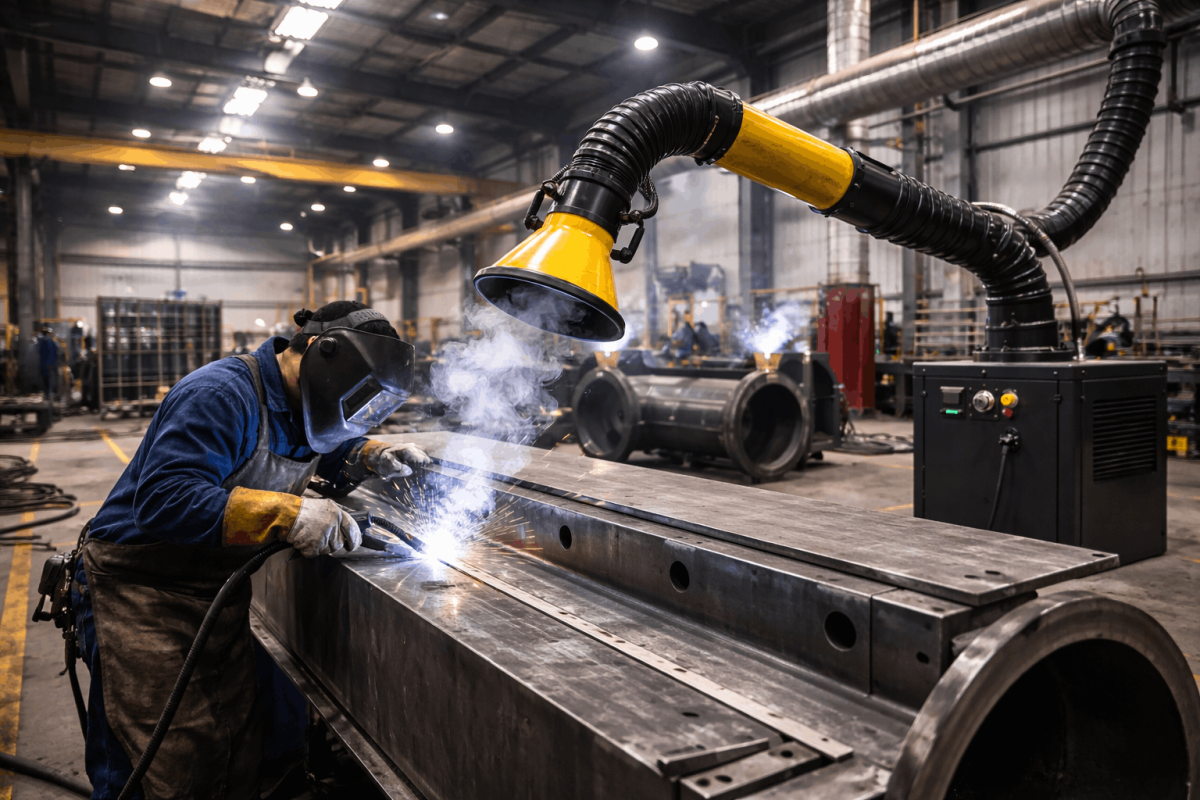
Welder using a fume extractor while welding a large steel structure in a heavy engineering workshop

Welding Fume Extraction Problems in Heavy Engineering Units

Heavy engineering shops work with big metal structures, thick materials, and long welding cycles. These conditions produce a large amount of welding fumes that spread out over large areas of production.

Heavy engineering units often have more complicated extraction problems than small fabrication shops. It’s hard to control fumes when there are big workpieces, moving equipment, and open spaces.

To keep the air clean and the work environment safe, a well-designed welding fume extraction system must be installed to deal with these problems.

Why Heavy Engineering Units Make More Welding Fumes

Heavy engineering processes usually include:

  • Welding with a lot of current
  • Parts of thick material
  • Long seams in the weld
  • Shifts in continuous welding

These conditions make more fumes. In a lot of cases, welding goes on for a long time without stopping.

Frames, pressure vessels, and structural assemblies are some of the big parts that also trap fumes around the weld zone.

Challenge 1: Big Workpieces Get in the Way of Fume Capture

Parts of the Structure Stop Airflow

Heavy engineering parts are often big and tall. Some examples are:

  • Industrial Frames
  • Bases for heavy machines
  • Structural Beams

These components can stop air from flowing naturally and keep fumes from rising freely. Because of this, fumes build up around the operator’s breathing zone.

Hard to Place the Hood

For extraction hoods to work well, they need to be close to the welding point. But big workpieces often make it hard to get the right position.

If the hood is too far away, the fumes spread out before they can be extracted.

Challenge 2: There are several welding stations in the same area.

Most of the time, heavy engineering units have many welding stations on one shop floor.

When multiple stations work together:

  • Fumes from different places get mixed.
  • The flow of air becomes hard to predict.
  • Local extraction systems fight for air flow

If the system isn’t set up right, fumes from one station can move to another.

Powertech Pollution Controls is a welding fume extractor manufacturer in Bangalore that often helps facilities figure out how much air needs to flow through different welding zones.

Challenge 3: Moving Welding Locations

Welding Doesn’t Always Happen in the Same Place

Welders in heavy engineering units often have to move around big parts while they are making them. For instance:

  • Welding around large tanks
  • Welding long beams
  • Welding internal parts

Fixed extraction hoods may not work well because the welding point moves around a lot and flexible extraction arms or mobile systems are often required.

Challenge 4: Workshops with High Roofs

A lot of heavy engineering plants have high roofs so that cranes and big buildings can fit. High ceilings give you more room, but they also let fumes build up at different levels. Instead of leaving the building, the fumes spread across the shop floor over time.

During long welding shifts, the air quality gets worse over time if extraction isn’t controlled.

Challenge 5: Big doors and fans that blow air across the room

Heavy engineering shops often leave their big doors open so that materials can move around. This makes the air move quickly inside the building causing cross drafts from:

  • Large doors
  • Cooling Fans
  • Crane Movement

These cross drafts can cause welding fumes to move away from the place where they are extracted. Even when equipment is in place, this makes extraction less effective.

Practical Solutions

When working with heavy machinery, extraction systems need to take into account the layout of the workshop to deal with fumes.

Some good ways to do this are:

Source Capture Systems

Operators can move the hood close to the weld location thanks to flexible extraction arms.

Centralized Extraction Systems

Central systems can work with more than one station at a time and keep the airflow balanced.

Mobile Extraction Units

Portable systems help collect fumes in places where welding positions change a lot.

Planning the flow of air

Before putting in extraction systems, you need to look at how air moves inside the shop. The right airflow design makes capture work better.

Q&A

Q1. Why is it harder to control welding fumes in heavy engineering units?

A. Source capture is harder because of big workpieces, moving welding locations, and open workshop layouts.

Q2. Are portable fume extractors helpful in these situations?

A. Yes. They help catch fumes when the places where you weld change often.

Q3. Do roofs that are high up lower the amount of welding fumes?

A. No. Instead of leaving the building, the fumes may spread throughout the workshop.

Q4. Is one extraction system enough for big workshops?

A. Many times, large facilities need more than one system that is based on the layout of the production area.

Final Thoughts

When it comes to controlling welding fumes, heavy engineering units have their own set of problems. Simple extraction systems don’t work well because of big buildings, many welding stations, and changing weld locations.

To control fumes well, the system must be designed correctly, the hood must be in the right place, and the airflow across the workshop must be balanced.

A good welding fume extractor keeps the welding area clear, makes the work environment better, and helps keep production steady in heavy engineering settings.

Welder using a source capture welding fume extractor to remove smoke at the welding arc in an industrial workshop

How Welding Fume Extractors Improve Visibility and Process Accuracy

In many welding shops, operators adjust to smoke around the arc. Over time, this becomes normal. But reduced visibility affects weld control more than most teams realise.

When fumes stay around the welding point, the welder cannot clearly see the weld pool. Small visibility issues lead to small control errors. Those small errors increase defects, grinding time, and inspection failures.

A properly installed welding fume extractor removes fumes at the source. The result is simple: clear sight of the weld pool and better process control.

Why Visibility Directly Affects Weld Quality

Welding depends on visual control. The operator constantly monitors:

  • Weld pool shape
  • Joint edges
  • Arc position
  • Travel speed

If smoke builds up around the arc, the weld pool becomes hard to track. The operator may:

  • Change angle slightly
  • Move too fast or too slow
  • Add excess filler
  • Miss joint alignment

These changes happen within seconds. They affect penetration, bead width, and finish quality.

Clear visibility supports steady hand movement and consistent weld formation.

How Welding Fumes Interfere With Accuracy

Obstructed View of the Molten Pool

Fumes rise fast. In enclosed areas, they collect around the face level of the welder. Even with a helmet, heavy smoke reduces clarity.

When the molten pool is not visible, depth control becomes guesswork.

Increased Defects

Poor visibility often results in:

  • Undercuts
  • Incomplete fusion
  • Irregular bead width
  • Excess spatter

These issues increase rework and inspection time.

Operator Fatigue

When welders strain to see through smoke, eye fatigue increases. Tired operators lose precision as the shift progresses.

How a Welding Fume Extractor Improves the Working Zone

A welding fume extractor captures fumes before they spread into the workspace. It pulls contaminants away from the arc area immediately.

Clear Line of Sight

When extraction arms sit close to the welding point, fumes do not rise into the operator’s viewing area. The weld pool remains clearly visible.

Clear sight improves:

  • Torch angle control
  • Travel speed stability
  • Joint tracking accuracy

Stable Arc Conditions

Airflow must stay balanced. Too little airflow allows smoke to spread. Too much airflow may disturb shielding gas.

Correct system sizing ensures clean air without affecting arc stability.

Many fabrication units work with a welding fume extractor manufacturer in Bangalore to calculate airflow based on welding type, current levels, and station layout.

Layout and Positioning Matter

Even a good system will not perform well if placement is poor.

Hood Distance

Keep the hood close enough to capture fumes but not block the operator’s movement.

Control Cross Drafts

Open doors and pedestal fans push fumes sideways. This reduces capture efficiency.

Station Design

Welding booths with controlled airflow improve visibility and capture consistency.

Good layout planning supports both safety and process accuracy.

Measurable Shop Floor Impact

Improved visibility often leads to:

  • Lower defect rates
  • Less grinding and cleaning
  • Faster weld completion
  • Reduced inspection delays

Clear air allows operators to focus on technique instead of adjusting for smoke.

Q&A

Q1. Does a welding fume extractor improve weld quality?

  1. It improves visibility and process control. Better control results in better weld quality.

Q2. Can extraction affect shielding gas?

  1. Only if airflow is excessive. Proper design prevents this issue.

Q3. How close should the extraction point be?

  1. Typically within 6 to 12 inches from the welding arc, depending on fume volume.

Q4. Is the visibility improvement noticeable?

  1. Yes. Operators usually see a difference as soon as source capture begins.

Conclusion

Welding fumes affect more than health. They reduce visibility and make precision difficult. Even small visual obstruction increases the risk of weld defects.

A properly designed welding fume extractor keeps the arc area clear. Clear visibility improves torch control, penetration consistency, and overall weld quality.

In fabrication, accuracy depends on what the operator can see. Clean air makes that possible.

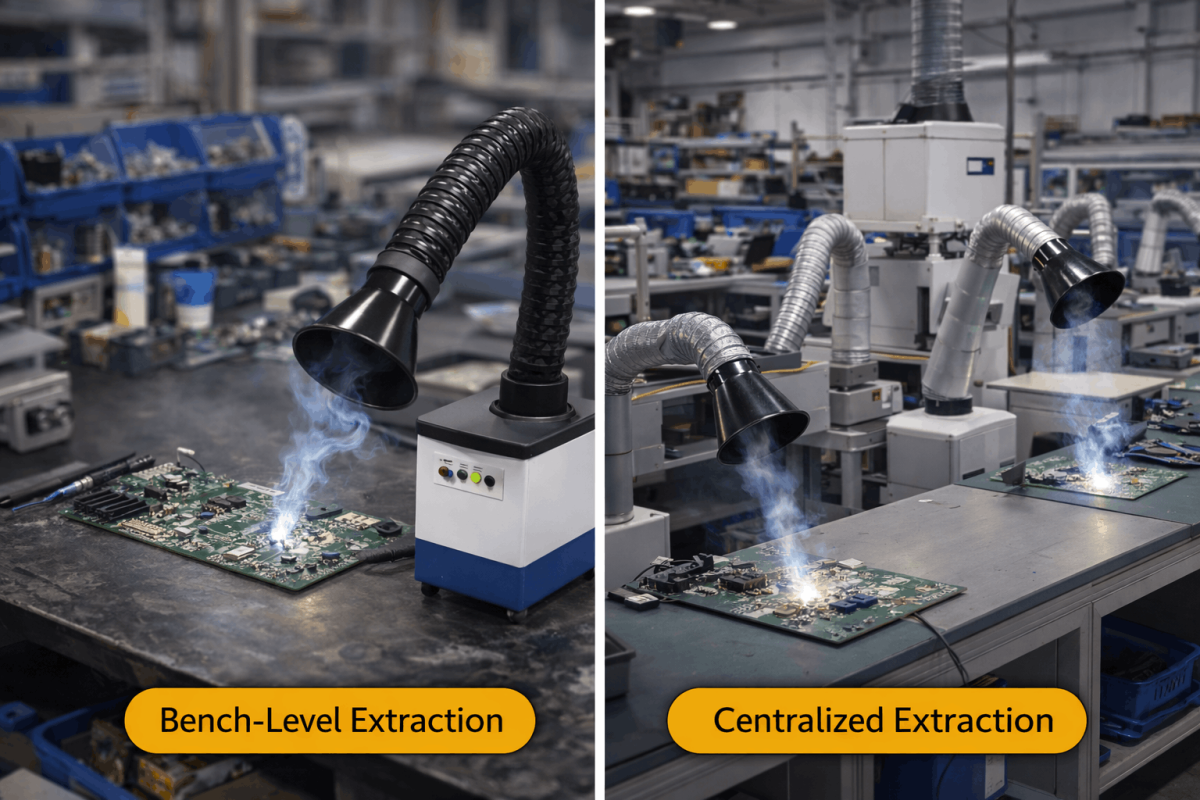
Comparison of bench-level and centralized soldering fume extractors

Centralized vs Bench-Level Soldering Fume Extractors Explained

Fumes are made at every workstation when soldering. In small setups, only one or two stations may be able to work at a time. Dozens of workers work at the same time on big assembly lines.

The right soldering fume extractor system for you will depend on how big your business is, how your workspace is set up, and how much air flow you need. There are two main types of systems: centralized and bench-level.

What is a bench-level soldering fume extractor?

A bench-level system is set up at each workstation. It usually has a small unit with one or two suction arms that are close to the soldering point.

Best For:

  • Small groups of people working together
  • Benches for repairs and service
  • Layouts that can change
  • Low to moderate density of solder

Advantages:

  • Each station has its own control.
  • Simple to put together
  • Needs very little ducting
  • Lower cost to set up at first

Limitations

  • More equipment in big setups
  • Individual upkeep for each unit

What Is a Centralized Soldering Fume Extraction System?

A centralized system has one big extraction unit that is connected to several soldering stations by ducting. There is a suction point on each bench that connects to the central unit.

Best Suited For

  • High-density electronics assembly
  • Production lines with set layouts
  • Places where soldering is done all the time

Benefits

  • Maintenance at one point
  • Airflow that is the same at all stations
  • Less noise at each bench
  • A cleaner place to work in general

Limitations

  • More expensive to install
  • Needs careful planning of the ducts
  • Less flexible after installation

Before suggesting a centralized solution, an experienced soldering fume extractor manufacturer looks at the number of stations and the amount of fumes.

Key Things to Think About: Number of Workstations:

Bench-level systems work best with a small number of workstations. A centralized setup is usually justified by many stations.

Production Volume

More fume load comes from continuous soldering. Central systems are better at handling heavy and constant demand.

Planning for Maintenance

Central systems make maintenance easier. Separate service schedules are needed for bench systems.

Future Growth

Centralized systems make it easier to grow if growth is likely.

Practical Use Cases

Case 1: Small Service Workshop

Bench-level soldering fume extractors are flexible and easy to move.

Case 2: A Mid-Size Electronics Unit

A mix of bench-level and centralized systems might work for phased growth.

Case 3: Big Assembly Line

Centralized extraction makes sure that the airflow is stable and the air quality is the same at all stations.

Q&A: Centralized vs. Bench-Level Systems

Q1: Is it stronger to extract from a single source?

A: When sized correctly, it can handle more air flow.

Q2: Do bench-level systems give you more control?

A: Yes. At their own stations, operators can change the flow of air.

Q 3: Which system costs less?

A: For small setups, bench systems are cheaper. Central systems work better when they are bigger.

Q4: Who should help you choose a system?

A: A qualified soldering fume extractor manufacturer can look at the layout and suggest the best setup.

Conclusion

Bench-level and centralized soldering fume extractors are made for different purposes. Compact, stand-alone units are good for small setups. Centralized systems are needed for stable and consistent fume control on large assembly lines.

Choosing the right system makes sure that the air is clean, the operator is comfortable, and production runs smoothly.

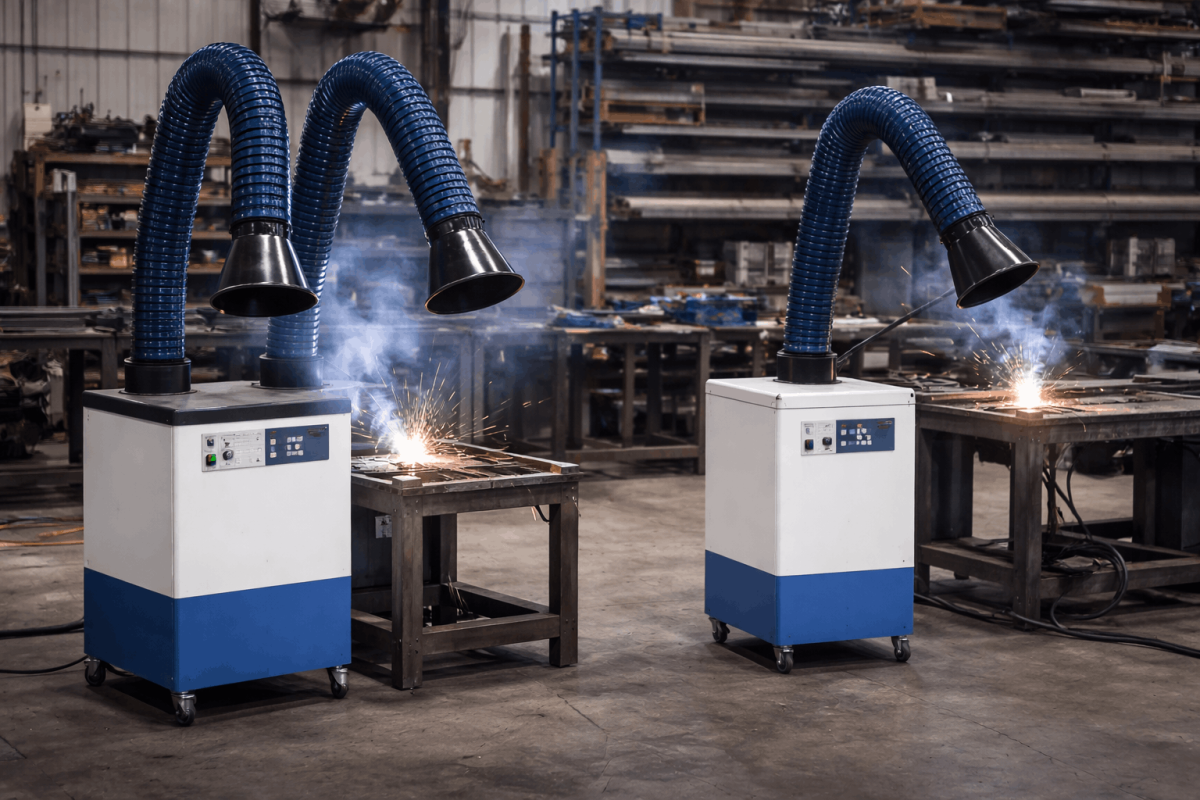
Twin-arm and single-arm welding fume extractors positioned beside welding stations in an industrial workshop.

Single-Arm vs Twin-Arm Welding Fume Extractors: Practical Use Cases

Why the Arm Configuration is Important for Welding Fume Extraction

A welding fume extractor needs to catch fumes at the source. The number of extractor arms affects how many welding stations a unit can serve and how well it works.

The layout, workload, and fume level will help you decide between a single-arm and twin-arm system.

What Is a Single-Arm Welding Fume Extractor?

Basic Configuration

A single-arm system has one flexible suction arm that is linked to the extractor unit. It can only work on one welding station at a time.

Best Suited for:

  • Separate welding stations
  • Work on repairs and upkeep
  • Welding load that is low to moderate
  • Shops with layouts that can change

Benefits:

  • Easy to set up
  • Less money up front
  • Simple to move around
  • Airflow that is focused on one source

Limitations:

  • Can’t serve more than one active station
  • Not as useful in busy workshops

What Is a Twin-Arm Welding Fume Extractor?

A twin-arm system has two flexible suction arms that are connected to a single extractor unit.

Depending on the amount of fumes, it can work at two welding stations at the same time.

Best Suited For:

  • Welding stations next to each other
  • Moderate levels of production floors
  • Workshops with a steady flow of work

Benefits

  • One unit serves two stations
  • Saves space on the floor
  • Lessens the number of tools

Limitations

  • Airflow divides between the arms
  • It may not be able to handle heavy welding at both stations at once.

Before suggesting a twin-arm setup, an experienced welding fume extractor manufacturer checks how the air flows.

Important Things to Think About When Choosing

Simultaneous Welding Intensity:

If both welders are working all the time and making a lot of fumes, the twin-arm unit needs to be the right size.

Distance Between Stations

Twin arms work best when stations are close to each other. Long distances make it harder to move around.

Available Floor Space

Twin-arm systems take up less space than two separate units.

Future Growth

Think about whether production might go up. Planning ahead keeps you from having to replace the system.

Real-Life Examples

Case 1: Small Repair Shop

A single-arm welding fume extractor works well when only one welder is working at a time.

Case 2: Medium Fabrication Unit

Twin-arm extractors help two welders work at the same time with moderate duty cycles.

Case 3: High-Volume Production

A twin-arm setup may not be the best choice for high-volume production. Instead, separate units or a central extraction system may work better.

Q&A: Single vs. Twin-Arm Welding Fume Extractors

Q1: Does a system with two arms make the suction weaker?

A: Airflow splits between the arms. The right size makes sure that capture works.

Q2: Is it possible for one twin-arm unit to take the place of two single-arm units?

A: Yes, if the welding is not too strong and the stations are close together.

Q3: Is a system with only one arm more efficient?

A: It directs the airflow to one source, which is great for single stations.

Q4: Who can help you choose the best configuration?

A: A qualified manufacturer of welding fume extractors can look at the layout and calculate the airflow needs.

Conclusion

Single-arm and twin-arm welding fume extractors are made for different purposes. Single-arm systems are good for single stations. Twin-arm systems are good for welders who work next to each other and have moderate workloads.

Choosing the right setup makes sure that fume capture works well, air quality stays stable, and equipment is used efficiently.