Introduction
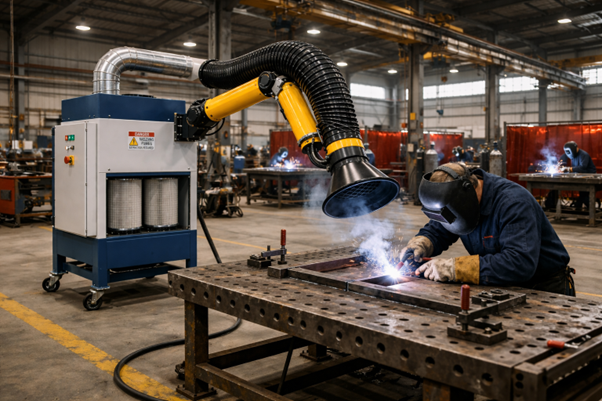
Welding fumes consist of submicron particulate matter, metal oxides, and gaseous byproducts that are difficult to remove without properly engineered filtration systems. While capture at the source is critical, the effectiveness of a welding fume extraction system ultimately depends on how efficiently these contaminants are filtered before the air is discharged or recirculated.
Different applications require different filtration approaches based on particle size, concentration, and process conditions. Selecting the right welding fume filtration technology is essential to ensure compliance with safety standards, protect worker health, and maintain system efficiency.
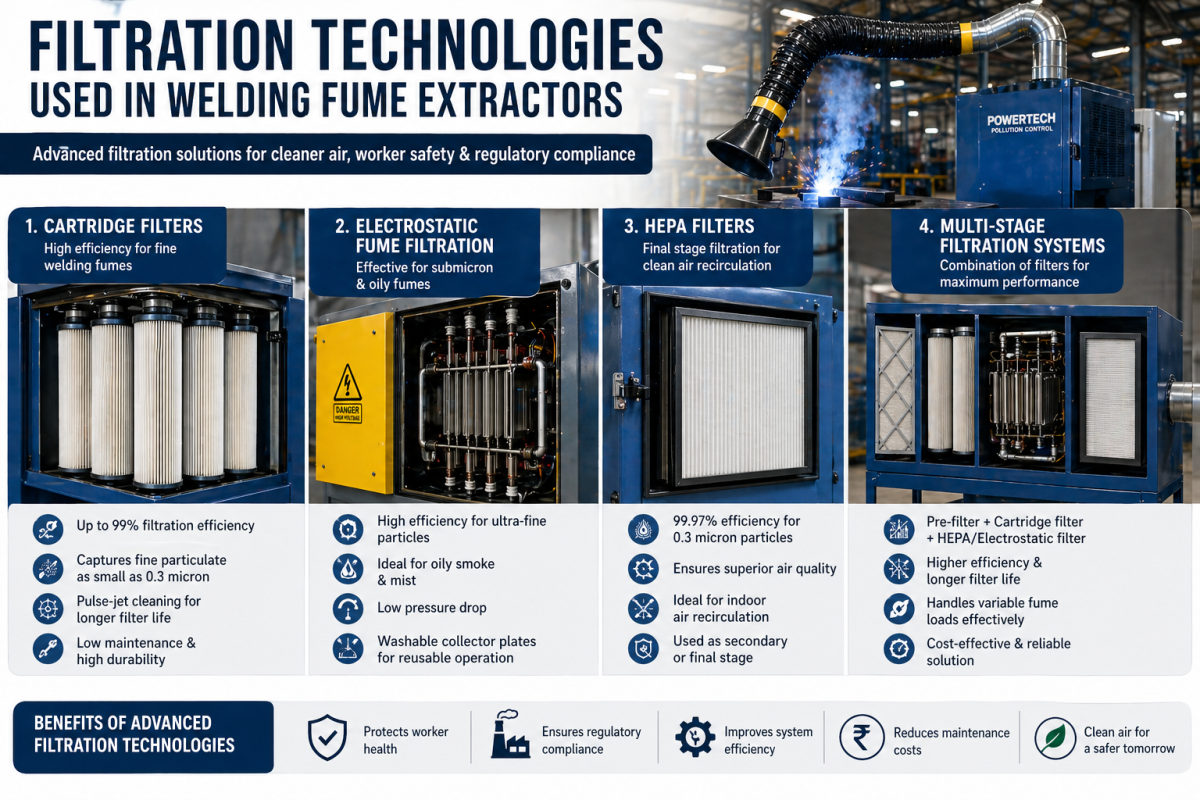
Modern extraction systems use a combination of industrial fume filters, including cartridge filters welding fumes and advanced methods such as electrostatic fume filtration, to achieve high levels of efficiency.
With over 30 years of experience, Powertech has implemented a range of filtration solutions tailored to industrial environments, ensuring reliable and consistent performance across diverse welding applications.
Key Takeaways
- Effective welding fume filtration requires selecting the right technology based on application.
- Cartridge filters are widely used for high-efficiency particulate removal.
- Electrostatic filtration is effective for fine and oily fumes.
- Multi-stage filtration systems provide optimal performance and reliability.
The Problem: Complexity of Welding Fume Filtration
Welding fumes contain a mix of particles with varying sizes and properties, making filtration challenging.
Causes
- Fine particulate size (often <1 micron)
- High temperature fumes
- Variation in welding processes
- Presence of oily or sticky particles
Workplace Impact
- Ineffective filtration leading to poor air quality
- Frequent filter clogging
- Increased maintenance costs
- Reduced system efficiency
Safety Risks
According to the Occupational Safety and Health Administration (OSHA), welding fumes can contain hazardous substances such as manganese and chromium.
The World Health Organization (WHO) highlights that exposure to fine particulate matter can lead to respiratory and cardiovascular diseases.
Technical Explanation: Types of Filtration Technologies
1. Cartridge Filters
Cartridge filters are the most widely used industrial fume filters for welding applications.
Working Principle
- Contaminated air passes through pleated filter media
- Particles are captured on the surface
- Clean air exits the system
Features
- High filtration efficiency (up to 99%)
- Suitable for fine particulate
- Pulse-jet cleaning for extended life
Applications
- Fabrication shops
- Automotive manufacturing
- General welding operations
2. Electrostatic Fume Filtration
Electrostatic fume filtration is used for capturing extremely fine particles and oily fumes.
Working Principle
- Particles are electrically charged
- Charged particles are attracted to collector plates
- Clean air is released
Features
- Effective for submicron particles
- Low pressure drop
- Suitable for oil mist and smoke
Applications
- Welding with oil-coated materials
- CNC machining environments
- High-precision industries
3. HEPA Filtration
High-Efficiency Particulate Air (HEPA) filters provide an additional level of filtration.
Features
- Efficiency up to 99.97% for very fine particles
- Used as secondary or final stage
- Ensures clean air recirculation
Applications
- Critical environments
- Indoor air recirculation systems
4. Multi-Stage Filtration Systems
Most industrial systems use a combination of filtration stages.
Typical Configuration
- Pre-filter (large particles)
- Cartridge filter (fine particles)
- HEPA or secondary filter (ultra-fine particles)
This approach improves overall efficiency and filter life.
Filtration Comparison Table
| Filtration Type | Efficiency | Particle Size Range | Pressure Drop | Best Application |
|---|---|---|---|---|
| Cartridge Filter | Up to 99% | Fine particles | Medium | General welding |
| Electrostatic Filter | High | Submicron & oily fumes | Low | Oil mist, smoke |
| HEPA Filter | 99.97% | Ultra-fine particles | High | Clean air recirculation |
| Multi-Stage System | Very High | Wide range | Variable | Industrial applications |
Practical Industrial Applications
Fabrication Shops
- Cartridge-based systems
- Moderate fume loads
- Flexible filtration requirements
Automotive Manufacturing
- Multi-stage filtration systems
- High-volume continuous operations
- Centralized systems
Maintenance Workshops
- Portable systems with cartridge filters
- Lower filtration complexity
Heavy Engineering
- High dust load
- Requires robust filter systems
- Frequent cleaning cycles
Expert Insight
From Powertech’s experience, one of the most common mistakes in welding fume filtration is selecting a filtration system based solely on efficiency ratings without considering operating conditions.
Key observations:
- High-efficiency filters can fail quickly if pre-filtration is inadequate
- Electrostatic systems perform best in specific applications, not all environments
- Multi-stage systems offer the best balance between efficiency and durability
In several installations, optimizing filter configuration has significantly reduced maintenance frequency and improved overall system performance.
Cartridge filters are widely used, but multi-stage systems provide the best overall performance.
For fine, oily, or sticky fumes where traditional filters may clog quickly.
HEPA filters are used when very high filtration efficiency or air recirculation is required.
Depends on usage and dust load; monitoring pressure drop is the best method.
No, filtration systems must be selected based on specific process requirements.
Effective welding fume filtration is essential for ensuring clean air, worker safety, and system efficiency. Different filtration technologies—such as cartridge filters, electrostatic fume filtration, and multi-stage systems—offer unique advantages depending on the application. A well-designed system combines appropriate filtration technologies with proper airflow and duct design to deliver optimal performance. With decades of experience in industrial fume filters, Powertech continues to emphasize tailored filtration solutions that meet the specific needs of industrial environments, ensuring reliable and long-term air pollution control.