
Introduction
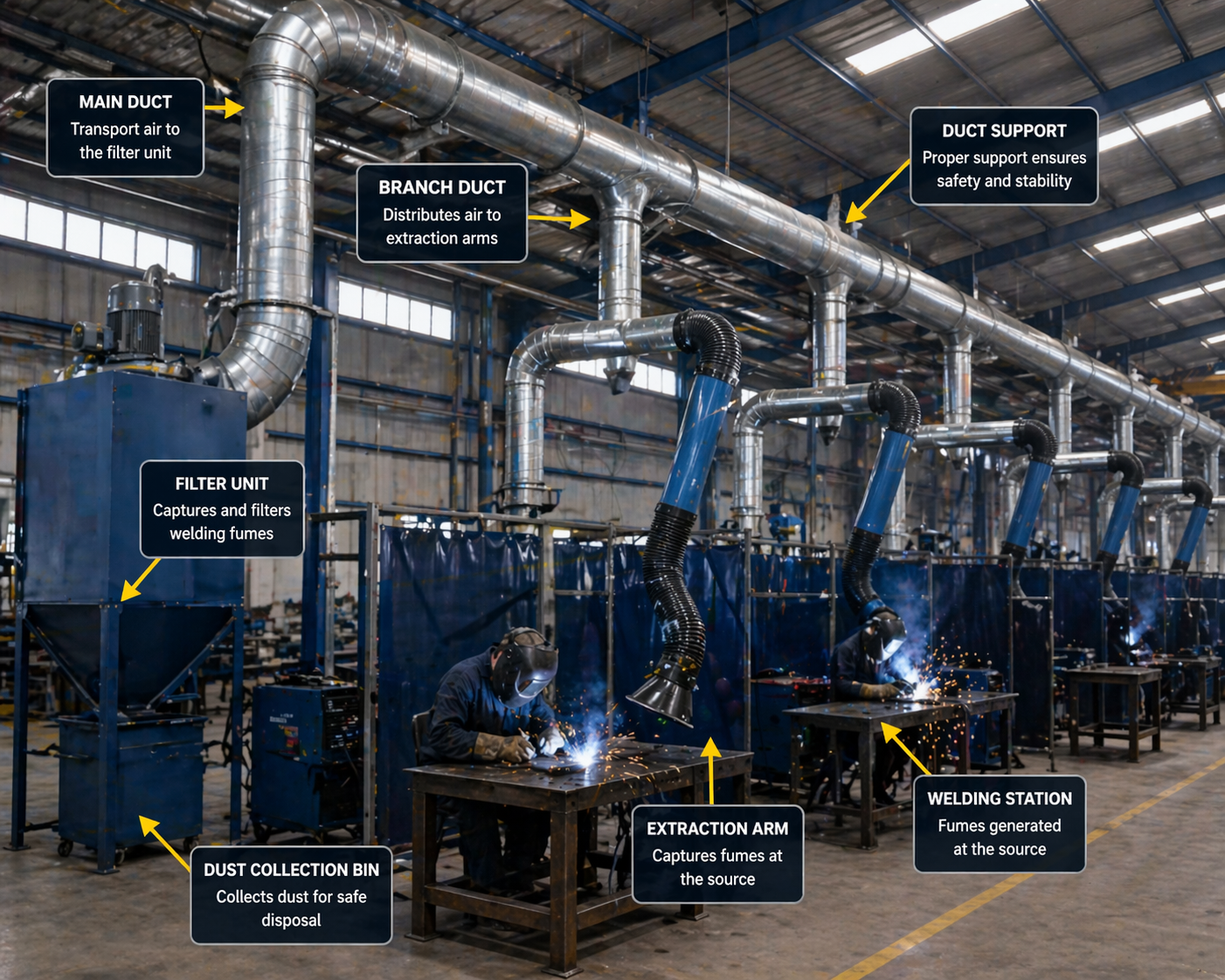
In welding fume control, the extraction unit often gets the most attention—but in practice, system performance is governed just as much by the duct network that connects capture points to the collector. Poorly designed ducting leads to pressure losses, uneven airflow distribution, dust settling, and ultimately ineffective fume capture at the source.
A robust welding fume extraction duct design ensures that the airflow calculated at the hood actually reaches the filtration unit with minimal losses. This requires careful consideration of duct velocity, layout geometry, branch balancing, and material selection. In many workshops, suboptimal industrial ventilation duct design is the root cause behind persistent ventilation issues, even when high-capacity collectors are installed.
With over three decades of field experience, Powertech has optimized fume extraction system layout across fabrication shops, automotive plants, and heavy engineering facilities—where correcting duct design alone has significantly improved system efficiency without increasing fan capacity.
Key Takeaways
- Effective welding fume extraction duct design minimizes pressure loss and maintains airflow to all stations.
- Proper duct velocity prevents particulate settling and blockages.
- Balanced branching is critical for uniform extraction across multiple points.
- Layout simplicity (fewer bends, shorter runs) improves overall welding exhaust system design performance.
The Problem: Inefficient Duct Networks
Many ventilation systems underperform due to poor duct design rather than insufficient airflow.
Causes
- Excessive bends and long duct runs
- Incorrect duct diameter selection
- Poor airflow balancing across branches
- Low duct velocity causing dust settlement
- Leakage due to poor fabrication or joints
Workplace Impact
- Uneven fume extraction across stations
- Visible smoke in certain areas
- Frequent duct clogging
- Increased maintenance downtime
Safety Risks
According to the Occupational Safety and Health Administration (OSHA), inadequate ventilation can expose workers to hazardous airborne contaminants.
The American Conference of Governmental Industrial Hygienists (ACGIH) recommends proper duct design practices to ensure effective contaminant transport and control.
Technical Explanation: Key Principles of Duct Design
Step 1: Maintain Proper Duct Velocity
Duct velocity must be high enough to keep particles suspended.
Recommended range:
- 10 – 15 m/s for welding fumes
Lower velocity leads to dust settling and clogging.
Step 2: Select Correct Duct Diameter
Duct size directly affects airflow and velocity.
Q = A × V
Where:
- Q = Airflow (m³/s)
- A = Cross-sectional area (m²)
- V = Velocity (m/s)
Larger ducts reduce velocity; smaller ducts increase pressure loss.
Step 3: Minimize Pressure Losses
Pressure loss occurs due to:
- Friction in straight ducts
- Bends and fittings
- Entry and exit losses
Best practices:
- Use smooth interior ducts
- Minimize bends
- Use long-radius elbows
Step 4: Optimize Duct Layout
A good fume extraction system layout should:
- Use the shortest possible duct routes
- Avoid unnecessary branches
- Maintain gradual transitions
Simple layouts perform better than complex ones.
Step 5: Balance Airflow Across Branches
In multi-point systems:
- Ensure equal airflow distribution
- Use dampers for balancing
- Avoid overloading one branch
Poor balancing leads to uneven extraction.
Recommended Design Parameters
| Parameter | Recommended Range | Remarks |
|---|---|---|
| Duct velocity | 10 – 15 m/s | Prevents particle settling |
| Static pressure | 800 – 2000 Pa | Depends on system size |
| Bend radius | ≥ 2 × duct diameter | Reduces pressure loss |
| Branch angle | ≤ 45° | Improves airflow distribution |
| Leakage tolerance | <5% | Ensures efficiency |
Practical Industrial Applications
Fabrication Shops
- Flexible layouts
- Multiple extraction arms
- Need for adaptable duct routing
Automotive Manufacturing
- Large centralized systems
- Long duct runs
- Requires precise balancing
Maintenance Workshops
- Smaller duct systems
- Focus on simplicity and flexibility
Heavy Engineering
- High particulate load
- Requires high-velocity ducting
Expert Insight
From Powertech’s field experience, one of the most overlooked aspects of welding exhaust system design is duct layout simplicity.
In many installations, improving duct routing—reducing bends and optimizing branch connections—has resulted in significant performance gains without increasing fan capacity.
Key practical lessons:
- Airflow efficiency is lost more in ducts than in collectors
- Balanced systems outperform oversized systems
- Good duct design reduces both energy consumption and maintenance
Typically between 10–15 m/s to prevent particle settling.
Because it ensures that airflow reaches all extraction points efficiently without losses.
Yes, it can lead to pressure losses, uneven airflow, and ineffective fume capture.
By reducing bends, using smooth ducts, and optimizing layout design.
Dampers help balance airflow across multiple branches in the system.
Duct design is a critical component of any welding fume extraction system. Even the most advanced extraction units cannot perform effectively without a well-engineered duct network. A proper welding fume extraction duct design ensures efficient airflow transport, minimizes pressure losses, and maintains consistent extraction performance across all stations. By applying sound industrial ventilation duct design principles and optimizing fume extraction system layout, industries can significantly improve system efficiency and reliability. With decades of experience, Powertech continues to emphasize engineering-driven duct design as a key factor in achieving effective and long-lasting welding exhaust system design solutions.