
Choosing the Right Filter for Cleaner Air
Industrial processes like welding, soldering or machining all require efficient fume control
and fume extractors play an important role in maintaining safe air quality. The filters inside a
fume extractor is what traps the airborne pollutants before releasing the air into the
atmosphere or back in to the shopfloor. Generally, these systems make use of either HEPA
filters or Electrostatic filters. It is important to understand the working, advantages and
drawbacks of both type of filters to ensure that you choose the right system for your facility.
What Are HEPA Filters?
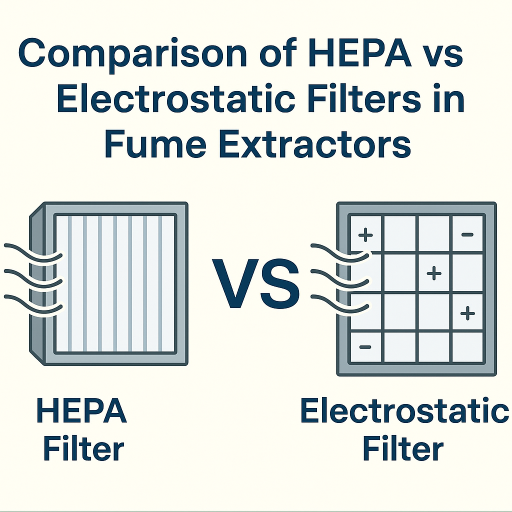
HEPA stands for High Efficiency Particulate Air. These filters are made of tightly packed fibers that trap very fine particles as air passes through. They are widely known for their ability to remove up to 99.97% of particles as small as 0.3 microns.
Strengths of HEPA Filters
- Highly effective at capturing small particles such as smoke, dust, and fine mist.
- Preferred in environments that demand strict air cleanliness, such as labs and electronics assembly.
- Easy to replace and commonly available.
- Has a comparatively lower cost for the same airflow capacity.
Limitations of HEPA Filters
- Require regular replacement, which adds to running costs.
- Can restrict airflow if clogged or overloaded.
- Higher pressure drop in the airflow leads to higher power consumption.
- Not washable or reusable.
What Are Electrostatic Filters?
Electrostatic filters use electric charges to attract and trap particles. As air flows through the unit, particles are given a charge and then captured by oppositely charged collector plates. These filters are common in welding fume extractors and soldering fume extractors. They also find use in oil mist collectors from neat cutting oil in CNC machining processes.
Strengths of Electrostatic Filters
- Excellent for capturing oil mist, smoke, and fine fumes.
- Can capture particles up to 0.01 microns in size.
- Filters are washable and reusable, lowering long-term costs.
- Maintain steady airflow since they do not clog like fiber filters.
The parallel plate design ensures lower pressure drop which leads to about 30 – 40% lower power consumption.
Limitations of Electrostatic Filters
- Require regular cleaning to maintain performance.
- May not trap larger particles that are typically caught in HEPA filters.
- Not suitable for dry, fibrous dust in some settings.
- Involves a higher initial cost for a system of the same air flow capacity.
What Type of Filter Should You Use?
The choice between HEPA and electrostatic filters depends on the type of air pollution in your facility. For very fine dry particles, HEPA filters are ideal. If your process produces oil mist, smoke, or sticky fumes, electrostatic filters offer better performance and lower maintenance.
Quick Comparison between HEPA and Electrostatic Filters
| Feature | HEPA Filter | Electrostatic Filter |
| Particle Size Handling | 0.3 microns and above | Fine particles up to 0.01 microns |
| Reusability | No (disposable) | Yes (washable) |
| Maintenance | Filter replacement | Regular cleaning |
| Best Used As | Cleanroom Filters, dry dust filters | Welding fume extracotr, oil mist collector, soldering fume extractor |
| Cost Over Time | Higher (frequent replacement) | Lower (reusable parts) |
Conclusion
Both HEPA and electrostatic filters serve an important role in fume extraction systems. HEPA filters are best for high-purity environments where removing fine dust is the priority. Electrostatic filters work better in tough industrial settings with mist and smoke. Choosing the right one depends on the pollutants in your workspace and how often you can maintain the system. A well-matched filter will keep your air clean, reduce health risks, and protect your equipment.