Introduction
Many industrial workshops invest in fume extraction systems but still struggle with poor air quality, visible smoke, and inconsistent system performance. These issues are typically not due to the absence of equipment, but rather improper system design, incorrect usage, or lack of maintenance. As a result, common welding fume extraction problems persist despite the presence of ventilation systems.
Fixing these issues requires a structured engineering approach that focuses on source capture, airflow optimization, and system configuration. Simply increasing airflow or upgrading equipment without addressing the root cause often leads to inefficient results.
A well-designed strategy to fix welding fume extraction problems involves improving welding air pollution control, correcting design flaws, and implementing proper welding ventilation solutions. Based on over 30 years of experience, Powertech has successfully optimized systems across fabrication shops, automotive facilities, and heavy engineering environments by focusing on practical, application-specific improvements.
Key Takeaways
- Most welding fume extraction problems can be resolved through proper system optimization rather than replacement.
- Improving poor welding ventilation requires correct hood positioning and airflow balancing.
- Addressing fume extraction system design mistakes significantly enhances performance.
- Regular monitoring and maintenance are critical for effective welding air pollution control.
The Problem: Persistent Fume Extraction Issues
Workshops often experience recurring ventilation issues even after installing extraction systems.
Common Causes
- Incorrect positioning of extraction arms
- Insufficient airflow at the source
- Poor duct design and airflow imbalance
- Use of undersized or mismatched systems
- Lack of maintenance and filter clogging
Workplace Impact
- Smoke accumulation in work areas
- Reduced visibility and operator comfort
- Increased contamination of equipment
- Lower productivity due to poor working conditions
Safety Risks
Exposure to welding fumes poses significant health concerns.
According to the Occupational Safety and Health Administration (OSHA), welding fumes may contain toxic substances that can affect the respiratory and nervous systems.
The National Institute for Occupational Safety and Health (NIOSH) states that prolonged exposure to welding fumes can lead to lung function impairment and other occupational health issues.
Technical Explanation: How to Fix Welding Fume Extraction Problems
Step 1: Optimize Hood Positioning
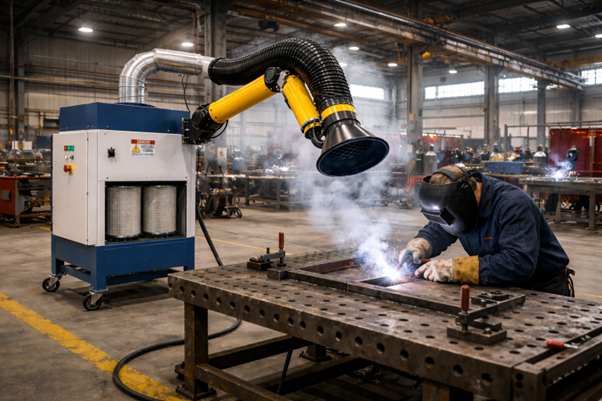
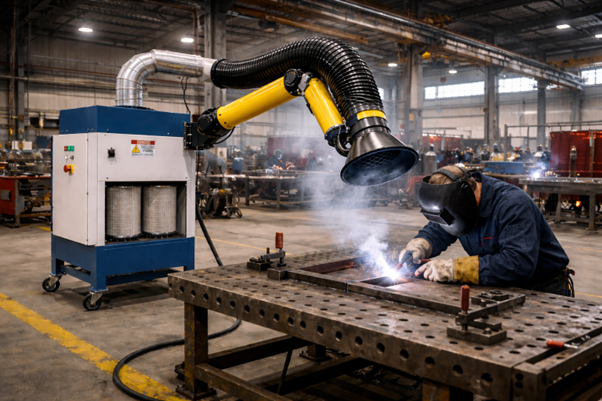
Position the extraction arm or hood closer to the welding arc.
- Ideal distance: 150–300 mm
- Align airflow with fume direction
- Avoid placing the hood behind the welder
This alone can significantly improve capture efficiency.
Step 2: Improve Airflow and Capture Velocity
Ensure adequate airflow at the point of extraction.
- Increase airflow where necessary
- Maintain consistent suction across all stations
- Verify capture velocity (0.5–1.5 m/s)
Increasing airflow without proper positioning is ineffective.
Step 3: Correct Duct Design Issues
Optimize ducting to reduce pressure losses.
- Minimize sharp bends
- Maintain proper duct velocity (10–15 m/s)
- Balance airflow across all branches
Poor duct design is a major cause of uneven extraction.
Step 4: Match System Type to Application
Use the correct system for the workload.
- Portable systems for flexible, low-load applications
- Centralized systems for multiple stations
- Hybrid setups for mixed environments
Incorrect system selection leads to persistent performance issues.
Step 5: Maintain Filters and System Components
Regular maintenance ensures consistent performance.
- Monitor pressure drop across filters
- Replace clogged filters promptly
- Inspect fans and ducting regularly
Neglecting maintenance reduces system efficiency significantly.
Key Performance Parameters for Effective Welding Ventilation Solutions
|
Parameter |
Recommended Range |
Remarks |
|
Capture distance |
150 – 300 mm |
Critical for source capture |
|
Capture velocity |
0.5 – 1.5 m/s |
Ensures effective suction |
|
Airflow per arm |
800 – 1500 m³/hr |
Based on welding intensity |
|
Duct velocity |
10 – 15 m/s |
Prevents particle settling |
|
Filter efficiency |
Up to 99% |
Multi-stage filtration |
Practical Industrial Applications
Fabrication Workshops
Common issues:
- Poor positioning of extraction arms
- Variable workflows
Fix:
- Use flexible extraction arms
- Train operators on correct positioning
Automotive Workshops
Common issues:
- Uneven airflow in centralized systems
Fix:
- Balance duct networks
- Integrate extraction into robotic cells
Maintenance and Repair Workshops
Common issues:
- Incorrect use of portable systems
Fix:
- Ensure proper placement
- Select adequate capacity units
Heavy Engineering Facilities
Common issues:
- High fume loads exceeding system capacity
Fix:
- Upgrade system capacity
- Optimize airflow distribution
Expert Insight
From Powertech’s experience across multiple industries, the most effective improvements often come from simple corrections rather than major system upgrades.
In several workshop installations, repositioning extraction arms and balancing airflow has improved system performance by over 30% without increasing equipment capacity.
Key practical lessons:
- Source capture is more important than airflow volume
- System design must match real-world usage
- Regular performance checks are essential
Workshops that treat fume extraction as an engineering system rather than a standalone product achieve significantly better results.
Frequently Asked Questions
By optimizing hood positioning, improving airflow, correcting duct design, and maintaining system components.
Because systems are often incorrectly designed, positioned, or maintained.
No. Proper positioning and system design are equally important.
Yes. Most issues can be resolved through optimization and minor modifications.
Regular inspections and monitoring of airflow and filter conditions are recommended.
Conclusion
Welding fume extraction systems are essential for maintaining safe and efficient workshop environments, but many facilities continue to face performance issues due to design and operational shortcomings.
Fixing these welding fume extraction problems requires a structured approach that focuses on source capture, airflow optimization, and proper system configuration. By addressing poor welding ventilation and correcting fume extraction system design mistakes, workshops can significantly improve air quality and operational efficiency.With decades of experience in welding air pollution control, Powertech emphasizes the importance of practical, engineering-driven solutions that are tailored to real-world workshop conditions, ensuring reliable and long-term performance.