
Why Choosing the Right Welding Fume Extractor Matters
Welding fumes pose serious health risks when they remain in the workspace. A welding fume extractor removes these fumes before workers inhale them. However, not all facilities need the same type of system.
The two common options are portable welding fume extractors and central welding fume extraction systems. Each works well in specific conditions. Choosing the right one depends on layout, number of stations, and production style.
What Is a Portable Welding Fume Extractor?
How It Works
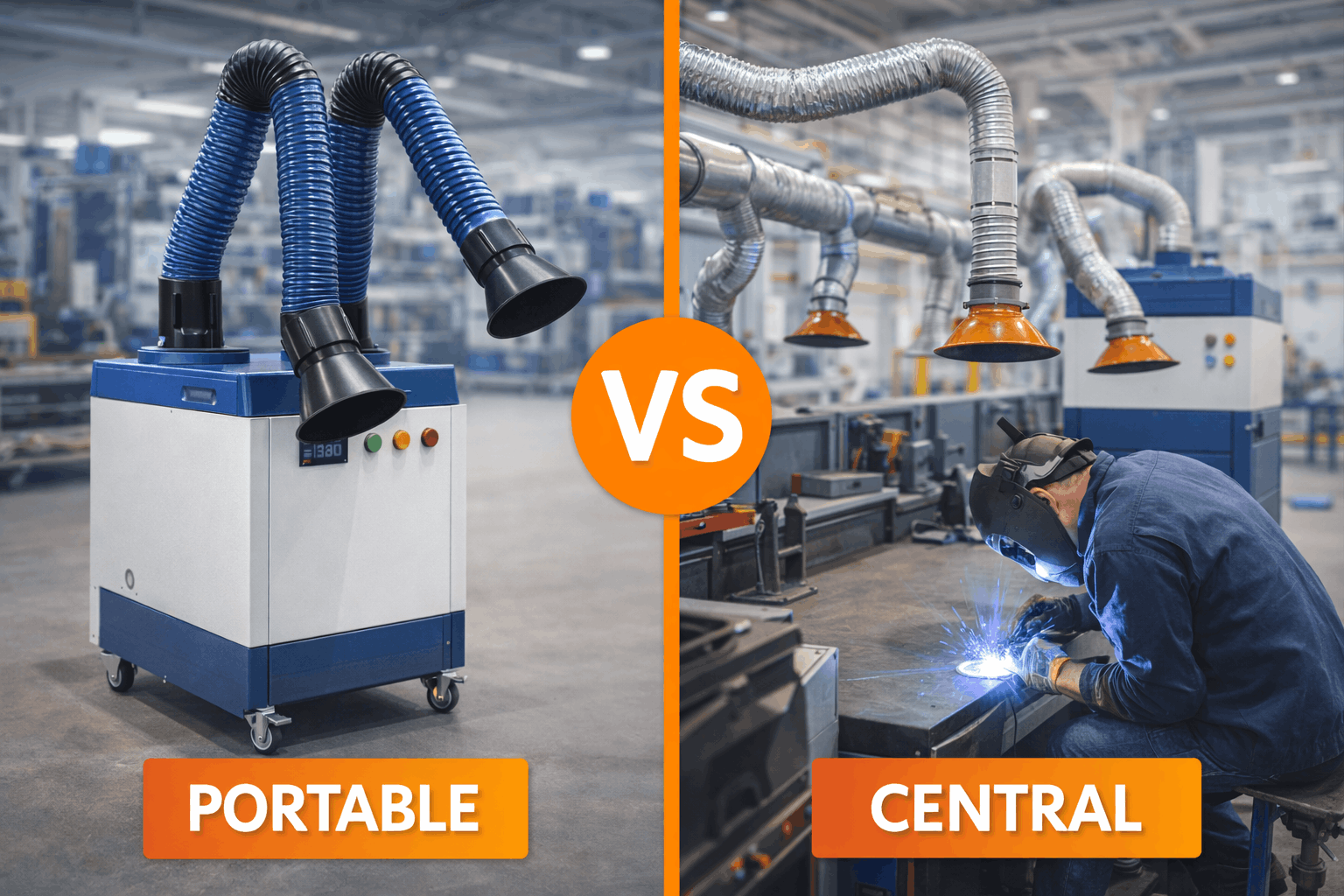
A portable welding fume extractor is a self-contained unit. It usually has wheels and one or two flexible suction arms. Operators move it close to the welding point to capture fumes directly.
Best Suited For
- Small workshops
- Job shops
- Repair and maintenance areas
- Low to medium number of welding stations
Key Advantages
- Easy to move
- No fixed ducting required
- Lower installation cost
- Flexible use across different work areas
Limitations
- Limited capacity for large facilities
- Requires manual repositioning
- Not ideal for continuous high-volume welding
What Is a Central Welding Fume Extraction System?
How It Works
A central system uses a single high-capacity extractor connected to multiple welding stations through ducting. Each station has a hood or suction arm connected to the system.
Best Suited For
- Large production floors
- Fixed welding stations
- High-volume or multi-shift welding
- Facilities with consistent layouts
Key Advantages
- Handles multiple stations at once
- Stable airflow and suction
- Minimal operator intervention
- Cleaner overall shop environment
Limitations
- Higher initial installation cost
- Requires duct planning
- Less flexible once installed
Key Factors to Consider When Choosing
Number of Welding Stations
Few stations benefit from portable units. Many stations usually need a central system.
Layout Flexibility
If workstations move often, portable extractors work better. Fixed layouts suit central systems.
Production Volume
High-duty welding requires consistent extraction, which central systems handle better.
Maintenance Planning
Central systems allow planned maintenance at one point. Portable units need individual attention.
Q&A: Portable vs Central Welding Fume Extractors
Q1: Can portable welding fume extractors serve two stations?
Yes. Some models support twin extractor arms, depending on fume load.
Q2: Do central systems consume more power?
Not always. Well-designed systems use optimized airflow to reduce energy use.
Q3: Is a portable system suitable for continuous production?
It works for limited production but may struggle under heavy, continuous loads.
Q4: Who can help choose the right system?
An experienced welding fume extractor manufacturer in Bangalore can assess layout, welding type, and airflow needs.
Conclusion
Portable and central welding fume extractors serve different needs. Portable units offer flexibility and lower setup cost. Central systems provide consistent extraction for large and busy facilities.
The right choice depends on how many stations you have, how often layouts change, and how intensive the welding process is. Selecting the correct system ensures clean air, better safety, and stable operations.