
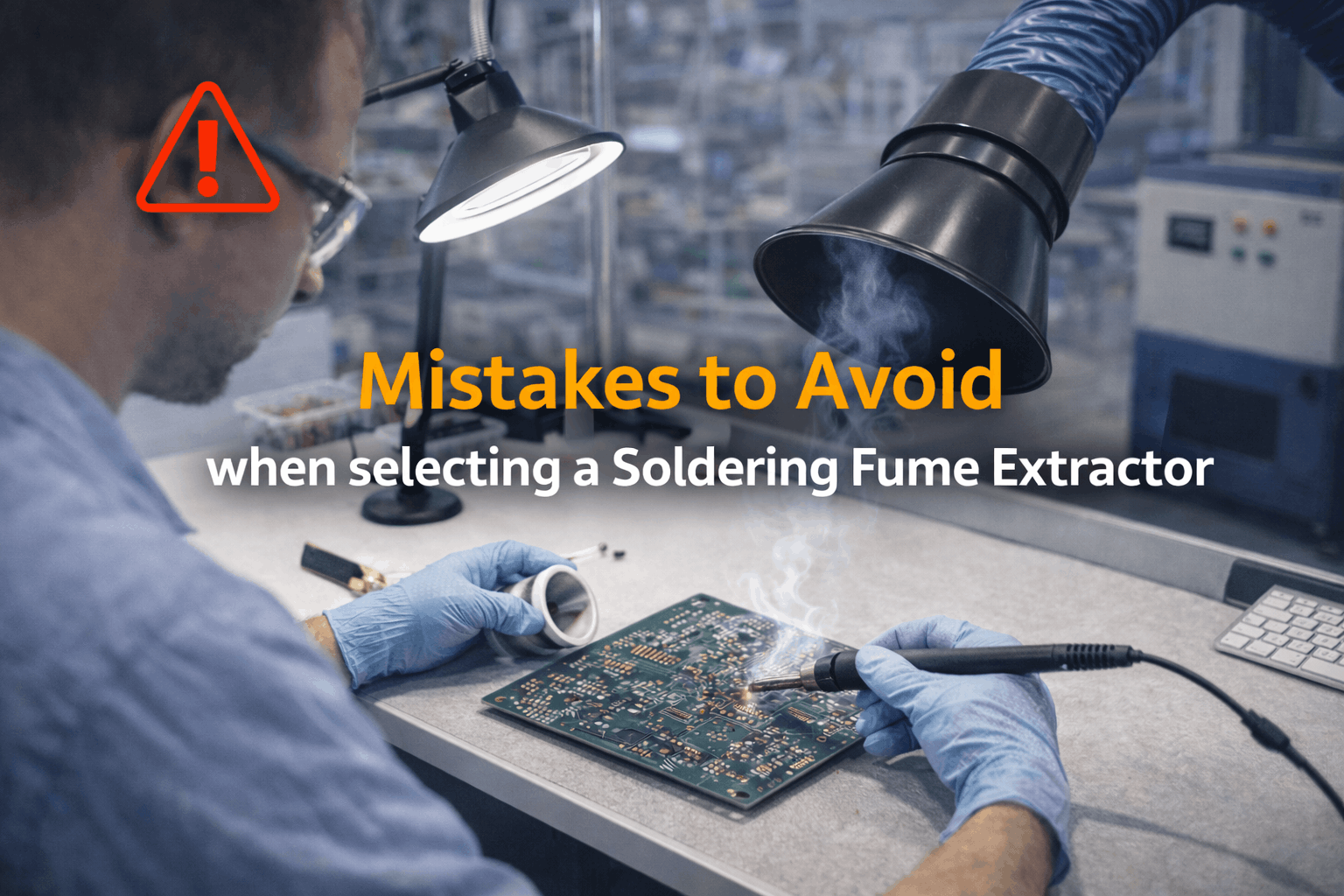
Why Choosing the Right Soldering Fume Extractor Matters
Soldering fumes affect worker comfort, health, and product quality. Many facilities invest in fume extraction but still face air quality issues. In most cases, the problem is not the equipment. It is the selection process.
Avoiding common mistakes helps ensure effective fume control and long-term reliability.
1. Choosing an Extractor Based Only on Price
Why This Is a Problem
Low-cost systems often compromise on suction strength and filtration quality. These systems struggle in continuous soldering operations.
What to Do Instead
Select a fume extractor based on airflow needs, filtration efficiency, and duty cycle, not price alone.
2. Ignoring Source Capture Requirements
Common Mistake
Many systems rely on general air movement instead of capturing fumes at the soldering point.
Correct Approach
A soldering fume extractor must capture fumes directly at the source to prevent inhalation.
3. Underestimating Fume Load
Why It Happens
Facilities assume soldering produces light fumes. In reality, continuous soldering generates high fume concentration.
Impact
Undersized systems lose effectiveness quickly and require frequent intervention.
4. Selecting the Wrong Filtration Type
Filtration Matters
Different flux types produce different fumes. Inadequate filtration allows fumes to pass through or clog filters.
What to Check
Ensure the system can handle fine particles and gas components released during soldering.
An experienced soldering fume extractor manufacturer in Bangalore usually recommends filtration based on actual process conditions.
5. Overlooking Noise Levels
Why Noise Is Important
High noise levels cause discomfort during long shifts. Operators may switch off noisy systems.
Better Choice
Choose systems designed for low-noise operation without reducing suction.
6. Ignoring Maintenance and Accessibility
Hidden Issue
Systems that are hard to clean or service get neglected over time.
Best Practice
Select extractors with easy access to filters and clear maintenance procedures.
Q&A: Selecting a Soldering Fume Extractor
Q1: Can one extractor serve multiple soldering stations?
Yes, if the system supports twin arms and soldering load is moderate.
Q2: Does stronger suction always mean better performance?
No. Correct positioning matters more than excessive airflow.
Q3: Is general ventilation enough for soldering fumes?
No. Ventilation only dilutes fumes. Extraction removes them at the source.
Q4: Who should help with system selection?
A qualified soldering fume extractor manufacturer in Bangalore can assess layout and soldering intensity.
Conclusion
Selecting the wrong soldering fume extractor leads to poor air quality and operator discomfort. Common mistakes include focusing only on cost, ignoring fume load, and choosing incorrect filtration.
Avoiding these errors ensures effective fume capture, stable air quality, and a safer soldering environment.