
Why the Arm Configuration is Important for Welding Fume Extraction
A welding fume extractor needs to catch fumes at the source. The number of extractor arms affects how many welding stations a unit can serve and how well it works.
The layout, workload, and fume level will help you decide between a single-arm and twin-arm system.
What Is a Single-Arm Welding Fume Extractor?
Basic Configuration
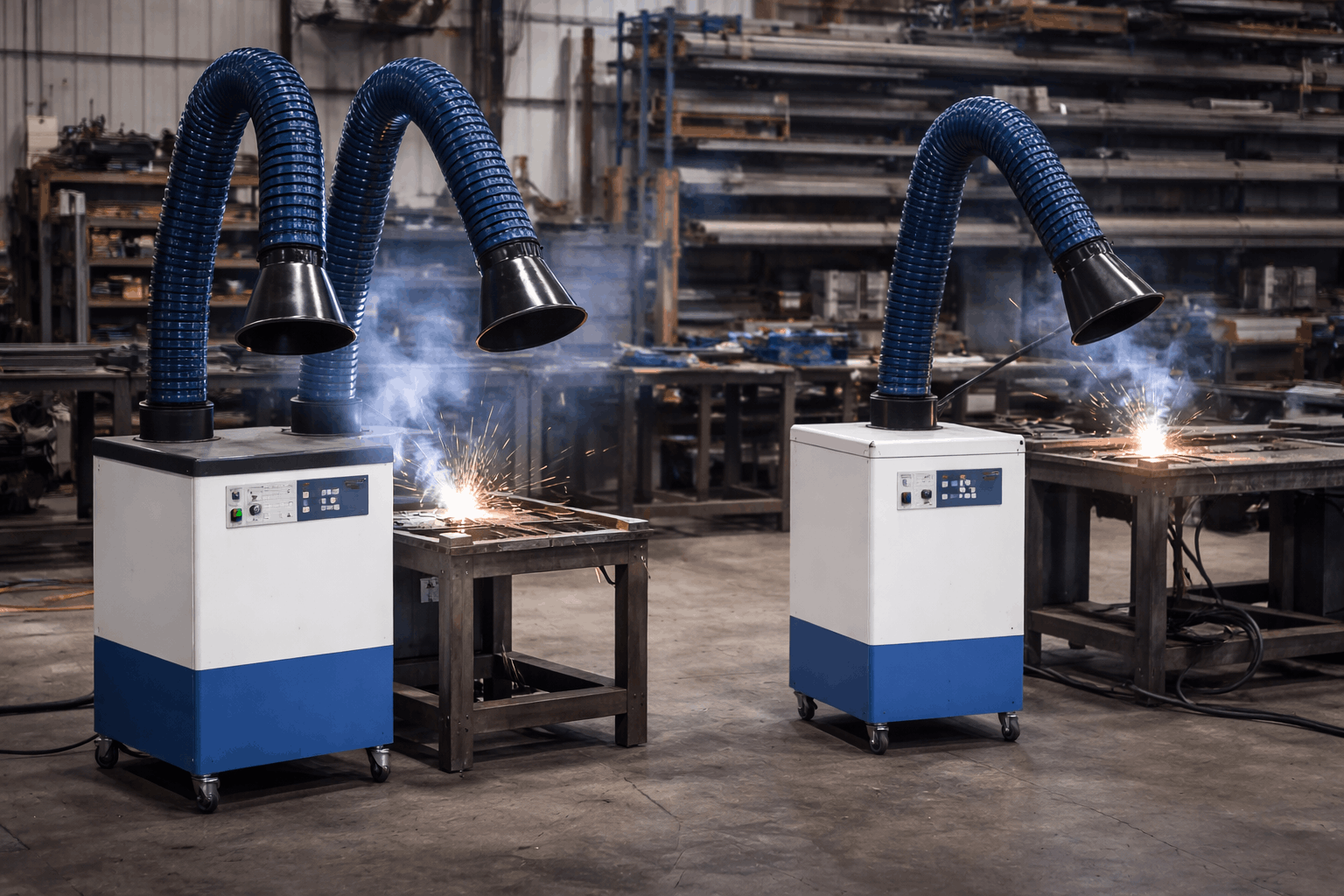
A single-arm system has one flexible suction arm that is linked to the extractor unit. It can only work on one welding station at a time.
Best Suited for:
- Separate welding stations
- Work on repairs and upkeep
- Welding load that is low to moderate
- Shops with layouts that can change
Benefits:
- Easy to set up
- Less money up front
- Simple to move around
- Airflow that is focused on one source
Limitations:
- Can’t serve more than one active station
- Not as useful in busy workshops
What Is a Twin-Arm Welding Fume Extractor?
A twin-arm system has two flexible suction arms that are connected to a single extractor unit.
Depending on the amount of fumes, it can work at two welding stations at the same time.
Best Suited For:
- Welding stations next to each other
- Moderate levels of production floors
- Workshops with a steady flow of work
Benefits
- One unit serves two stations
- Saves space on the floor
- Lessens the number of tools
Limitations
- Airflow divides between the arms
- It may not be able to handle heavy welding at both stations at once.
Before suggesting a twin-arm setup, an experienced welding fume extractor manufacturer checks how the air flows.
Important Things to Think About When Choosing
Simultaneous Welding Intensity:
If both welders are working all the time and making a lot of fumes, the twin-arm unit needs to be the right size.
Distance Between Stations
Twin arms work best when stations are close to each other. Long distances make it harder to move around.
Available Floor Space
Twin-arm systems take up less space than two separate units.
Future Growth
Think about whether production might go up. Planning ahead keeps you from having to replace the system.
Real-Life Examples
Case 1: Small Repair Shop
A single-arm welding fume extractor works well when only one welder is working at a time.
Case 2: Medium Fabrication Unit
Twin-arm extractors help two welders work at the same time with moderate duty cycles.
Case 3: High-Volume Production
A twin-arm setup may not be the best choice for high-volume production. Instead, separate units or a central extraction system may work better.
Q&A: Single vs. Twin-Arm Welding Fume Extractors
Q1: Does a system with two arms make the suction weaker?
A: Airflow splits between the arms. The right size makes sure that capture works.
Q2: Is it possible for one twin-arm unit to take the place of two single-arm units?
A: Yes, if the welding is not too strong and the stations are close together.
Q3: Is a system with only one arm more efficient?
A: It directs the airflow to one source, which is great for single stations.
Q4: Who can help you choose the best configuration?
A: A qualified manufacturer of welding fume extractors can look at the layout and calculate the airflow needs.
Conclusion
Single-arm and twin-arm welding fume extractors are made for different purposes. Single-arm systems are good for single stations. Twin-arm systems are good for welders who work next to each other and have moderate workloads.
Choosing the right setup makes sure that fume capture works well, air quality stays stable, and equipment is used efficiently.