
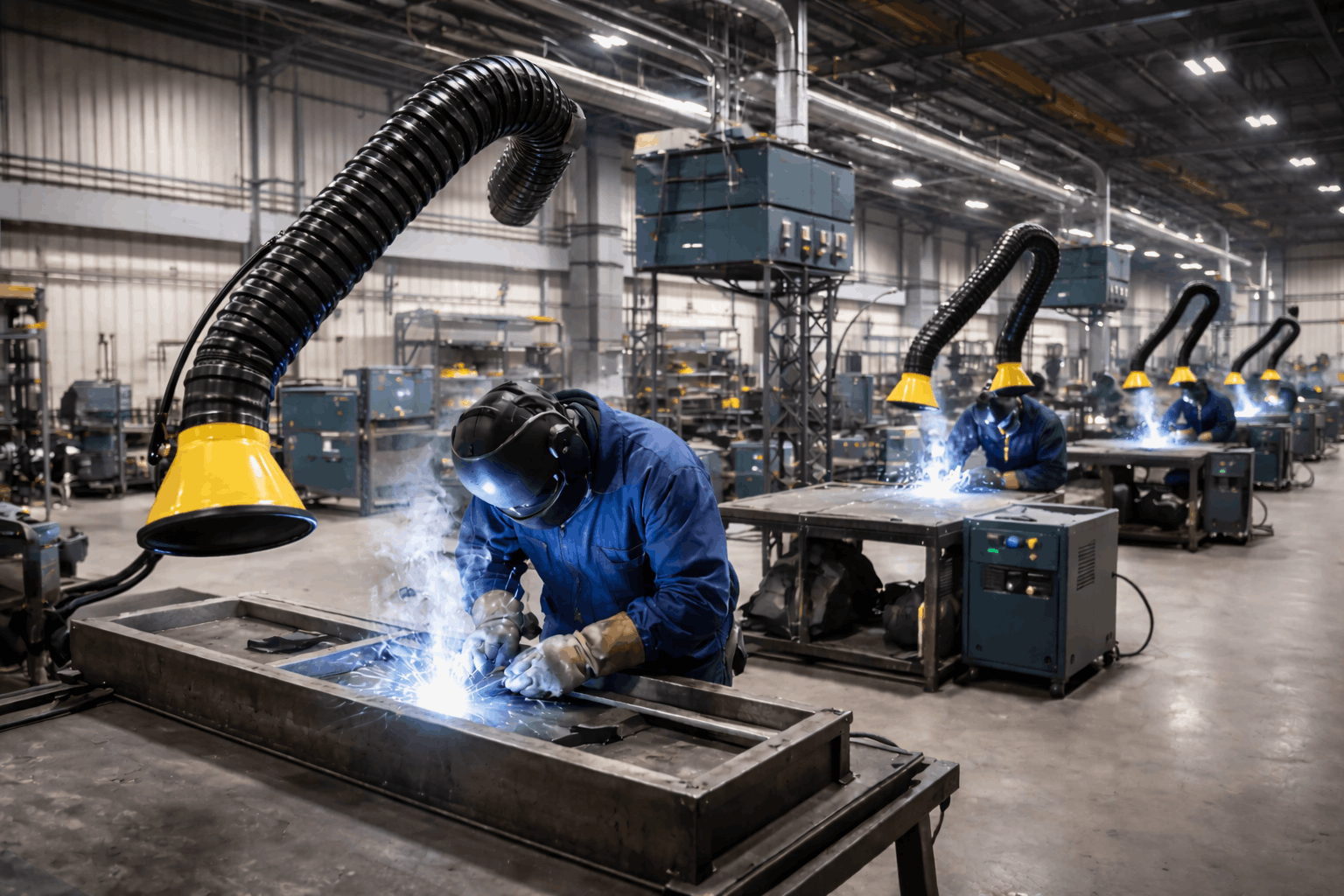
Many factories are open 24 hours a day. To meet production goals, welding often goes on for two or three shifts. In these places, welding fume extraction systems work for long hours every day.
When equipment runs all the time, it has to work harder, keep the airflow stable, and plan for maintenance. A well-made welding fume extractor should be able to handle heavy workloads without losing efficiency.
Why Multi-Shift Welding Needs More Extraction
When welding happens over more than one shift, the extraction system has to work harder because of a number of things.
- The time it takes to weld goes up significantly.
- Over the course of the day, more fumes build up.
- Filters catch more particles than they let through.
- The equipment works for longer periods of time.
If the system is not of the required capacity, the airflow slowly drops as the filters fill up with particles. This makes it harder to capture and lets fumes spread around the welding area.
Consistent Airflow is Critical
Stable Performance of Capture
Extraction systems need to keep the airflow steady for long periods of time in places with multiple shifts. Any drop in suction makes it harder to catch fumes at the source.
When the airflow slows down, fumes start to rise into the operator’s breathing zone before they are caught.
Not Losing Performance over Time
Loss of airflow usually happens over time. People who work with it might not notice the change right away. As time goes on, the smoke around the welding arc gets thicker.
Routine checks of the airflow help find these changes early. Powertech Pollution Controls is a welding fume extractor manufacturer in Bangalore that designs systems that can handle welding all the time.
Filter Capacity becomes more Important
Filters pick up particles faster in welding shops that work in shifts.
Faster Filter Loading
When a lot of welding is going on, there are a lot of small particles in the air. In a plant with multiple shifts, filters may load much faster than they do in a plant with only one shift.
Cycles for Planned Replacement
Instead of calendar dates, maintenance teams should set filter replacement schedules based on how many hours of production there are.
This helps keep the airflow from dropping while production is going on.
Durability of Equipment is Important
Extraction units in plants that work more than one shift must work reliably for long periods of time. Some important things to think about when designing are:
- Fans that are very efficient and made to run all the time
- Filter housings that last.
- Electrical parts that stay stable.
- Easy access to filters for upkeep.
Strong construction helps make sure the system keeps working even when it’s used for a long time.
Layout of Workstations for Continuous Production
The arrangement of welding stations also affects how well extraction works.
How to Position the Hood Correctly
To quickly catch fumes, extraction arms should stay close to the welding point.
People who work in shifts must be trained on how to properly place the hood.
Avoid Airflow Interference
Cross drafts can happen when doors are open or when big fans are on. These air currents might move the fumes away from the capture zone.
Planning the direction of airflow makes the system work better.
Planning Maintenance for Operations with Multiple Shifts
Because of continuous welding, maintenance needs to be planned carefully.
Things that people do often are:
- Checking filters at the end of every shift.
- Checking the levels of airflow on a regular basis.
- Cleaning the hoods and extraction arms.
- Keeping an eye on how well the fans work
Planned maintenance can prevent sudden airflow loss during production hours.
Q&A
Q1. What is the importance of welding fume extractors in operations with more than one shift?
A. Welding makes a lot of fumes because it takes a long time. These fumes must be constantly removed by extraction systems.
Q2. Do filters wear out more quickly in facilities that have more than one shift?
A.Yes. Longer hours of operation make filters collect particles faster.
Q3.How can you keep an eye on how well the airflow is working?
A. Checking the airflow regularly and looking at the fume capture system can help you find changes in performance.
Q4. Is it possible for the same system to work for both single-shift and multi-shift operations?
A. Yes, but systems for multi-shift environments need to be able to handle more work and run for longer periods of time.
Conclusion
Welding fume extraction systems have to work harder in factories that run multiple shifts. Welding all the time raises the amount of particles, the use of filters, and the number of hours equipment runs.
A well-designed welding fume extractor makes sure that the airflow stays steady and the machine works well for long periods of time.
Facilities can keep the air clean and the welding safe all day long if they size their systems correctly, do regular maintenance, and set up their workstations properly.