
Introduction
Accurate airflow design is one of the most critical aspects of any welding fume extraction system. Undersized systems fail to capture fumes effectively, while oversized systems lead to unnecessary energy consumption and operational costs. In industrial workshops, improper airflow design is one of the leading causes of poor fume control performance.
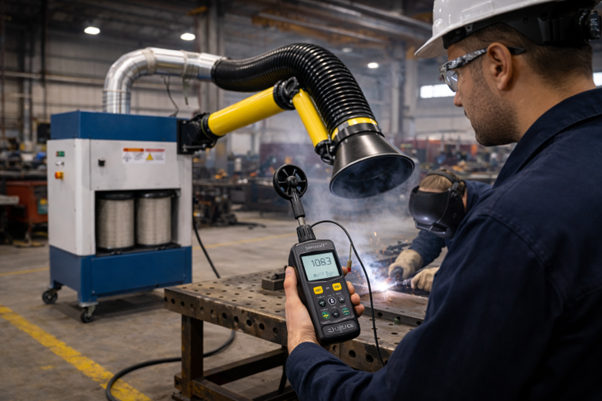
The key to an efficient system lies in understanding welding fume extractor airflow calculation, which depends on factors such as capture velocity, hood design, and distance from the source. Without proper calculation, even high-quality systems may fail to deliver the required performance.
A well-engineered approach to welding ventilation airflow ensures that fumes are captured at the source before they disperse into the workspace. With decades of experience, Powertech has designed systems where precise fume extraction airflow design has significantly improved air quality and system efficiency across fabrication and manufacturing environments.
Key Takeaways
- Accurate welding fume extractor airflow calculation is essential for effective fume capture.
- Capture velocity welding is the most important parameter in determining airflow requirements.
- Airflow depends on hood design, distance from source, and welding intensity.
- Proper airflow design improves both safety and energy efficiency.
The Problem: Incorrect Airflow Design
Many workshops face issues due to incorrect airflow calculations during system design.
Causes
- Lack of understanding of capture velocity requirements
- Incorrect hood sizing
- Ignoring distance between hood and welding arc
- Poor duct design and airflow losses
Workplace Impact
- Ineffective fume capture
- Smoke accumulation in work areas
- Increased operator exposure
- Reduced system efficiency
Safety Risks
According to the Occupational Safety and Health Administration (OSHA), inadequate ventilation can result in exposure to hazardous welding fumes, affecting respiratory health.
The National Institute for Occupational Safety and Health (NIOSH) emphasizes the importance of proper ventilation design to control airborne contaminants effectively.
Technical Explanation: Airflow Calculation Method
Step 1: Understand Capture Velocity
Capture velocity is the air speed required to draw fumes into the extraction hood.
V = Q / A
Where:
- V = Capture velocity (m/s)
- Q = Airflow rate (m³/s)
- A = Area of hood opening (m²)
Step 2: Determine Hood Area
Calculate the area of the extraction hood opening.
For a circular hood:
A = πr2
Ex: r = 500mm = 0.5m
A = πr2 ≈ 0.79m2
C = 2πr ≈ 3.14m2
For a rectangular hood:
A = L × W
Step 3: Calculate Required Airflow
Rearranging the formula:
Q = V × A
This gives the airflow required for effective fume capture.
Step 4: Adjust for Distance
Airflow requirements increase significantly with distance from the source.
- At 150 mm → standard airflow
- At 300 mm → airflow requirement may double
Airflow is directly proportional to the square of the distance of the extraction hood from the fume generation source.
Step 5: Account for System Losses
Include additional airflow to compensate for:
- Duct losses
- Filter resistance
- System inefficiencies
Typical design practice:
- Add 20–30% safety margin
Example Airflow Calculation
Assume:
- Hood diameter = 300 mm → radius = 0.15 m
- Required capture velocity = 1 m/s
Step 1: Area
A = π × (0.15)2 = 0.0707m2
Step 2: Airflow
Q = 1 × 0.0707 = 0.0707 m3/s
Convert to m3/hr:
Q = 0.0707 × 3600 = 254.5 m3/hr
- Final airflow requirement ≈ 250–300 m3/hr (minimum)
- After adding losses: 300 – 400 m3/hr per extraction point
Recommended Airflow Parameters
|
Parameter |
Recommended Range |
Remarks |
|
Capture velocity |
0.5 – 1.5 m/s |
Depends on welding type |
|
Airflow per arm |
800 – 1500 m³/hr |
Industrial standard |
|
Hood distance |
150 – 300 mm |
Critical for efficiency |
|
Duct velocity |
10 – 15 m/s |
Prevents dust settling |
|
Safety margin |
+20–30% |
For system losses |
Practical Industrial Applications
Fabrication Shops
- Flexible extraction arms
- Variable airflow requirements
- Need for adaptable systems
Automotive Manufacturing
- High airflow centralized systems
- Robotic welding requiring consistent airflow
Maintenance Workshops
- Portable systems
- Lower airflow but high positioning dependency
Heavy Engineering
- High fume loads
- Requires high-capacity airflow systems
Expert Insight
From Powertech’s experience, the biggest mistake in airflow design is assuming that higher airflow always leads to better performance.
In reality:
- Poor hood positioning cannot be compensated by increasing airflow
- Oversized systems waste energy without improving efficiency
- Proper calculation and design outperform trial-and-error approaches
In several installations, optimizing airflow based on correct capture velocity welding principles has improved system efficiency without increasing system capacity.
Frequently Asked Questions
Typically between 800–1500 m³/hr per extraction arm, depending on application.
It is the air speed required to capture fumes at the source before dispersion.
Yes, larger hood openings require higher airflow to maintain the same capture velocity.
Yes, reducing the distance improves capture efficiency and lowers airflow requirements.
It ensures effective fume capture while optimizing energy consumption.
Conclusion
Accurate welding fume extractor airflow calculation is fundamental to designing effective ventilation systems. Without proper calculation, systems either fail to capture fumes or operate inefficiently.
By understanding welding ventilation airflow, applying correct capture velocity welding principles, and optimizing fume extraction airflow design, industries can achieve efficient fume control and improved air quality.
With decades of experience, Powertech emphasizes engineering-based airflow design to ensure reliable, efficient, and cost-effective welding fume extraction systems.