
Introduction
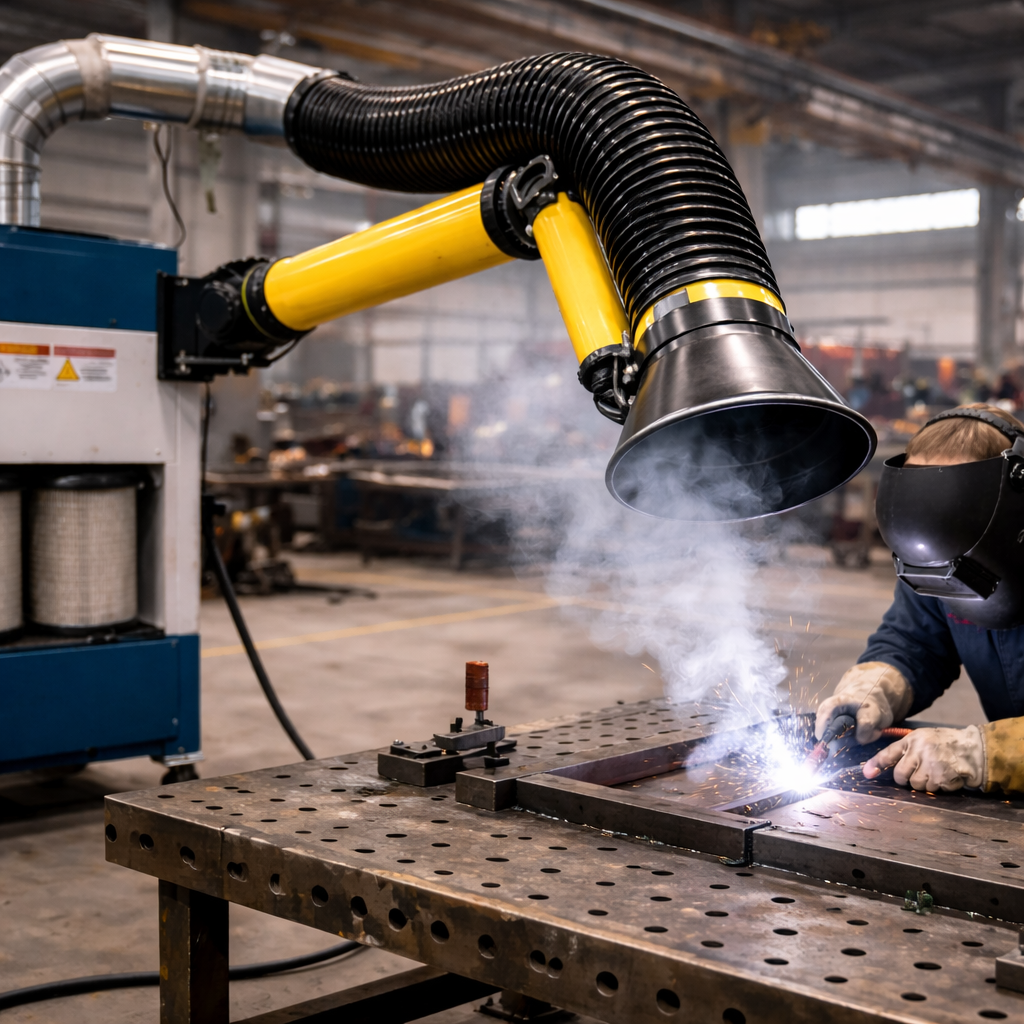
Effective welding fume control depends fundamentally on the ability to capture contaminants at the point of generation. In welding operations, fumes are produced at high temperatures and disperse rapidly into the surrounding air. If not captured immediately, they spread across the workspace, reducing air quality and increasing operator exposure.
The key parameter that determines whether fumes are successfully captured is capture velocity welding fumes. Capture velocity defines the air speed required at the source to overcome the momentum of rising fumes and draw them into the extraction system.
In industrial environments, improper understanding of welding ventilation design often leads to inadequate airflow, resulting in poor system performance. A well-engineered approach to fume extraction airflow requirements ensures that contaminants are effectively removed before dispersion.
With over 30 years of experience, Powertech has designed industrial welding ventilation systems where optimizing capture velocity has significantly improved air quality and system efficiency across fabrication and manufacturing facilities.
Key Takeaways
- Capture velocity welding fumes is critical for effective source capture.
- Incorrect capture velocity leads to poor fume extraction even with high airflow.
- Proper welding ventilation design must account for hood distance and airflow direction.
- Optimizing capture velocity improves both safety and system efficiency.
The Problem: Inadequate Capture Velocity
Many welding fume extraction systems fail not due to lack of airflow, but due to insufficient capture velocity at the source.
Causes
- Extraction hood positioned too far from welding arc
- Low airflow at the hood opening
- Cross drafts interfering with airflow
- Incorrect hood design
- Poor system balancing
Workplace Impact
- Visible smoke escaping into the workspace
- Reduced visibility during welding
- Increased contamination of equipment
- Inefficient system performance
Safety Risks
According to the Occupational Safety and Health Administration (OSHA), inadequate ventilation can lead to exposure to hazardous welding fumes affecting respiratory health.
The National Institute for Occupational Safety and Health (NIOSH) emphasizes that proper ventilation design is essential to control airborne contaminants effectively.
Technical Explanation: Understanding Capture Velocity
Capture velocity is the air velocity at any point in front of the hood required to capture contaminants.
Key Relationship
V = Q / A
Where:
- V = Capture velocity (m/s)
- Q = Airflow rate (m³/s)
- A = Hood area (m²)
Factors Affecting Capture Velocity
1. Distance from Source
Capture velocity decreases rapidly with distance.
- 150 mm → effective capture
- 300 mm → significant reduction
The required airflow is directly related to the square of the distance of the hood from the source.
2. Hood Design
Different hood types affect airflow patterns.
- Flanged hoods improve efficiency
- Plain openings require higher airflow
- Enclosures provide best performance
3. Airflow Rate
Higher airflow increases capture velocity, but only within practical limits.
- Excess airflow increases energy cost
- Poor positioning cannot be compensated by airflow
4. Cross Drafts
Air movement in the workspace can disrupt capture.
- Fans
- Open doors
- HVAC systems
👉 These reduce effective capture velocity.
Recommended Capture Velocity Values
| Welding Application | Capture Velocity (m/s) | Remarks |
|---|---|---|
| Light welding (TIG) | 0.5 – 0.75 | Low fume generation |
| Medium welding (MIG) | 0.75 – 1.0 | Standard applications |
| Heavy welding (Arc) | 1.0 – 1.5 | High fume generation |
| Robotic welding | 1.0 – 1.5 | Continuous operation |
| Enclosed systems | 0.5 – 0.75 | Controlled environment |
Practical Industrial Applications
Fabrication Shops
- Flexible extraction arms
- Variable capture requirements
- Importance of operator positioning
Automotive Manufacturing
- Robotic welding cells
- Enclosed extraction systems
- Consistent airflow requirements
Maintenance Workshops
- Portable extraction systems
- High dependency on correct positioning
Heavy Engineering
- High fume generation
- Requires higher capture velocity
Expert Insight
From Powertech’s experience, one of the most common misconceptions is that increasing airflow automatically improves fume capture.
In reality:
- Capture velocity at the source is more important than total airflow
- Poor hood placement cannot be corrected by increasing system capacity
- Optimized design reduces energy consumption while improving performance
In several installations, improving capture velocity through better positioning and hood design has increased efficiency without increasing airflow.
It is the air speed required at the source to capture welding fumes before they disperse.
Typically between 0.5 to 1.5 m/s depending on the welding process.
Yes, but only if the hood is properly positioned.
Because air velocity dissipates rapidly as it moves away from the hood opening.
Yes, by reducing hood distance and improving hood design.
Capture velocity is a critical parameter in designing effective welding fume extraction systems. Without sufficient capture velocity welding fumes, even well-designed systems fail to control contaminants effectively. A proper welding ventilation design must consider airflow, hood positioning, and environmental conditions to meet fume extraction airflow requirements. By optimizing capture velocity, industries can achieve better air quality, improved safety, and more efficient industrial welding ventilation systems. With decades of experience, Powertech continues to emphasize engineering-driven design to ensure reliable and effective welding fume extraction solutions.