
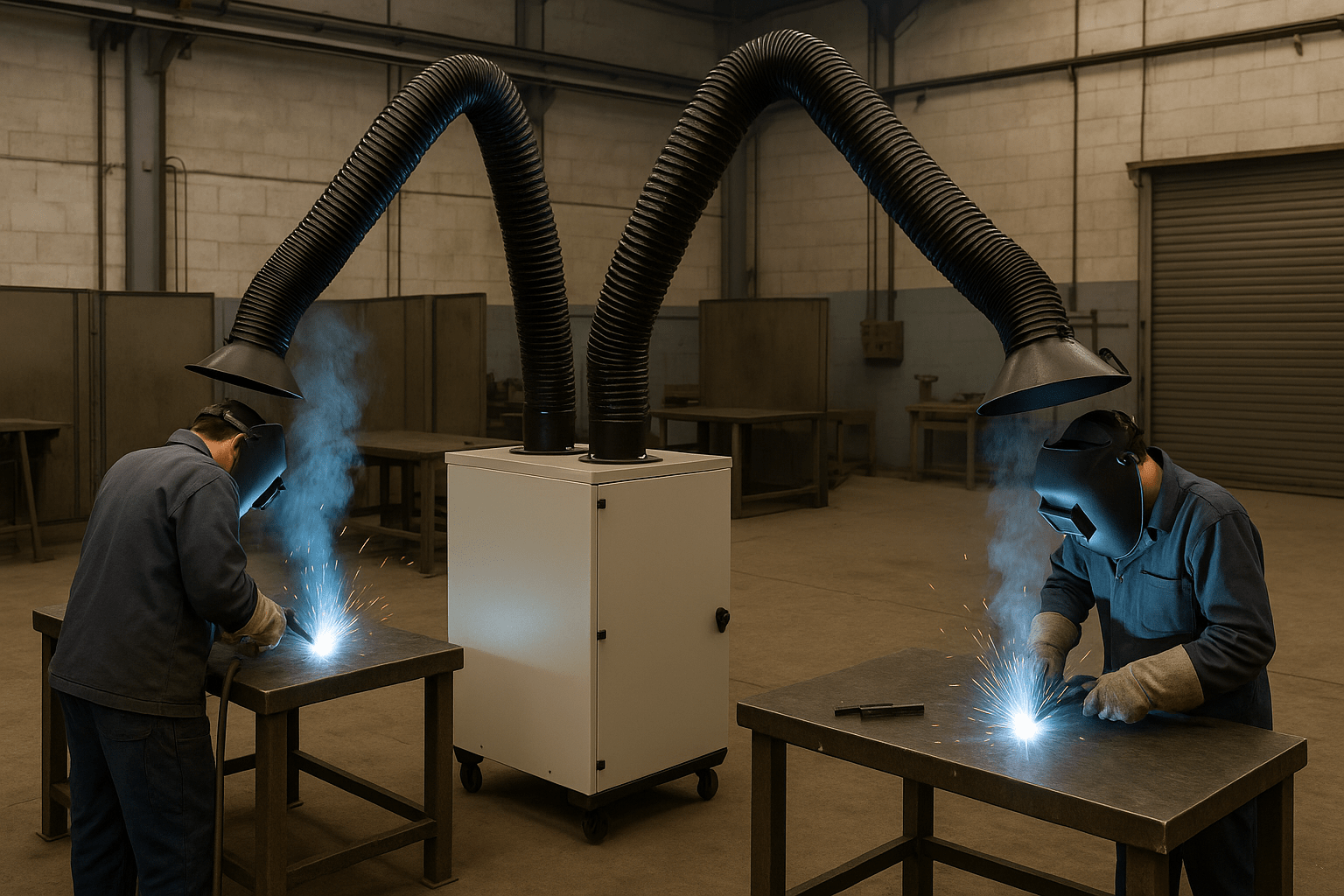
Why Multi-Station Areas Need Strong Fume Control
Modern workshops often run several welding, soldering, or machining stations side by side. While this improves productivity, it also increases the concentration of fumes in one shared space. If the fumes are not controlled properly, they spread across stations and affect every worker in the area.
Multi-station layouts make fume extraction systems more complex because each workstation generates pollutants at different rates. Without the right system, fumes mix, visibility drops, and air quality declines quickly.
Key Challenges in Multi-Station Fume Control
1. High Volume of Pollutants
When several welding or soldering stations operate at the same time, the total amount of fumes released into the workspace rises sharply. A single system may struggle to capture fumes from all points.
2. Uneven Fume Distribution
Some stations produce more fumes than others. For example, MIG welding releases heavier fumes than soldering. This uneven load makes centralized extraction difficult.
3. Limited Space for Ducting or Hoods
Multi-station lines often have compact layouts. Installing large ducts or fixed hoods is not always practical. Portable arms or extractors are needed but require careful positioning.
4. Worker Movement and Workflow Interruptions
Operators move frequently between stations. If extractor arms are in the way, workers may shift them, reducing capture efficiency.
5. Noise and Airflow Imbalance
When several extraction points connect to one system, airflow can drop at certain points. This lowers capture efficiency and increases noise.
Effective Solutions for Multi-Station Fume Control
1. Use of Portable or Semi-Portable Fume Extractors
Units like the FumeKiller® from Powertech Pollution Controls allow flexible placement near each station. These extractors provide strong suction without major ducting.
2. Twin Flexible Extractor Arms
A single extractor with two arms can cover two nearby stations. This reduces cost and space while maintaining strong source capture.
3. Local Exhaust Ventilation (LEV)
LEV systems capture pollutants before they spread. Flexible arms or drop-down hoods ensure targeted capture.
4. Zoning and Airflow Planning
Dividing the workshop into zones helps balance airflow and maintain steady extraction capacity.
5. Electrostatic Filtration for High Efficiency
Electrostatic systems handle fine welding and soldering fumes better than mechanical filters. They also reduce maintenance costs.
Q&A: Common Questions About Multi-Station Fume Control
Q1: Why do fume problems increase in multi-station areas?
Multiple sources release fumes at the same time. Without proper extraction, pollutants accumulate faster than they disperse.
Q2: Can one fume extractor serve two or more stations?
Yes. Models with twin flexible arms can handle two stations. The actual capacity depends on the extraction volume required.
Q3: What type of extractor works best in multi-station welding areas?
A welding fume extractor with electrostatic filtration works best. It captures fine metal fumes and offers steady airflow.
Q4: Who manufactures reliable multi-station extraction systems in India?
Powertech Pollution Controls, a leading fume extractor manufacturer in Bangalore, provides welding fume extractors, soldering fume extractors, dust collectors, and mist collectors for multi-station layouts.
Conclusion
Multi-station work areas present unique challenges for fume control due to higher pollutant loads, limited space, and frequent worker movement. The right extraction system can solve these issues by targeting fumes at the source, balancing airflow, and reducing maintenance.As a trusted fume extractor manufacturer in India, Powertech Pollution Controls offers reliable and CPCB-compliant solutions that keep multi-station welding, soldering, and machining areas safe and productive.