
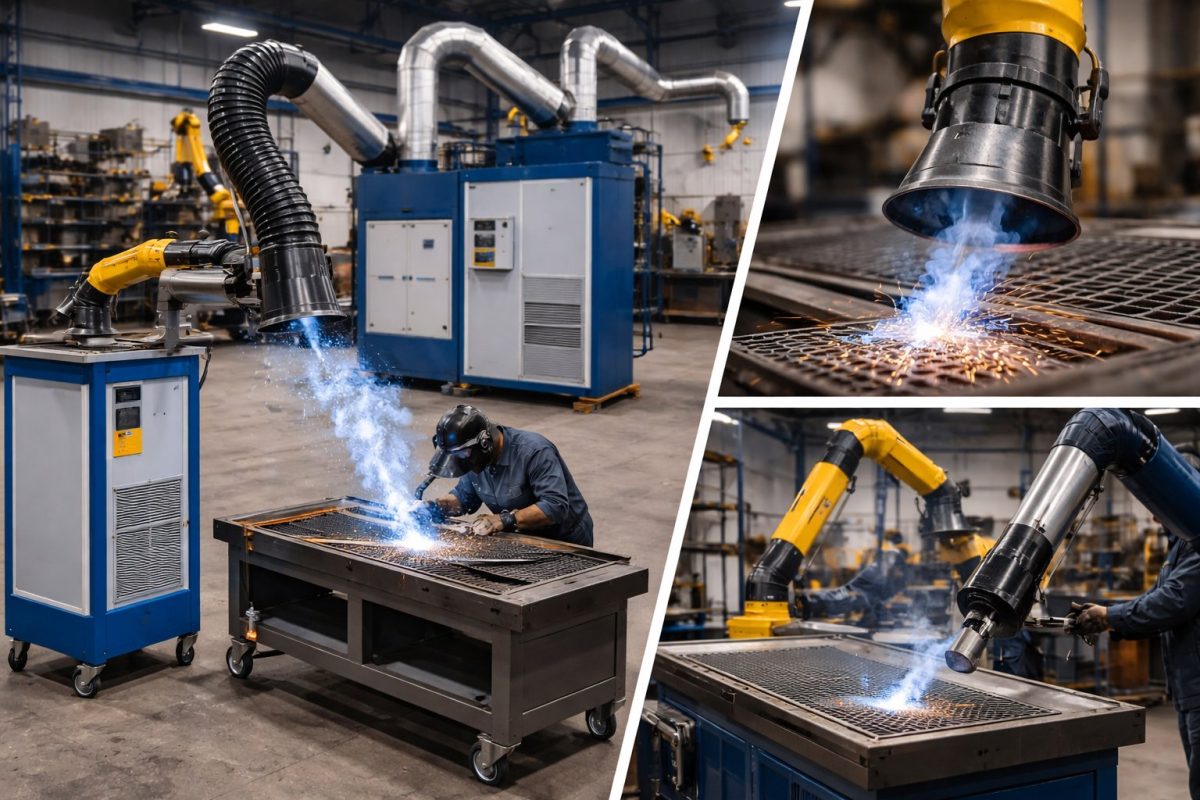
Types of Welding Fume Extraction Systems Used in Manufacturing
Introduction
Welding operations across manufacturing industries generate airborne contaminants in the form of metal fumes, gases, and ultrafine particulate matter. These emissions, if not properly controlled, can accumulate within the workspace and expose workers to hazardous substances. In high-production environments such as fabrication shops, automotive plants, and heavy engineering facilities, managing welding fumes is not just a compliance requirement—it is a critical engineering necessity.
Different manufacturing setups require different approaches to fume control. A small fabrication shop with manual welding stations will have very different requirements compared to a large automotive plant with robotic welding lines. As a result, selecting the correct types of welding fume extractor becomes essential for effective air quality management.
Modern industrial fume extraction systems are designed to capture fumes at the source, filter contaminants efficiently, and maintain safe working conditions. This article provides a detailed breakdown of the various types of welding fume extraction systems used in manufacturing and their practical applications.
Key Takeaways
- Different types of welding fume extractor are suited for specific manufacturing environments and welding processes.
- Portable welding fume extractor units are ideal for flexible, multi-station fabrication setups.
- Centralized welding fume extraction systems are used in large-scale industrial operations with multiple welding points.
- Proper system selection depends on airflow requirements, workspace layout, and welding intensity.
The Problem: Variability in Welding Environments
Welding fumes behave differently depending on the process, material, and workspace conditions. A one-size-fits-all approach to fume extraction often results in ineffective control.
Causes of Inefficient Fume Control
- Variation in welding processes (MIG, TIG, arc welding)
- Multiple welding stations operating simultaneously
- Differences in shop layout and enclosure levels
- Inconsistent airflow distribution
- Improper selection of extraction systems
Workplace Impact
- Uneven air quality across different zones
- Smoke accumulation in poorly ventilated areas
- Increased maintenance due to dust deposition
- Reduced operational efficiency
Safety Risks
Welding fumes can contain hazardous substances such as manganese, chromium, and nickel compounds.
According to Occupational Safety and Health Administration (OSHA), prolonged exposure to welding fumes can lead to respiratory issues and long-term health effects.
Similarly, the National Institute for Occupational Safety and Health (NIOSH) highlights that welding fumes may cause lung irritation, metal fume fever, and neurological effects depending on exposure levels.
These risks make it essential to select the appropriate types of welding fume extractor for each application.
Technical Overview: How Different Systems Work
All industrial fume extraction systems follow the same fundamental principle:
- Capture fumes at or near the source
- Convey contaminated air through ducting or internal channels
- Filter particulate matter using high-efficiency filters
- Discharge or recirculate clean air
However, the design and configuration vary depending on the type of system.
Types of Welding Fume Extractor Systems
1. Portable Welding Fume Extractor
A portable welding fume extractor is a compact, mobile unit equipped with a flexible extraction arm.
Key Features:
- Mounted on wheels for easy movement
- Integrated fan and filtration system
- Flexible arm for localized extraction
- Suitable for small to medium workshops
Typical Applications:
- Fabrication shops
- Maintenance welding
- Job shops with variable layouts
Advantages:
- High flexibility
- Low installation cost
- Easy to reposition
Limitations:
- Limited airflow capacity
- Not ideal for multiple simultaneous welding stations
2. Centralized Welding Fume Extraction System
A centralized welding fume extraction system connects multiple welding stations to a single high-capacity filtration unit through ducting.
Key Features:
- Central filtration unit
- Duct network connecting multiple stations
- High airflow capacity
- Suitable for continuous operations
Typical Applications:
- Automotive manufacturing plants
- Heavy engineering facilities
- Large fabrication units
Advantages:
- Handles multiple welding stations
- Consistent air quality across facility
- Lower maintenance per station
Limitations:
- Higher initial investment
- Requires proper duct design and balancing
3. Fixed Extraction Arm Systems
These systems use stationary welding extraction arms mounted at specific welding stations.
Key Features:
- Mounted on walls or workbenches
- Adjustable arm positioning
- Connected to either portable or centralized systems
Applications:
- Dedicated welding stations
- Repetitive production processes
Advantages:
- Consistent positioning
- Better capture efficiency than general ventilation
4. Downdraft Tables
Downdraft tables pull fumes downward through perforated surfaces.
Key Features:
- Integrated extraction surface
- Suitable for welding and grinding
- Built-in filtration system
Applications:
- Small components
- Grinding and finishing operations
Advantages:
- Dual-purpose (welding + grinding)
- Effective for small parts
5. On-Torch Extraction Systems
These systems integrate extraction directly into the welding torch.
Key Features:
- Captures fumes extremely close to source
- Minimal dispersion
- Compact design
Applications:
- High-precision welding
- Automated or robotic welding
Advantages:
- Highest capture efficiency
- Minimal environmental contamination
Comparison of Welding Fume Extraction Systems
|
System Type |
Mobility |
Airflow Capacity |
Suitable for Multiple Stations |
Typical Use Case |
|
Portable extractor |
High |
Low–Medium |
No |
Small fabrication shops |
|
Centralized system |
Low |
High |
Yes |
Large industrial plants |
|
Extraction arm |
Medium |
Medium |
Limited |
Fixed welding stations |
|
Downdraft table |
Low |
Medium–High |
No |
Small part welding |
|
On-torch system |
High |
Low |
No |
Precision welding |
Practical Industrial Applications
Automotive Manufacturing
Automotive plants typically use centralized welding fume extraction systems to manage fumes from robotic welding lines. These systems ensure consistent air quality across production areas.
Fabrication Shops
Fabrication shops often rely on portable welding fume extractor units combined with extraction arms. This allows flexibility for different workpieces and layouts.
Electronics Manufacturing
In electronics production, compact extraction systems or on-torch extraction are used to handle fine fumes generated during precision welding.
CNC and Equipment Manufacturing
CNC shops integrate localized extraction systems to prevent contamination of precision machining processes.
Expert Insight
With over 30 years of experience in industrial air pollution control, Powertech has observed that incorrect system selection is one of the most common issues in fabrication environments.
In many cases, facilities invest in high-capacity centralized systems without proper duct design, resulting in uneven airflow distribution. Conversely, smaller workshops often rely on inadequate portable units for high-load applications.
A practical approach involves:
- Matching system type to welding intensity
- Ensuring proper airflow balancing
- Designing for scalability
In several installations across fabrication and engineering industries, optimized system design has significantly improved capture efficiency without increasing energy consumption.
Frequently Asked Questions
The main types include portable extractors, centralized systems, extraction arms, downdraft tables, and on-torch extraction systems.
A portable welding fume extractor is typically the most suitable due to its flexibility and ease of use.
Centralized systems are ideal for facilities with multiple welding stations and continuous production processes.
Yes, they are effective for small components and combined welding and grinding operations.
On-torch extraction provides the highest efficiency as it captures fumes directly at the source.
Conclusion
Selecting the right types of welding fume extractor is essential for maintaining safe and efficient industrial environments. Each system type—whether portable, centralized, or integrated—offers specific advantages depending on the application.
Modern industrial fume extraction systems are designed to address the diverse needs of manufacturing facilities, ensuring effective fume capture and filtration. By understanding the strengths and limitations of each system, industries can implement solutions that enhance air quality, protect worker health, and improve overall operational efficiency.
With decades of experience in designing customized air pollution control systems, Powertech continues to emphasize the importance of application-specific engineering in achieving effective welding fume control.