
Introduction
Fabrication shops rely heavily on welding processes such as MIG, TIG, and arc welding to manufacture structural components, assemblies, and custom metal products. While these processes are essential to production, they generate significant amounts of welding fumes consisting of fine metal particles and gases. In enclosed or semi-enclosed fabrication environments, these contaminants can quickly accumulate, affecting air quality and worker safety.
Unlike large automated plants, fabrication shops often operate with flexible layouts, multiple workstations, and varying workloads. This makes fume control more complex and requires carefully engineered solutions rather than generic ventilation approaches.
A properly designed welding fume extractor for fabrication shops ensures that fumes are captured at the source, preventing them from spreading into the workspace. By implementing effective fabrication shop ventilation strategies and using appropriate fume extraction system for welding, operators can maintain safe working conditions, improve productivity, and meet regulatory requirements.
Key Takeaways
- A welding fume extractor for fabrication shops must be flexible to handle varying layouts and workloads.
- Source capture is more effective than general ventilation in controlling welding fumes.
- Proper airflow and hood positioning are critical for effective industrial welding extraction.
- Customized system design improves both safety and operational efficiency.
The Problem: Fume Accumulation in Fabrication Shops
Fabrication shops often operate in dynamic environments where multiple welding activities occur simultaneously. Without proper extraction, fumes accumulate quickly.
Causes
- Multiple welding stations operating in confined areas
- Frequent movement of workpieces and operators
- Lack of localized extraction systems
- Inadequate airflow distribution
- Use of general ventilation instead of source capture
Workplace Impact
- Reduced visibility due to smoke buildup
- Discomfort for workers
- Contamination of nearby equipment
- Increased maintenance requirements
Safety Risks
Welding fumes can contain hazardous metals and gases.
According to the Occupational Safety and Health Administration (OSHA), exposure to welding fumes may lead to respiratory irritation, metal fume fever, and long-term health effects.
The National Institute for Occupational Safety and Health (NIOSH) also highlights that prolonged exposure can affect lung function and overall worker health.
These risks make it essential to implement an effective fume extraction system for welding in fabrication environments.
Technical Explanation: How Welding Fume Extraction Works in Fabrication Shops
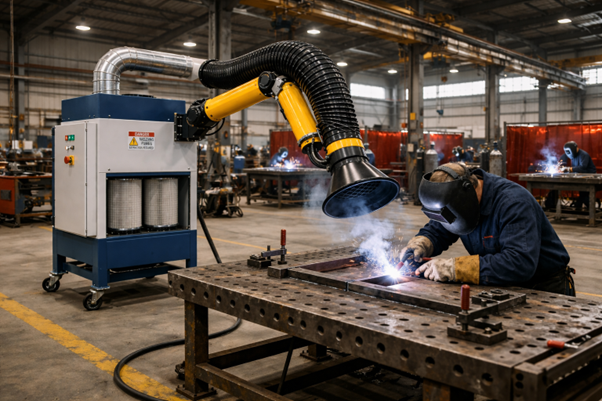
A welding fume extractor for fabrication shops is designed to capture fumes directly at the source and remove contaminants efficiently.
Step 1: Source Capture
Extraction arms or hoods are positioned close to the welding arc.
- Typically within 150–300 mm
- Prevents fumes from entering the breathing zone
Step 2: Airflow Generation
A fan creates negative pressure to draw fumes into the system.
- Ensures consistent capture
- Maintains airflow direction toward the extractor
Step 3: Air Conveyance
Captured air is transported through ducts or extraction arms.
- Smooth duct design reduces pressure loss
- Balanced airflow improves system efficiency
Step 4: Filtration
Air passes through multiple filtration stages:
- Pre-filters for larger particles
- Cartridge filters for fine particulates
- Optional HEPA filters for high-efficiency capture
Step 5: Clean Air Discharge
Filtered air is either recirculated or exhausted safely.
Typical Design Parameters for Fabrication Shop Ventilation
|
Parameter |
Recommended Range |
Remarks |
|
Capture distance |
150 – 300 mm |
Critical for efficiency |
|
Airflow per arm |
800 – 1500 m³/hr |
Depends on welding process |
|
Capture velocity |
0.5 – 1.5 m/s |
Ensures effective capture |
|
Static pressure |
800 – 1500 Pa |
Based on duct design |
|
Filter efficiency |
Up to 99% |
Multi-stage filtration |
Proper design ensures consistent performance of the welding fume extractor for fabrication shops.
Practical Industrial Applications
Small Fabrication Shops
Small shops typically use portable extraction units.
- Flexible positioning
- Suitable for low to medium workloads
- Easy installation
Medium Fabrication Units
Medium-scale facilities often use a combination of portable units and fixed extraction arms.
- Improved coverage
- Better airflow control
- Adaptable to changing layouts
Large Fabrication Facilities
Large facilities may implement centralized systems.
- Handles multiple stations
- Ensures uniform air quality
- Suitable for continuous operations
Custom Fabrication Environments
Custom fabrication setups require tailored solutions.
- Variable workpiece sizes
- Irregular layouts
- Need for flexible extraction systems
Expert Insight
With over 30 years of experience, Powertech has observed that fabrication shops often underestimate the importance of system design. Many rely on general ventilation or undersized extraction units, which fail to capture fumes effectively.
In several fabrication environments, simply repositioning extraction arms and optimizing airflow has resulted in significant improvements in air quality without increasing system capacity.
Key practical recommendations:
- Prioritize source capture over dilution
- Ensure proper hood positioning
- Design systems based on actual workload, not assumptions
In real-world installations, customized industrial welding extraction solutions consistently outperform standard setups.
The best system depends on shop size and workload. Portable units are ideal for small shops, while centralized systems suit larger operations.
It prevents fumes from spreading into the workspace, improving air quality and worker safety.
Yes, centralized systems can connect multiple stations through ducting.
Filter replacement depends on usage and dust load. Monitoring pressure drop is the best indicator.
– Hood positioning
– Airflow rate
– Filter condition
– System design
Conclusion
Fabrication shops present unique challenges for welding fume control due to their dynamic layouts and varying workloads. General ventilation alone is not sufficient to manage airborne contaminants effectively.
A well-designed welding fume extractor ensures efficient source capture, improves air quality, and protects worker health. By implementing tailored fabrication shop ventilation strategies and using the right fume extraction system for welding, industries can achieve safer and more efficient operations.
With decades of experience in designing industrial air pollution control systems, Powertech continues to emphasize the importance of customized engineering solutions for effective welding fume extraction in fabrication environments.