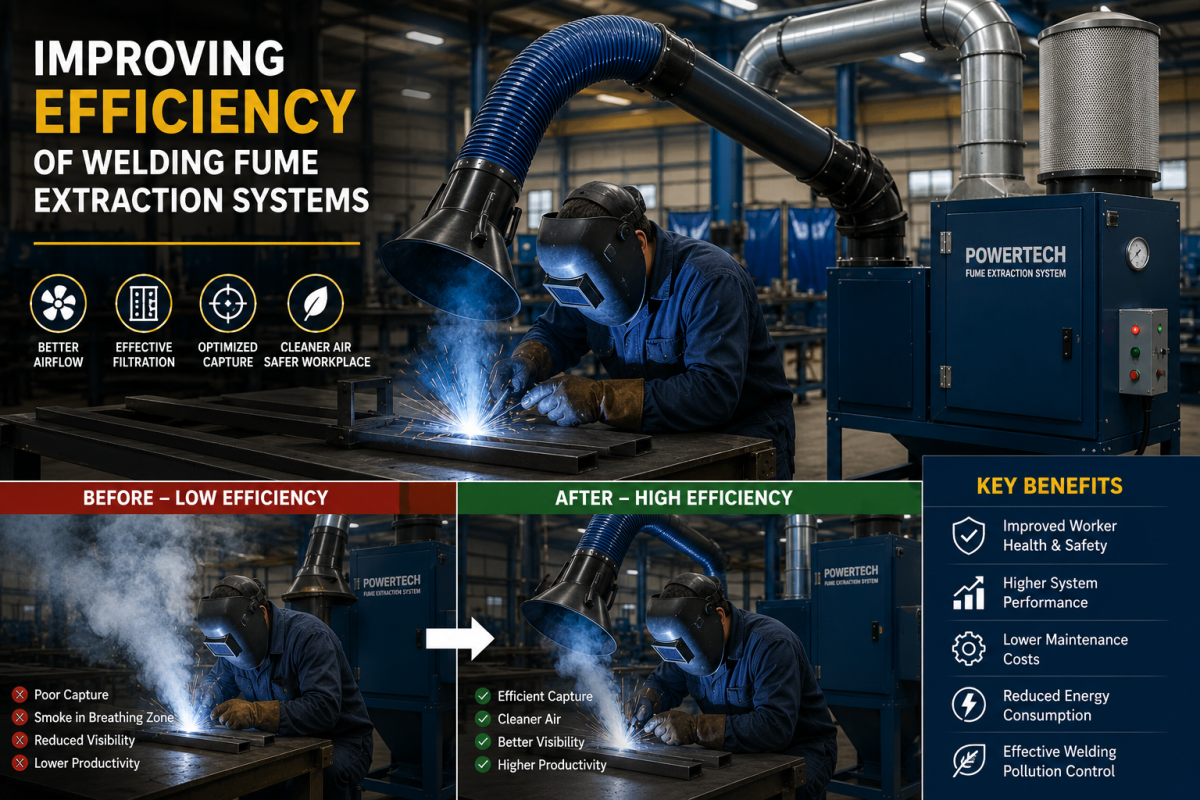
Improving Efficiency of Welding Fume Extraction Systems

Introduction

Installing a welding fume extraction system is only the first step toward maintaining clean and safe industrial environments. In many facilities, systems operate below their intended performance due to airflow imbalance, poor hood positioning, clogged filters, or improper maintenance practices. As a result, fumes escape into the workspace despite the presence of extraction equipment.

Improving the efficiency of a welding fume extractor requires a combination of proper engineering design, operational optimization, and preventive maintenance. Even small adjustments in airflow, duct layout, or extraction arm positioning can significantly enhance overall system performance.

An optimized approach to welding pollution control not only improves air quality but also reduces energy consumption and maintenance costs. With over 30 years of experience, Powertech has improved fume extraction system performance across fabrication shops, automotive manufacturing facilities, and heavy engineering industries through practical engineering-driven optimization strategies.

Key Takeaways

  1. Proper source capture is the most important factor in welding fume extraction efficiency.
  2. Airflow balancing and duct optimization significantly improve system performance.
  3. Regular maintenance prevents efficiency loss over time.
  4. Optimized systems improve both air quality and energy efficiency.

The Problem: Reduced System Efficiency

Many extraction systems gradually lose performance due to operational and maintenance issues.

Causes

  1. Incorrect extraction arm positioning
  2. Insufficient airflow at capture points
  3. Poor duct design and pressure losses
  4. Clogged or overloaded filters
  5. Lack of preventive maintenance

Workplace Impact

  1. Visible welding fumes in the workspace
  2. Reduced visibility and operator comfort
  3. Higher energy consumption
  4. Increased downtime and maintenance costs

Safety Risks

According to the Occupational Safety and Health Administration (OSHA), inadequate welding ventilation may expose workers to hazardous airborne contaminants.

The National Institute for Occupational Safety and Health (NIOSH) recommends proper ventilation and source capture methods for effective welding fume control.

Technical Explanation: How to Improve System Efficiency

Step 1: Optimize Source Capture

Effective source capture is the foundation of system efficiency.

Best Practices

  1. Position extraction arms 150–300 mm from the arc
  2. Align hood with rising fume direction
  3. Avoid airflow obstruction by the operator

Proper positioning improves capture without increasing airflow.

Step 2: Balance Airflow Across the System

Uneven airflow reduces performance in multi-point systems.

Optimization Methods

  1. Adjust dampers
  2. Measure airflow at all stations
  3. Ensure consistent suction levels

Balanced systems deliver more reliable performance.

Step 3: Improve Duct Design

Poor duct layouts increase pressure losses.

Recommended Improvements

  1. Reduce sharp bends
  2. Maintain proper duct velocity (12–17 m/s)
  3. Shorten unnecessary duct runs

Better duct design improves airflow efficiency.

Step 4: Maintain Filtration Systems

Filter condition directly affects airflow and extraction performance.

Maintenance Actions

  1. Monitor pressure drop
  2. Replace clogged filters
  3. Clean filters and ducting regularly

Delayed maintenance is a major cause of performance decline.

Step 5: Monitor System Performance

Continuous monitoring helps identify problems early.

Parameters to Monitor

  1. Airflow
  2. Static pressure
  3. Filter pressure drop
  4. Fan performance

Data-driven maintenance improves reliability.

Key Parameters Affecting Efficiency

ParameterRecommended RangeImpact
Hood distance150 – 300 mmSource capture efficiency
Capture velocity0.5 – 1.5 m/sFume control effectiveness
Duct velocity10 – 15 m/sPrevents dust settling
Filter pressure dropWithin design rangeMaintains airflow
Airflow balanceUniform across stationsConsistent performance

Practical Industrial Applications

Fabrication Shops

  1. Frequent repositioning of extraction arms
  2. Need for flexible airflow balancing

Automotive Manufacturing

  1. Centralized systems requiring precise balancing
  2. Robotic welding with consistent airflow demands

Maintenance Workshops

  1. Portable systems dependent on operator positioning

Heavy Engineering

  1. High particulate load requiring optimized filtration and airflow

Expert Insight

From Powertech’s field experience, one of the most effective ways to improve welding fume extraction efficiency is through system optimization rather than equipment replacement.

Key observations:

  1. Poor positioning often causes greater efficiency loss than insufficient airflow
  2. Regular airflow measurements reveal hidden performance issues
  3. Preventive maintenance significantly improves long-term performance

In several installations, optimizing airflow distribution and hood positioning improved system efficiency without increasing fan capacity.

How can welding fume extraction efficiency be improved?

By optimizing hood positioning, balancing airflow, improving duct design, and maintaining filters regularly.

Does higher airflow always improve performance?

No. Proper source capture and system design are equally important.

Why does system performance decline over time?

Due to clogged filters, airflow imbalance, and lack of maintenance.

How often should airflow be checked?

Regular inspections and airflow measurements are recommended.

Can existing systems be improved without replacement?

Yes. Many systems can be optimized through design corrections and maintenance.

Conclusion

Improving welding fume extraction efficiency requires a comprehensive approach that combines proper source capture, optimized airflow, effective filtration, and preventive maintenance. By focusing on fume extraction system performance and implementing engineering-driven improvements, industries can achieve better welding pollution control, improved air quality, and lower operational costs. With decades of experience, Powertech continues to help industries optimize welding ventilation systems for reliable, efficient, and long-term performance.
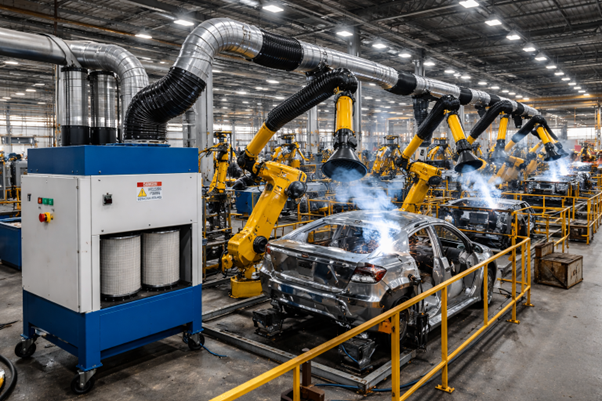
welding fume extraction system in automotive manufacturing plant capturing fumes at source

Welding Fume Extraction in the Automotive Industry

Introduction

Automotive manufacturing is one of the most welding-intensive industries, involving processes such as robotic spot welding, MIG welding, and arc welding across body shops, chassis assembly lines, and component fabrication units. These processes generate large volumes of welding fumes containing fine metal particulates and gases, which can quickly accumulate in enclosed production environments.

Unlike small fabrication shops, automotive plants operate at high production speeds with multiple welding stations functioning simultaneously. Without proper control, fumes can spread across large shop floors, affecting air quality, worker safety, and equipment performance.

A well-engineered welding fume extraction automotive industry solution is essential to capture contaminants at the source and maintain a safe working environment. By implementing effective automotive welding ventilation and advanced welding pollution control systems, manufacturers can ensure compliance with safety standards while maintaining production efficiency.

With over 30 years of experience, Powertech has worked with manufacturing environments where high-volume welding requires robust and scalable air pollution control solutions tailored to industrial demands.


Key Takeaways

  • Welding fume extraction automotive industry solutions must handle high-volume, continuous welding operations.
  • Source capture combined with centralized systems ensures effective automotive welding ventilation.
  • Robotic welding cells require specialized extraction designs for consistent performance.
  • Proper system design improves air quality, worker safety, and production efficiency.


The Problem: High-Volume Welding in Automotive Plants

Automotive manufacturing environments involve continuous welding across multiple stations, often within enclosed or semi-enclosed areas.

Causes

  • High-density welding operations across production lines
  • Continuous robotic welding processes
  • Enclosed welding cells with limited natural ventilation
  • Large-scale production layouts
  • Inadequate airflow balancing in centralized systems

Workplace Impact

  • Accumulation of fumes across large shop floors
  • Reduced visibility in welding zones
  • Contamination of equipment and surfaces
  • Increased maintenance requirements

Safety Risks

Welding fumes in automotive plants can contain hazardous metals and compounds.
According to the Occupational Safety and Health Administration (OSHA), exposure to welding fumes may lead to respiratory issues and long-term health effects.

The World Health Organization (WHO) states that prolonged exposure to airborne particulate matter can result in chronic respiratory diseases and reduced lung function.

Given the scale of operations, effective welding pollution control is critical in automotive manufacturing.


Technical Explanation: How Welding Fume Extraction Works in Automotive Manufacturing

A welding fume extraction automotive industry system is designed to handle large volumes of contaminants efficiently.

Step 1: Source Capture

Extraction hoods or enclosures are integrated into robotic welding cells.

  • Captures fumes directly at the welding arc
  • Prevents dispersion into surrounding areas

Step 2: Airflow Generation

High-capacity fans generate strong airflow.

  • Ensures consistent capture across multiple stations
  • Maintains proper ventilation across large areas

Step 3: Air Conveyance

Ducting networks transport contaminated air to centralized systems.

  • Requires precise engineering to balance airflow
  • Minimizes pressure losses

Step 4: Filtration

Air passes through industrial filtration systems:

  • Cartridge filters for fine particulate removal
  • High-efficiency filters for critical applications

Step 5: Clean Air Discharge

Filtered air is either:

  • Recirculated within the facility
  • Or discharged externally in compliance with standards


Typical Design Parameters in Automotive Welding Ventilation

Parameter

Recommended Range

Remarks

Airflow per station

1000 – 2500 m³/hr

Depends on welding intensity

Capture velocity

0.8 – 1.5 m/s

Higher for robotic welding

Duct velocity

10 – 15 m/s

Prevents particle settling

Static pressure

1200 – 2000 Pa

For large centralized systems

Filter efficiency

Up to 99%

Multi-stage filtration

Proper system design is essential for effective industrial welding fume extractor performance.


Practical Industrial Applications

Automotive Body Shops

Body shops use robotic welding cells for assembling vehicle frames.

  • Enclosed systems with integrated extraction
  • High-capacity centralized systems
  • Continuous operation

Chassis Manufacturing

Chassis fabrication involves heavy welding operations.

  • Combination of local extraction and centralized systems
  • High airflow requirements

Component Manufacturing

Smaller components are welded in dedicated stations.

  • Local extraction arms
  • Flexible ventilation systems

Assembly Lines

Final assembly areas may include spot welding and minor welding operations.

  • Localized extraction systems
  • Supplementary ventilation

Expert Insight

Based on Powertech’s experience in industrial air pollution control, automotive plants often face challenges related to airflow balancing in centralized systems.

A common issue is uneven extraction across multiple stations, where some areas receive adequate airflow while others remain under-ventilated. This is typically due to poor duct design or lack of system optimization.

Practical recommendations include:

  • Design ducting networks with proper balancing
  • Integrate extraction into robotic cells
  • Regularly monitor airflow performance

In several automotive installations, optimizing airflow distribution has significantly improved system efficiency without increasing energy consumption.

Frequently Asked Questions


Why is welding fume extraction important in automotive manufacturing?

It prevents the accumulation of hazardous fumes, ensuring worker safety and maintaining air quality in high-production environments.

What type of system is used in automotive welding ventilation?

Centralized systems combined with localized extraction are commonly used.

How are robotic welding cells ventilated?

Extraction hoods or enclosures are integrated into the cells to capture fumes directly at the source.

Can welding fumes affect equipment?

Yes, fumes can settle on machinery, leading to contamination and increased maintenance.

What factors affect system performance?

– Airflow distribution
– Duct design
– Filter efficiency
– System maintenance

Conclusion

Automotive manufacturing presents unique challenges for welding fume control due to high production volumes and continuous operations. General ventilation alone is insufficient to manage airborne contaminants effectively.A properly designed welding fume extraction automotive industry system ensures efficient source capture, improves air quality, and protects worker health. By implementing advanced automotive welding ventilation and reliable welding pollution control solutions, manufacturers can achieve safer, cleaner, and more efficient production environments.

With decades of experience, Powertech continues to deliver customized solutions that address the complex requirements of automotive welding operations, ensuring optimal performance and long-term reliability.