
Introduction
Selecting the correct mist collector is one of the most important decisions when designing an effective air pollution control system for CNC machining operations. An undersized unit may fail to capture airborne coolant mist efficiently, while an oversized system can increase energy consumption and operating costs without providing additional benefits.
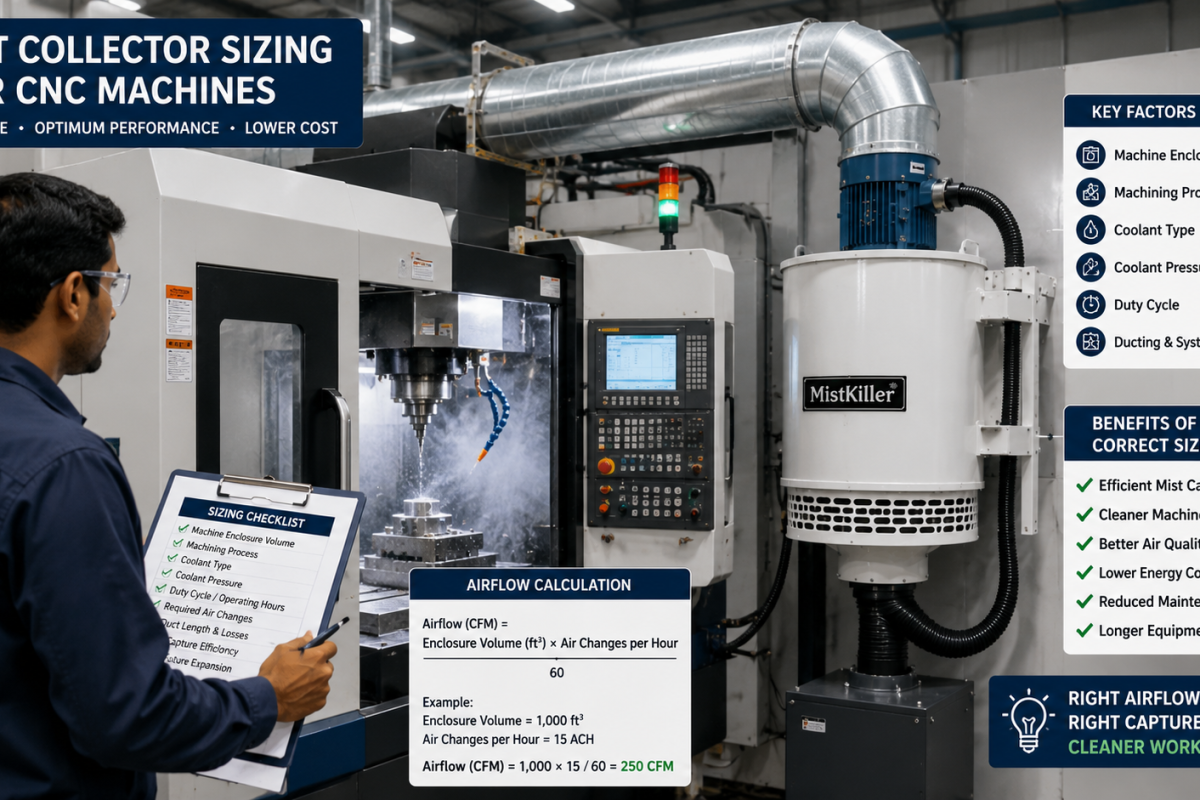
Proper mist collector sizing requires evaluating several factors, including machine enclosure volume, coolant type, machining process, airflow requirements, and production intensity. A well-designed system ensures adequate CNC mist extraction airflow, maintains cleaner machine enclosures, and supports effective machine shop ventilation design.
Whether the application involves turning, milling, grinding, or multi-axis machining, understanding oil mist collector airflow requirements helps manufacturers improve air quality, reduce maintenance, and extend equipment life.
With over 30 years of experience in industrial air pollution control, Powertech engineers customized mist collection systems that deliver optimal performance while minimizing operating costs for machining facilities.
Key Takeaways
- Mist collector sizing should be based on machine characteristics, not just machine horsepower.
- Airflow requirements vary depending on machining process and coolant type.
- Proper CNC mist extraction airflow improves collection efficiency and equipment cleanliness.
- Oversized systems waste energy, while undersized systems reduce extraction performance.
- Professional airflow calculations ensure reliable long-term operation.
Why Mist Collector Sizing Matters
Every CNC machine produces different volumes of airborne mist depending on the machining operation.
Incorrect sizing can lead to:
- Poor mist capture
- Residual oil deposits
- Reduced indoor air quality
- Increased maintenance
- Higher operating costs
Proper sizing balances extraction efficiency with energy consumption.
Factors That Influence Mist Collector Sizing
1. Machine Enclosure Size
The enclosure volume affects the amount of air that must be extracted.
Larger machining centers generally require greater airflow than compact CNC machines.
2. Machining Process
Different machining operations generate different mist levels.
Lower Mist Generation
- Drilling
- Light milling
- Precision finishing
Moderate Mist Generation
- CNC turning
- General milling
- Machining centers
High Mist Generation
- Grinding
- High-speed machining
- High-pressure coolant applications
3. Coolant Type
The characteristics of the machining fluid influence extraction requirements.
Water-Based Coolants
Typically produce coolant mist that responds well to centrifugal separation.
Oil-Based Lubricants
Often generate finer aerosols and may require higher-efficiency collection methods.
4. Coolant Pressure
Higher coolant pressure creates smaller airborne droplets, increasing mist concentration and airflow requirements.
5. Machine Duty Cycle
Machines operating continuously over multiple shifts generate greater cumulative mist loads than intermittently operated equipment.
Determining CNC Mist Extraction Airflow
Airflow is typically determined by considering:
- Machine enclosure volume
- Air changes required within the enclosure
- Mist generation rate
- Capture efficiency
- Duct losses
Rather than relying on a fixed airflow value for every machine, airflow should be engineered for each application to ensure efficient mist removal without creating unnecessary energy consumption.
Oil Mist Collector Airflow Considerations
An effective oil mist collection system should maintain sufficient airflow to:
- Capture airborne mist at the source
- Prevent mist leakage when machine doors open
- Maintain slight negative pressure within the enclosure
- Support continuous machining operations
Excessively high airflow may disturb machining conditions, while insufficient airflow reduces collection efficiency.
Machine Shop Ventilation Design Considerations
Mist collectors should complement—not replace—the overall ventilation strategy.
A complete machine shop ventilation design should include:
- Local source capture
- Proper make-up air
- General building ventilation
- Strategic equipment placement
- Maintenance access
This integrated approach improves overall air quality and operational efficiency.
Common Mist Collector Sizing Mistakes
Selecting by Machine Horsepower
Horsepower alone does not determine mist generation.
Ignoring Coolant Type
Oil-based and water-based coolants behave differently.
Oversizing the Collector
Larger systems consume more power and increase operating costs without proportional performance gains.
Undersizing the Collector
Insufficient airflow allows mist to escape into the workplace.
Ignoring Future Expansion
Production increases may require additional extraction capacity.
Powertech’s Engineering Approach
Powertech evaluates multiple parameters before recommending a mist collection solution.
These include:
- CNC machine type
- Enclosure dimensions
- Coolant characteristics
- Machining process
- Operating hours
- Airflow requirements
- Plant layout
This engineering-based approach ensures every MistKiller installation delivers reliable performance with optimal operating efficiency.
Expert Insight
From Powertech’s experience, one of the most common mistakes is selecting a mist collector based solely on airflow capacity listed in a product catalogue.
In practice, effective mist collection depends on the interaction between machine enclosure design, contaminant generation, duct routing, and extraction efficiency.
Proper engineering frequently delivers better results with a correctly sized collector than with a larger unit operating inefficiently.
Sizing depends on enclosure volume, machining process, coolant type, mist generation rate, and required airflow—not simply machine horsepower.
Machine size, coolant pressure, machining operation, enclosure design, and production intensity all influence airflow requirements.
Yes. Oversized systems increase energy consumption and operating costs without necessarily improving collection performance.
Proper airflow captures airborne mist before it escapes into the workplace while maintaining efficient machine enclosure ventilation.
Many facilities achieve the best results with dedicated machine-mounted mist collectors, although centralized systems may be appropriate for certain production layouts.
Yes. Powertech evaluates machine specifications, airflow requirements, coolant characteristics, and operating conditions to recommend appropriately sized MistKiller systems.
Proper mist collector sizing is essential for achieving efficient oil mist control in CNC machining operations. By considering CNC mist extraction airflow, oil mist collector airflow, machine enclosure characteristics, and overall machine shop ventilation design, manufacturers can improve air quality, reduce maintenance, and optimize operating costs. Rather than relying on standard airflow values, engineered sizing ensures that every mist collection system is matched to the specific machining application. With decades of expertise in industrial air pollution control, Powertech provides customized MistKiller solutions that deliver reliable, energy-efficient performance for modern manufacturing facilities.