
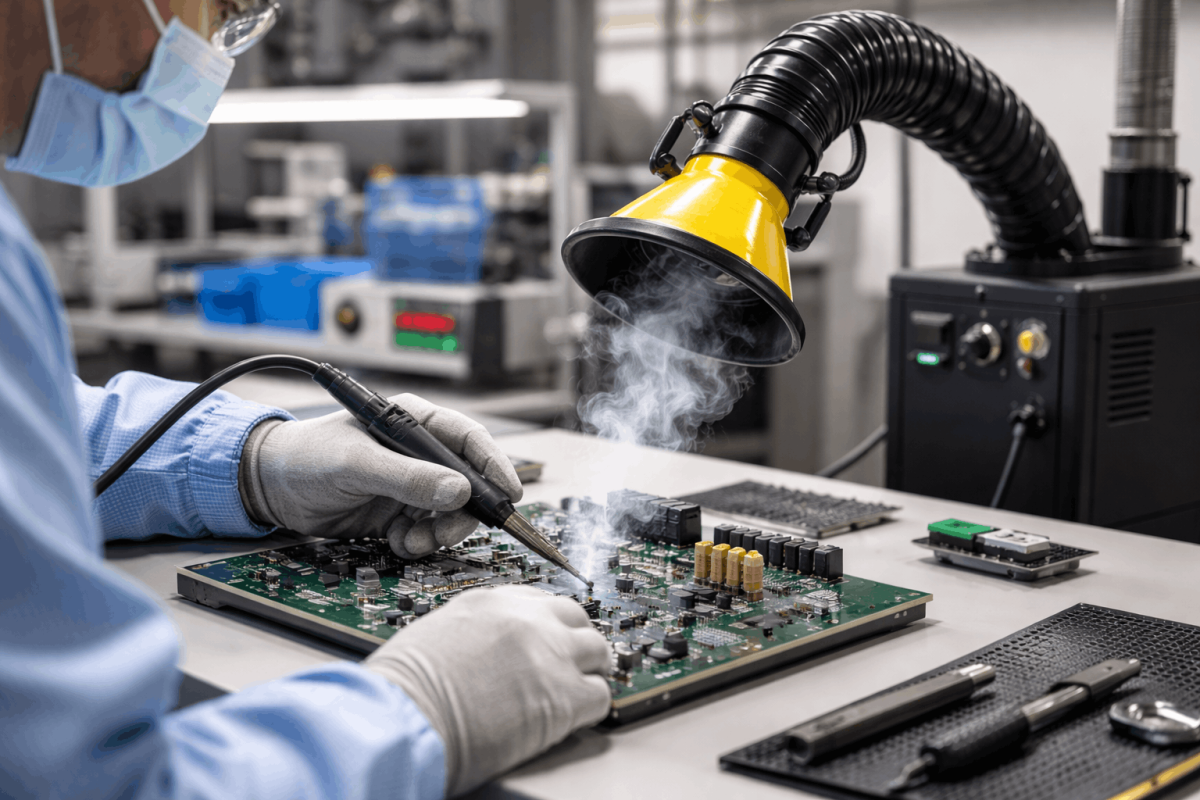
Lead-free soldering is now the norm in making electronics. It gets rid of lead from the process, but not the fumes.
In many cases, soldering without lead makes more smoke than soldering with lead. Higher melting points and active flux compounds make more fumes come out.
Facilities must manage fumes at the source to limit exposure and keep the quality of the product.
Why soldering without lead makes more fumes
Lead-free alloys melt at higher temperatures than solder that contains lead. This hotter heat:
- Increases the activation of flux
- Makes more thermal breakdown happen
- Makes fumes with tiny particles
The flux, not the metal itself, makes most of the fumes. When flux burns, it sends harmful particles into the air that go straight into the operator’s breathing zone.
Risks of Bad Fume Control
Operator Exposure
Fumes rise toward the face if they aren’t properly extracted. This can lead to:
- Irritation of the eyes
- Pain in the throat
- Headaches
- Less comfortable for the operator
Less visibility
It is harder to check if there is smoke around the solder joint:
- Wetting the pad
- Flow of solder
- Bridging problems
Clear visibility helps with accurate hand soldering and rework.
Contamination of Residue and Surface
When fumes spread across the workstation, residue settles on:
- Surfaces of PCBs
- Lenses for optical inspection
- Tools and fixtures
This has an impact on the quality of the product and how often it needs to be cleaned.
Source Capture Is the Best Method of Control
A soldering fume extractor that is in the right place catches fumes as soon as they come out of the solder joint.
Capture at the Tip
The extraction nozzle should be close to the soldering point but not get in the way of hand movement.
This keeps fumes from getting into the breathing zone.
Airflow that is controlled
Airflow needs to be strong enough to catch fumes, but not so strong that it cools the solder joint or changes the flow of solder.
Balanced airflow makes sure that:
- Temperature of soldering stays the same
- A clear line of sight
- Consistent joint formation
A lot of electronics companies require soldering fume extractor manufacturers to size their systems based on how many workstations there are and how much soldering they do.
Things to think about when laying out a workstation
There is more to fume control than just equipment.
Where to Put the Bench
Set up extraction units so that air flows away from the operator.
Don’t Let Cross Drafts Happen
Air conditioning or fans blowing across the bench can move fumes to the side and make it less effective at capturing them.
Planning for Multiple Stations
Central extraction systems may be better for balancing airflow in assembly lines with a lot of soldering stations than having a lot of separate units.
A correct layout makes things safer and more consistent.
Things to Keep an Eye on for Performance
To make sure that the fume control system works well:
- Make sure the air is flowing well often.
- Change the filters on time
- Check the connections between the ducts
- Watch the suction at the nozzle
Bad maintenance lowers the efficiency of capture and lets fumes spread again.
A Real-Life Example
In a PCB assembly unit that did manual soldering and rework, workers said there was a lot of smoke after they switched to lead-free solder.
After putting source capture extraction at each station:
- The air was clearer.
- Fewer complaints from operators
- The accuracy of inspections went up.
- Less frequent cleaning
The improvement came from putting the nozzles in the right places and balancing the airflow.
Q & A
Q1. Is the smoke from lead-free solder less dangerous than the smoke from leaded solder?
- They get rid of lead exposure, but they still need to control flux fumes.
Q2. What are the main sources of soldering fumes?
- Mostly from the flux that is used to solder.
Q3. Can extraction make the solder joint cooler?
- Yes, if the airflow is too strong. This won’t happen if the system is the right size.
Q4. Is portable extraction good enough for small labs?
- Yes, for work that doesn’t require a lot of volume. Larger assembly lines might need systems that are all in one place.
Conclusion:
Lead-free soldering makes materials safer, but it doesn’t get rid of fumes. Higher temperatures in the process often make more smoke.
Controlling fumes at the source keeps workers safe, makes it easier to see, and helps with the accuracy of solder joints.
A well-chosen soldering fume extractor, along with a well-organized and well-maintained workstation, keeps the air clean and production running smoothly.