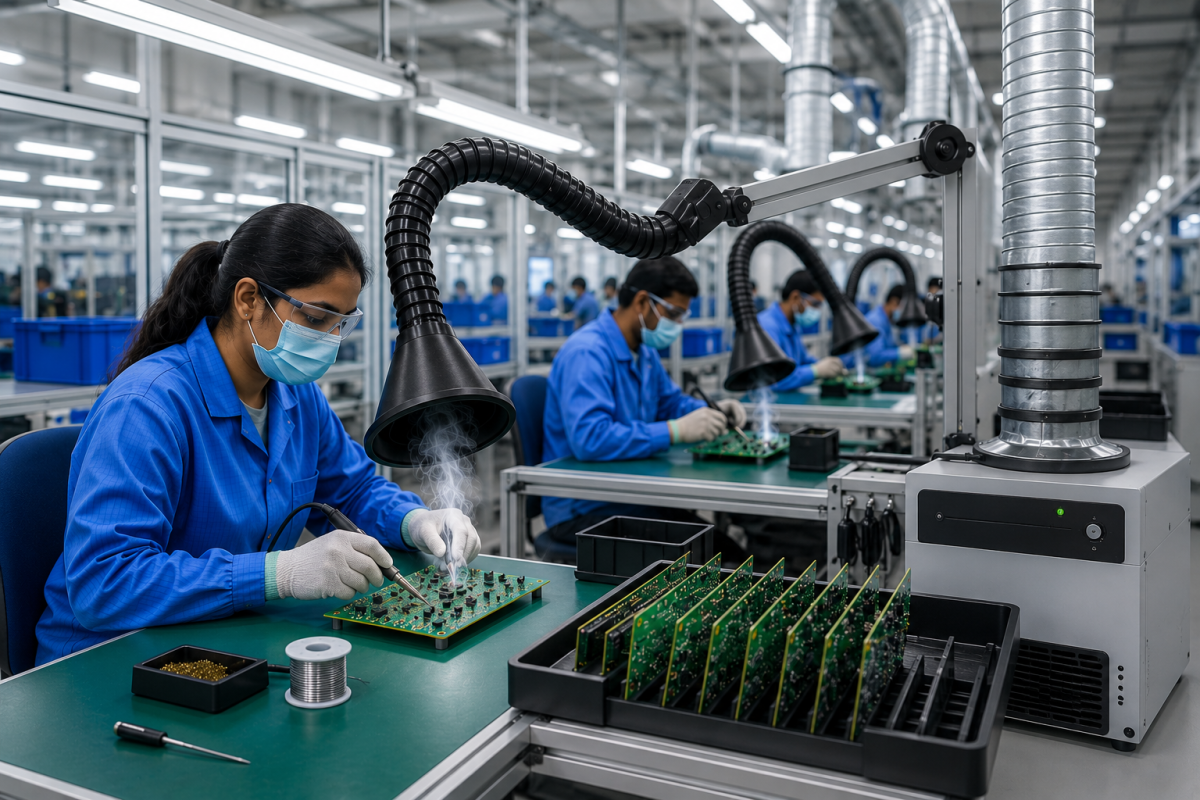
Best Practices for Soldering Fume Extraction in Electronics Plants

Introduction

Electronics manufacturing facilities rely heavily on soldering processes for PCB assembly, component installation, rework, and repair operations. While these processes are essential for production, they generate flux vapors, solder smoke, fine particulate matter, and volatile organic compounds (VOCs) that can compromise indoor air quality if not properly controlled.

Implementing effective soldering fume extraction systems is one of the most important steps in creating a safer and more productive manufacturing environment. Proper electronics factory ventilation not only protects operators from airborne contaminants but also improves visibility, reduces odors, and supports regulatory compliance.

Modern solder smoke extraction solutions combine source capture, multi-stage filtration, and optimized airflow to deliver reliable industrial electronics ventilation across assembly lines and workstations.

With more than 30 years of expertise in industrial air pollution control, Powertech has designed and implemented engineered ventilation solutions for electronics manufacturers across diverse production environments.

Key Takeaways

  1. Source capture is the most effective method for controlling soldering fumes.
  2. Extraction nozzles should be positioned close to the soldering point.
  3. Multi-stage filtration provides superior particulate and VOC removal.
  4. Regular maintenance is essential for maintaining extraction performance.
  5. Proper workstation design enhances ventilation efficiency and operator comfort.

Why Best Practices Matter

Simply installing a fume extractor does not guarantee effective ventilation. Poor positioning, inadequate airflow, clogged filters, or improper workstation layouts can significantly reduce system performance.

Common Challenges

  1. Extraction arms positioned too far from the source
  2. Insufficient airflow at workstations
  3. Saturated activated carbon filters
  4. Blocked or poorly maintained filters
  5. Inconsistent ventilation across multiple stations

Impact on Production

  1. Poor indoor air quality
  2. Reduced operator comfort
  3. Increased odor levels
  4. Lower extraction efficiency
  5. Higher maintenance costs

Best Practice 1: Capture Fumes at the Source

The closer the extraction nozzle is to the soldering point, the more effective the system becomes.

Recommended Position

  1. 50–150 mm from the soldering joint
  2. Aligned with the natural upward movement of fumes
  3. Positioned without obstructing the operator

Source capture prevents contaminants from entering the breathing zone.

Best Practice 2: Use Multi-Stage Filtration

Effective solder smoke extraction requires removal of both particles and gases.

Recommended Filtration Configuration

  1. Pre-filter
  2. HEPA filter
  3. Activated carbon filter
Filter TypeRemoves
Pre-filterLarge particles
HEPAFine solder smoke
Activated CarbonFlux vapors, VOCs, odors

Best Practice 3: Optimize Electronics Workstation Layout

Ventilation performance depends on workstation design.

Recommendations

  1. Keep extraction arms unobstructed
  2. Position tools to avoid airflow disruption
  3. Allow operators to work comfortably without blocking the nozzle

Best Practice 4: Maintain Consistent Airflow

Stable airflow is essential for effective source capture.

Monitor

  1. Fan performance
  2. Air velocity
  3. Pressure drop
  4. Suction consistency

Avoid excessive airflow that may disturb delicate soldering work.

Best Practice 5: Replace Filters on Schedule

Overloaded filters reduce airflow and filtration efficiency.

Maintenance Checklist

  1. Inspect pre-filters regularly
  2. Monitor HEPA filter condition
  3. Replace activated carbon when odor breakthrough occurs
  4. Clean extraction arms and ducts

Best Practice 6: Select the Right Extraction System

Different applications require different solutions.

Suitable Options

  1. Portable extractors for rework stations
  2. Bench-top systems for individual operators
  3. Centralized extraction for production lines
  4. Flexible extraction arms for manual soldering

Best Practice 7: Train Operators

Even the best equipment performs poorly without proper use.

Operators should understand:

  1. Correct nozzle positioning
  2. Basic maintenance procedures
  3. Signs of reduced airflow
  4. Filter replacement schedules

Practical Applications

PCB Assembly Lines

  1. Dedicated extraction for each workstation
  2. Multi-stage filtration
  3. Continuous airflow monitoring

Electronics Manufacturing Plants

  1. Centralized ventilation systems
  2. Integrated workstation extraction
  3. Preventive maintenance programs

Repair & Rework Stations

  1. Portable extraction units
  2. Adjustable source capture arms

Research & Development Labs

  1. Compact, low-noise extraction systems
  2. High-efficiency filtration

Expert Insight

Powertech’s experience across electronics manufacturing facilities has shown that workstation positioning often has a greater impact on extraction efficiency than increasing fan capacity.

Facilities that implement proper nozzle placement, routine maintenance, and activated carbon filtration consistently achieve:

  1. Better indoor air quality
  2. Improved operator comfort
  3. Lower maintenance costs
  4. Higher extraction efficiency

In many cases, optimizing existing systems produces better results than installing larger equipment.

What is the best method for controlling soldering fumes?

Local source capture using dedicated soldering fume extraction systems is the most effective method.

How close should the extraction nozzle be?

Ideally between 50 and 150 mm from the soldering point.

Why is activated carbon important?

It removes VOCs, flux vapors, and odors that HEPA filters cannot capture.

Should every workstation have its own extractor?

For manual soldering operations, individual source capture generally provides the best performance.

How often should filters be replaced?

Replacement depends on usage, but regular inspection and monitoring are essential to maintain performance.

Conclusion

Implementing best practices for soldering fume extraction systems is essential for maintaining safe, efficient, and productive electronics manufacturing environments. By combining effective source capture, optimized electronics factory ventilation, multi-stage solder smoke extraction, and proper maintenance, manufacturers can significantly improve indoor air quality and operator safety. Well-designed industrial electronics ventilation systems not only protect employees but also enhance productivity and reduce long-term operating costs. With decades of experience in industrial air pollution control, Powertech continues to provide customized ventilation solutions that help electronics manufacturers achieve cleaner, safer, and more efficient production facilities.
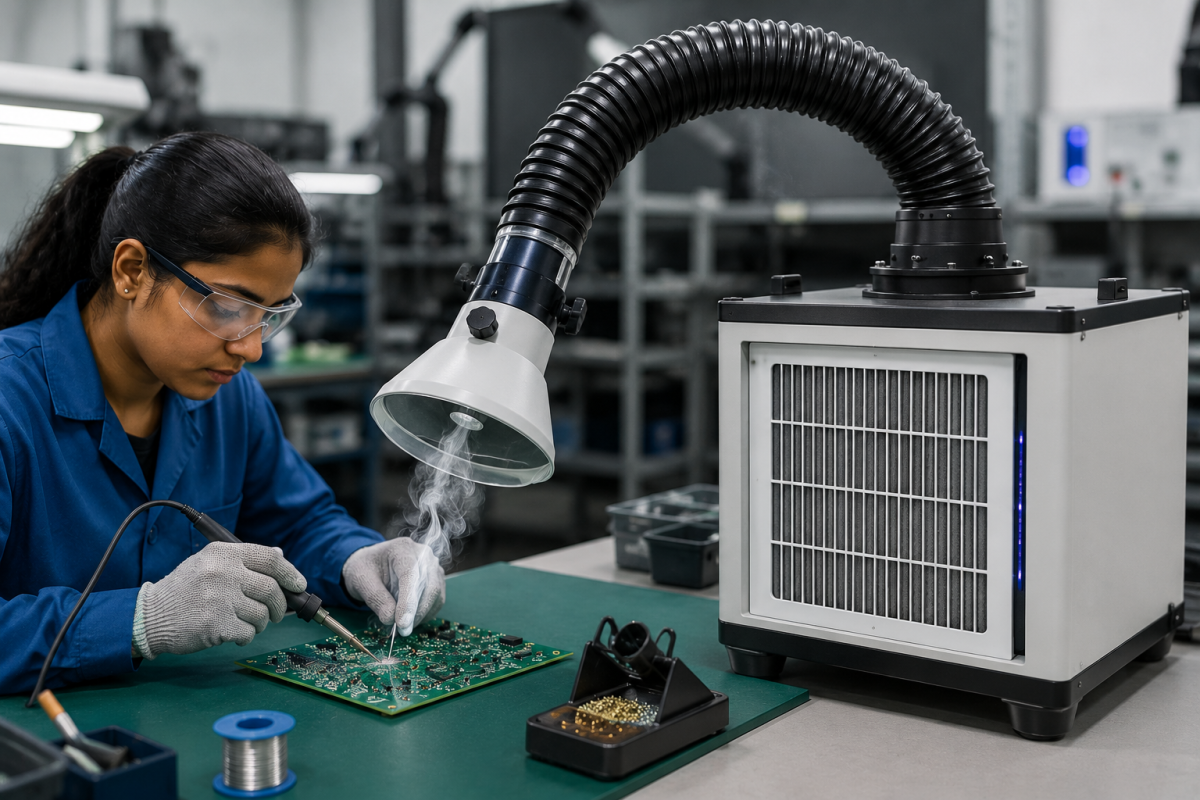
Soldering Fume Extraction Systems in Electronics Manufacturing

Introduction

Electronics manufacturing processes such as manual soldering, wave soldering, and rework operations generate fumes containing flux vapors, fine particulate matter, and volatile organic compounds (VOCs). Although soldering fumes may appear less intense than welding fumes, prolonged exposure in enclosed workspaces can significantly affect indoor air quality and operator health.

A properly designed soldering fume extractor is essential for controlling airborne contaminants directly at the source. In electronics manufacturing environments where operators work for extended durations at close proximity to soldering points, effective electronics fume extraction becomes critical for maintaining safe and productive working conditions.

Modern soldering ventilation systems are designed to capture fumes before dispersion, improving visibility, reducing odor, and minimizing exposure to hazardous substances generated during soldering operations.

With over 30 years of experience in industrial air pollution control, Powertech has implemented customized fume extraction for soldering applications across electronics assembly facilities, PCB manufacturing units, and precision production environments.

Key Takeaways

  1. A soldering fume extractor captures hazardous fumes directly at the source.
  2. Flux fumes and VOCs generated during soldering can affect indoor air quality.
  3. Proper source capture improves operator safety and process visibility.
  4. Filtration efficiency and airflow positioning are critical for effective performance.

The Problem: Soldering Fume Exposure in Electronics Manufacturing

Soldering operations generate fine fumes that often remain concentrated around operators in enclosed workstations.

Causes

  1. Flux vaporization during soldering
  2. Continuous manual soldering operations
  3. Poor ventilation in assembly areas
  4. Ineffective source capture systems

Workplace Impact

  1. Irritation of eyes and respiratory system
  2. Reduced operator comfort
  3. Accumulation of fumes in indoor environments
  4. Decreased visibility during precision work

Safety Risks

According to the Occupational Safety and Health Administration (OSHA), soldering fumes may contain harmful airborne contaminants including flux decomposition products.

The National Institute for Occupational Safety and Health (NIOSH) recommends local exhaust ventilation for soldering operations to minimize exposure.

Technical Explanation: How Soldering Fume Extraction Systems Work

Step 1: Source Capture

The extraction nozzle or hood is positioned close to the soldering point.

  1. Typical distance: 50–150 mm from source
  2. Captures fumes before dispersion

Source capture is significantly more effective than general room ventilation.

Step 2: Airflow Generation

A blower creates airflow that pulls fumes into the extraction system.

Key Requirements

  1. Stable airflow
  2. Low noise operation
  3. Consistent suction at workstation level

Step 3: Filtration Process

Modern electronics fume extraction systems often use multi-stage filtration.

Typical Filtration Stages

  1. Pre-filter for larger particles
  2. HEPA filter for fine particulate
  3. Activated carbon filter for VOCs and odors

Activated carbon filtration is especially important for flux fumes.

Step 4: Clean Air Discharge

Filtered air is either:

  1. Discharged safely
  2. Or recirculated into the workspace (depending on filtration efficiency)

Filtration Requirements for Soldering Applications

Filtration StagePurposeTypical Contaminants
Pre-filterLarger particlesDust and coarse particulate
HEPA FilterFine particulateSolder smoke and fine fumes
Activated CarbonGas adsorptionFlux vapors and VOCs
Multi-stage SystemCombined protectionMixed contaminants

Practical Industrial Applications

PCB Assembly Lines

  1. Continuous soldering operations
  2. Multiple operator stations
  3. Compact extraction systems required

Electronics Manufacturing

  1. Precision work environments
  2. Need for low-noise systems
  3. High indoor air quality requirements

Rework Stations

  1. Portable extraction arms or nozzles
  2. Flexible positioning needed

Laboratory and R&D Applications

  1. Small-scale soldering operations
  2. Benchtop fume extractors commonly used

Expert Insight

From Powertech’s experience, one of the most overlooked aspects of soldering ventilation systems is airflow positioning.

Key observations:

  1. Even high-efficiency filters underperform if source capture is poor
  2. Activated carbon filtration is critical for odor and VOC control
  3. Compact systems require careful airflow balancing to maintain suction

In several electronics manufacturing installations, optimizing nozzle placement significantly improved fume extraction for soldering without increasing airflow capacity.

Why is a soldering fume extractor necessary?

It removes harmful fumes and flux vapors generated during soldering operations.

What filters are used in soldering fume extraction systems?

Typically HEPA filters and activated carbon filters.

Can soldering fumes affect health?

Yes, prolonged exposure can irritate the respiratory system and eyes.

What is the ideal distance for source capture?

Usually between 50–150 mm from the soldering point.

Are portable soldering fume extractors effective?

Yes, when properly positioned close to the source.

Conclusion

A properly designed soldering fume extractor is essential for maintaining safe air quality in electronics manufacturing environments. By implementing effective electronics fume extraction systems and optimizing soldering ventilation systems, industries can significantly improve worker safety and indoor air quality. Effective fume extraction for soldering requires a combination of proper source capture, efficient filtration, and well-balanced airflow. With decades of experience in industrial air pollution control, Powertech continues to provide engineered solutions for electronics manufacturing environments where precision, safety, and clean air are critical.