
Introduction
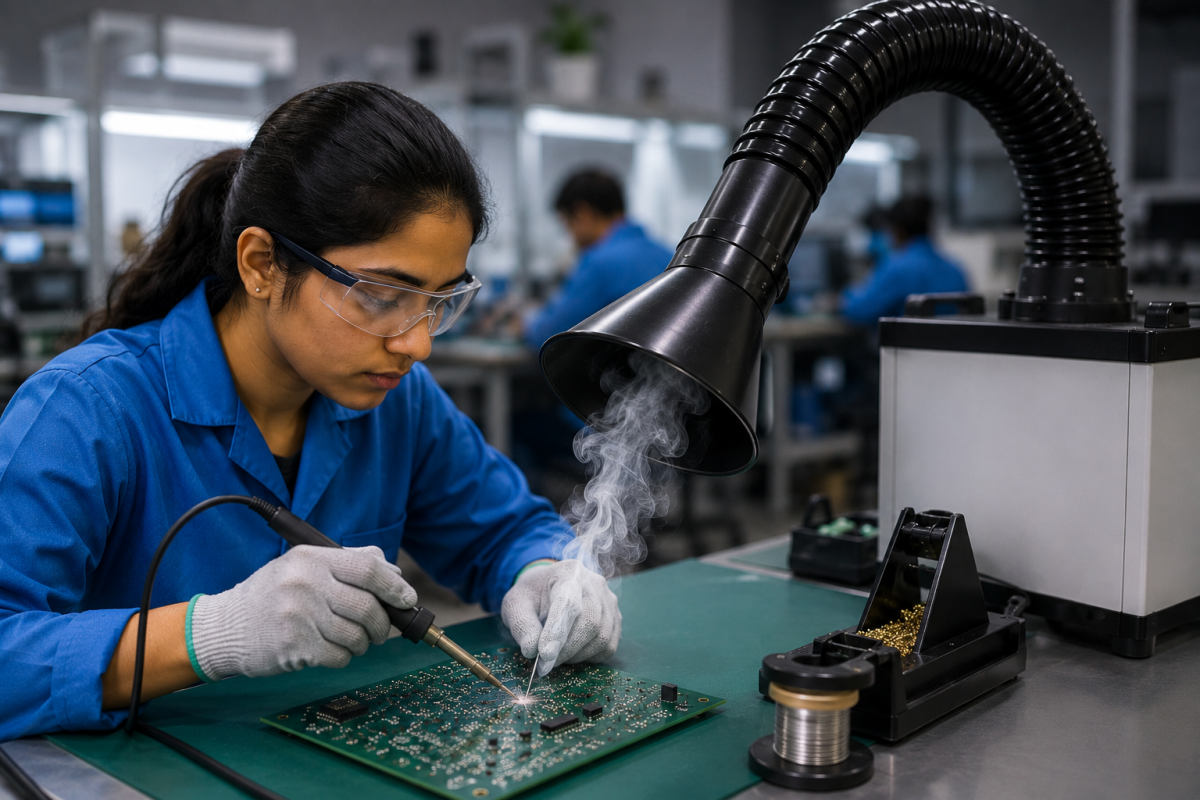
Soldering is a critical process in electronics manufacturing, PCB assembly, and repair operations. While the process itself appears relatively clean compared to heavy industrial applications, soldering generates airborne contaminants that can accumulate rapidly in enclosed workspaces. These fumes are primarily produced when flux compounds are heated during soldering and may contain particulate matter, aldehydes, resin acids, and volatile organic compounds (VOCs).
Over time, exposure to these contaminants can affect operator health, indoor air quality, and overall workplace safety. Understanding soldering fumes health risks is essential for designing safer electronics production environments and implementing effective control measures.
Proper flux fumes extraction and engineered electronics soldering ventilation systems are critical for minimizing exposure and maintaining compliant working conditions. With over 30 years of experience in industrial air pollution control, Powertech has implemented specialized ventilation solutions for electronics manufacturing environments where precision work and clean air are equally important.
Key Takeaways
- Soldering fumes can contain harmful airborne contaminants generated from heated flux materials.
- Long-term exposure may affect respiratory health and operator comfort.
- Effective flux fumes extraction significantly reduces airborne exposure.
- Proper electronics soldering ventilation improves workplace safety and air quality.
The Problem: Exposure to Soldering Fumes
During soldering operations, heated flux releases fumes that remain concentrated near the operator’s breathing zone.
Causes
- Heating of flux compounds during soldering
- Poor source capture ventilation
- Continuous soldering operations in enclosed spaces
- Inadequate airflow and filtration systems
Workplace Impact
- Unpleasant odors in production areas
- Reduced operator comfort
- Eye and throat irritation
- Reduced visibility during precision soldering work
Health Risks
According to the Occupational Safety and Health Administration (OSHA), soldering fumes may contain airborne contaminants that can irritate the respiratory system and eyes.
The National Institute for Occupational Safety and Health (NIOSH) recommends local exhaust ventilation for soldering applications to minimize exposure to flux fumes and airborne particulate matter.
The World Health Organization (WHO) has also emphasized the importance of controlling indoor airborne pollutants in occupational environments.
Technical Explanation: What Makes Soldering Fumes Hazardous
Step 1: Flux Vaporization
Flux is heated during soldering to improve metal bonding.
Result
- Flux compounds vaporize
- Smoke and gases are released into the air
Step 2: Formation of Airborne Particles
As vapors cool:
- Fine particulate matter forms
- Contaminants remain suspended in air
These particles can remain concentrated near the operator.
Step 3: Exposure in the Breathing Zone
Without proper electronics soldering ventilation, fumes accumulate near workstations.
Common Exposure Areas
- Manual soldering stations
- PCB assembly lines
- Rework benches
- Electronics laboratories
Step 4: Need for Source Capture
General room ventilation is often insufficient.
Effective Control Method
- Local exhaust ventilation
- Source capture nozzles
- Multi-stage filtration systems
Proper flux fumes extraction is the most effective approach.
Common Contaminants in Soldering Fumes
| Contaminant Type | Source | Potential Impact |
|---|---|---|
| Flux vapors | Heated flux | Respiratory irritation |
| Fine particulate | Solder smoke | Airborne exposure |
| VOCs | Flux decomposition | Odor and discomfort |
| Resin acids | Rosin-based flux | Eye and throat irritation |
Practical Industrial Applications
PCB Assembly Facilities
- Continuous manual soldering
- Multiple operators in confined areas
- Requires localized extraction systems
Electronics Manufacturing
- High-density workstation layouts
- Need for low-noise ventilation systems
Rework and Repair Stations
- Portable extraction systems commonly used
- Frequent close-range soldering operations
Research Laboratories
- Precision soldering work
- High emphasis on indoor air quality
Expert Insight
From Powertech’s field experience, many electronics facilities underestimate the importance of proper soldering ventilation because the visible smoke generated is relatively small compared to welding operations.
Key observations:
- Small soldering workstations can still produce significant localized exposure
- Poor nozzle positioning reduces source capture efficiency dramatically
- Activated carbon filtration is essential for controlling flux vapors and odors
In several installations, improving electronics soldering ventilation has noticeably improved operator comfort and workstation air quality without requiring major infrastructure changes.
Yes, prolonged exposure to soldering fumes can irritate the respiratory system and eyes.
Soldering fumes are primarily generated when flux compounds are heated during soldering.
Local exhaust ventilation and source capture extraction systems are the most effective methods.
HEPA filters remove particulate matter, but activated carbon filters are also needed for VOC and odor control.
It removes fumes before they disperse into the operator’s breathing zone.
Understanding soldering fumes health risks is essential for maintaining safe and efficient electronics manufacturing environments. Although soldering fumes may appear minimal, continuous exposure can significantly affect indoor air quality and operator comfort. By implementing proper flux fumes extraction, optimized electronics soldering ventilation, and effective filtration systems, industries can substantially reduce soldering air pollution and improve workplace safety. With decades of experience in industrial air pollution control, Powertech continues to design engineered ventilation solutions that help electronics manufacturers maintain cleaner, safer, and more productive work environments.