
Introduction
Even the most advanced extraction unit will underperform if the capture point is incorrectly positioned. In welding environments, fumes rise rapidly due to thermal buoyancy and disperse with even minor air currents. If the extraction arm is not placed strategically, fumes bypass the hood and enter the operator’s breathing zone.
Effective welding extraction arm positioning is therefore one of the most critical—and most overlooked—factors in system performance. Many cases of poor ventilation are not caused by inadequate equipment, but by incorrect fume extraction hood placement.
A well-positioned arm enables true source capture welding fumes, ensuring contaminants are removed before dispersion. With over 30 years of experience, Powertech has consistently observed that proper positioning alone can significantly improve welding ventilation efficiency without increasing airflow or system capacity.
Key Takeaways
- Correct welding extraction arm positioning is essential for effective fume capture.
- Source capture is far more effective than general ventilation.
- Hood distance and angle directly impact welding ventilation efficiency.
- Small positioning changes can significantly improve system performance.
The Problem: Poor Hood Placement
Improper positioning is one of the leading causes of ineffective welding fume extraction.
Causes
- Extraction arm placed too far from the arc
- Incorrect angle relative to fume rise direction
- Obstruction by the operator or workpiece
- Lack of operator training
- Frequent repositioning without guidelines
Workplace Impact
- Visible fumes escaping into the workspace
- Reduced visibility during welding
- Increased exposure for operators
- Inefficient use of extraction systems
Safety Risks
According to the Occupational Safety and Health Administration (OSHA), exposure to welding fumes can lead to respiratory irritation and long-term health risks.
The National Institute for Occupational Safety and Health (NIOSH) emphasizes source capture as the most effective method for controlling airborne contaminants.
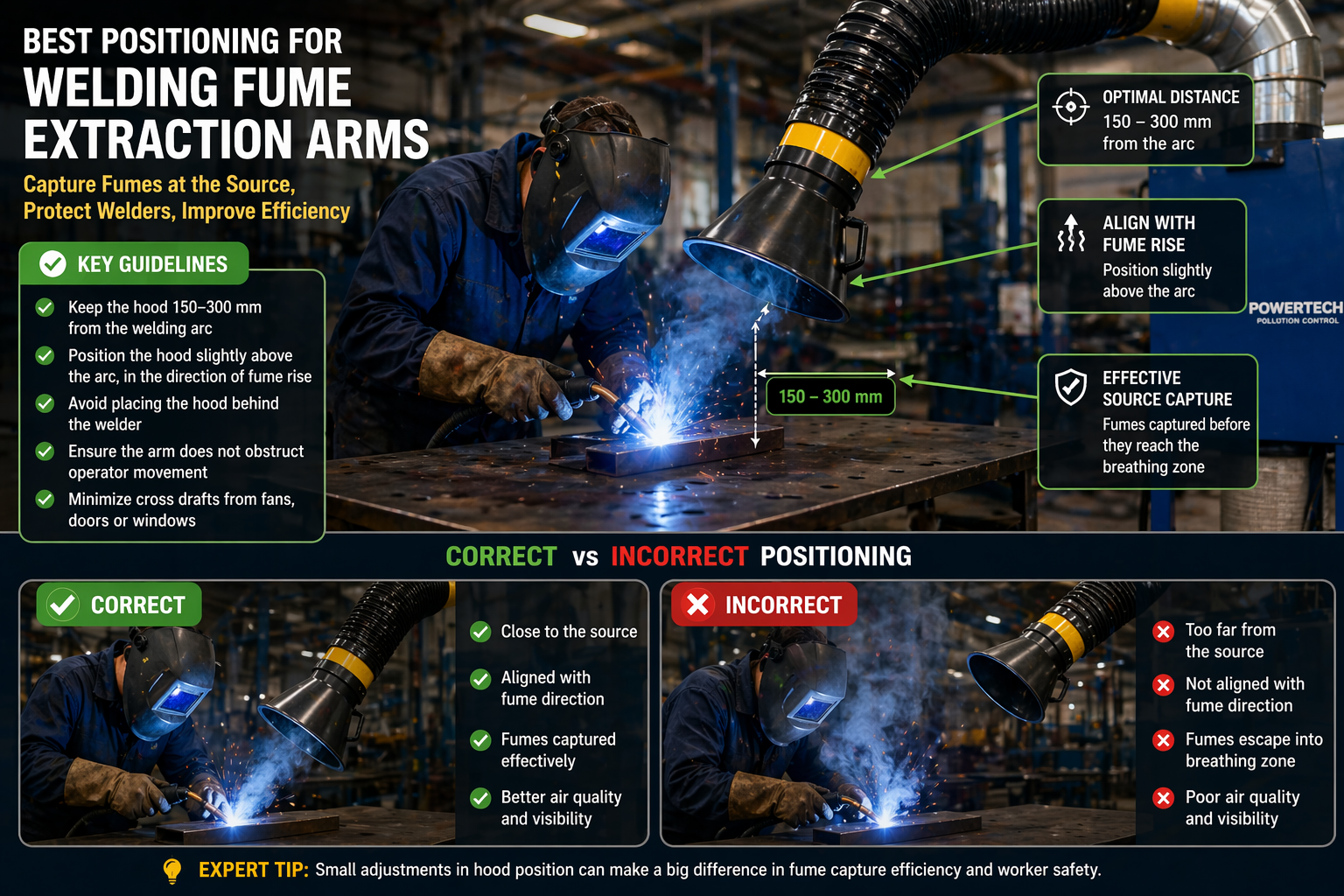
Technical Explanation: How to Position Extraction Arms Correctly
Step 1: Maintain Optimal Distance
The hood should be positioned close enough to capture fumes effectively.
- Ideal distance: 150 – 300 mm from the welding arc
- Closer positioning reduces airflow requirements
Doubling the distance can significantly reduce capture efficiency.
Step 2: Align with Fume Direction
Welding fumes typically rise upward due to heat.
- Position hood slightly above the arc
- Angle it to intercept the rising plume
Avoid placing the hood below the welding point.
Step 3: Avoid Blocking Airflow
Improper placement can cause fumes to pass through the operator’s breathing zone.
- Do not position hood behind the welder
- Avoid placing the hood directly between the arc and the operator’s face
The hood should capture fumes before they reach the operator.
Step 4: Maintain Stable Positioning
Flexible arms must be properly adjusted and locked.
- Ensure the arm does not drift during operation
- Use arms with good positional stability
Step 5: Minimize Cross Draft Effects
External air movement can disrupt capture.
- Avoid placing hoods near fans or open doors
- Position to counter airflow disturbances
Recommended Positioning Guidelines
| Parameter | Recommended Value | Remarks |
|---|---|---|
| Hood distance | 150 – 300 mm | Critical for capture |
| Hood angle | 30° – 60° toward plume | Align with fume rise |
| Position relative to operator | In front of plume | Avoid breathing zone |
| Height above arc | Slightly above | Matches fume movement |
| Stability | Fixed position | Prevents drift |
Practical Industrial Applications
Fabrication Shops
- Frequent repositioning required
- Operator training is critical
- Flexible arms preferred
Automotive Manufacturing
- Fixed positioning in robotic cells
- Enclosed extraction systems
- Consistent placement improves reliability
Maintenance Workshops
- Portable systems used
- High dependency on operator positioning
Heavy Engineering
- Larger workpieces
- Requires adjustable and extended arms
Expert Insight
From Powertech’s field experience, incorrect positioning is one of the most common and easiest-to-fix issues in welding ventilation systems.
In many workshops, improving welding extraction arm positioning has resulted in immediate improvements in air quality without any changes to system capacity.
Key practical observations:
- Source capture is more effective than increasing airflow
- Proper positioning reduces energy consumption
- Operator training is as important as system design
In several installations, correcting fume extraction hood placement has improved efficiency by over 25% without additional investment.
The hood should be placed 150–300 mm from the welding arc and aligned with the direction of rising fumes.
It prevents fumes from spreading into the workspace and reduces operator exposure.
Yes, incorrect positioning can significantly reduce capture efficiency even with high airflow.
It should be placed slightly above the arc to capture rising fumes.
By keeping the hood close to the source, aligning it with fume direction, and avoiding airflow obstruction.
Proper welding extraction arm positioning is a fundamental requirement for effective fume control. Without correct placement, even well-designed systems fail to capture fumes efficiently. By focusing on source capture welding fumes, optimizing fume extraction hood placement, and improving welding ventilation efficiency, industries can achieve safer and more efficient working environments. With decades of experience, Powertech emphasizes that correct positioning—combined with sound engineering design—is key to achieving reliable and effective welding fume extraction performance.