How to Size a Mist Collector for CNC Machines

Introduction

Selecting the correct mist collector is one of the most important decisions when designing an effective air pollution control system for CNC machining operations. An undersized unit may fail to capture airborne coolant mist efficiently, while an oversized system can increase energy consumption and operating costs without providing additional benefits.

Proper mist collector sizing requires evaluating several factors, including machine enclosure volume, coolant type, machining process, airflow requirements, and production intensity. A well-designed system ensures adequate CNC mist extraction airflow, maintains cleaner machine enclosures, and supports effective machine shop ventilation design.

Whether the application involves turning, milling, grinding, or multi-axis machining, understanding oil mist collector airflow requirements helps manufacturers improve air quality, reduce maintenance, and extend equipment life.

With over 30 years of experience in industrial air pollution control, Powertech engineers customized mist collection systems that deliver optimal performance while minimizing operating costs for machining facilities.

Key Takeaways

  1. Mist collector sizing should be based on machine characteristics, not just machine horsepower.
  2. Airflow requirements vary depending on machining process and coolant type.
  3. Proper CNC mist extraction airflow improves collection efficiency and equipment cleanliness.
  4. Oversized systems waste energy, while undersized systems reduce extraction performance.
  5. Professional airflow calculations ensure reliable long-term operation.

Why Mist Collector Sizing Matters

Every CNC machine produces different volumes of airborne mist depending on the machining operation.

Incorrect sizing can lead to:

  1. Poor mist capture
  2. Residual oil deposits
  3. Reduced indoor air quality
  4. Increased maintenance
  5. Higher operating costs

Proper sizing balances extraction efficiency with energy consumption.

Factors That Influence Mist Collector Sizing

1. Machine Enclosure Size

The enclosure volume affects the amount of air that must be extracted.

Larger machining centers generally require greater airflow than compact CNC machines.

2. Machining Process

Different machining operations generate different mist levels.

Lower Mist Generation

  1. Drilling
  2. Light milling
  3. Precision finishing

Moderate Mist Generation

  1. CNC turning
  2. General milling
  3. Machining centers

High Mist Generation

  1. Grinding
  2. High-speed machining
  3. High-pressure coolant applications

3. Coolant Type

The characteristics of the machining fluid influence extraction requirements.

Water-Based Coolants

Typically produce coolant mist that responds well to centrifugal separation.

Oil-Based Lubricants

Often generate finer aerosols and may require higher-efficiency collection methods.

4. Coolant Pressure

Higher coolant pressure creates smaller airborne droplets, increasing mist concentration and airflow requirements.

5. Machine Duty Cycle

Machines operating continuously over multiple shifts generate greater cumulative mist loads than intermittently operated equipment.

Determining CNC Mist Extraction Airflow

Airflow is typically determined by considering:

  1. Machine enclosure volume
  2. Air changes required within the enclosure
  3. Mist generation rate
  4. Capture efficiency
  5. Duct losses

Rather than relying on a fixed airflow value for every machine, airflow should be engineered for each application to ensure efficient mist removal without creating unnecessary energy consumption.

Oil Mist Collector Airflow Considerations

An effective oil mist collection system should maintain sufficient airflow to:

  1. Capture airborne mist at the source
  2. Prevent mist leakage when machine doors open
  3. Maintain slight negative pressure within the enclosure
  4. Support continuous machining operations

Excessively high airflow may disturb machining conditions, while insufficient airflow reduces collection efficiency.

Machine Shop Ventilation Design Considerations

Mist collectors should complement—not replace—the overall ventilation strategy.

A complete machine shop ventilation design should include:

  1. Local source capture
  2. Proper make-up air
  3. General building ventilation
  4. Strategic equipment placement
  5. Maintenance access

This integrated approach improves overall air quality and operational efficiency.

Common Mist Collector Sizing Mistakes

Selecting by Machine Horsepower

Horsepower alone does not determine mist generation.

Ignoring Coolant Type

Oil-based and water-based coolants behave differently.

Oversizing the Collector

Larger systems consume more power and increase operating costs without proportional performance gains.

Undersizing the Collector

Insufficient airflow allows mist to escape into the workplace.

Ignoring Future Expansion

Production increases may require additional extraction capacity.

Powertech’s Engineering Approach

Powertech evaluates multiple parameters before recommending a mist collection solution.

These include:

  1. CNC machine type
  2. Enclosure dimensions
  3. Coolant characteristics
  4. Machining process
  5. Operating hours
  6. Airflow requirements
  7. Plant layout

This engineering-based approach ensures every MistKiller installation delivers reliable performance with optimal operating efficiency.

Expert Insight

From Powertech’s experience, one of the most common mistakes is selecting a mist collector based solely on airflow capacity listed in a product catalogue.

In practice, effective mist collection depends on the interaction between machine enclosure design, contaminant generation, duct routing, and extraction efficiency.

Proper engineering frequently delivers better results with a correctly sized collector than with a larger unit operating inefficiently.

How do you size a mist collector for a CNC machine?

Sizing depends on enclosure volume, machining process, coolant type, mist generation rate, and required airflow—not simply machine horsepower.

What affects CNC mist extraction airflow?

Machine size, coolant pressure, machining operation, enclosure design, and production intensity all influence airflow requirements.

Can a mist collector be oversized?

Yes. Oversized systems increase energy consumption and operating costs without necessarily improving collection performance.

Why is airflow important in oil mist collection?

Proper airflow captures airborne mist before it escapes into the workplace while maintaining efficient machine enclosure ventilation.

Should every CNC machine have its own mist collector?

Many facilities achieve the best results with dedicated machine-mounted mist collectors, although centralized systems may be appropriate for certain production layouts.

Can Powertech help determine the correct mist collector size?

Yes. Powertech evaluates machine specifications, airflow requirements, coolant characteristics, and operating conditions to recommend appropriately sized MistKiller systems.

Conclusion

Proper mist collector sizing is essential for achieving efficient oil mist control in CNC machining operations. By considering CNC mist extraction airflow, oil mist collector airflow, machine enclosure characteristics, and overall machine shop ventilation design, manufacturers can improve air quality, reduce maintenance, and optimize operating costs. Rather than relying on standard airflow values, engineered sizing ensures that every mist collection system is matched to the specific machining application. With decades of expertise in industrial air pollution control, Powertech provides customized MistKiller solutions that deliver reliable, energy-efficient performance for modern manufacturing facilities.

Health Risks of Oil Mist in Machine Shops

Introduction

Modern machine shops rely on CNC machining, turning, milling, grinding, and other precision manufacturing processes that use cutting oils and coolants to improve machining efficiency and tool life. While these fluids are essential for production, they often generate airborne oil mist that can spread throughout the facility if not effectively controlled.

Understanding oil mist health risks is critical for maintaining a safe and productive workplace. Fine oil aerosols generated during machining can remain suspended in the air for extended periods, increasing the potential for CNC mist exposure among machine operators and maintenance personnel. Without proper coolant mist ventilation, airborne contaminants contribute to machine shop air pollution, reducing indoor air quality and creating less comfortable working conditions.

Implementing effective mist collection and ventilation systems helps capture contaminants at the source, improving workplace cleanliness, protecting equipment, and supporting a healthier manufacturing environment.

With over 30 years of experience in industrial air pollution control, Powertech designs engineered mist collection solutions that help manufacturers control airborne coolant and oil mist in demanding machining applications.

Key Takeaways

  1. Oil mist is generated during CNC machining, turning, milling, and grinding operations.
  2. Prolonged CNC mist exposure can negatively affect workplace air quality.
  3. Proper coolant mist ventilation captures airborne contaminants at the source.
  4. Oil mist control also protects machinery and reduces housekeeping requirements.
  5. Engineered mist collection systems improve operator comfort and operational efficiency.

Understanding Oil Mist in Machine Shops

Oil mist forms when cutting oils or lubricants are atomized by high-speed rotating tools, workpieces, or coolant delivery systems.

These microscopic droplets remain suspended in the air and may spread throughout the workshop if they are not captured close to the machining process.

Common sources include:

  1. CNC Turning
  2. CNC Milling
  3. Grinding
  4. Drilling
  5. Multi-axis Machining Centers
  6. Automatic Production Lines

Health Risks Associated with Oil Mist Exposure

Although the severity depends on the type of machining fluid, exposure duration, and ventilation effectiveness, uncontrolled oil mist can create several workplace concerns.

Respiratory Irritation

Airborne oil aerosols may irritate the respiratory system, particularly in poorly ventilated machine shops.

Possible symptoms include:

  1. Dry throat
  2. Coughing
  3. Breathing discomfort
  4. Irritation of the nose and airways

Eye Irritation

Fine airborne droplets can cause:

  1. Watery eyes
  2. Burning sensation
  3. Eye discomfort

particularly during prolonged machining operations.

Skin Contact

Repeated contact with machining oils and airborne mist may contribute to:

  1. Skin irritation
  2. Dryness
  3. Dermatitis in susceptible individuals

Good housekeeping and personal protective practices help minimize direct contact.

Reduced Indoor Air Quality

Accumulated airborne mist contributes to:

  1. Visible haze
  2. Oily odors
  3. Reduced workplace comfort

This can negatively affect the overall working environment.

Machine Shop Air Pollution Beyond Health

Oil mist does not only affect people.

It also impacts:

Equipment

Residue accumulates on:

  1. Electrical cabinets
  2. Sensors
  3. Machine controls
  4. Automation systems

Floors

Oil deposits increase slip hazards and cleaning requirements.

Building Infrastructure

Mist may settle on:

  1. Lighting fixtures
  2. Walls
  3. Ceilings
  4. HVAC components

Productivity

Cleaner environments often support:

  1. Better visibility
  2. Improved operator comfort
  3. Reduced maintenance downtime

Why CNC Mist Exposure Occurs

Several factors influence airborne mist generation.

High Spindle Speeds

Higher rotational speeds increase coolant atomization.

High-Pressure Coolant Systems

Higher coolant pressure produces finer airborne droplets.

Continuous Production

Long machining cycles increase cumulative mist concentration.

Poor Ventilation

Without localized extraction, mist spreads throughout the workshop.

The Role of Coolant Mist Ventilation

Proper coolant mist ventilation captures airborne contaminants before they disperse into the work environment.

Effective systems typically:

  1. Capture mist directly from CNC enclosures
  2. Separate liquid droplets from the air
  3. Recover usable coolant where applicable
  4. Return cleaner air to the workplace

Source capture remains significantly more effective than relying on general building ventilation alone.

Best Practices for Controlling Oil Mist

Install Dedicated Mist Collectors

Machine-mounted extraction provides the highest collection efficiency.

Capture Mist at the Source

Prevent contaminants from escaping machine enclosures.

Maintain Equipment Regularly

Inspect:

  1. Fans
  2. Ductwork
  3. Collection systems
  4. Separation components

Monitor Air Quality

Regular inspections help identify ventilation problems before they affect production.

Train Operators

Operators should understand:

  1. Correct machine operation
  2. Ventilation system use
  3. Basic maintenance awareness

Powertech’s Approach to Oil Mist Control

Powertech’s MistKiller centrifugal mist collectors are engineered for continuous industrial machining operations.

Key advantages include:

  1. High-efficiency centrifugal separation
  2. No disposable filter media
  3. Low maintenance
  4. Continuous operation
  5. Coolant recovery capability
  6. Reliable performance for water-based coolant mist

These systems help manufacturers improve workplace air quality while reducing contamination and maintenance costs.

Expert Insight

From Powertech’s experience, many manufacturers first notice oil mist only after residue becomes visible on machinery and floors. By this stage, airborne contaminants have often been circulating throughout the workshop for an extended period.

Facilities that implement dedicated source-capture mist collection consistently report:

  1. Cleaner machining environments
  2. Improved operator comfort
  3. Lower maintenance requirements
  4. Better machine reliability
  5. Reduced housekeeping effort

The most effective strategy is to prevent oil mist from escaping the machine enclosure rather than attempting to remove it after it has spread through the facility.

What causes oil mist in machine shops?

Oil mist is created when cutting oils or lubricants become atomized by high-speed machining operations.

Why is oil mist ventilation important?

It improves workplace air quality by capturing airborne contaminants before they spread throughout the machine shop.

Which machining operations generate the most oil mist?

Grinding, high-speed milling, turning, and machining processes using oil-based lubricants typically generate the highest levels of airborne oil mist.

How can oil mist exposure be reduced?

The most effective method is installing dedicated mist collectors that capture contaminants directly at the source.

Does oil mist affect machinery?

Yes. Oil residue can contaminate electrical cabinets, sensors, controls, and other machine components, increasing maintenance requirements.

What is the difference between oil mist and coolant mist?

Oil mist originates from oil-based lubricants, while coolant mist is produced from water-based cutting fluids. Both require appropriate extraction systems to maintain clean air.

Conclusion

Understanding oil mist health risks is essential for maintaining safe and efficient machining environments. Uncontrolled CNC mist exposure contributes to machine shop air pollution, affects workplace comfort, and increases equipment contamination. By implementing effective coolant mist ventilation and source-capture mist collection systems, manufacturers can significantly improve indoor air quality, protect valuable machinery, and create cleaner production environments. With decades of experience in industrial air pollution control, Powertech continues to provide engineered mist collection solutions that help manufacturers achieve safer, cleaner, and more productive machining operations.

Welding Fume Extraction Systems in Industrial Fabrication Shops

Introduction

Welding is one of the most common fabrication processes used across industries such as automotive manufacturing, heavy engineering, structural fabrication, and equipment manufacturing. While welding enables strong and reliable metal joints, it also produces significant airborne contaminants in the form of welding fumes. These fumes consist of fine metal particles, gases, and chemical compounds that can pose serious health risks to workers if not properly controlled.

In industrial fabrication shops where welding operations are performed continuously, airborne contaminants can quickly accumulate in the work environment. Poor air quality affects worker health, reduces visibility in the workspace, and can lead to regulatory compliance issues. Controlling welding fumes is therefore a critical aspect of industrial safety and workplace engineering.

A properly designed welding fume extraction system helps capture and remove fumes at the source before they disperse into the surrounding environment. By using specialized welding fume extractor units and appropriate industrial welding ventilation, fabrication shops can significantly improve air quality, enhance worker safety, and maintain regulatory compliance. This article explains how welding fume extraction equipment works and how it is applied in industrial fabrication environments.

Key Takeaways

  1. A welding fume extraction system captures hazardous welding fumes at the source, preventing them from spreading into the work environment.
  2. Effective industrial welding ventilation improves worker safety, visibility, and compliance with occupational health regulations.
  3. Proper selection of welding fume extraction equipment depends on airflow requirements, welding process type, and workspace layout.
  4. Localized extraction systems are generally more effective than general ventilation for controlling welding fumes.

The Problem: Welding Fume Exposure in Fabrication Shops

Welding fumes are generated when metals are heated to high temperatures and vaporize. These vapors quickly cool and condense into extremely fine airborne particles that remain suspended in the air.

Without proper extraction, these contaminants accumulate in the workplace.

Causes of Welding Fume Accumulation

  1. Continuous welding operations in enclosed workshops
  2. Inadequate general ventilation systems
  3. Multiple welding stations operating simultaneously
  4. Poor positioning of extraction equipment
  5. High deposition rates from processes such as MIG and flux-cored arc welding

Workplace Impact

Poor welding fume control can negatively affect fabrication shop operations:

  1. Reduced visibility due to smoke accumulation
  2. Uncomfortable working conditions for welders
  3. Contamination of nearby workstations and equipment
  4. Increased maintenance requirements for machinery

Safety Risks

Exposure to welding fumes can lead to several health concerns, including:

  1. Respiratory irritation and lung damage
  2. Metal fume fever caused by inhalation of metal oxide particles
  3. Long-term exposure risks associated with chromium, manganese, and nickel compounds
  4. Potential neurological effects from prolonged exposure to certain metals

For these reasons, many industrial safety standards emphasize the need for effective welding fume extraction systems and engineered ventilation solutions.

How a Welding Fume Extraction System Works

A welding fume extraction system is designed to capture fumes at the point where they are generated and remove them from the worker’s breathing zone.

The system typically consists of several integrated components.

Step 1: Fume Capture

The first stage involves capturing fumes as close to the welding arc as possible.

This is commonly achieved using:

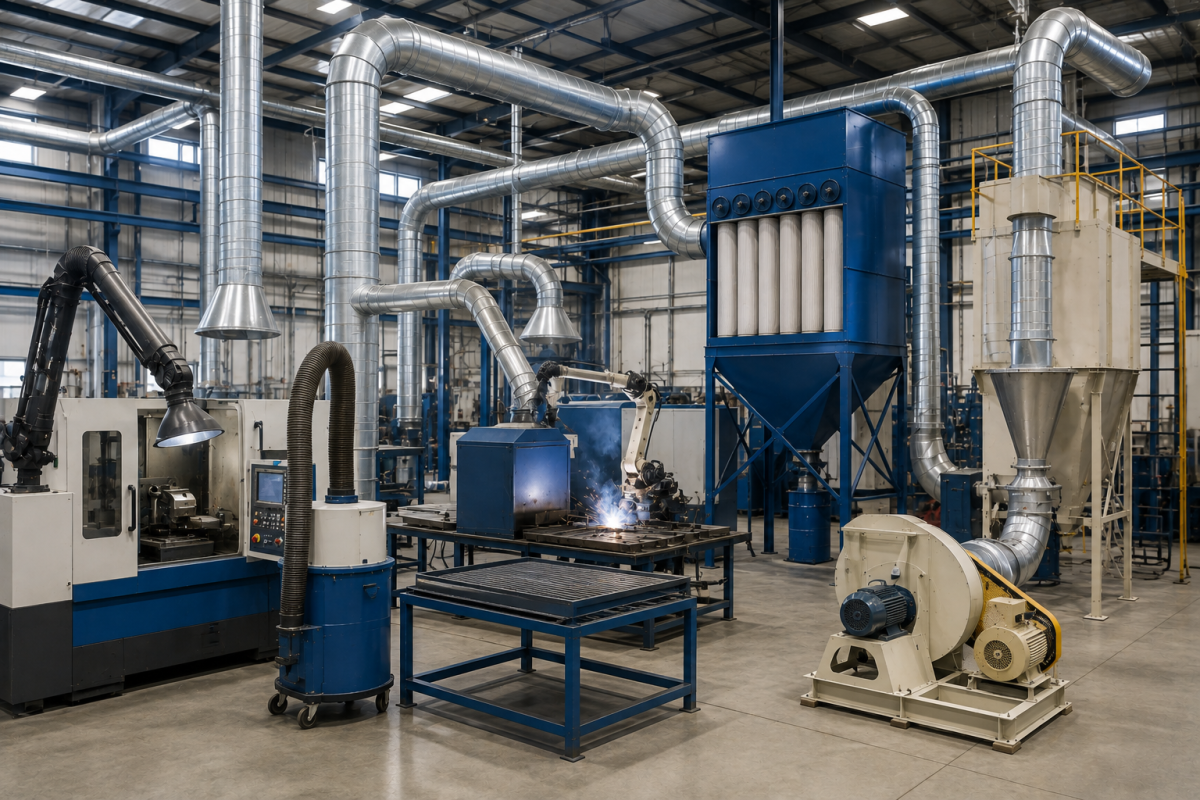
  1. Flexible extraction arms
  2. Extraction hoods
  3. Downdraft tables
  4. On-torch extraction systems

These devices position the airflow source directly near the welding area, preventing fumes from spreading.

Step 2: Air Conveyance

Once fumes are captured, they are transported through ducting or internal channels within the welding fume extractor.

A high-efficiency fan or blower generates airflow that pulls contaminated air through the system.

Step 3: Filtration

The captured air then passes through filtration stages designed to remove particulate matter.

Typical filtration methods include:

  1. Cartridge filters for fine metal particles
  2. HEPA filters or electrostaticfilters for very fine particulate capture
  3. Spark arrestors for safety protection

These filters remove hazardous particles from the air stream.

Step 4: Clean Air Discharge

After filtration, the cleaned air can either:

  1. Be returned to the workspace (recirculation systems)
  2. Be discharged outside through exhaust ducting

Proper filtration ensures that discharged air meets environmental and workplace safety standards.

Typical Airflow Requirements for Welding Fume Extraction

Airflow is one of the most important parameters in designing a welding fume extraction system. Insufficient airflow will allow fumes to escape, while excessive airflow increases energy consumption.

Welding ApplicationTypical Capture MethodRecommended Airflow (m³/hr)Typical Capture Velocity
Manual MIG weldingExtraction arm800 – 12000.5 – 1.0 m/s
TIG weldingLocal hood600 – 9000.4 – 0.8 m/s
Robotic welding cellEnclosed hood1500 – 25000.8 – 1.2 m/s
Grinding and welding stationsDowndraft table2000 – 35001.0 – 1.5 m/s

Actual airflow requirements depend on:

  1. Welding process type
  2. Distance between the arc and extraction hood
  3. Workshop layout
  4. Number of active welding stations

Proper engineering calculations are required to size the welding fume extraction equipment correctly.

Practical Industrial Applications

Automotive Manufacturing

Automotive manufacturing facilities rely heavily on robotic welding systems for assembling vehicle bodies and components.

These facilities often use centralized welding fume extraction systems connected to multiple welding stations. Enclosures and high-capacity filtration units ensure that fumes generated during robotic welding are effectively captured.

Fabrication Shops

Structural fabrication shops typically operate multiple manual welding stations. In such environments, mobile welding fume extractor units with flexible arms are commonly used.

These systems allow welders to reposition the extraction arm depending on the workpiece location, ensuring effective fume capture.

Electronics Manufacturing

Electronics manufacturing processes often involve soldering and micro-welding operations. Although the fume volumes are smaller, the particles produced can still pose health risks.

Compact extraction units are used to capture fumes generated during soldering and precision welding processes.

CNC and Equipment Manufacturing

Many CNC machine shops include welding as part of the manufacturing process for frames, fixtures, and machine components.

Local extraction systems integrated into welding stations prevent fumes from spreading into areas where precision machining operations are conducted.

Expert Insight

In many fabrication shops, welding fumes are controlled using general ventilation or ceiling exhaust fans. However, these approaches often fail to capture fumes before they reach the worker’s breathing zone.

From an engineering perspective, source capture is the most effective strategy. Positioning extraction arms within 200–300 mm of the welding arc significantly improves capture efficiency. Proper maintenance of filters and periodic airflow verification are also essential to ensure long-term performance of the welding fume extraction system.

What is a welding fume extraction system?

A welding fume extraction system is an engineered ventilation system designed to capture and filter fumes generated during welding processes before they disperse into the workplace environment.

Why is local extraction preferred over general ventilation?

Local extraction captures fumes directly at the source, preventing them from spreading into the surrounding workspace. General ventilation dilutes contaminants but does not remove them effectively.

How often should filters in welding fume extraction equipment be replaced?

Filter replacement intervals depend on welding intensity and system design. In most industrial environments, filters are inspected regularly and replaced when pressure drop exceeds recommended limits.

Can a welding fume extractor handle multiple welding stations?

Yes. Larger systems can be designed to serve multiple stations using ducting networks connected to a centralized filtration unit.

Are welding fumes hazardous even in small workshops?

Yes. Even small welding operations can produce harmful metal particles and gases. Proper industrial welding ventilation is important regardless of workshop size.

Conclusion

Welding fumes are an unavoidable by-product of metal fabrication processes, but their impact on workplace safety and air quality can be effectively controlled with proper engineering solutions. A well-designed welding fume extraction system captures fumes at the source, filters hazardous particles, and prevents contamination of the work environment. By implementing appropriate welding fume extraction equipment and maintaining proper industrial welding ventilation, fabrication shops can significantly improve worker safety, operational efficiency, and regulatory compliance. As welding operations continue to expand across manufacturing industries, investing in reliable air pollution control systems remains a critical component of modern industrial facility design.

Welding Fume Extraction Challenges in Heavy Engineering Units

Heavy engineering shops work with big metal structures, thick materials, and long welding cycles. These conditions produce a large amount of welding fumes that spread out over large areas of production.

Heavy engineering units often have more complicated extraction problems than small fabrication shops. It’s hard to control fumes when there are big workpieces, moving equipment, and open spaces.

To keep the air clean and the work environment safe, a well-designed welding fume extraction system must be installed to deal with these problems.

Why Heavy Engineering Units Make More Welding Fumes

Heavy engineering processes usually include:

  1. Welding with a lot of current
  2. Parts of thick material
  3. Long seams in the weld
  4. Shifts in continuous welding

These conditions make more fumes. In a lot of cases, welding goes on for a long time without stopping.

Frames, pressure vessels, and structural assemblies are some of the big parts that also trap fumes around the weld zone.

Challenge 1: Big Workpieces Get in the Way of Fume Capture

Parts of the Structure Stop Airflow

Heavy engineering parts are often big and tall. Some examples are:

  1. Industrial Frames
  2. Bases for heavy machines
  3. Structural Beams

These components can stop air from flowing naturally and keep fumes from rising freely. Because of this, fumes build up around the operator’s breathing zone.

Hard to Place the Hood

For extraction hoods to work well, they need to be close to the welding point. But big workpieces often make it hard to get the right position.

If the hood is too far away, the fumes spread out before they can be extracted.

Challenge 2: There are several welding stations in the same area.

Most of the time, heavy engineering units have many welding stations on one shop floor.

When multiple stations work together:

  1. Fumes from different places get mixed.
  2. The flow of air becomes hard to predict.
  3. Local extraction systems fight for air flow

If the system isn’t set up right, fumes from one station can move to another.

Powertech Pollution Controls is a welding fume extractor manufacturer in Bangalore that often helps facilities figure out how much air needs to flow through different welding zones.

Challenge 3: Moving Welding Locations

Welding Doesn’t Always Happen in the Same Place

Welders in heavy engineering units often have to move around big parts while they are making them. For instance:

  1. Welding around large tanks
  2. Welding long beams
  3. Welding internal parts

Fixed extraction hoods may not work well because the welding point moves around a lot and flexible extraction arms or mobile systems are often required.

Challenge 4: Workshops with High Roofs

A lot of heavy engineering plants have high roofs so that cranes and big buildings can fit. High ceilings give you more room, but they also let fumes build up at different levels. Instead of leaving the building, the fumes spread across the shop floor over time.

During long welding shifts, the air quality gets worse over time if extraction isn’t controlled.

Challenge 5: Big doors and fans that blow air across the room

Heavy engineering shops often leave their big doors open so that materials can move around. This makes the air move quickly inside the building causing cross drafts from:

  1. Large doors
  2. Cooling Fans
  3. Crane Movement

These cross drafts can cause welding fumes to move away from the place where they are extracted. Even when equipment is in place, this makes extraction less effective.

Practical Solutions

When working with heavy machinery, extraction systems need to take into account the layout of the workshop to deal with fumes.

Some good ways to do this are:

Source Capture Systems

Operators can move the hood close to the weld location thanks to flexible extraction arms.

Centralized Extraction Systems

Central systems can work with more than one station at a time and keep the airflow balanced.

Mobile Extraction Units

Portable systems help collect fumes in places where welding positions change a lot.

Planning the flow of air

Before putting in extraction systems, you need to look at how air moves inside the shop. The right airflow design makes capture work better.

Q&A

Q1. Why is it harder to control welding fumes in heavy engineering units?

  1. Source capture is harder because of big workpieces, moving welding locations, and open workshop layouts.

Q2. Are portable fume extractors helpful in these situations?

  1. Yes. They help catch fumes when the places where you weld change often.

Q3. Do roofs that are high up lower the amount of welding fumes?

  1. No. Instead of leaving the building, the fumes may spread throughout the workshop.

Q4. Is one extraction system enough for big workshops?

  1. Many times, large facilities need more than one system that is based on the layout of the production area.

Final Thoughts

When it comes to controlling welding fumes, heavy engineering units have their own set of problems. Simple extraction systems don’t work well because of big buildings, many welding stations, and changing weld locations.

To control fumes well, the system must be designed correctly, the hood must be in the right place, and the airflow across the workshop must be balanced.

A good welding fume extractor keeps the welding area clear, makes the work environment better, and helps keep production steady in heavy engineering settings.

Oil Mist Collectors in Metal Machining

Introduction

Metal machining operations such as CNC turning, milling, grinding, drilling, and machining center applications often use cutting oils and lubricants to improve machining performance, reduce friction, and extend tool life. During these processes, high-speed rotating tools and workpieces can atomize oil into fine airborne droplets, creating oil mist that spreads throughout the manufacturing environment.

An effective oil mist collector is essential for controlling airborne contaminants, improving indoor air quality, protecting equipment, and maintaining a cleaner workplace. Without proper extraction, oil mist can accumulate on machinery, floors, walls, electrical cabinets, and production equipment, increasing maintenance requirements and operational costs.

Modern machining mist collector systems are designed to capture contaminants directly at the source before they enter the workplace atmosphere. By implementing engineered CNC oil mist extraction solutions, manufacturers can significantly improve workplace cleanliness and operational efficiency.

The FumeKiller® unit from Powertech serves as an advanced oil mist collector designed specifically for effective extraction of oil mist while also facilitating reclaiming the extracted oil for filtration and potential reuse..

Key Takeaways

  1. Oil mist is generated when machining oils become atomized during metal cutting operations.
  2. An oil mist collector captures airborne contaminants directly from machine enclosures.
  3. Effective mist extraction improves air quality and machine reliability.
  4. Proper CNC oil mist extraction reduces maintenance requirements.
  5. Source capture is significantly more effective than general building ventilation.

The Problem: Oil Mist in Machining Operations

During machining, lubricating oils are exposed to:

  1. High spindle speeds
  2. Cutting forces
  3. Rotating components
  4. Turbulent airflow

This causes oil droplets to become airborne and form mist.

Common Sources

CNC Turning

High-speed rotation produces significant oil mist generation.

Milling Operations

Rotating cutters disperse lubricant into the air.

Grinding Applications

Fine aerosolized oil particles are often generated continuously.

Multi-Axis Machining Centers

Continuous machining and lubrication systems increase mist concentration.

Impact of Oil Mist on Manufacturing Facilities

Workplace Air Quality

Oil mist can remain suspended in the air for extended periods.

Equipment Contamination

Oil residue accumulates on:

  1. Machine controls
  2. Sensors
  3. Electrical cabinets
  4. Automation equipment

Housekeeping Challenges

Oil contamination can create:

  1. Slippery floors
  2. Dirty machine surfaces
  3. Increased cleaning requirements

Maintenance Costs

Excessive contamination often leads to:

  1. Increased downtime
  2. Additional maintenance labor
  3. Higher operating costs

How Oil Mist Collectors Work

Step 1: Source Capture

The collector extracts contaminated air directly from the machine enclosure.

Capturing mist before it escapes delivers maximum efficiency.

Step 2: Mist Separation

The extraction system separates oil droplets from the air stream.

Collection Methods

  1. Centrifugal separation
  2. Mechanical separation
  3. Multi-stage filtration

Step 3: Oil Recovery

Separated oil is collected and drained.

Benefits include:

  1. Reduced waste
  2. Cleaner equipment
  3. Improved operational efficiency

Step 4: Clean Air Discharge

Filtered air is safely discharged or recirculated depending on the application.

Types of Industrial Mist Collectors

TypeApplication
Centrifugal Mist CollectorHigh-volume machining operations
Filter-Based Mist CollectorFine particulate applications
Electrostatic Mist CollectorOil smoke and ultra-fine mist
Multi-Stage SystemsComplex machining environments

Applications

CNC Turning Centers

Continuous oil-based lubrication creates airborne mist requiring extraction.

CNC Milling Machines

High spindle speeds generate significant oil aerosols.

Grinding Operations

Fine oil mist generation often requires high-efficiency collection systems.

Automatic Machining Lines

Centralized extraction systems may be required.

Precision Engineering

Maintaining clean environments improves product quality and machine reliability.

Benefits of CNC Oil Mist Extraction

Improved Air Quality

Reduces airborne oil contamination.

Cleaner Equipment

Prevents residue build-up on machinery and controls.

Reduced Maintenance

Less contamination means lower cleaning requirements.

Enhanced Operator Comfort

Cleaner working environments support productivity.

Longer Equipment Life

Protects sensitive machine components.

Expert Insight

Powertech’s experience across machining industries shows that oil mist control is frequently treated as a housekeeping issue rather than an air quality issue.

Facilities that implement dedicated machining mist collector systems consistently achieve:

  1. Cleaner production environments
  2. Reduced maintenance downtime
  3. Improved machine reliability
  4. Better operator satisfaction
  5. Lower overall operating costs

Source capture directly at the machine enclosure remains the most effective strategy for controlling oil mist.

What is an oil mist collector?

An oil mist collector is an extraction system that removes airborne oil droplets generated during machining operations.

Why is oil mist extraction important?

It improves air quality, protects equipment, reduces maintenance, and creates cleaner work environments.

Which machining processes generate oil mist?

Turning, milling, grinding, drilling, and machining center operations commonly generate oil mist.

Can collected oil be recovered?

Many mist collection systems allow separated oil to be collected and reused depending on the application.

Where should an oil mist collector be installed?

Ideally directly on or connected to the machining enclosure for maximum source capture efficiency.

Conclusion

An effective oil mist collector is a critical component of modern machining operations. By implementing engineered machining mist collector solutions and efficient CNC oil mist extraction, manufacturers can improve air quality, reduce contamination, and enhance operational performance. Properly designed industrial mist collector systems provide long-term benefits through cleaner equipment, lower maintenance costs, and improved workplace conditions. With decades of experience in industrial air pollution control, Powertech continues to deliver customized oil mist extraction solutions that support cleaner, safer, and more productive manufacturing environments.