
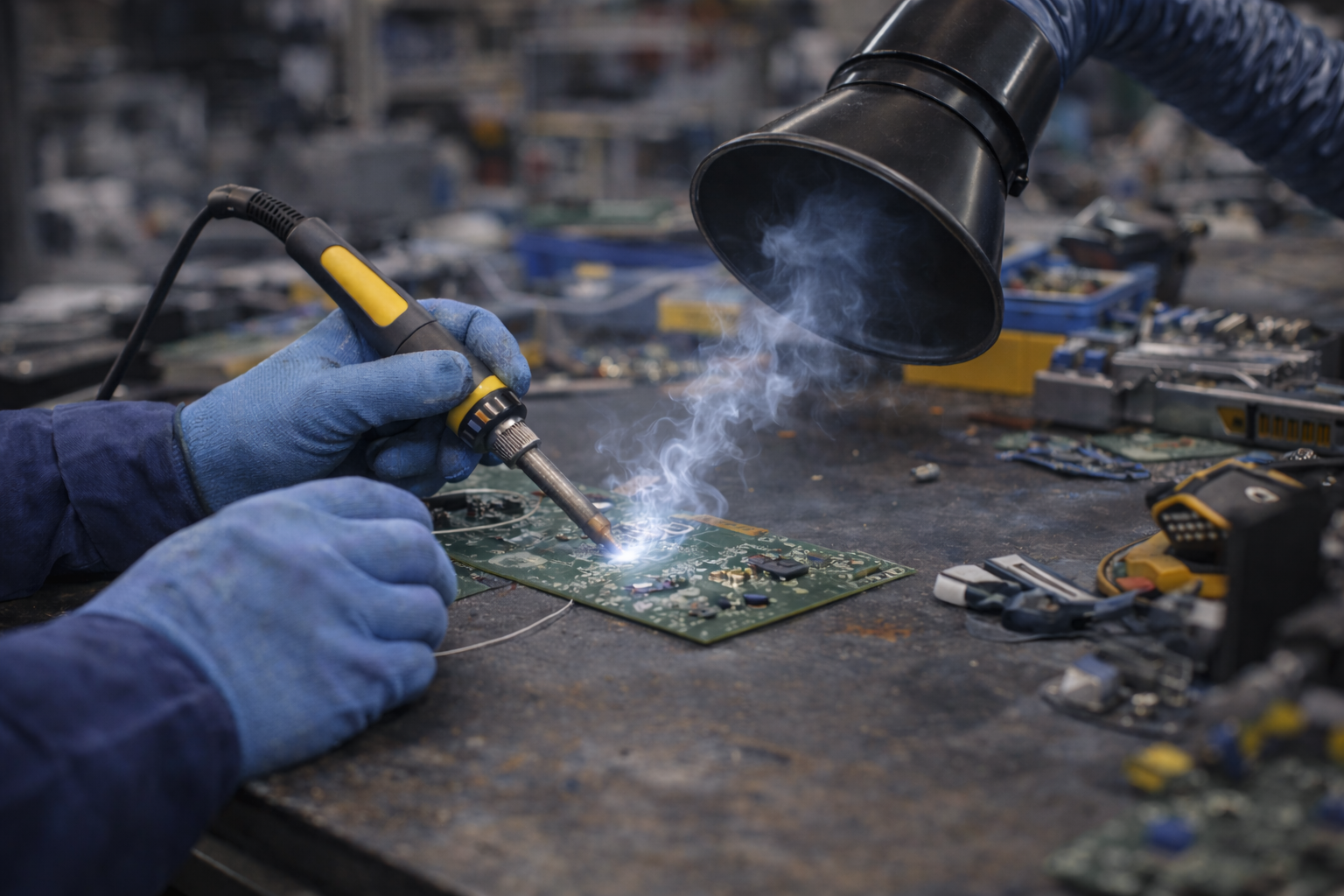
Why Fume Control Matters in PCB Assembly
Soldering is a precision process. Even small contamination affects joint quality and inspection accuracy. During soldering, flux fumes rise and spread across the workstation. If these fumes remain uncontrolled, they affect both workers and the PCB itself.
Poor fume control increases defects, inspection failures, and rework rates.
What Happens When Soldering Fumes Are Not Controlled
Residue Build-Up on PCB Surfaces
Flux fumes contain fine particles. These particles settle on boards, tools, and nearby components. This creates surface contamination.
Reduced Visibility During Soldering
Smoke around the solder joint reduces operator visibility. Poor visibility leads to uneven joints and missed defects.
Inconsistent Solder Joints
When fumes linger, operators adjust posture or reposition parts to avoid smoke. This affects hand stability and joint consistency.
Impact on PCB Quality
Cold Solder Joints
Limited visibility and unstable posture increase the risk of incomplete joints.
Bridging and Excess Solder
Impaired vision leads to excess solder or unintended connections between pads.
Inspection Delays
Surface haze from settled fumes affects visual inspection accuracy.
How Poor Fume Control Increases Rework Rates
Rework often results from avoidable defects. When soldering fumes are not captured at the source:
- Defects increase
- Inspection time rises
- Cleaning effort increases
- Production slows down
Repeated rework reduces overall efficiency and increases labor cost.
Role of a Soldering Fume Extractor
Source-Level Capture
A soldering fume extractor removes fumes directly at the soldering point. This prevents residue from settling on the PCB.
Improved Visibility
Clear air allows operators to see the joint clearly. This improves precision.
Cleaner Work Surface
Less airborne contamination means fewer cleaning cycles.
A reliable soldering fume extractor manufacturer in Bangalore designs systems suited for high-density PCB assembly lines.
Q&A: Soldering Fumes and PCB Quality
Q1: Can soldering fumes directly damage PCBs?
Fumes do not damage boards instantly, but residue increases contamination and rework risk.
Q2: Does room ventilation solve the issue?
No. Ventilation dilutes fumes. Extraction removes them at the source.
Q3: Can better fume control reduce inspection time?
Yes. Clear visibility improves inspection speed and accuracy.
Q4: Is fume extraction necessary for small assembly units?
Yes. Even low-volume soldering generates fumes that affect quality over time.
Conclusion
Poor soldering fume control affects more than worker comfort. It reduces PCB quality, increases defects, and raises rework rates. Flux fumes settle on boards, reduce visibility, and slow inspection.
Using a soldering fume extractor ensures clean air at the workstation. This improves joint quality, reduces rework, and supports consistent production performance.