
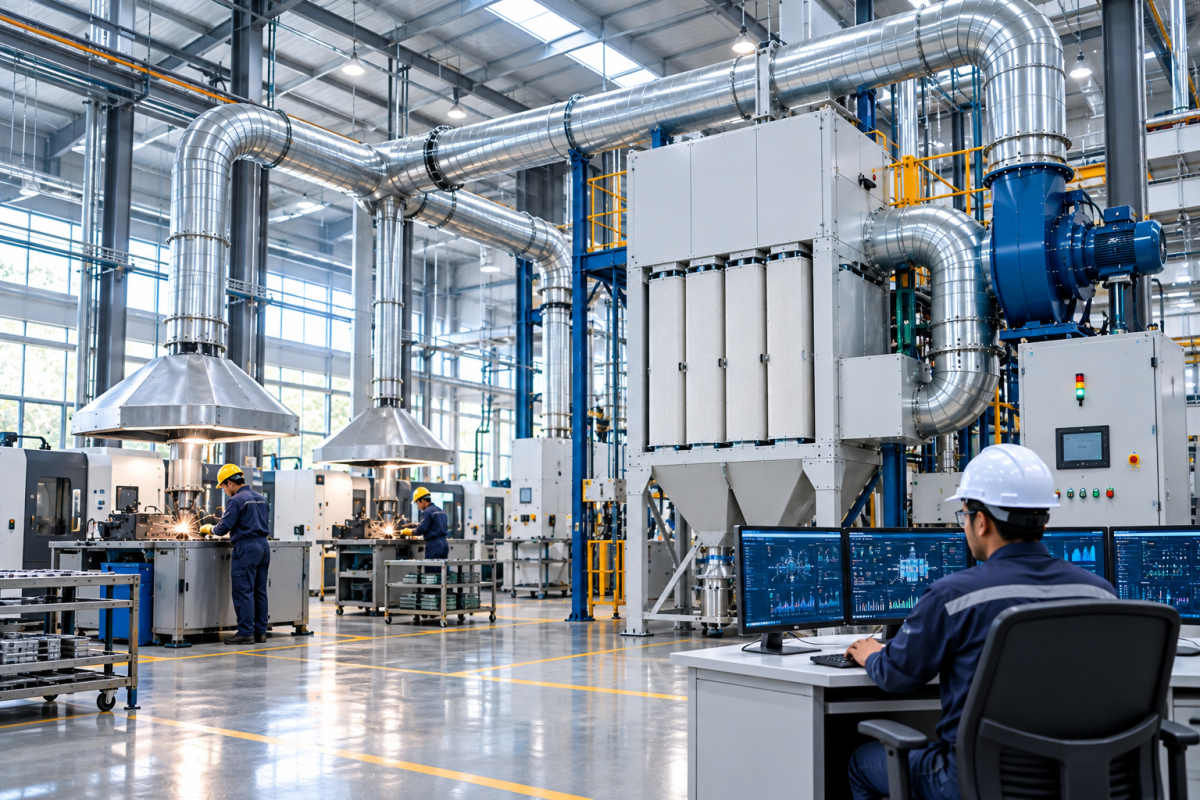
Industrial air pollution control is moving beyond conventional filtration equipment toward systems that are more connected, measurable, energy-conscious, and responsive to changing production conditions.
Traditional dust collectors, mist collectors, scrubbers, baghouses, cartridge collectors, and fume extraction systems will continue to play an important role. However, developments in sensors, connected equipment, automated controls, data analytics, and advanced filtration are changing how these systems are monitored and maintained.
For manufacturers, the future of industrial air pollution control technology is therefore not simply about developing a better filter. It is increasingly about creating an integrated system that can capture contaminants effectively, measure performance continuously, and respond to changing operating conditions.
Key Takeaways
- Industrial filtration is increasingly incorporating sensors and connected monitoring.
- Condition-based maintenance can use real-time performance data rather than relying only on fixed maintenance schedules.
- Advanced monitoring can track parameters such as airflow, filter differential pressure, particulate emissions, and equipment status.
- Energy efficiency is becoming increasingly important in extraction and filtration system design.
- Future systems are likely to place greater emphasis on automated controls and variable airflow.
- Advanced filtration will remain application-specific rather than relying on one universal technology.
- Digital monitoring can also support documentation and environmental compliance activities.
How Industrial Air Pollution Control Is Changing
Historically, industrial air pollution control systems were primarily evaluated according to whether they could capture and filter the required contaminant.
The system would typically consist of:
Capture hood → Ductwork → Filter → Blower → Exhaust
That basic architecture remains relevant.
The difference is that modern systems can increasingly add a layer of measurement and automation:
Capture → Filtration → Monitoring → Analysis → Automated response
Connected filtration systems already monitor parameters such as differential pressure, airflow, compressed-air pressure, particulate trends, and maintenance hours.
This creates opportunities to move from periodic inspection toward continuous performance monitoring.
1. Smart and Connected Filtration Systems
One of the clearest developments in industrial filtration is the integration of sensors and connectivity.
A conventional collector may provide a differential-pressure gauge that an operator checks periodically.
A connected system can continuously collect performance information and provide alerts when operating parameters move outside defined limits.
Depending on the equipment, monitored parameters can include:
- Filter differential pressure
- Airflow
- Compressed-air pressure
- Filter-cleaning performance
- Particulate emissions
- Fan or motor performance
- Dust discharge conditions
- Maintenance hours
Industrial filtration manufacturers are already deploying these capabilities commercially.
Why This Matters
Continuous monitoring can help maintenance teams identify developing problems earlier rather than discovering them during a scheduled inspection.
For example, a gradual increase in differential pressure may indicate increasing filter loading.
An unexpected change in airflow could indicate:
- Filter loading
- Duct blockage
- Damper changes
- Fan problems
- System leakage
The technology does not replace engineering inspection, but it can provide additional information about when inspection may be required.
2. Condition-Based Maintenance
Traditional maintenance often follows a calendar:
Inspect every month → Replace filters after a fixed period → Service equipment annually
Future filtration systems are increasingly moving toward condition-based maintenance.
Instead of replacing a filter simply because a predetermined period has passed, maintenance decisions can incorporate actual system performance.
For example:
Normal differential pressure → Continue operation
Increasing differential pressure → Investigate
Pressure reaches defined threshold → Plan filter service or replacement
Connected filtration systems are already being used to support this approach. Donaldson describes connected monitoring as a way to track equipment performance continuously and identify maintenance issues through alerts and historical trends.
This can be particularly useful for large manufacturing plants operating multiple collectors.
3. More Advanced Air Quality Monitoring
Another developing area is the use of increasingly capable sensors to measure pollutants and emissions.
Environmental monitoring technologies are evolving toward:
- Higher-frequency measurements
- Remote monitoring
- Distributed sensors
- Mobile monitoring
- Source-emission monitoring
- Automated data collection
The U.S. EPA has highlighted sensor technologies, leak detection, fenceline monitoring, mobile monitoring, and combining sensor data with other information systems as areas of development in next-generation emissions measurement.
For industrial facilities, this could allow air pollution control systems to be evaluated using more detailed operational data rather than occasional manual measurements alone.
4. Automated Airflow Control
Airflow is central to the performance of industrial extraction systems.
Too little airflow can reduce capture effectiveness.
Too much airflow can increase energy consumption and potentially cause unnecessary wear.
This creates an opportunity for automated airflow control.
Variable-frequency drives and airflow controllers can adjust fan operation to maintain appropriate system conditions as operating requirements change. Industrial filtration guidance already identifies variable-frequency drives as one method of maintaining design airflow as filter resistance changes.
Future systems can increasingly combine:
Sensors + controls + variable-speed drives
to adapt extraction performance to actual production requirements.
5. Energy-Efficient Industrial Filtration
Energy consumption is an important consideration because industrial extraction systems may operate for long periods.
The blower must overcome resistance from:
- Hoods
- Ductwork
- Filters
- Dampers
- Exhaust components
As resistance increases, maintaining airflow can require additional fan energy.
Future system design is therefore likely to focus increasingly on:
- Lower-pressure-drop filtration
- Efficient fan selection
- Variable-speed operation
- Optimized ductwork
- Demand-based airflow
- Better filter cleaning
- Reduced leakage
The objective is not simply to minimize fan power. The system still needs to maintain the airflow required for effective contaminant capture.
6. Improved Filter Media
Filter media continue to evolve in response to increasingly demanding industrial applications.
Developments can focus on characteristics such as:
- Filtration efficiency
- Dust-holding capacity
- Pressure drop
- Resistance to moisture
- Temperature resistance
- Chemical compatibility
- Mechanical durability
- Filter service life
The important point is that advanced air filtration systems will not necessarily mean one universal filter technology.
A filter suitable for fine dry dust may not be suitable for oil mist.
A filter designed for welding fumes may not be suitable for high-temperature process gases.
Future filtration will therefore continue to be application-specific.
7. Multi-Stage Filtration
Some industrial processes generate more than one type of contaminant.
For example, a process may produce both particulate and vapour-phase contaminants.
A single filtration stage may not provide the required control.
This can lead to multi-stage systems combining technologies such as:
Pre-filtration → Fine particulate filtration → Gas/vapour filtration
Depending on the application, technologies can include:
- Cartridge filters
- Bag filters
- HEPA filtration
- Activated carbon
- Electrostatic filtration
- Wet scrubbing
- Other specialized filtration
The appropriate combination depends on the contaminant characteristics and required performance.
8. Better Emission Monitoring
Future industrial emission control systems are likely to place greater emphasis on measuring system performance rather than assuming it.
Monitoring can help answer questions such as:
- Is the collector operating normally?
- Is airflow being maintained?
- Are filters loading unusually quickly?
- Are particulate emissions changing?
- Is the cleaning system functioning?
- Is the exhaust performance changing over time?
Connected filtration systems already provide examples of this approach, with some systems monitoring particulate trends and generating alerts when defined operating parameters are exceeded.
9. Digital Maintenance Records
Industrial filtration maintenance traditionally relies heavily on:
- Inspection sheets
- Manual readings
- Service logs
- Filter replacement records
Connected systems can automate some of this data collection.
Historical information can help maintenance teams identify trends such as:
- Increasing filter life
- Declining filter life
- Repeated pressure increases
- Recurring airflow problems
- Frequent equipment alarms
This information can also support environmental, health, and safety documentation. Connected filtration systems are already being used to automate certain performance and compliance data collection.
10. Retrofitting Existing Equipment
The future of industrial air pollution control does not necessarily mean replacing existing equipment.
Older dust collectors and filtration systems can potentially benefit from:
- New sensors
- Digital pressure monitoring
- Airflow measurement
- Automated alerts
- Variable-speed drives
- Improved filter media
- Updated controls
Connected monitoring has specifically been developed as a way of adding performance visibility to existing filtration equipment.
For manufacturers with large installed equipment bases, retrofitting monitoring and control technology may therefore become an important part of modernization.
11. Integration With Factory Automation
As manufacturing facilities become more connected, air pollution control equipment can increasingly become part of the broader plant automation environment.
Instead of operating as an isolated system, a filtration unit could potentially exchange information with:
- Building management systems
- Manufacturing control systems
- Maintenance platforms
- Energy-management systems
- Environmental monitoring systems
This could allow production and environmental-control data to be considered together.
For example, extraction demand could potentially be adjusted according to machine operating status rather than maintaining maximum airflow continuously.
12. Greater Focus on Source Capture
Despite advances in filtration technology, one principle is unlikely to change:
Capturing contaminants close to their source remains fundamental.
A more efficient filter does not eliminate the need for appropriate capture.
For example:
- Welding fumes → capture close to the welding operation
- CNC oil mist → extraction at the machine
- Grinding dust → capture at the grinding process
- Powder → extraction at the transfer or handling point
The future is therefore likely to combine better filtration with better capture, airflow control, and monitoring rather than treating filtration as an isolated component.
13. Artificial Intelligence and Predictive Analytics
As filtration systems generate more operational data, analytics can potentially be used to identify patterns that are difficult to detect through occasional manual inspections.
Potential applications include:
- Predicting filter replacement requirements
- Detecting unusual pressure trends
- Identifying airflow abnormalities
- Comparing equipment performance over time
- Detecting recurring faults
- Supporting maintenance scheduling
This should be viewed as an emerging application rather than a universal capability. The usefulness of predictive analytics depends on the quality and quantity of sensor data available and how well the system is integrated with maintenance processes.
What Future Filtration Systems May Look Like
A future industrial filtration system could combine several technologies:
Process
↓
Source Capture
↓
Multi-Stage Filtration
↓
Airflow & Pressure Sensors
↓
Particulate/Emission Monitoring
↓
Variable-Speed Blower
↓
Connected Control System
↓
Performance Dashboard
↓
Condition-Based Maintenance
The physical filtration technology remains essential, but the surrounding control and monitoring layer becomes increasingly sophisticated.
Choosing Future-Ready Air Pollution Control Technology
Manufacturers evaluating a new system should consider more than the initial filtration equipment.
Important questions include:
Can the system be monitored?
Look for the ability to measure relevant performance parameters.
Can airflow be controlled?
Variable-speed operation may be useful where production requirements change.
Can the system generate alerts?
Early notification can help maintenance teams respond to developing problems.
Can the system store historical data?
Trend data can be useful for maintenance and performance analysis.
Can the equipment be expanded?
Consider future production capacity and additional extraction points.
Can existing equipment be upgraded?
Sensors and control upgrades may extend the usefulness of existing filtration equipment.
What This Means for Manufacturers
The future of industrial air pollution control technology is not simply about replacing conventional dust collectors with "smart" equipment.
The more important shift is toward integrated system performance.
A manufacturer may increasingly evaluate:
- Capture effectiveness
- Filtration efficiency
- Energy consumption
- Airflow stability
- Filter life
- Maintenance requirements
- Emission performance
- Equipment uptime
- Historical operating data
This creates a more complete picture of how the pollution-control system is performing.
Powertech and the Future of Industrial Air Pollution Control
Powertech’s approach to industrial pollution control can be built around the same fundamental engineering principles: identify the contaminant, capture it effectively, select appropriate filtration, and design the airflow system around the application.
Its solution categories include:
- DustBag industrial dust collection
- FumeKiller welding fume extraction
- MistKiller oil and coolant mist collection
- Local exhaust systems
- Centralized extraction
- Customized ductwork and filtration
As monitoring and control technologies develop, these systems can increasingly be complemented by performance monitoring, airflow measurement, automated controls, and condition-based maintenance.
The sector is increasingly moving toward connected monitoring, automated controls, energy-efficient operation, condition-based maintenance, advanced sensors, and application-specific filtration.
Advanced air filtration systems can combine improved filter media with multi-stage filtration, automated cleaning, monitoring, airflow control, and other technologies designed around specific industrial contaminants.
IoT-enabled filtration systems can collect information such as differential pressure, airflow, particulate trends, and equipment status and provide alerts or historical performance data.
Condition-based maintenance uses actual equipment performance information to determine when maintenance may be required rather than relying entirely on fixed calendar intervals.
No. AI and analytics are more likely to complement physical filtration equipment by helping monitor performance, identify trends, and support maintenance decisions. The capture and filtration technology remains essential.
Potential approaches include efficient fans, optimized ductwork, lower-pressure-drop filtration, variable-frequency drives, appropriate airflow control, and reducing unnecessary extraction airflow.
In some cases, existing collectors can be fitted with sensors and connected monitoring systems. The feasibility depends on the collector design, controls, available instrumentation, and required measurements.
The future of industrial air pollution control technology is moving toward systems that are not only capable of filtering contaminants but can also measure, communicate, and adapt. Advanced air filtration systems will continue to rely on established technologies such as cartridge filters, baghouses, mist collectors, scrubbers, and specialized filtration media. Around these technologies, however, sensors, connected controls, airflow management, data analytics, and condition-based maintenance are creating new ways to operate and maintain pollution-control equipment. For manufacturers, the most useful future technologies will be those that solve practical problems: maintaining capture performance, reducing unnecessary energy use, identifying maintenance needs earlier, and providing better visibility into industrial emission control. The result is likely to be a more integrated approach in which capture, filtration, airflow, monitoring, and maintenance work together as one system.