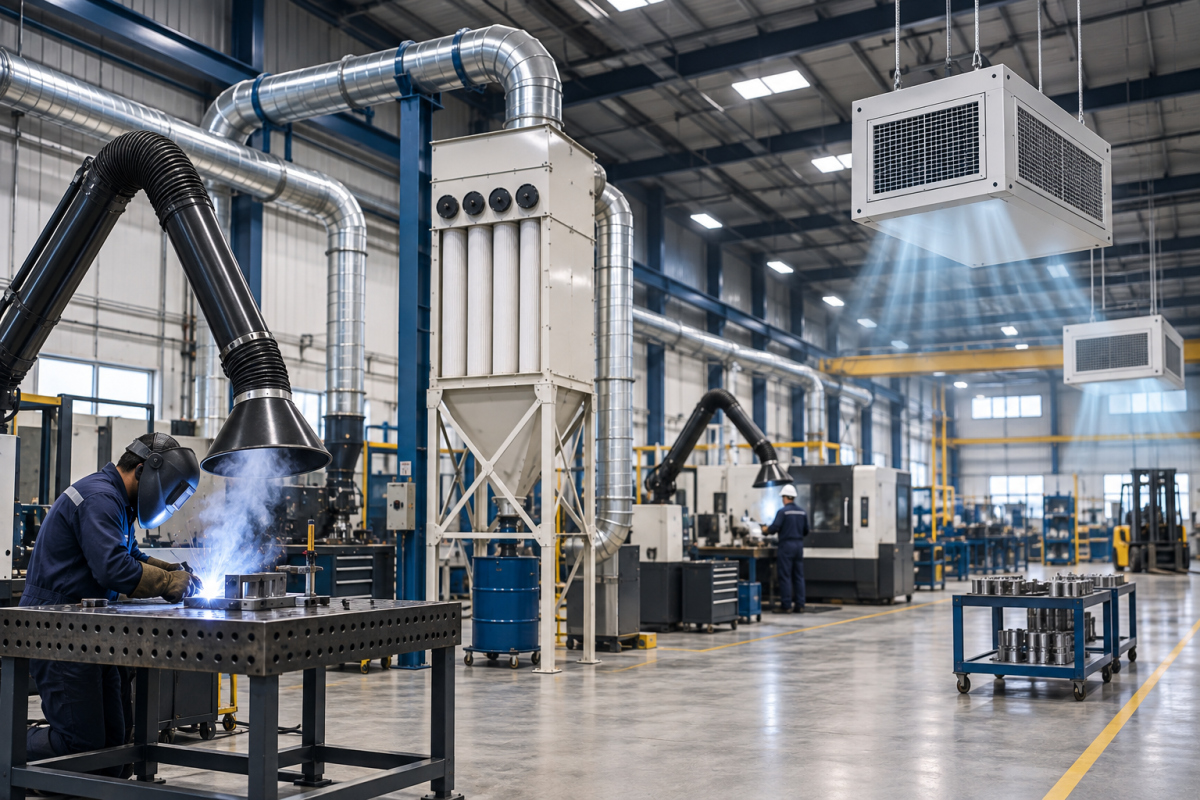
Source Capture vs Ambient Air Filtration Systems

Introduction

Manufacturing processes can generate dust, welding fumes, oil mist, coolant mist, smoke, and other airborne contaminants. Controlling these pollutants effectively requires more than simply moving air around a facility. The location and method of extraction play a major role in determining how efficiently contaminants are controlled.

Two common approaches are source capture ventilation and ambient air filtration. While both can improve workplace air quality, they serve different purposes.

Source capture ventilation removes contaminants directly where they are generated, while ambient industrial air filtration cleans contaminated air after it has dispersed into the surrounding workspace.

For most processes that produce concentrated airborne contaminants, local exhaust ventilation (LEV) and properly designed source extraction systems should form the primary method of control, with ambient filtration used as a complementary solution where appropriate.

Key Takeaways

  1. Source capture removes contaminants before they disperse into the workplace.
  2. Ambient filtration cleans air that has already become contaminated.
  3. Local exhaust ventilation generally requires less airflow than whole-room filtration.
  4. Source capture is particularly effective for welding fumes, dust, oil mist, and process emissions.
  5. Ambient filtration can complement source extraction by controlling residual airborne contaminants.
  6. The best solution depends on the process, contaminant, plant layout, and operating conditions.

What Is Source Capture Ventilation?

Source capture ventilation is an extraction method that captures an airborne contaminant at or very close to the point where it is generated.

Examples include:

  1. Welding fume extraction arms
  2. CNC mist collectors
  3. Grinding dust extraction hoods
  4. Machine enclosures
  5. Downdraft tables
  6. Side-draft extraction
  7. Extraction hoods over process equipment

The objective is simple: capture the contaminant before it spreads.

For example, a welding extraction arm positioned close to the welding arc can capture fumes before they travel through the operator’s breathing zone and surrounding workspace.

What Is Ambient Air Filtration?

Ambient filtration operates differently.

Instead of capturing contaminants directly at the source, the system draws contaminated air from the surrounding workspace, passes it through filters, and returns cleaner air to the facility or exhausts it appropriately.

Ambient industrial air filtration can be useful when:

  1. Source capture is difficult
  2. Contaminants are released from multiple dispersed sources
  3. Residual airborne contamination remains after source extraction
  4. Large open production areas require supplementary air cleaning

However, ambient filtration should not automatically be treated as a replacement for source capture.

Source Capture vs Ambient Filtration

FactorSource Capture VentilationAmbient Air Filtration
Capture locationAt contaminant sourceThroughout workspace
Primary objectivePrevent dispersionClean already-contaminated air
Required airflowUsually lowerUsually higher
Contaminant controlHighly targetedGeneral
Best forConcentrated emissionsResidual/background contamination
Energy efficiencyGenerally favorableCan require greater airflow
Equipment protectionExcellent when captured at sourceLess effective against source emissions
Plant layoutProcess-specificFacility-wide
Typical equipmentHoods, arms, enclosuresAmbient filtration units
Best rolePrimary controlSupplementary control

Why Source Capture Is Usually More Effective

The concentration of a contaminant is generally highest close to the point where it is generated.

As it moves away from the source, it becomes increasingly dispersed.

Capturing it close to the source therefore provides several advantages.

1. Smaller Airflow Requirements

A localized extraction hood can control a specific emission without attempting to move the air volume of an entire factory.

2. Better Contaminant Control

The pollutant is removed before it can spread to other workstations.

3. Reduced Workplace Contamination

Less dust, mist, and fume reaches machinery, surfaces, and surrounding work areas.

4. Improved Operator Protection

Properly positioned source extraction can reduce the amount of contaminant reaching the operator’s breathing zone.

5. Lower Energy Consumption

Moving smaller quantities of air can require less energy than continuously filtering the entire production area.

How Local Exhaust Ventilation Works

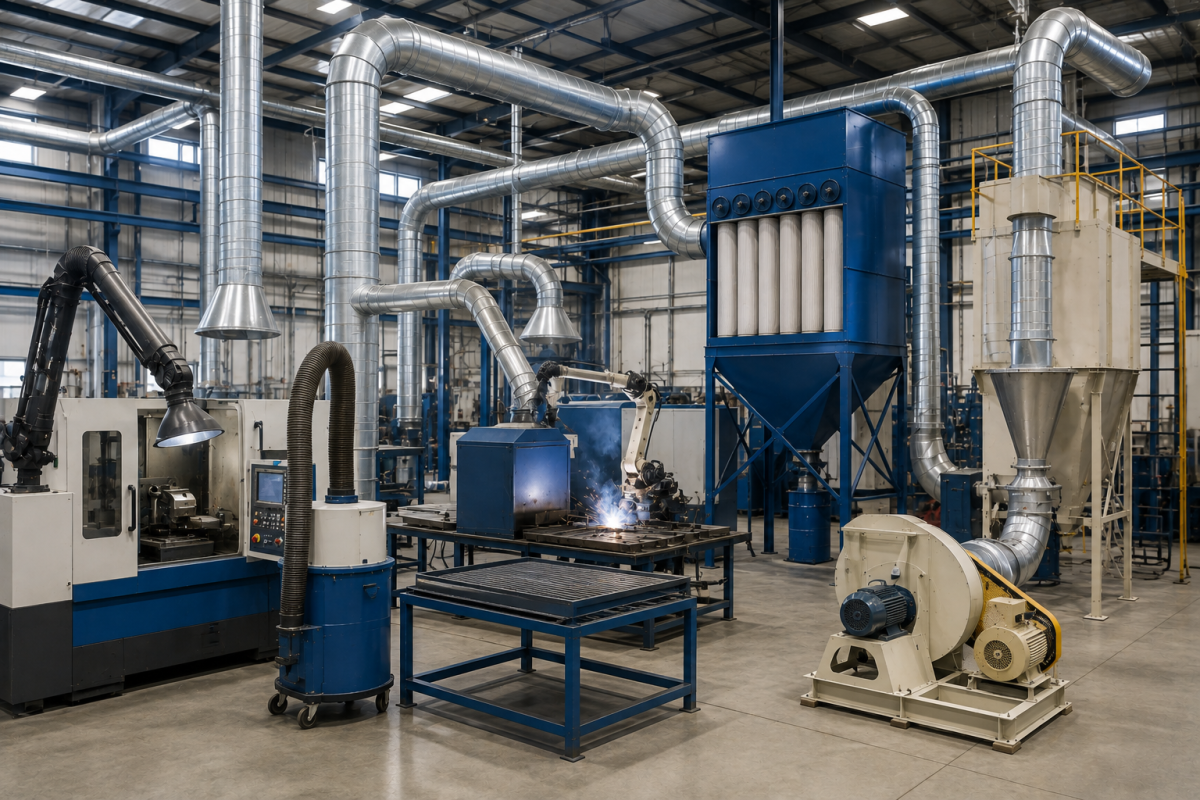
A typical local exhaust ventilation system consists of:

  1. Capture hood
  2. Ductwork
  3. Filtration equipment
  4. Exhaust blower
  5. Discharge or return-air arrangement

The hood captures contaminated air.

The ductwork transports it.

The filtration equipment removes the contaminant.

The blower provides the airflow needed to overcome system resistance.

For the system to work effectively, these components must be designed as an integrated system.

Common Source Extraction Systems

Welding Fume Extraction

Flexible extraction arms can be positioned close to welding operations to capture fumes at the source.

For mobile welding applications, a portable welding fume extractor can provide source capture without permanent ductwork.

CNC Oil and Coolant Mist Extraction

A mist collector connected directly to a CNC machine enclosure can remove airborne coolant and oil mist before it escapes into the machine shop.

Grinding Dust Extraction

Extraction hoods or downdraft systems can help dust collectors capture grinding dust close to the point of generation.

Powder Handling

A dust collector coupled with enclosures and extraction hoods around bag dumping, filling, mixing, and transfer points can prevent fine powder from dispersing.

Where Ambient Industrial Air Filtration Helps

Ambient filtration can still play an important role in an overall air quality strategy.

It may be useful when:

Sources Are Widely Dispersed

A large facility may have numerous small emission sources that are difficult to capture individually.

Processes Are Open

Some manufacturing operations cannot be completely enclosed.

Residual Contamination Remains

Even well-designed source extraction may leave a small amount of airborne contamination in the workspace.

Additional Air Cleaning Is Required

Ambient filtration can provide a secondary layer of contaminant control.

Can Ambient Filtration Replace Source Capture?

In most concentrated emission applications, it should not be the first choice.

Consider a welding shop.

If welding fumes are allowed to disperse throughout the facility before an ambient filtration unit removes them, workers and equipment may already have been exposed to the contaminant.

A source extraction system instead attempts to remove the fumes immediately at the welding operation.

The same principle applies to:

  1. Grinding dust
  2. CNC coolant mist
  3. Powder transfer
  4. Process smoke
  5. Cutting emissions

Capture first. Clean the remaining air second.

Combining Source Capture and Ambient Filtration

The two technologies do not have to compete.

A well-designed industrial air quality strategy can use both.

Primary Control

Use source extraction systems to capture contaminants directly at emission points.

Secondary Control

Use ambient industrial air filtration to control residual airborne contaminants.

General Ventilation

Use appropriately designed general ventilation to support overall facility air management.

This layered approach can be particularly useful in large manufacturing plants with multiple processes.

Factors to Consider When Choosing a System

Type of Contaminant

Determine whether the process generates:

  1. Dust
  2. Welding fumes
  3. Oil mist
  4. Coolant mist
  5. Smoke
  6. Vapour
  7. Fine powder

Different contaminants require different filtration technologies.

Source Characteristics

Consider:

  1. Location
  2. Emission rate
  3. Process energy
  4. Temperature
  5. Particle size
  6. Operating frequency

Facility Layout

A compact workshop with fixed machines may be well suited to centralized source extraction.

A large facility with frequently changing work locations may require portable systems or a combination of technologies.

Number of Sources

Multiple fixed sources can potentially be connected to a centralized extraction system.

Widely distributed or mobile operations may benefit from portable source extraction.

Common Mistakes

Using Ambient Filtration as the Only Control

This can allow contaminants to disperse before they are captured.

Poor Hood Positioning

Even a powerful extraction system may perform poorly if the capture hood is too far from the emission source.

Selecting Equipment Based Only on CFM

Airflow must be evaluated alongside static pressure, hood design, ductwork, and filtration resistance.

Ignoring Process Changes

Adding machines or changing production conditions can affect the performance of an existing extraction system.

Neglecting Maintenance

Loaded filters, damaged ductwork, and poor airflow can gradually reduce extraction effectiveness.

Powertech’s Approach

Powertech’s pollution control solutions are designed around the contaminant and the process generating it.

Depending on the application, an appropriate system may include:

  1. FumeKiller welding fume extraction
  2. MistKiller oil and coolant mist collection
  3. DustBag industrial dust collection
  4. Local exhaust ventilation
  5. Centralized source extraction
  6. Ambient air filtration
  7. Customized ductwork and filtration

The objective is to capture contaminants as close as practical to their source and use supplementary air filtration where it provides additional value.

What is source capture ventilation?

Source capture ventilation removes airborne contaminants directly at or near the point where they are generated, preventing them from dispersing throughout the workplace.

What is local exhaust ventilation?

Local exhaust ventilation is a ventilation method that captures contaminants at their source using hoods, enclosures, extraction arms, ductwork, and filtration equipment.

Is source capture better than ambient air filtration?

For concentrated emissions, source capture is generally more effective because it removes contaminants before they disperse. Ambient filtration is often best used as a supplementary control.

When is ambient industrial air filtration useful?

Ambient filtration can be useful for controlling residual airborne contamination, widely dispersed emissions, or applications where complete source capture is impractical.

Can source extraction and ambient filtration be used together?

Yes. Source extraction can provide primary contaminant control while ambient filtration provides secondary air cleaning throughout the facility.

How do I choose between source extraction and ambient filtration?

Consider the contaminant, emission source, process, required airflow, facility layout, number of sources, and whether the emission can be captured effectively at its origin.

Conclusion

The choice between source capture ventilation and ambient air filtration should not be based simply on the size or power of the filtration equipment. The fundamental difference is where the contaminant is captured. For concentrated manufacturing emissions, local exhaust ventilation and properly engineered source extraction systems generally provide the most effective primary control because they capture contaminants before they disperse. Ambient industrial air filtration remains valuable as a complementary solution, particularly in large facilities or applications where some residual contamination is unavoidable. For the strongest overall approach, manufacturers should consider a layered strategy: capture contaminants at the source, filter residual airborne contaminants, and maintain appropriate general ventilation throughout the facility.
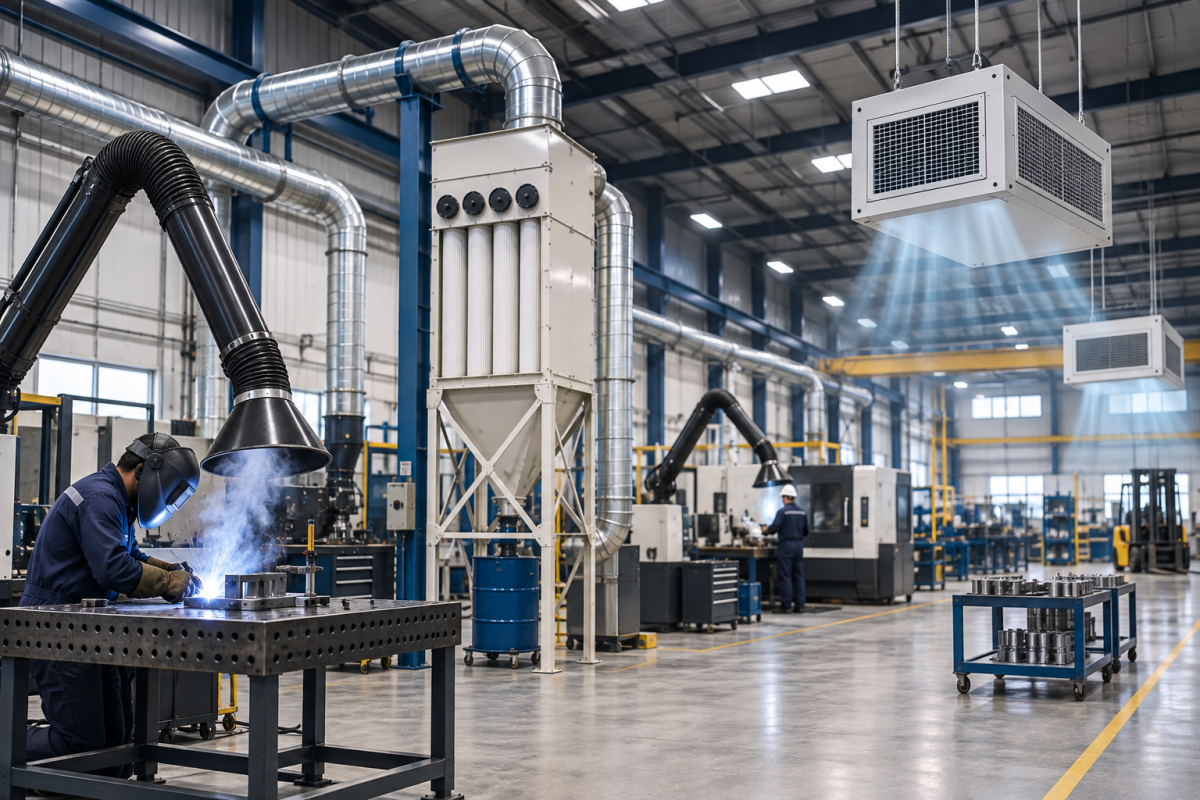
Source Capture vs Ambient Air Filtration Systems

Introduction

Manufacturing processes can generate dust, welding fumes, oil mist, coolant mist, smoke, and other airborne contaminants. Controlling these pollutants effectively requires more than simply moving air around a facility. The location and method of extraction play a major role in determining how efficiently contaminants are controlled.

Two common approaches are source capture ventilation and ambient air filtration. While both can improve workplace air quality, they serve different purposes.

Source capture ventilation removes contaminants directly where they are generated, while ambient industrial air filtration cleans contaminated air after it has dispersed into the surrounding workspace.

For most processes that produce concentrated airborne contaminants, local exhaust ventilation (LEV) and properly designed source extraction systems should form the primary method of control, with ambient filtration used as a complementary solution where appropriate.

Key Takeaways

  1. Source capture removes contaminants before they disperse into the workplace.
  2. Ambient filtration cleans air that has already become contaminated.
  3. Local exhaust ventilation generally requires less airflow than whole-room filtration.
  4. Source capture is particularly effective for welding fumes, dust, oil mist, and process emissions.
  5. Ambient filtration can complement source extraction by controlling residual airborne contaminants.
  6. The best solution depends on the process, contaminant, plant layout, and operating conditions.

What Is Source Capture Ventilation?

Source capture ventilation is an extraction method that captures an airborne contaminant at or very close to the point where it is generated.

Examples include:

  1. Welding fume extraction arms
  2. CNC mist collectors
  3. Grinding dust extraction hoods
  4. Machine enclosures
  5. Downdraft tables
  6. Side-draft extraction
  7. Extraction hoods over process equipment

The objective is simple: capture the contaminant before it spreads.

For example, a welding extraction arm positioned close to the welding arc can capture fumes before they travel through the operator’s breathing zone and surrounding workspace.

What Is Ambient Air Filtration?

Ambient filtration operates differently.

Instead of capturing contaminants directly at the source, the system draws contaminated air from the surrounding workspace, passes it through filters, and returns cleaner air to the facility or exhausts it appropriately.

Ambient industrial air filtration can be useful when:

  1. Source capture is difficult
  2. Contaminants are released from multiple dispersed sources
  3. Residual airborne contamination remains after source extraction
  4. Large open production areas require supplementary air cleaning

However, ambient filtration should not automatically be treated as a replacement for source capture.

Source Capture vs Ambient Filtration

FactorSource Capture VentilationAmbient Air Filtration
Capture locationAt contaminant sourceThroughout workspace
Primary objectivePrevent dispersionClean already-contaminated air
Required airflowUsually lowerUsually higher
Contaminant controlHighly targetedGeneral
Best forConcentrated emissionsResidual/background contamination
Energy efficiencyGenerally favorableCan require greater airflow
Equipment protectionExcellent when captured at sourceLess effective against source emissions
Plant layoutProcess-specificFacility-wide
Typical equipmentHoods, arms, enclosuresAmbient filtration units
Best rolePrimary controlSupplementary control

Why Source Capture Is Usually More Effective

The concentration of a contaminant is generally highest close to the point where it is generated.

As it moves away from the source, it becomes increasingly dispersed.

Capturing it close to the source therefore provides several advantages.

1. Smaller Airflow Requirements

A localized extraction hood can control a specific emission without attempting to move the air volume of an entire factory.

2. Better Contaminant Control

The pollutant is removed before it can spread to other workstations.

3. Reduced Workplace Contamination

Less dust, mist, and fume reaches machinery, surfaces, and surrounding work areas.

4. Improved Operator Protection

Properly positioned source extraction can reduce the amount of contaminant reaching the operator’s breathing zone.

5. Lower Energy Consumption

Moving smaller quantities of air can require less energy than continuously filtering the entire production area.

How Local Exhaust Ventilation Works

A typical local exhaust ventilation system consists of:

  1. Capture hood
  2. Ductwork
  3. Filtration equipment
  4. Exhaust blower
  5. Discharge or return-air arrangement

The hood captures contaminated air.

The ductwork transports it.

The filtration equipment removes the contaminant.

The blower provides the airflow needed to overcome system resistance.

For the system to work effectively, these components must be designed as an integrated system.

Common Source Extraction Systems

Welding Fume Extraction

Flexible extraction arms can be positioned close to welding operations to capture fumes at the source.

For mobile welding applications, a portable welding fume extractor can provide source capture without permanent ductwork.

CNC Oil and Coolant Mist Extraction

A mist collector connected directly to a CNC machine enclosure can remove airborne coolant and oil mist before it escapes into the machine shop.

Grinding Dust Extraction

Extraction hoods or downdraft systems can help dust collectors capture grinding dust close to the point of generation.

Powder Handling

A dust collector coupled with enclosures and extraction hoods around bag dumping, filling, mixing, and transfer points can prevent fine powder from dispersing.

Where Ambient Industrial Air Filtration Helps

Ambient filtration can still play an important role in an overall air quality strategy.

It may be useful when:

Sources Are Widely Dispersed

A large facility may have numerous small emission sources that are difficult to capture individually.

Processes Are Open

Some manufacturing operations cannot be completely enclosed.

Residual Contamination Remains

Even well-designed source extraction may leave a small amount of airborne contamination in the workspace.

Additional Air Cleaning Is Required

Ambient filtration can provide a secondary layer of contaminant control.

Can Ambient Filtration Replace Source Capture?

In most concentrated emission applications, it should not be the first choice.

Consider a welding shop.

If welding fumes are allowed to disperse throughout the facility before an ambient filtration unit removes them, workers and equipment may already have been exposed to the contaminant.

A source extraction system instead attempts to remove the fumes immediately at the welding operation.

The same principle applies to:

  1. Grinding dust
  2. CNC coolant mist
  3. Powder transfer
  4. Process smoke
  5. Cutting emissions

Capture first. Clean the remaining air second.

Combining Source Capture and Ambient Filtration

The two technologies do not have to compete.

A well-designed industrial air quality strategy can use both.

Primary Control

Use source extraction systems to capture contaminants directly at emission points.

Secondary Control

Use ambient industrial air filtration to control residual airborne contaminants.

General Ventilation

Use appropriately designed general ventilation to support overall facility air management.

This layered approach can be particularly useful in large manufacturing plants with multiple processes.

Factors to Consider When Choosing a System

Type of Contaminant

Determine whether the process generates:

  1. Dust
  2. Welding fumes
  3. Oil mist
  4. Coolant mist
  5. Smoke
  6. Vapour
  7. Fine powder

Different contaminants require different filtration technologies.

Source Characteristics

Consider:

  1. Location
  2. Emission rate
  3. Process energy
  4. Temperature
  5. Particle size
  6. Operating frequency

Facility Layout

A compact workshop with fixed machines may be well suited to centralized source extraction.

A large facility with frequently changing work locations may require portable systems or a combination of technologies.

Number of Sources

Multiple fixed sources can potentially be connected to a centralized extraction system.

Widely distributed or mobile operations may benefit from portable source extraction.

Common Mistakes

Using Ambient Filtration as the Only Control

This can allow contaminants to disperse before they are captured.

Poor Hood Positioning

Even a powerful extraction system may perform poorly if the capture hood is too far from the emission source.

Selecting Equipment Based Only on CFM

Airflow must be evaluated alongside static pressure, hood design, ductwork, and filtration resistance.

Ignoring Process Changes

Adding machines or changing production conditions can affect the performance of an existing extraction system.

Neglecting Maintenance

Loaded filters, damaged ductwork, and poor airflow can gradually reduce extraction effectiveness.

Powertech’s Approach

Powertech’s pollution control solutions are designed around the contaminant and the process generating it.

Depending on the application, an appropriate system may include:

  1. FumeKiller welding fume extraction
  2. MistKiller oil and coolant mist collection
  3. DustBag industrial dust collection
  4. Local exhaust ventilation
  5. Centralized source extraction
  6. Ambient air filtration
  7. Customized ductwork and filtration

The objective is to capture contaminants as close as practical to their source and use supplementary air filtration where it provides additional value.

What is source capture ventilation?

Source capture ventilation removes airborne contaminants directly at or near the point where they are generated, preventing them from dispersing throughout the workplace.

What is local exhaust ventilation?

Local exhaust ventilation is a ventilation method that captures contaminants at their source using hoods, enclosures, extraction arms, ductwork, and filtration equipment.

Is source capture better than ambient air filtration?

For concentrated emissions, source capture is generally more effective because it removes contaminants before they disperse. Ambient filtration is often best used as a supplementary control.

When is ambient industrial air filtration useful?

Ambient filtration can be useful for controlling residual airborne contamination, widely dispersed emissions, or applications where complete source capture is impractical.

Can source extraction and ambient filtration be used together?

Yes. Source extraction can provide primary contaminant control while ambient filtration provides secondary air cleaning throughout the facility.

How do I choose between source extraction and ambient filtration?

Consider the contaminant, emission source, process, required airflow, facility layout, number of sources, and whether the emission can be captured effectively at its origin.

Conclusion

The choice between source capture ventilation and ambient air filtration should not be based simply on the size or power of the filtration equipment. The fundamental difference is where the contaminant is captured. For concentrated manufacturing emissions, local exhaust ventilation and properly engineered source extraction systems generally provide the most effective primary control because they capture contaminants before they disperse. Ambient industrial air filtration remains valuable as a complementary solution, particularly in large facilities or applications where some residual contamination is unavoidable. For the strongest overall approach, manufacturers should consider a layered strategy: capture contaminants at the source, filter residual airborne contaminants, and maintain appropriate general ventilation throughout the facility.

Industrial Air Pollution Control Systems in Manufacturing

Introduction

Manufacturing processes can release a wide range of airborne contaminants, including dust, welding fumes, oil mist, coolant mist, smoke, vapours, and fine particulate matter. If these contaminants are not effectively controlled, they can affect workplace air quality, contaminate machinery, increase maintenance requirements, and create challenging operating conditions.

An effective industrial air pollution control strategy captures contaminants as close as possible to their source and removes them through appropriately selected filtration or separation equipment.

For manufacturing facilities, this may involve industrial air filtration systems, local exhaust ventilation, dust collectors, mist collectors, fume extraction systems, or a combination of technologies.

The right solution depends on the contaminant, process, airflow requirements, facility layout, and operating conditions.

Key Takeaways

  1. Different manufacturing processes generate different types of airborne contaminants.
  2. Source capture is generally more effective than attempting to clean contaminated air after it has dispersed.
  3. Industrial air filtration systems should be selected based on the specific contaminant.
  4. Dust, fumes, mist, and vapours require different collection and filtration technologies.
  5. Properly designed industrial ventilation systems improve contaminant control and workplace air quality.
  6. An integrated factory air pollution control strategy can reduce equipment contamination, maintenance, and housekeeping requirements.

What Is Industrial Air Pollution Control?

Industrial air pollution control refers to the systems and engineering practices used to capture, filter, separate, or otherwise control airborne contaminants generated by industrial processes.

A typical system may include:

  1. Source-capture hood or enclosure
  2. Extraction ductwork
  3. Filtration or separation equipment
  4. Industrial blower
  5. Dust or contaminant discharge system
  6. Monitoring and control equipment

The objective is to prevent contaminants from spreading into the production environment while maintaining the required airflow at the source.

Common Air Pollutants in Manufacturing

Different manufacturing processes produce different contaminants.

Dust

Generated during:

  1. Grinding
  2. Cutting
  3. Sanding
  4. Polishing
  5. Crushing
  6. Material handling
  7. Powder processing

Dust collectors are typically used to capture and filter these particles.

Welding Fumes

Welding and thermal cutting can generate fine particulate fumes and gases.

Source-capture welding fume extractors can remove these contaminants close to the welding operation.

Oil and Coolant Mist

CNC machining and metalworking operations can generate airborne oil and coolant droplets.

Mist collectors are designed to capture these aerosols before they spread throughout the machine shop.

Smoke and Fine Particles

Processes involving heating, thermal treatment, soldering, and other high-temperature operations can produce smoke and fine particulate emissions.

The filtration system should be selected according to the characteristics of the contaminant.

Why Source Capture Is Important

One of the fundamental principles of factory air pollution control is to capture contaminants before they disperse.

Consider a grinding machine generating fine metal dust.

If an extraction hood is positioned close to the grinding operation, the dust can be captured almost immediately.

If the facility instead relies on general room ventilation, the dust can spread throughout the workspace before eventually reaching the filtration system.

Source capture generally provides:

  1. Better contaminant control
  2. Lower required airflow
  3. Reduced workplace contamination
  4. Less equipment fouling
  5. Lower housekeeping requirements
  6. More targeted extraction

Types of Industrial Air Filtration Systems

There is no single filtration technology suitable for every manufacturing application.

1. Baghouse Dust Collectors

Baghouse systems use fabric filter bags to separate dust particles from an air stream.

They are commonly used for applications involving:

  1. High dust loading
  2. Grinding
  3. Material handling
  4. Mineral processing
  5. Large manufacturing operations

2. Cartridge Dust Collectors

Cartridge collectors use pleated filter elements that provide a large filtration surface within a relatively compact system.

They can be suitable for many fine, dry particulate applications.

3. Mist Collectors

Mist collectors remove airborne oil and coolant droplets generated during machining.

They are particularly relevant to:

  1. CNC machining
  2. Turning
  3. Milling
  4. Grinding
  5. Metalworking

Powertech’s MistKiller range is designed for industrial oil and coolant mist extraction applications.

4. Welding Fume Extractors

Welding fume extraction systems capture fumes directly at the welding source.

Depending on the application, systems may use:

  1. Flexible extraction arms
  2. Portable extractors
  3. Centralized extraction
  4. Source-capture hoods
  5. Specialized extraction arrangements

Powertech’s FumeKiller systems are designed for source-capture welding fume extraction.

5. Multi-Stage Filtration

Some industrial processes require more than one filtration stage.

A system may combine:

  1. Pre-filtration
  2. Particle filtration
  3. Fine filtration
  4. Gas or vapour filtration

The configuration depends on the contaminants and required air quality.

Industrial Ventilation Systems vs Local Exhaust

Industrial ventilation systems generally fall into two broad categories.

General or Dilution Ventilation

General ventilation replaces or dilutes contaminated air throughout a facility.

It can help manage overall environmental conditions but may not effectively control contaminants at their source.

Local Exhaust Ventilation

Local exhaust captures contaminants directly at the point where they are generated.

For concentrated industrial emissions, local exhaust is generally the preferred primary control strategy.

The two approaches can be used together where appropriate.

Designing a Factory Air Pollution Control System

A successful system should be designed around the actual manufacturing process.

Step 1: Identify Contaminant Sources

Determine where dust, fumes, mist, smoke, or other pollutants are generated.

Step 2: Characterize the Contaminant

Consider:

  1. Particle size
  2. Concentration
  3. Temperature
  4. Moisture
  5. Chemical properties
  6. Density
  7. Combustibility
  8. Required filtration level

Step 3: Select the Capture Method

Determine whether the process requires:

  1. Enclosure
  2. Extraction hood
  3. Extraction arm
  4. Downdraft extraction
  5. Side-draft extraction
  6. Machine-integrated extraction

Step 4: Calculate Airflow

The required airflow depends on the capture method, source geometry, process conditions, and number of extraction points.

Step 5: Design the Ductwork

Duct diameter, length, bends, branches, and airflow velocity all affect system resistance and performance.

Step 6: Select the Filtration Technology

Choose the appropriate dust collector, mist collector, fume extractor, or multi-stage filtration system.

Step 7: Select the Blower

The blower should be capable of delivering the required airflow at the calculated system static pressure.

Factors That Affect System Performance

Even a high-quality filtration unit can underperform if the overall system is poorly designed.

Important factors include:

Hood Position

The extraction point should be located as close as practical to the contaminant source.

Airflow

Insufficient airflow can result in poor capture.

Static Pressure

The blower must overcome resistance from the hood, ductwork, filters, fittings, and exhaust arrangement.

Filter Condition

Loaded or damaged filters can affect airflow and filtration performance.

Ductwork

Leaks, blockages, poor sizing, and excessive bends can reduce system efficiency.

Maintenance

Regular inspection is essential for maintaining long-term performance.

Benefits of Effective Industrial Air Pollution Control

A properly designed system can provide several operational benefits.

Cleaner Production Areas

Source capture reduces the amount of airborne contamination circulating through the facility.

Reduced Equipment Contamination

Dust, oil mist, and fumes can settle on machinery, electrical systems, and production equipment.

Effective extraction helps minimize this buildup.

Lower Housekeeping Requirements

Reducing airborne contaminants can reduce the amount of material settling on floors, equipment, and surfaces.

Improved Product Quality

Contamination can affect certain manufacturing and finishing processes. Better air control can help maintain cleaner production conditions.

Reduced Maintenance

Less contamination around equipment can contribute to lower cleaning and maintenance requirements.

Improved Working Environment

Effective contaminant control contributes to cleaner workplace conditions and better overall environmental management.

Common Industrial Air Pollution Control Mistakes

Relying Only on General Ventilation

General ventilation cannot always control concentrated emissions effectively.

Installing the Wrong Filtration Technology

A filter designed for dry dust may not be appropriate for oil mist or chemical vapours.

Using Insufficient Airflow

Inadequate airflow can result in contaminants escaping the capture zone.

Poor Hood Positioning

Increasing the distance between the hood and source can significantly reduce capture effectiveness.

Ignoring Duct Design

Even an appropriately sized collector can perform poorly when connected to an inefficient duct network.

Neglecting Maintenance

Loaded filters, damaged seals, blocked ducts, and malfunctioning cleaning systems can gradually reduce performance.

Choosing the Right Industrial Air Pollution Control System

Before selecting equipment, manufacturers should evaluate:

FactorWhat to Consider
ContaminantDust, fume, mist, smoke, vapour
Particle sizeCoarse, fine, or ultrafine
SourceMachine, process, workstation, transfer point
AirflowRequired CFM
Static pressureTotal system resistance
Operating hoursIntermittent or continuous
Number of sourcesSingle or multiple
FiltrationRequired filtration technology
Plant layoutPortable, local, or centralized
MaintenanceFilter and equipment servicing
Future expansionAdditional machines or processes

Powertech’s Approach to Industrial Air Pollution Control

Powertech develops application-specific pollution control solutions rather than relying on a single filtration technology for every manufacturing process.

Depending on the application, the solution may involve:

  1. FumeKiller welding fume extraction systems
  2. MistKiller oil and coolant mist collectors
  3. DustBag industrial dust collection systems
  4. Local exhaust ventilation
  5. Centralized extraction systems
  6. Customized ductwork and filtration arrangements

The system can be engineered around the contaminant characteristics, production process, airflow requirements, plant layout, and operating conditions.

What is industrial air pollution control?

Industrial air pollution control involves capturing, filtering, separating, or otherwise controlling airborne contaminants generated by manufacturing and industrial processes.

What are industrial air filtration systems used for?

Industrial air filtration systems are used to remove contaminants such as dust, welding fumes, smoke, oil mist, coolant mist, and other airborne particles from industrial environments.

What is the difference between dust collection and air filtration?

Dust collection typically focuses on capturing and removing particulate generated by a specific process, while industrial air filtration can refer more broadly to systems that clean contaminated air, including dust, fumes, mist, and other pollutants.

Are industrial ventilation systems enough to control factory pollution?

General ventilation can support overall air management, but it may not provide effective source control for concentrated emissions. Local exhaust extraction is generally more effective for capturing contaminants at their source.

How do I choose an industrial air pollution control system?

The system should be selected based on the contaminant type, particle characteristics, process, required airflow, static pressure, operating conditions, filtration requirements, and facility layout.

Can one system control multiple industrial pollutants?

In some facilities, multiple contaminants can be managed through a coordinated system, but different pollutants may require different collection or filtration technologies. The system should be engineered based on the specific application.

Conclusion

Effective industrial air pollution control is an important part of modern manufacturing. Dust, welding fumes, oil mist, coolant mist, and other airborne contaminants require different approaches, making application-specific engineering essential. The most effective strategy is generally to capture contaminants close to their source and transport them through a properly designed extraction and filtration system. Industrial air filtration systems, local exhaust, and industrial ventilation systems can then work together to maintain cleaner production environments. For manufacturers, the right factory air pollution control solution can reduce airborne contamination, protect equipment, lower housekeeping requirements, and support more reliable production. Powertech provides engineered pollution control solutions across dust, mist, and welding fume applications, helping manufacturers select the appropriate technology for their specific processes.