Source Capture vs Ambient Air Filtration Systems

Introduction

Manufacturing processes can generate dust, welding fumes, oil mist, coolant mist, smoke, and other airborne contaminants. Controlling these pollutants effectively requires more than simply moving air around a facility. The location and method of extraction play a major role in determining how efficiently contaminants are controlled.

Two common approaches are source capture ventilation and ambient air filtration. While both can improve workplace air quality, they serve different purposes.

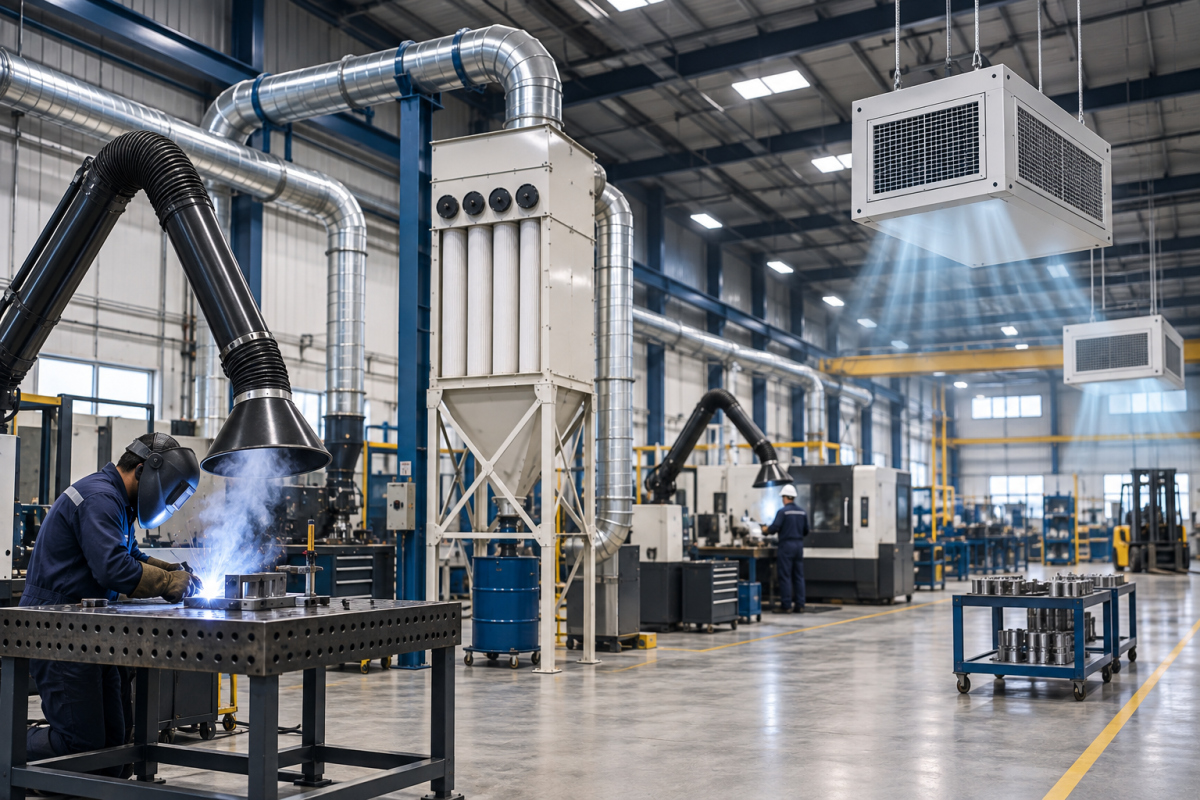
Source capture ventilation removes contaminants directly where they are generated, while ambient industrial air filtration cleans contaminated air after it has dispersed into the surrounding workspace.

For most processes that produce concentrated airborne contaminants, local exhaust ventilation (LEV) and properly designed source extraction systems should form the primary method of control, with ambient filtration used as a complementary solution where appropriate.

Key Takeaways

  1. Source capture removes contaminants before they disperse into the workplace.
  2. Ambient filtration cleans air that has already become contaminated.
  3. Local exhaust ventilation generally requires less airflow than whole-room filtration.
  4. Source capture is particularly effective for welding fumes, dust, oil mist, and process emissions.
  5. Ambient filtration can complement source extraction by controlling residual airborne contaminants.
  6. The best solution depends on the process, contaminant, plant layout, and operating conditions.

What Is Source Capture Ventilation?

Source capture ventilation is an extraction method that captures an airborne contaminant at or very close to the point where it is generated.

Examples include:

  1. Welding fume extraction arms
  2. CNC mist collectors
  3. Grinding dust extraction hoods
  4. Machine enclosures
  5. Downdraft tables
  6. Side-draft extraction
  7. Extraction hoods over process equipment

The objective is simple: capture the contaminant before it spreads.

For example, a welding extraction arm positioned close to the welding arc can capture fumes before they travel through the operator’s breathing zone and surrounding workspace.

What Is Ambient Air Filtration?

Ambient filtration operates differently.

Instead of capturing contaminants directly at the source, the system draws contaminated air from the surrounding workspace, passes it through filters, and returns cleaner air to the facility or exhausts it appropriately.

Ambient industrial air filtration can be useful when:

  1. Source capture is difficult
  2. Contaminants are released from multiple dispersed sources
  3. Residual airborne contamination remains after source extraction
  4. Large open production areas require supplementary air cleaning

However, ambient filtration should not automatically be treated as a replacement for source capture.

Source Capture vs Ambient Filtration

FactorSource Capture VentilationAmbient Air Filtration
Capture locationAt contaminant sourceThroughout workspace
Primary objectivePrevent dispersionClean already-contaminated air
Required airflowUsually lowerUsually higher
Contaminant controlHighly targetedGeneral
Best forConcentrated emissionsResidual/background contamination
Energy efficiencyGenerally favorableCan require greater airflow
Equipment protectionExcellent when captured at sourceLess effective against source emissions
Plant layoutProcess-specificFacility-wide
Typical equipmentHoods, arms, enclosuresAmbient filtration units
Best rolePrimary controlSupplementary control

Why Source Capture Is Usually More Effective

The concentration of a contaminant is generally highest close to the point where it is generated.

As it moves away from the source, it becomes increasingly dispersed.

Capturing it close to the source therefore provides several advantages.

1. Smaller Airflow Requirements

A localized extraction hood can control a specific emission without attempting to move the air volume of an entire factory.

2. Better Contaminant Control

The pollutant is removed before it can spread to other workstations.

3. Reduced Workplace Contamination

Less dust, mist, and fume reaches machinery, surfaces, and surrounding work areas.

4. Improved Operator Protection

Properly positioned source extraction can reduce the amount of contaminant reaching the operator’s breathing zone.

5. Lower Energy Consumption

Moving smaller quantities of air can require less energy than continuously filtering the entire production area.

How Local Exhaust Ventilation Works

A typical local exhaust ventilation system consists of:

  1. Capture hood
  2. Ductwork
  3. Filtration equipment
  4. Exhaust blower
  5. Discharge or return-air arrangement

The hood captures contaminated air.

The ductwork transports it.

The filtration equipment removes the contaminant.

The blower provides the airflow needed to overcome system resistance.

For the system to work effectively, these components must be designed as an integrated system.

Common Source Extraction Systems

Welding Fume Extraction

Flexible extraction arms can be positioned close to welding operations to capture fumes at the source.

For mobile welding applications, a portable welding fume extractor can provide source capture without permanent ductwork.

CNC Oil and Coolant Mist Extraction

A mist collector connected directly to a CNC machine enclosure can remove airborne coolant and oil mist before it escapes into the machine shop.

Grinding Dust Extraction

Extraction hoods or downdraft systems can help dust collectors capture grinding dust close to the point of generation.

Powder Handling

A dust collector coupled with enclosures and extraction hoods around bag dumping, filling, mixing, and transfer points can prevent fine powder from dispersing.

Where Ambient Industrial Air Filtration Helps

Ambient filtration can still play an important role in an overall air quality strategy.

It may be useful when:

Sources Are Widely Dispersed

A large facility may have numerous small emission sources that are difficult to capture individually.

Processes Are Open

Some manufacturing operations cannot be completely enclosed.

Residual Contamination Remains

Even well-designed source extraction may leave a small amount of airborne contamination in the workspace.

Additional Air Cleaning Is Required

Ambient filtration can provide a secondary layer of contaminant control.

Can Ambient Filtration Replace Source Capture?

In most concentrated emission applications, it should not be the first choice.

Consider a welding shop.

If welding fumes are allowed to disperse throughout the facility before an ambient filtration unit removes them, workers and equipment may already have been exposed to the contaminant.

A source extraction system instead attempts to remove the fumes immediately at the welding operation.

The same principle applies to:

  1. Grinding dust
  2. CNC coolant mist
  3. Powder transfer
  4. Process smoke
  5. Cutting emissions

Capture first. Clean the remaining air second.

Combining Source Capture and Ambient Filtration

The two technologies do not have to compete.

A well-designed industrial air quality strategy can use both.

Primary Control

Use source extraction systems to capture contaminants directly at emission points.

Secondary Control

Use ambient industrial air filtration to control residual airborne contaminants.

General Ventilation

Use appropriately designed general ventilation to support overall facility air management.

This layered approach can be particularly useful in large manufacturing plants with multiple processes.

Factors to Consider When Choosing a System

Type of Contaminant

Determine whether the process generates:

  1. Dust
  2. Welding fumes
  3. Oil mist
  4. Coolant mist
  5. Smoke
  6. Vapour
  7. Fine powder

Different contaminants require different filtration technologies.

Source Characteristics

Consider:

  1. Location
  2. Emission rate
  3. Process energy
  4. Temperature
  5. Particle size
  6. Operating frequency

Facility Layout

A compact workshop with fixed machines may be well suited to centralized source extraction.

A large facility with frequently changing work locations may require portable systems or a combination of technologies.

Number of Sources

Multiple fixed sources can potentially be connected to a centralized extraction system.

Widely distributed or mobile operations may benefit from portable source extraction.

Common Mistakes

Using Ambient Filtration as the Only Control

This can allow contaminants to disperse before they are captured.

Poor Hood Positioning

Even a powerful extraction system may perform poorly if the capture hood is too far from the emission source.

Selecting Equipment Based Only on CFM

Airflow must be evaluated alongside static pressure, hood design, ductwork, and filtration resistance.

Ignoring Process Changes

Adding machines or changing production conditions can affect the performance of an existing extraction system.

Neglecting Maintenance

Loaded filters, damaged ductwork, and poor airflow can gradually reduce extraction effectiveness.

Powertech’s Approach

Powertech’s pollution control solutions are designed around the contaminant and the process generating it.

Depending on the application, an appropriate system may include:

  1. FumeKiller welding fume extraction
  2. MistKiller oil and coolant mist collection
  3. DustBag industrial dust collection
  4. Local exhaust ventilation
  5. Centralized source extraction
  6. Ambient air filtration
  7. Customized ductwork and filtration

The objective is to capture contaminants as close as practical to their source and use supplementary air filtration where it provides additional value.

What is source capture ventilation?

Source capture ventilation removes airborne contaminants directly at or near the point where they are generated, preventing them from dispersing throughout the workplace.

What is local exhaust ventilation?

Local exhaust ventilation is a ventilation method that captures contaminants at their source using hoods, enclosures, extraction arms, ductwork, and filtration equipment.

Is source capture better than ambient air filtration?

For concentrated emissions, source capture is generally more effective because it removes contaminants before they disperse. Ambient filtration is often best used as a supplementary control.

When is ambient industrial air filtration useful?

Ambient filtration can be useful for controlling residual airborne contamination, widely dispersed emissions, or applications where complete source capture is impractical.

Can source extraction and ambient filtration be used together?

Yes. Source extraction can provide primary contaminant control while ambient filtration provides secondary air cleaning throughout the facility.

How do I choose between source extraction and ambient filtration?

Consider the contaminant, emission source, process, required airflow, facility layout, number of sources, and whether the emission can be captured effectively at its origin.

Conclusion

The choice between source capture ventilation and ambient air filtration should not be based simply on the size or power of the filtration equipment. The fundamental difference is where the contaminant is captured. For concentrated manufacturing emissions, local exhaust ventilation and properly engineered source extraction systems generally provide the most effective primary control because they capture contaminants before they disperse. Ambient industrial air filtration remains valuable as a complementary solution, particularly in large facilities or applications where some residual contamination is unavoidable. For the strongest overall approach, manufacturers should consider a layered strategy: capture contaminants at the source, filter residual airborne contaminants, and maintain appropriate general ventilation throughout the facility.
Source Capture vs Ambient Air Filtration Systems

Introduction

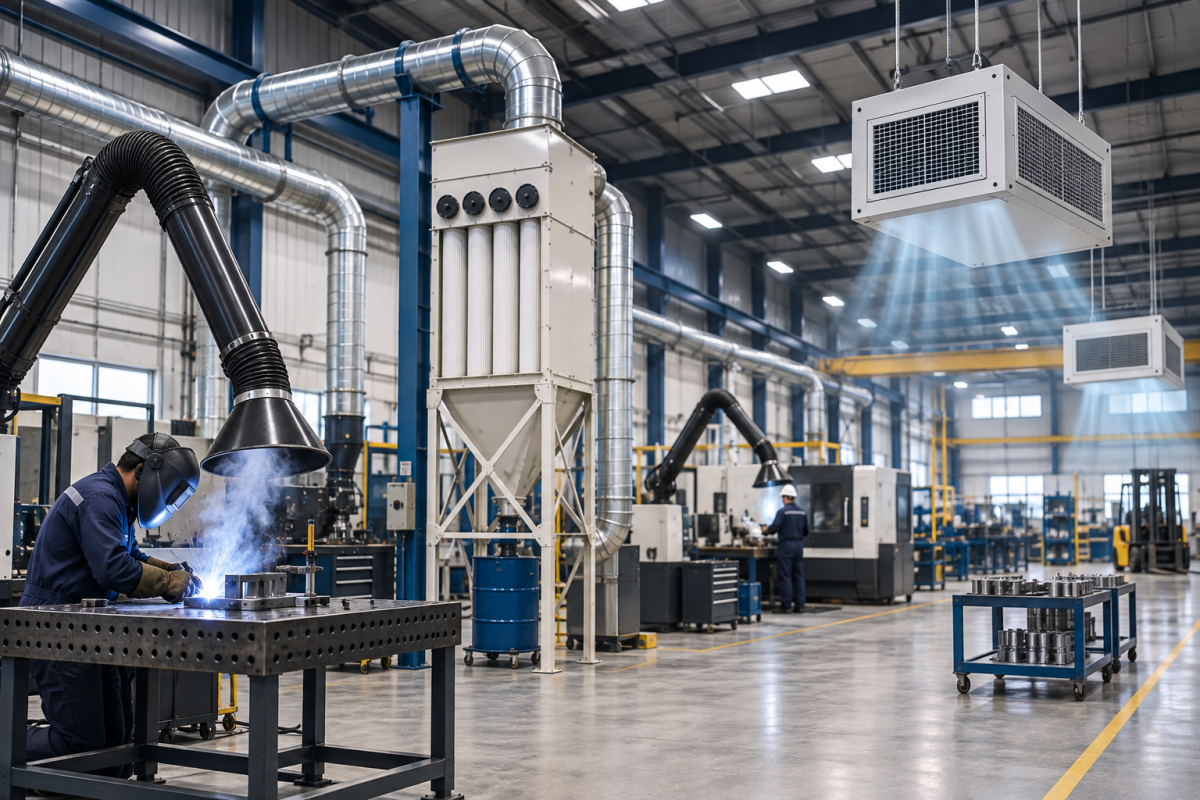
Manufacturing processes can generate dust, welding fumes, oil mist, coolant mist, smoke, and other airborne contaminants. Controlling these pollutants effectively requires more than simply moving air around a facility. The location and method of extraction play a major role in determining how efficiently contaminants are controlled.

Two common approaches are source capture ventilation and ambient air filtration. While both can improve workplace air quality, they serve different purposes.

Source capture ventilation removes contaminants directly where they are generated, while ambient industrial air filtration cleans contaminated air after it has dispersed into the surrounding workspace.

For most processes that produce concentrated airborne contaminants, local exhaust ventilation (LEV) and properly designed source extraction systems should form the primary method of control, with ambient filtration used as a complementary solution where appropriate.

Key Takeaways

  1. Source capture removes contaminants before they disperse into the workplace.
  2. Ambient filtration cleans air that has already become contaminated.
  3. Local exhaust ventilation generally requires less airflow than whole-room filtration.
  4. Source capture is particularly effective for welding fumes, dust, oil mist, and process emissions.
  5. Ambient filtration can complement source extraction by controlling residual airborne contaminants.
  6. The best solution depends on the process, contaminant, plant layout, and operating conditions.

What Is Source Capture Ventilation?

Source capture ventilation is an extraction method that captures an airborne contaminant at or very close to the point where it is generated.

Examples include:

  1. Welding fume extraction arms
  2. CNC mist collectors
  3. Grinding dust extraction hoods
  4. Machine enclosures
  5. Downdraft tables
  6. Side-draft extraction
  7. Extraction hoods over process equipment

The objective is simple: capture the contaminant before it spreads.

For example, a welding extraction arm positioned close to the welding arc can capture fumes before they travel through the operator’s breathing zone and surrounding workspace.

What Is Ambient Air Filtration?

Ambient filtration operates differently.

Instead of capturing contaminants directly at the source, the system draws contaminated air from the surrounding workspace, passes it through filters, and returns cleaner air to the facility or exhausts it appropriately.

Ambient industrial air filtration can be useful when:

  1. Source capture is difficult
  2. Contaminants are released from multiple dispersed sources
  3. Residual airborne contamination remains after source extraction
  4. Large open production areas require supplementary air cleaning

However, ambient filtration should not automatically be treated as a replacement for source capture.

Source Capture vs Ambient Filtration

FactorSource Capture VentilationAmbient Air Filtration
Capture locationAt contaminant sourceThroughout workspace
Primary objectivePrevent dispersionClean already-contaminated air
Required airflowUsually lowerUsually higher
Contaminant controlHighly targetedGeneral
Best forConcentrated emissionsResidual/background contamination
Energy efficiencyGenerally favorableCan require greater airflow
Equipment protectionExcellent when captured at sourceLess effective against source emissions
Plant layoutProcess-specificFacility-wide
Typical equipmentHoods, arms, enclosuresAmbient filtration units
Best rolePrimary controlSupplementary control

Why Source Capture Is Usually More Effective

The concentration of a contaminant is generally highest close to the point where it is generated.

As it moves away from the source, it becomes increasingly dispersed.

Capturing it close to the source therefore provides several advantages.

1. Smaller Airflow Requirements

A localized extraction hood can control a specific emission without attempting to move the air volume of an entire factory.

2. Better Contaminant Control

The pollutant is removed before it can spread to other workstations.

3. Reduced Workplace Contamination

Less dust, mist, and fume reaches machinery, surfaces, and surrounding work areas.

4. Improved Operator Protection

Properly positioned source extraction can reduce the amount of contaminant reaching the operator’s breathing zone.

5. Lower Energy Consumption

Moving smaller quantities of air can require less energy than continuously filtering the entire production area.

How Local Exhaust Ventilation Works

A typical local exhaust ventilation system consists of:

  1. Capture hood
  2. Ductwork
  3. Filtration equipment
  4. Exhaust blower
  5. Discharge or return-air arrangement

The hood captures contaminated air.

The ductwork transports it.

The filtration equipment removes the contaminant.

The blower provides the airflow needed to overcome system resistance.

For the system to work effectively, these components must be designed as an integrated system.

Common Source Extraction Systems

Welding Fume Extraction

Flexible extraction arms can be positioned close to welding operations to capture fumes at the source.

For mobile welding applications, a portable welding fume extractor can provide source capture without permanent ductwork.

CNC Oil and Coolant Mist Extraction

A mist collector connected directly to a CNC machine enclosure can remove airborne coolant and oil mist before it escapes into the machine shop.

Grinding Dust Extraction

Extraction hoods or downdraft systems can help dust collectors capture grinding dust close to the point of generation.

Powder Handling

A dust collector coupled with enclosures and extraction hoods around bag dumping, filling, mixing, and transfer points can prevent fine powder from dispersing.

Where Ambient Industrial Air Filtration Helps

Ambient filtration can still play an important role in an overall air quality strategy.

It may be useful when:

Sources Are Widely Dispersed

A large facility may have numerous small emission sources that are difficult to capture individually.

Processes Are Open

Some manufacturing operations cannot be completely enclosed.

Residual Contamination Remains

Even well-designed source extraction may leave a small amount of airborne contamination in the workspace.

Additional Air Cleaning Is Required

Ambient filtration can provide a secondary layer of contaminant control.

Can Ambient Filtration Replace Source Capture?

In most concentrated emission applications, it should not be the first choice.

Consider a welding shop.

If welding fumes are allowed to disperse throughout the facility before an ambient filtration unit removes them, workers and equipment may already have been exposed to the contaminant.

A source extraction system instead attempts to remove the fumes immediately at the welding operation.

The same principle applies to:

  1. Grinding dust
  2. CNC coolant mist
  3. Powder transfer
  4. Process smoke
  5. Cutting emissions

Capture first. Clean the remaining air second.

Combining Source Capture and Ambient Filtration

The two technologies do not have to compete.

A well-designed industrial air quality strategy can use both.

Primary Control

Use source extraction systems to capture contaminants directly at emission points.

Secondary Control

Use ambient industrial air filtration to control residual airborne contaminants.

General Ventilation

Use appropriately designed general ventilation to support overall facility air management.

This layered approach can be particularly useful in large manufacturing plants with multiple processes.

Factors to Consider When Choosing a System

Type of Contaminant

Determine whether the process generates:

  1. Dust
  2. Welding fumes
  3. Oil mist
  4. Coolant mist
  5. Smoke
  6. Vapour
  7. Fine powder

Different contaminants require different filtration technologies.

Source Characteristics

Consider:

  1. Location
  2. Emission rate
  3. Process energy
  4. Temperature
  5. Particle size
  6. Operating frequency

Facility Layout

A compact workshop with fixed machines may be well suited to centralized source extraction.

A large facility with frequently changing work locations may require portable systems or a combination of technologies.

Number of Sources

Multiple fixed sources can potentially be connected to a centralized extraction system.

Widely distributed or mobile operations may benefit from portable source extraction.

Common Mistakes

Using Ambient Filtration as the Only Control

This can allow contaminants to disperse before they are captured.

Poor Hood Positioning

Even a powerful extraction system may perform poorly if the capture hood is too far from the emission source.

Selecting Equipment Based Only on CFM

Airflow must be evaluated alongside static pressure, hood design, ductwork, and filtration resistance.

Ignoring Process Changes

Adding machines or changing production conditions can affect the performance of an existing extraction system.

Neglecting Maintenance

Loaded filters, damaged ductwork, and poor airflow can gradually reduce extraction effectiveness.

Powertech’s Approach

Powertech’s pollution control solutions are designed around the contaminant and the process generating it.

Depending on the application, an appropriate system may include:

  1. FumeKiller welding fume extraction
  2. MistKiller oil and coolant mist collection
  3. DustBag industrial dust collection
  4. Local exhaust ventilation
  5. Centralized source extraction
  6. Ambient air filtration
  7. Customized ductwork and filtration

The objective is to capture contaminants as close as practical to their source and use supplementary air filtration where it provides additional value.

What is source capture ventilation?

Source capture ventilation removes airborne contaminants directly at or near the point where they are generated, preventing them from dispersing throughout the workplace.

What is local exhaust ventilation?

Local exhaust ventilation is a ventilation method that captures contaminants at their source using hoods, enclosures, extraction arms, ductwork, and filtration equipment.

Is source capture better than ambient air filtration?

For concentrated emissions, source capture is generally more effective because it removes contaminants before they disperse. Ambient filtration is often best used as a supplementary control.

When is ambient industrial air filtration useful?

Ambient filtration can be useful for controlling residual airborne contamination, widely dispersed emissions, or applications where complete source capture is impractical.

Can source extraction and ambient filtration be used together?

Yes. Source extraction can provide primary contaminant control while ambient filtration provides secondary air cleaning throughout the facility.

How do I choose between source extraction and ambient filtration?

Consider the contaminant, emission source, process, required airflow, facility layout, number of sources, and whether the emission can be captured effectively at its origin.

Conclusion

The choice between source capture ventilation and ambient air filtration should not be based simply on the size or power of the filtration equipment. The fundamental difference is where the contaminant is captured. For concentrated manufacturing emissions, local exhaust ventilation and properly engineered source extraction systems generally provide the most effective primary control because they capture contaminants before they disperse. Ambient industrial air filtration remains valuable as a complementary solution, particularly in large facilities or applications where some residual contamination is unavoidable. For the strongest overall approach, manufacturers should consider a layered strategy: capture contaminants at the source, filter residual airborne contaminants, and maintain appropriate general ventilation throughout the facility.

Benefits of a Portable Weld Fume Extractor

Introduction

Welding fumes contain fine metal particles and gases that are generated whenever metals are joined using processes such as MIG, TIG, Stick, or Flux-Cored Arc Welding. In many fabrication shops, repair facilities, maintenance departments, and construction sites, welding is performed at multiple locations, making fixed extraction systems impractical. A portable weld fume extractor provides an efficient and flexible solution by capturing fumes directly at the source while allowing the extraction system to move wherever welding takes place.

Unlike centralized systems that serve fixed welding stations, portable units can be repositioned quickly between work areas. This flexibility makes them an ideal choice for workshops with changing layouts, low-to-medium production volumes, or maintenance operations where welding is performed intermittently across different locations.

Powertech’s FumeKiller portable welding fume extractors are engineered to provide effective source-capture extraction, helping manufacturers improve workplace air quality, protect operators, and maintain cleaner fabrication environments.

Key Takeaways

  1. Portable weld fume extractors capture fumes directly at the welding source.
  2. Mobile design allows easy movement between welding stations.
  3. Ideal for fabrication shops, maintenance, and repair operations.
  4. Improves air quality while reducing workshop contamination.
  5. Lower installation costs than centralized extraction systems.

What Is a Portable Weld Fume Extractor?

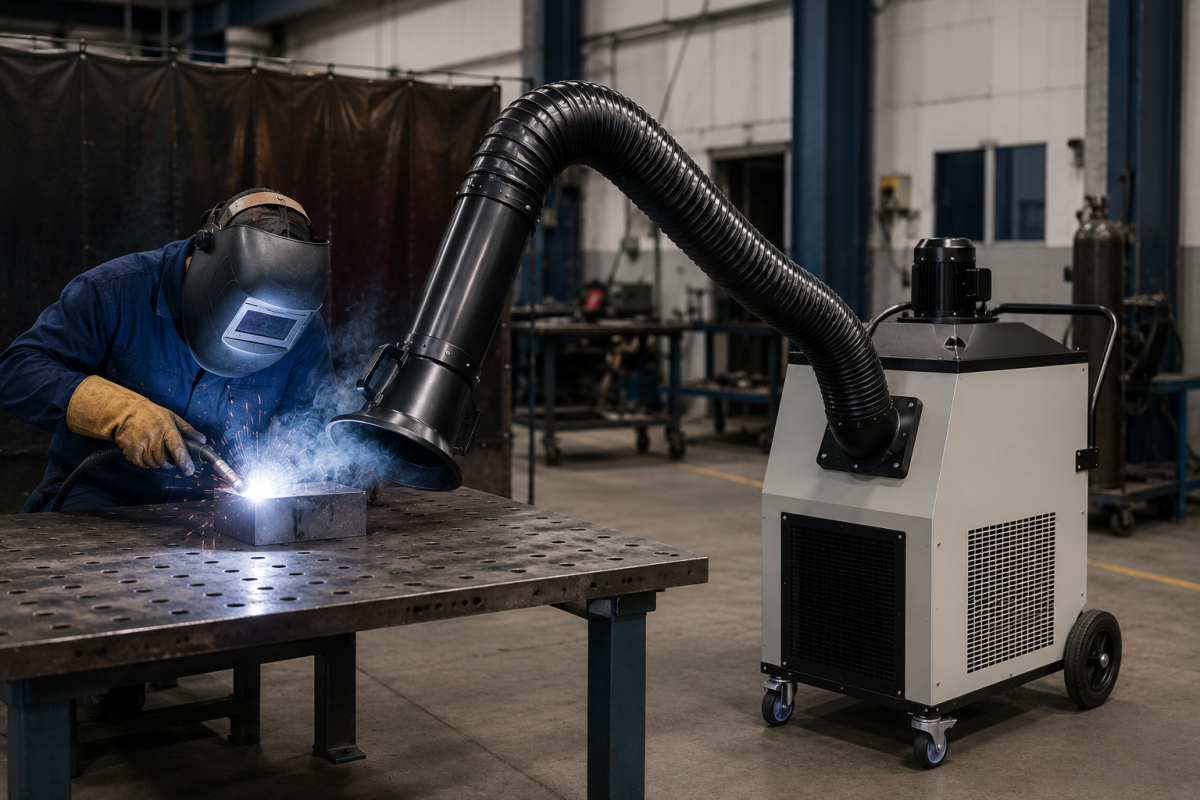
A portable weld fume extractor is a self-contained air filtration unit mounted on wheels and equipped with a flexible extraction arm. The operator positions the extraction hood close to the welding arc, where airborne fumes are captured before dispersing into the surrounding workspace.

Most systems include:

  1. Flexible extraction arm
  2. High-efficiency filtration system
  3. Industrial blower
  4. Mobile cabinet
  5. Collection filters
  6. Easy-access maintenance panels

Benefits of a Portable Weld Fume Extractor

1. Mobility

The biggest advantage is portability.

One unit can easily serve multiple welding stations by simply moving it where welding is taking place.

2. Effective Source Capture

When the extraction hood is positioned near the welding arc, fumes are captured before reaching the operator’s breathing zone.

This significantly improves extraction efficiency.

3. Lower Installation Cost

Portable units do not require:

  1. Permanent ductwork
  2. Extensive plant modifications
  3. Centralized piping
  4. Large capital investment

This makes them an economical solution for many facilities.

4. Flexible Workshop Layout

As production requirements change, the extractor can be relocated without modifying the facility.

Ideal for:

  1. Job shops
  2. Contract manufacturers
  3. Repair workshops
  4. Maintenance departments

5. Improved Workplace Air Quality

Capturing fumes directly at the source reduces airborne contaminants throughout the workshop.

Benefits include:

  1. Cleaner work environment
  2. Reduced visible welding smoke
  3. Lower dust accumulation
  4. Better operator comfort

6. Reduced Equipment Contamination

Welding fumes often settle on:

  1. Machines
  2. Electrical cabinets
  3. Tools
  4. Fixtures

Portable extraction helps minimize this contamination.

7. Increased Productivity

Operators can work at different locations without waiting for access to a fixed extraction station.

8. Easy Maintenance

Most portable systems are designed with:

  1. Accessible filters
  2. Simple servicing
  3. Quick inspections
  4. Easy filter replacement

This minimizes downtime.

9. Suitable for Expanding Businesses

Portable systems can be added gradually as production grows, making them an excellent investment for expanding fabrication shops.

Ideal Applications

Portable weld fume extractors are widely used in:

  1. Metal fabrication shops
  2. Welding repair facilities
  3. Maintenance workshops
  4. Automotive repair
  5. Agricultural equipment manufacturing
  6. Structural steel fabrication
  7. Educational welding labs
  8. Prototype manufacturing
  9. Small and medium engineering companies

Portable vs Centralized Welding Fume Extraction

FeaturePortable Weld Fume ExtractorCentralized System
MobilityExcellentFixed
Initial InvestmentLowerHigher
InstallationSimpleComplex
Best ForSmall to medium workshopsLarge production facilities
Multiple Work AreasExcellentLimited to installed ductwork
ExpansionEasyRequires duct modifications
MaintenanceIndividual unitsCentralized maintenance

Best Practices

To maximize performance:

  1. Position the extraction hood 150–300 mm (6–12 inches) from the welding arc.
  2. Inspect filters regularly.
  3. Maintain unrestricted airflow.
  4. Keep extraction arms correctly positioned.
  5. Follow scheduled maintenance procedures.

Expert Insight

From Powertech’s experience, portable weld fume extractors provide the greatest value for workshops where welding locations change throughout the day. Many facilities initially invest in portable systems before expanding to centralized extraction as production increases. For low- and medium-volume fabrication, portable source-capture extraction often delivers the best balance of performance, flexibility, and cost.

What is a portable weld fume extractor?

A portable weld fume extractor is a mobile filtration unit with a flexible extraction arm that captures welding fumes directly at the source.

What are the advantages of portable welding fume extraction?

It offers mobility, lower installation costs, improved air quality, flexible workshop layouts, and effective source-capture extraction.

Is a portable extractor suitable for multiple welding stations?

Yes. The unit can be moved between workstations, making it ideal for facilities where welding is performed in different locations.

Does a portable weld fume extractor require ductwork?

No. Most portable units are self-contained and do not require permanent ductwork or major facility modifications.

When should a centralized system be considered?

Centralized systems are generally more suitable for facilities with multiple fixed welding stations operating continuously.

Why choose Powertech’s FumeKiller portable weld fume extractor?

Powertech’s FumeKiller offers efficient source-capture extraction, robust industrial construction, low-maintenance operation, and the flexibility needed for modern fabrication and maintenance environments.

Conclusion

A portable weld fume extractor is an excellent solution for workshops that require flexible, efficient, and cost-effective welding fume control. By capturing fumes directly at the source, these systems improve workplace air quality, protect operators, reduce equipment contamination, and support cleaner manufacturing environments. For fabrication shops, maintenance departments, and growing businesses, Powertech’s FumeKiller portable welding fume extractors provide a reliable and scalable solution for effective welding fume extraction.