Introduction
Manufacturing processes such as grinding, cutting, sanding, polishing, mixing, material handling, and machining can generate significant quantities of airborne dust. Without proper control, these contaminants can spread throughout a production facility, settle on machinery, affect product quality, increase housekeeping requirements, and reduce workplace air quality.
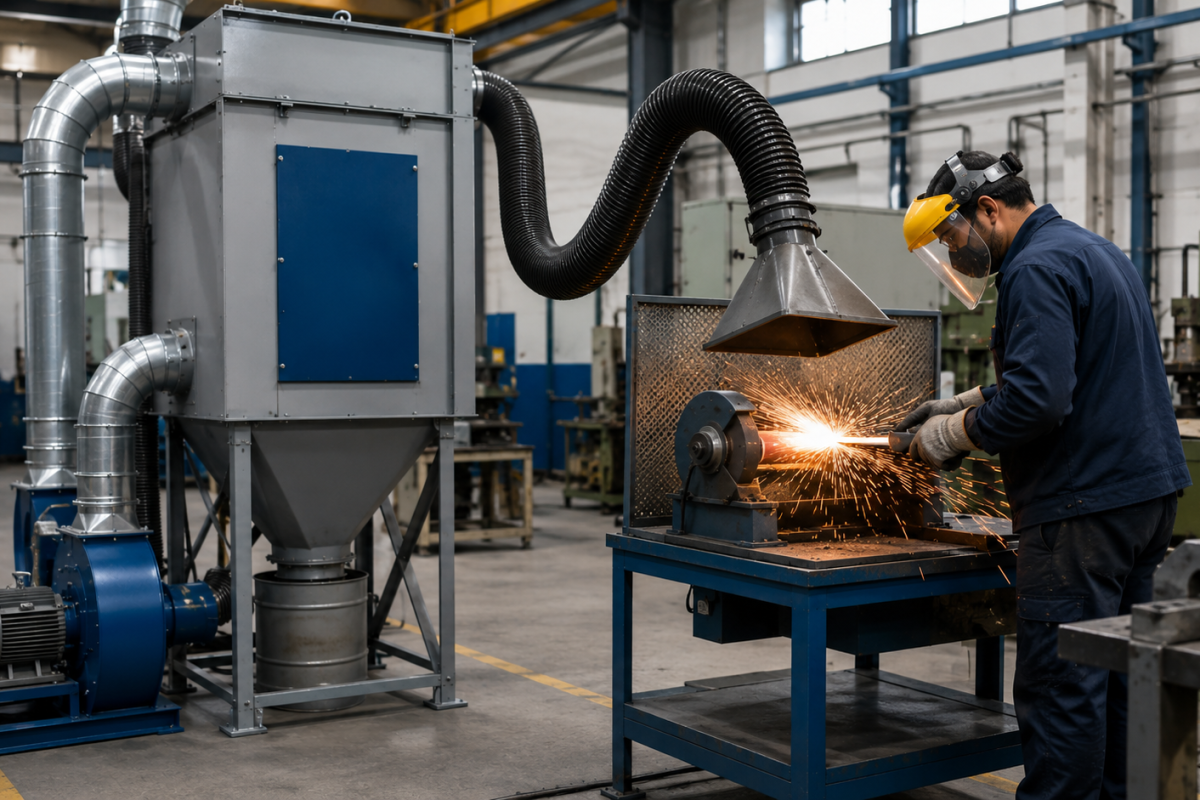
An effective dust collection system design captures dust as close as possible to the point of generation and transports it through a properly engineered extraction network to a filtration system. The performance of the complete system depends not only on the dust collector itself, but also on hood design, airflow, ductwork, static pressure, filtration, and dust discharge.
A properly engineered industrial dust extraction system can therefore provide substantially better results than simply installing a high-capacity dust collector and connecting it to existing ductwork.
For manufacturing facilities, the objective should be to design a complete factory dust control system around the actual processes, dust characteristics, operating conditions, and future production requirements.
Key Takeaways
- Effective dust collection begins with source capture.
- Dust collector capacity should be determined from airflow and static-pressure requirements.
- Hood and duct design are just as important as the filtration unit.
- Different manufacturing processes require different extraction strategies.
- Proper system balancing ensures consistent airflow across multiple machines.
- A well-designed system reduces dust contamination, maintenance, and energy waste.
What Is Dust Collection System Design?
Dust collection system design is the engineering process of determining how airborne dust will be captured, transported, filtered, and discharged from a manufacturing facility.
A complete system generally consists of:
- Source-capture hoods
- Extraction ductwork
- Dampers and branches
- Dust collector
- Filtration media
- Exhaust blower
- Dust discharge system
- Electrical and control systems
Each component must work together.
A high-performance dust collector cannot compensate for poorly designed hoods, undersized ductwork, excessive pressure losses, or inadequate airflow.
Step 1: Identify the Dust Sources
The first stage is to identify every process generating airborne contaminants.
Common sources include:
- Grinding machines
- Cutting machines
- Sanding stations
- Polishing equipment
- CNC machining
- Mixing systems
- Crushing equipment
- Material transfer points
- Powder handling
- Packaging machinery
The design should document the location and operating conditions of each source.
Step 2: Understand the Dust Characteristics
Not all dust behaves the same way.
Before selecting an industrial dust extraction system, engineers should evaluate:
- Particle size
- Particle density
- Dust concentration
- Moisture content
- Temperature
- Abrasiveness
- Chemical properties
- Combustibility
Fine powder may require a different filtration strategy from coarse metal particles or abrasive mineral dust.
Step 3: Select the Right Capture Method
Source capture is generally the most effective approach because it removes dust before it disperses into the facility.
Depending on the process, capture may involve:
Enclosed Extraction
The machine or process is partially or completely enclosed.
This is often highly effective because the extraction system controls the contaminant within a defined area.
Extraction Hood
A hood is positioned close to the dust-generating operation.
Downdraft Extraction
Air is drawn downward through a work surface, capturing dust generated during operations such as grinding or finishing.
Side-Draft Extraction
Air is pulled horizontally across the process toward an extraction opening.
Canopy Hood
Used where contaminants rise naturally and where other source-capture arrangements are impractical.
The capture method should be selected based on the process rather than simply using the same hood configuration throughout the plant.
Step 4: Determine Required Airflow
Airflow is one of the most important parameters in dust collection system design.
The required airflow depends on:
- Hood dimensions
- Capture distance
- Process energy
- Dust characteristics
- Number of extraction points
- Simultaneous operation
Airflow is typically expressed in CFM (cubic feet per minute).
The system must provide sufficient airflow at each extraction point while also maintaining adequate transport velocity through the ductwork.
Simply choosing a collector with a high CFM rating does not guarantee effective extraction.
Step 5: Design the Ductwork
Ductwork connects individual extraction points to the central collector.
Poorly designed ductwork can result in:
- Excessive pressure loss
- Uneven airflow
- Dust settling
- Increased fan energy consumption
- Poor extraction at remote machines
The design should consider:
- Duct diameter
- Duct length
- Air velocity
- Number of branches
- Elbow configuration
- Transitions
- Dampers
- Main duct arrangement
Smooth, properly sized duct routing generally provides better system performance than unnecessarily complicated layouts.
Step 6: Calculate Static Pressure
A dust collection blower must overcome the resistance created by the entire system.
Pressure losses can occur through:
- Hoods
- Ductwork
- Elbows
- Branches
- Dampers
- Filters
- Cyclones
- Exhaust outlets
The blower therefore needs to be selected based on the required airflow at the system’s operating static pressure.
Selecting a fan based solely on its maximum CFM rating can result in inadequate performance once the system is installed.
Step 7: Select the Dust Collector
The filtration unit should be selected according to the dust and process conditions.
Common technologies include:
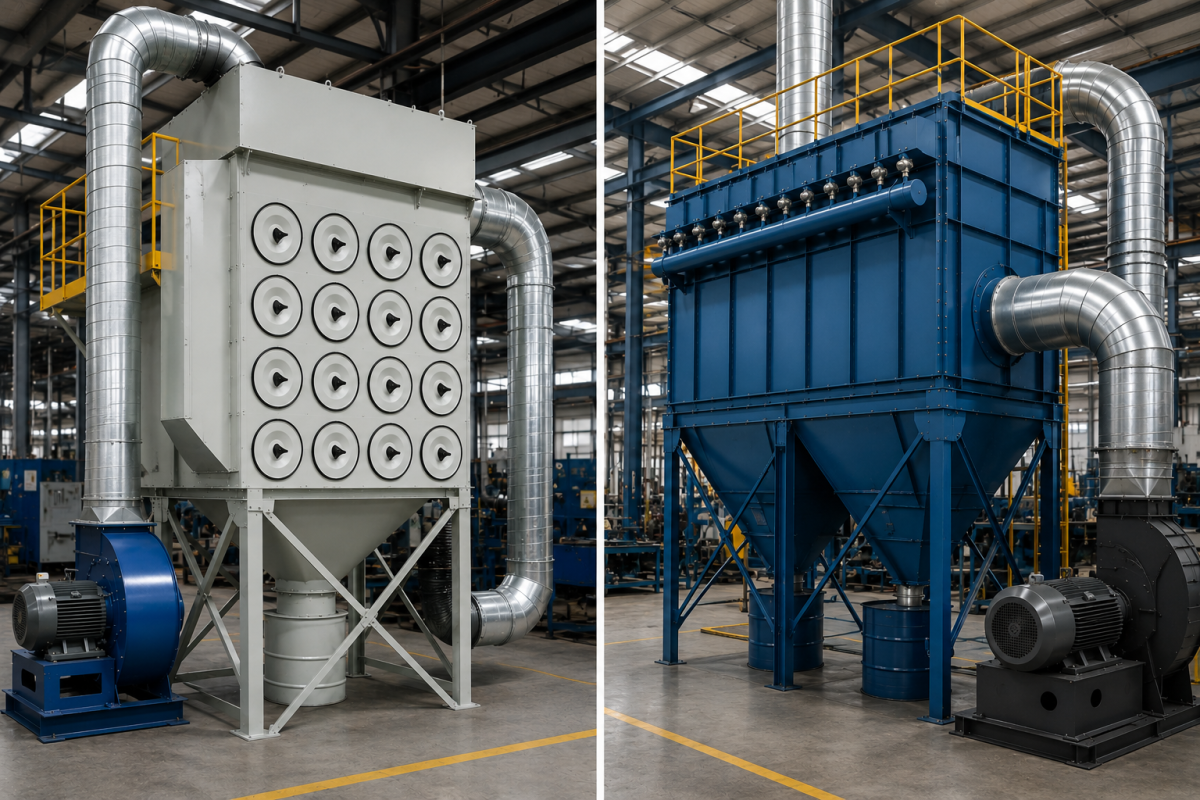
Cartridge Dust Collectors
Suitable for many fine, dry dust applications where a compact system and high filtration surface area are advantageous.
Baghouse Dust Collectors
Suitable for high dust loading, high airflow, and many heavy industrial applications.
Cyclone Pre-Separators
Often used to remove larger particles before they reach the primary filtration stage.
The appropriate technology depends on the application rather than simply the desired airflow.
Step 8: Consider Dust Discharge
Collected dust needs to be removed reliably from the system.
Possible arrangements include:
- Collection bins
- Hoppers
- Rotary airlocks
- Screw conveyors
- Continuous discharge systems
- Automated material handling
The discharge method should match the volume and characteristics of the collected dust.
Step 9: Design for Multiple Machines
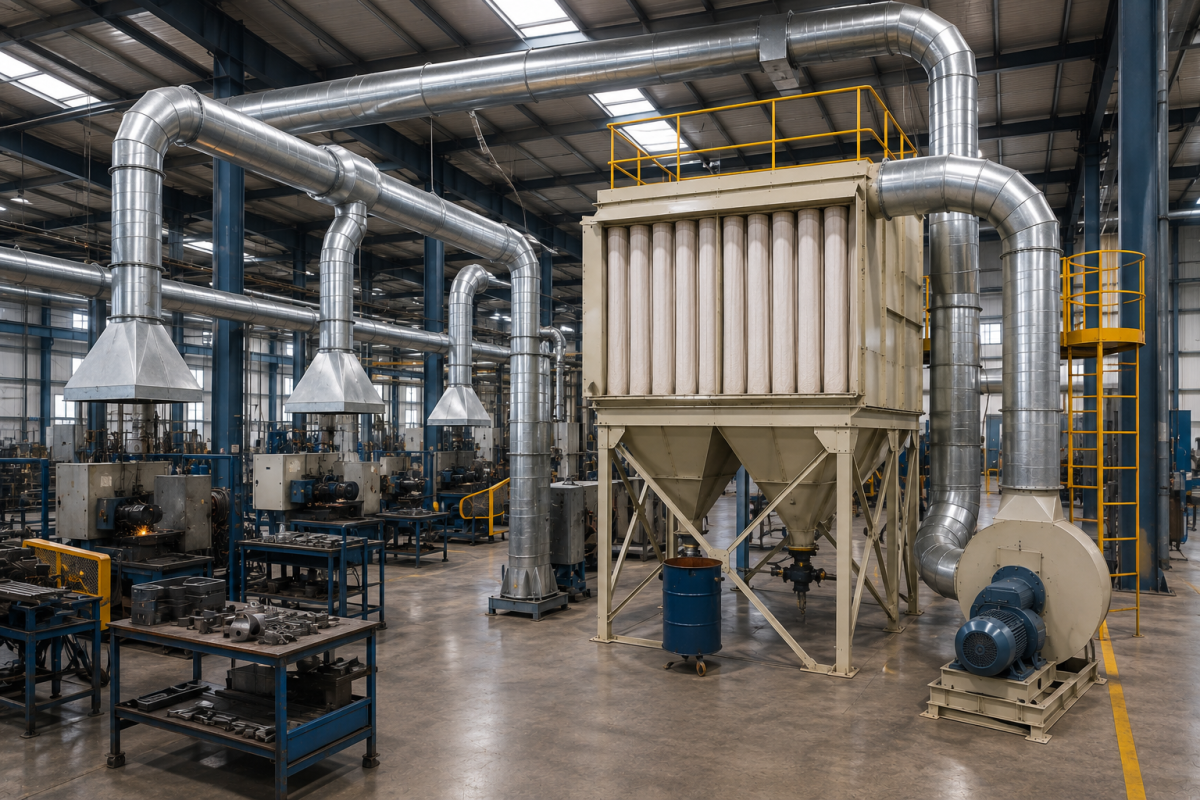
Manufacturing facilities frequently require a centralized factory dust control system serving multiple machines.
For these systems, engineers must determine:
- Total airflow
- Individual branch airflow
- Simultaneous operation
- Diversity factor
- Main duct dimensions
- Branch balancing
- Fan capacity
For example, a facility may have ten machines connected to one collector, but not all ten may operate simultaneously.
Designing around actual production conditions can prevent unnecessary oversizing while maintaining adequate extraction.
Step 10: Balance the System
A centralized system must be balanced so that each extraction point receives the required airflow.
Without proper balancing, some machines may experience:
- Excessive suction
- Insufficient suction
- Uneven dust capture
Balancing dampers and properly designed branch ductwork can help distribute airflow appropriately.
Manufacturing Dust Ventilation vs Local Exhaust
General manufacturing dust ventilation and local exhaust serve different purposes.
General Ventilation
Controls overall room air conditions by replacing or diluting contaminated air.
Local Exhaust
Captures contaminants directly at their source.
For dust-generating manufacturing processes, local exhaust is generally the primary control strategy. General ventilation can complement source capture but should not be relied upon to remove concentrated dust emissions after they have dispersed.
Common Dust Collection Design Mistakes
Using the Collector CFM as the Only Design Parameter
A collector’s rated CFM does not describe the performance of the complete system.
Poor Hood Placement
If the hood is too far from the dust source, substantially more airflow may be required.
Undersized Ductwork
Small ducts can create excessive pressure losses and restrict airflow.
Excessive Duct Bends
Unnecessary elbows and complicated routing increase system resistance.
Ignoring Static Pressure
A blower must be capable of delivering the required airflow against the actual system resistance.
Designing Without Future Expansion
A system designed only for today’s production may become inadequate as new machines are added.
Designing for Energy Efficiency
An efficient dust collection system does not necessarily mean using the largest possible blower.
Energy consumption can be reduced through:
- Correctly sized ductwork
- Efficient hood design
- Proper system balancing
- Variable-frequency drives where appropriate
- Automatic dampers
- Filter monitoring
- Maintaining clean filtration media
The objective is to deliver the required airflow at the required pressure with minimum unnecessary resistance.
Designing for Future Expansion
Manufacturing facilities often expand over time.
A good dust collection system design should consider potential:
- Additional machines
- Increased production
- New extraction points
- Extended operating hours
- Process changes
Providing appropriate provisions for future expansion can be considerably more economical than replacing the entire system later.
Powertech’s Approach to Dust Collection System Design
Powertech approaches industrial dust extraction as a complete system rather than simply supplying a dust collector.
The design process considers:
- Dust-generating processes
- Dust characteristics
- Capture method
- Required airflow
- Ductwork configuration
- Static pressure
- Filtration technology
- Dust discharge
- Fan selection
- Plant layout
- Maintenance requirements
- Future expansion
This application-specific approach allows DustBag systems to be configured for the actual operating conditions of the manufacturing facility.
Effective source capture is one of the most important factors. Dust should ideally be captured as close as possible to where it is generated before it disperses into the workplace.
Sizing depends on required airflow, capture conditions, dust characteristics, number of extraction points, ductwork, static pressure, filtration requirements, and operating conditions.
Yes. Centralized systems can serve multiple machines and production areas when the collector, blower, ductwork, and controls are correctly engineered.
Generally, no. General ventilation can supplement local extraction, but source capture is normally more effective for controlling concentrated dust emissions.
An undersized system may provide insufficient airflow, resulting in poor dust capture, dust accumulation, filter overload, increased maintenance, and reduced workplace air quality.
Yes. Where future production growth is expected, the system should be designed with appropriate capacity and provisions for additional extraction points.
Effective dust collection system design requires much more than selecting a dust collector with a suitable CFM rating. The complete industrial dust extraction system must integrate source capture, airflow, ductwork, static pressure, filtration, dust discharge, and fan selection into a coordinated system. For manufacturing facilities, a properly engineered factory dust control system provides more consistent dust capture, cleaner production areas, reduced equipment contamination, and better energy efficiency. General manufacturing dust ventilation can complement the system, but localized source extraction should remain the foundation for controlling dust generated by industrial processes. Powertech’s engineering-led approach to DustBag systems enables manufacturers to develop customized dust collection solutions based on their actual processes, operating conditions, and future production requirements.