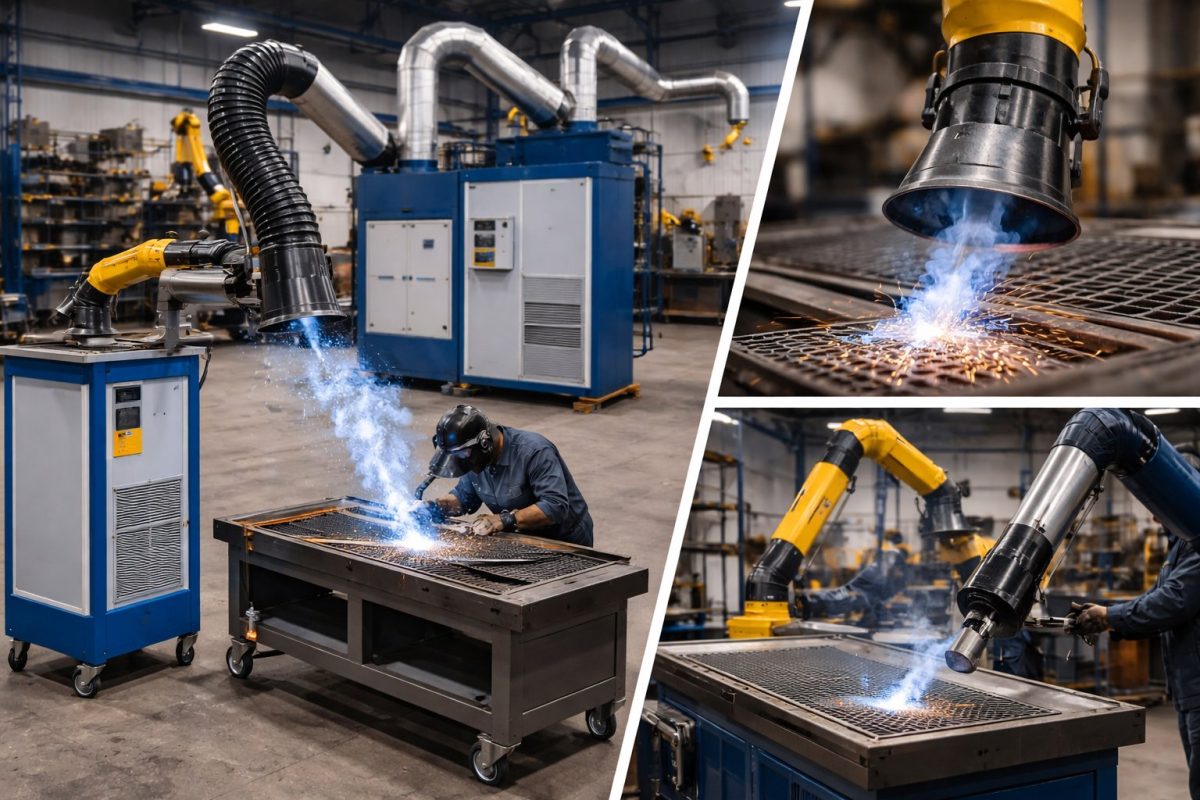
different types of welding fume extractor systems in industrial manufacturing

Welding Fume Extractor Types Used in Manufacturing

Types of Welding Fume Extraction Systems Used in Manufacturing

Introduction

Welding operations across manufacturing industries generate airborne contaminants in the form of metal fumes, gases, and ultrafine particulate matter. These emissions, if not properly controlled, can accumulate within the workspace and expose workers to hazardous substances. In high-production environments such as fabrication shops, automotive plants, and heavy engineering facilities, managing welding fumes is not just a compliance requirement—it is a critical engineering necessity.

Different manufacturing setups require different approaches to fume control. A small fabrication shop with manual welding stations will have very different requirements compared to a large automotive plant with robotic welding lines. As a result, selecting the correct types of welding fume extractor becomes essential for effective air quality management.

Modern industrial fume extraction systems are designed to capture fumes at the source, filter contaminants efficiently, and maintain safe working conditions. This article provides a detailed breakdown of the various types of welding fume extraction systems used in manufacturing and their practical applications.


Key Takeaways

  • Different types of welding fume extractor are suited for specific manufacturing environments and welding processes.
  • Portable welding fume extractor units are ideal for flexible, multi-station fabrication setups.
  • Centralized welding fume extraction systems are used in large-scale industrial operations with multiple welding points.
  • Proper system selection depends on airflow requirements, workspace layout, and welding intensity.

The Problem: Variability in Welding Environments

Welding fumes behave differently depending on the process, material, and workspace conditions. A one-size-fits-all approach to fume extraction often results in ineffective control.

Causes of Inefficient Fume Control

  • Variation in welding processes (MIG, TIG, arc welding)
  • Multiple welding stations operating simultaneously
  • Differences in shop layout and enclosure levels
  • Inconsistent airflow distribution
  • Improper selection of extraction systems

Workplace Impact

  • Uneven air quality across different zones
  • Smoke accumulation in poorly ventilated areas
  • Increased maintenance due to dust deposition
  • Reduced operational efficiency

Safety Risks

Welding fumes can contain hazardous substances such as manganese, chromium, and nickel compounds.
According to Occupational Safety and Health Administration (OSHA), prolonged exposure to welding fumes can lead to respiratory issues and long-term health effects.

Similarly, the National Institute for Occupational Safety and Health (NIOSH) highlights that welding fumes may cause lung irritation, metal fume fever, and neurological effects depending on exposure levels.

These risks make it essential to select the appropriate types of welding fume extractor for each application.

Technical Overview: How Different Systems Work

All industrial fume extraction systems follow the same fundamental principle:

  1. Capture fumes at or near the source
  2. Convey contaminated air through ducting or internal channels
  3. Filter particulate matter using high-efficiency filters
  4. Discharge or recirculate clean air

However, the design and configuration vary depending on the type of system.

Types of Welding Fume Extractor Systems

1. Portable Welding Fume Extractor

A portable welding fume extractor is a compact, mobile unit equipped with a flexible extraction arm.

Key Features:

  • Mounted on wheels for easy movement
  • Integrated fan and filtration system
  • Flexible arm for localized extraction
  • Suitable for small to medium workshops

Typical Applications:

  • Fabrication shops
  • Maintenance welding
  • Job shops with variable layouts

Advantages:

  • High flexibility
  • Low installation cost
  • Easy to reposition

Limitations:

  • Limited airflow capacity
  • Not ideal for multiple simultaneous welding stations

2. Centralized Welding Fume Extraction System

A centralized welding fume extraction system connects multiple welding stations to a single high-capacity filtration unit through ducting.

Key Features:

  • Central filtration unit
  • Duct network connecting multiple stations
  • High airflow capacity
  • Suitable for continuous operations

Typical Applications:

  • Automotive manufacturing plants
  • Heavy engineering facilities
  • Large fabrication units

Advantages:

  • Handles multiple welding stations
  • Consistent air quality across facility
  • Lower maintenance per station

Limitations:

  • Higher initial investment
  • Requires proper duct design and balancing

3. Fixed Extraction Arm Systems

These systems use stationary welding extraction arms mounted at specific welding stations.

Key Features:

  • Mounted on walls or workbenches
  • Adjustable arm positioning
  • Connected to either portable or centralized systems

Applications:

  • Dedicated welding stations
  • Repetitive production processes

Advantages:

  • Consistent positioning
  • Better capture efficiency than general ventilation

4. Downdraft Tables

Downdraft tables pull fumes downward through perforated surfaces.

Key Features:

  • Integrated extraction surface
  • Suitable for welding and grinding
  • Built-in filtration system

Applications:

  • Small components
  • Grinding and finishing operations

Advantages:

  • Dual-purpose (welding + grinding)
  • Effective for small parts

5. On-Torch Extraction Systems

These systems integrate extraction directly into the welding torch.

Key Features:

  • Captures fumes extremely close to source
  • Minimal dispersion
  • Compact design

Applications:

  • High-precision welding
  • Automated or robotic welding

Advantages:

  • Highest capture efficiency
  • Minimal environmental contamination


Comparison of Welding Fume Extraction Systems

System Type

Mobility

Airflow Capacity

Suitable for Multiple Stations

Typical Use Case

Portable extractor

High

Low–Medium

No

Small fabrication shops

Centralized system

Low

High

Yes

Large industrial plants

Extraction arm

Medium

Medium

Limited

Fixed welding stations

Downdraft table

Low

Medium–High

No

Small part welding

On-torch system

High

Low

No

Precision welding


Practical Industrial Applications

Automotive Manufacturing

Automotive plants typically use centralized welding fume extraction systems to manage fumes from robotic welding lines. These systems ensure consistent air quality across production areas.

Fabrication Shops

Fabrication shops often rely on portable welding fume extractor units combined with extraction arms. This allows flexibility for different workpieces and layouts.

Electronics Manufacturing

In electronics production, compact extraction systems or on-torch extraction are used to handle fine fumes generated during precision welding.

CNC and Equipment Manufacturing

CNC shops integrate localized extraction systems to prevent contamination of precision machining processes.

Expert Insight

With over 30 years of experience in industrial air pollution control, Powertech has observed that incorrect system selection is one of the most common issues in fabrication environments.

In many cases, facilities invest in high-capacity centralized systems without proper duct design, resulting in uneven airflow distribution. Conversely, smaller workshops often rely on inadequate portable units for high-load applications.

A practical approach involves:

  • Matching system type to welding intensity
  • Ensuring proper airflow balancing
  • Designing for scalability

In several installations across fabrication and engineering industries, optimized system design has significantly improved capture efficiency without increasing energy consumption.

Frequently Asked Questions

What are the main types of welding fume extractor systems?

The main types include portable extractors, centralized systems, extraction arms, downdraft tables, and on-torch extraction systems.

Which system is best for small fabrication shops?

A portable welding fume extractor is typically the most suitable due to its flexibility and ease of use.

When should centralized welding fume extraction be used?

Centralized systems are ideal for facilities with multiple welding stations and continuous production processes.

Are downdraft tables effective for welding?

Yes, they are effective for small components and combined welding and grinding operations.

What is the most efficient method of fume capture?

On-torch extraction provides the highest efficiency as it captures fumes directly at the source.

Conclusion

Selecting the right types of welding fume extractor is essential for maintaining safe and efficient industrial environments. Each system type—whether portable, centralized, or integrated—offers specific advantages depending on the application.

Modern industrial fume extraction systems are designed to address the diverse needs of manufacturing facilities, ensuring effective fume capture and filtration. By understanding the strengths and limitations of each system, industries can implement solutions that enhance air quality, protect worker health, and improve overall operational efficiency.

With decades of experience in designing customized air pollution control systems, Powertech continues to emphasize the importance of application-specific engineering in achieving effective welding fume control.
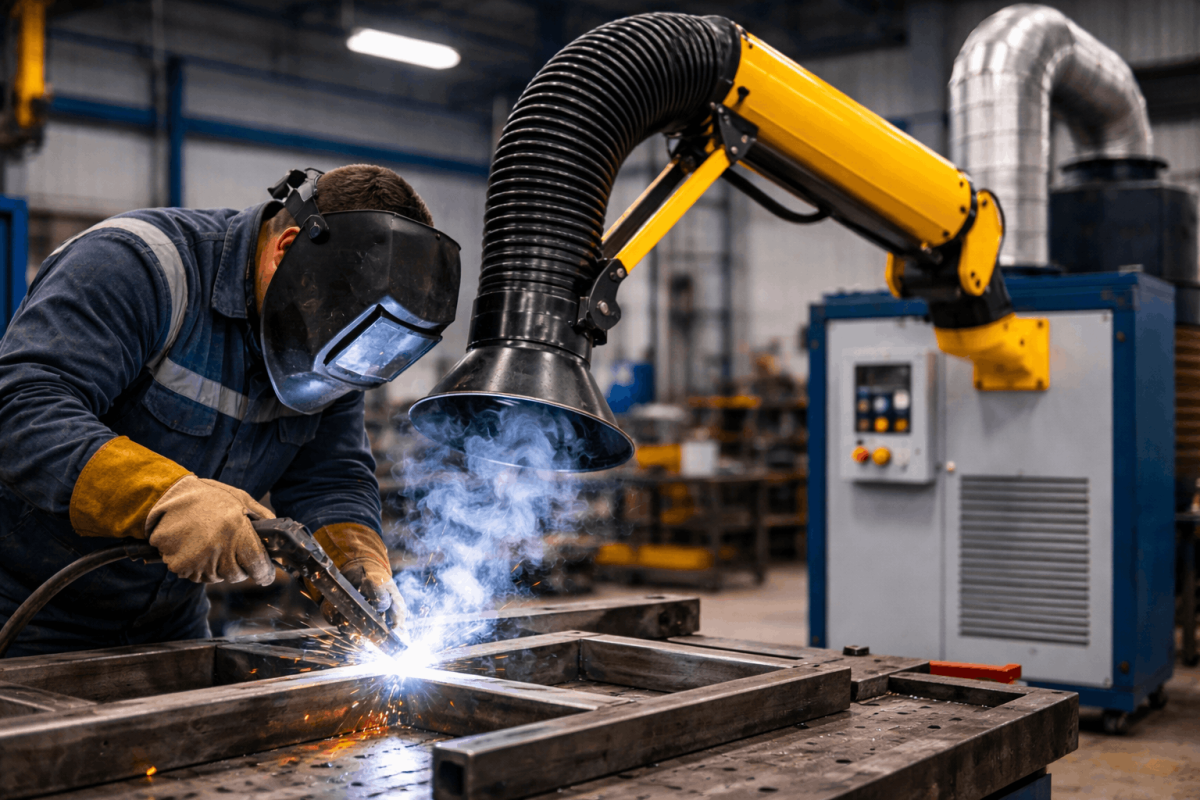
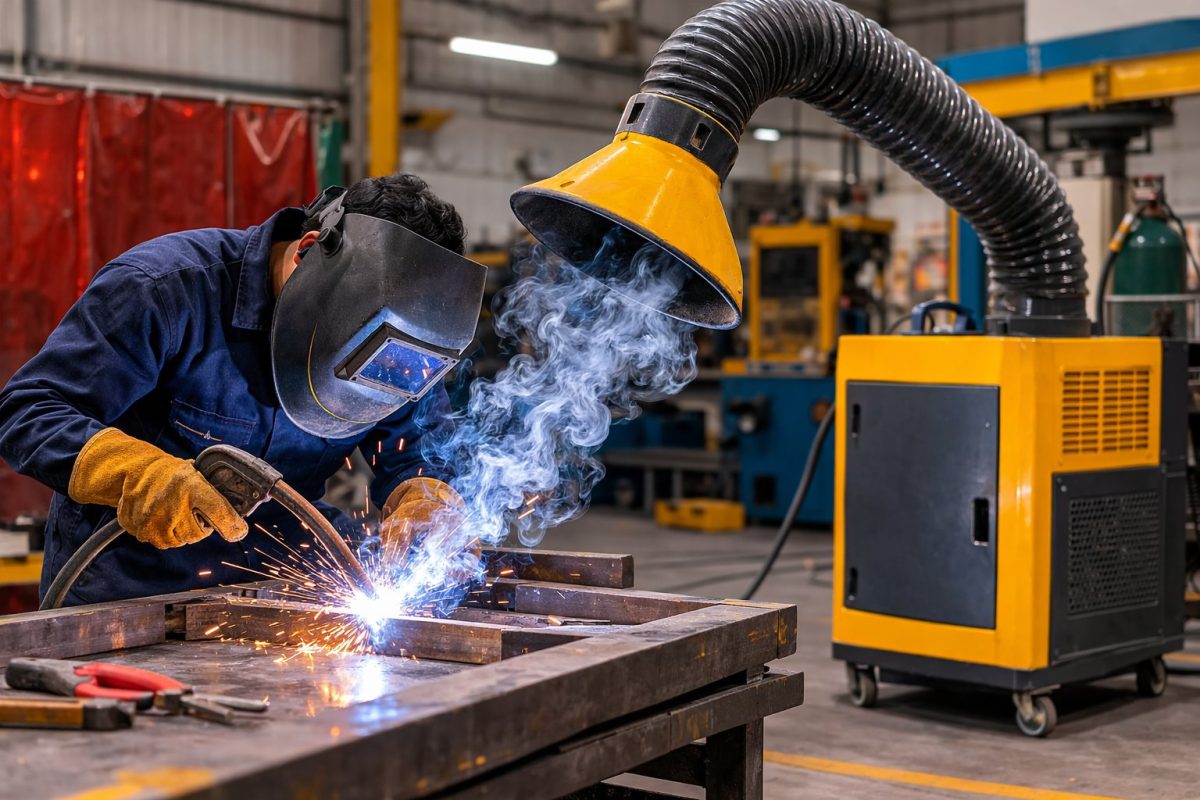
welding fume extractor capturing fumes at source using extraction arm

Welding Fume Extractor: How Source Capture Works in Welding

How Welding Fume Extractors Capture Fumes at the Source

Introduction

Welding operations are a critical part of industrial fabrication, but they generate hazardous fumes composed of fine metal particulates and gases. These fumes, if not effectively controlled, disperse into the work environment and expose workers to harmful contaminants. In fabrication shops where multiple welding stations operate simultaneously, this issue becomes significantly more pronounced.

Traditional ventilation methods often rely on general air dilution, which does not effectively remove contaminants from the welder’s breathing zone. As a result, airborne pollutants remain suspended and continue to pose risks to both workers and equipment.

A welding fume extractor addresses this challenge by capturing fumes directly at the point of generation. This method, known as source capture welding fumes, is far more effective than general ventilation. By using properly designed local exhaust ventilation welding systems and flexible welding extraction arm setups, industries can significantly improve air quality and maintain safer working conditions.

Key Takeaways

  • A welding fume extractor captures fumes directly at the source, preventing dispersion into the workspace.
  • Local exhaust ventilation welding is more effective than general ventilation for controlling welding fumes.
  • Proper positioning of the welding extraction arm is critical for effective fume capture.
  • Source capture systems improve worker safety, visibility, and compliance with industrial safety standards.

The Problem: Ineffective Fume Control in Welding Environments

Welding fumes are generated instantly when metals are heated, vaporized, and condensed into fine airborne particles. Without immediate capture, these particles spread rapidly across the workspace.

Causes of Poor Fume Control

  • Over-reliance on general ventilation systems
  • Incorrect placement of extraction arms
  • Insufficient airflow at the point of welding
  • Multiple welding operations in confined spaces
  • Lack of system maintenance and filter clogging

Workplace Impact

  • Smoke accumulation reducing visibility
  • Worker discomfort due to poor air quality
  • Deposition of metal particles on machinery
  • Reduced efficiency in fabrication processes

Safety Risks

  • Exposure to toxic metals such as manganese and chromium
  • Respiratory illnesses and long-term lung damage
  • Increased risk of occupational health violations
  • Reduced operator alertness in poor air conditions

These challenges highlight the importance of using a welding fume extractor designed specifically for source capture.

How a Welding Fume Extractor Captures Fumes at the Source

A welding fume extractor works by creating localized airflow that pulls contaminants away from the welding arc before they disperse.

Step 1: Positioning the Extraction Arm

The welding extraction arm is placed close to the welding arc, typically within 150–300 mm.

  • This proximity ensures immediate capture
  • Prevents fumes from entering the breathing zone
  • Improves capture efficiency significantly

Step 2: Creating Negative Pressure

The extractor unit generates suction using a high-efficiency fan.

  • Negative pressure draws fumes into the hood
  • Airflow direction is controlled toward the extractor
  • Capture velocity is maintained at required levels

Step 3: Capturing and Conveying Fumes

Once captured, fumes are drawn through the extraction arm into the system.

  • Smooth internal ducting reduces pressure losses
  • Consistent airflow ensures stable performance
  • Multiple arms can connect to a central unit

Step 4: Filtration of Contaminants

The contaminated air passes through filtration stages:

  • Pre-filters capture larger particles
  • Cartridge filters remove fine particulate matter
  • Optional HEPA filters capture ultra-fine particles

Step 5: Clean Air Discharge

After filtration:

  • Clean air is either recirculated into the workspace
  • Or safely exhausted outside the facility

This entire process ensures effective source capture welding fumes and maintains safe air quality levels.

Capture Efficiency and Airflow Guidelines

Proper airflow and capture velocity are critical for the performance of a welding fume extractor.

Parameter Recommended Range Remarks
Capture distance 150 – 300 mm Closer distance improves efficiency
Capture velocity 0.5 – 1.5 m/s Depends on welding intensity
Airflow per arm 800 – 1500 m³/hr Varies with hood size
Filter efficiency Up to 99% With multi-stage filtration
Static pressure 800 – 1500 Pa Depends on duct design

Engineering design must ensure that airflow remains consistent across all extraction points.

Practical Industrial Applications

Automotive Manufacturing

Automotive plants use robotic and manual welding extensively. Fixed extraction hoods and centralized systems ensure continuous fume capture in high-volume production environments.

Fabrication Shops

Fabrication shops rely heavily on flexible welding extraction arm systems.

  • Operators can reposition arms easily
  • Suitable for varying workpiece sizes
  • Ideal for multi-station workshops

Electronics Manufacturing

In electronics manufacturing, micro-welding and soldering produce fine fumes.

Compact welding fume extractor units provide localized extraction without affecting precision work.

CNC and Equipment Manufacturing

Welding operations in CNC shops require localized extraction to prevent contamination of precision machining areas.

Integrated systems ensure clean air without disrupting adjacent processes.

Expert Insight

One of the most common mistakes in industrial setups is placing the extraction arm too far from the welding arc. Even a small increase in distance can drastically reduce capture efficiency.

From a practical engineering standpoint:

  • Keep the extraction hood within 200 mm whenever possible
  • Avoid cross drafts that disrupt airflow
  • Regularly check airflow performance and filter condition

A well-positioned welding fume extractor can achieve significantly higher efficiency without increasing system capacity.

Frequently Asked Questions

Q. What is source capture in welding?

A. Source capture refers to capturing welding fumes directly at the point where they are generated, preventing them from spreading into the workspace.

Q. How does a welding extraction arm work?

A. A welding extraction arm positions the suction inlet close to the welding arc, allowing fumes to be drawn into the extractor system immediately.

Q. Why is local exhaust ventilation important in welding?

A. Local exhaust ventilation welding systems remove contaminants directly from the source, making them more effective than general ventilation methods.

Q. What affects the efficiency of a welding fume extractor?

A. Key factors include:

  • Distance from the welding arc
  • Airflow rate
  • Hood design
  • Filter condition

Q. Can one extractor serve multiple welding stations?

A. Yes, centralized systems can connect multiple extraction arms to a single unit, provided airflow is properly balanced.

Conclusion

Welding fumes pose a significant challenge in industrial environments, particularly in fabrication shops where continuous operations generate high volumes of airborne contaminants. General ventilation alone is not sufficient to control these fumes effectively.

A properly designed welding fume extractor provides an efficient solution by capturing contaminants at the source. Through effective local exhaust ventilation welding systems and correctly positioned welding extraction arm setups, industries can significantly improve air quality and worker safety.

Implementing source capture strategies not only enhances workplace conditions but also ensures compliance with industrial safety standards. As fabrication processes continue to evolve, investing in effective welding fume extraction solutions remains essential for maintaining a safe and efficient industrial environment.

welder using welding fume extraction system in industrial fabrication shop

Welding Fume Extraction System: Industrial Ventilation Guide

Introduction

Welding is one of the most common fabrication processes used across industries such as automotive manufacturing, heavy engineering, structural fabrication, and equipment manufacturing. While welding enables strong and reliable metal joints, it also produces significant airborne contaminants in the form of welding fumes. These fumes consist of fine metal particles, gases, and chemical compounds that can pose serious health risks to workers if not properly controlled.

In industrial fabrication shops where welding operations are performed continuously, airborne contaminants can quickly accumulate in the work environment. Poor air quality affects worker health, reduces visibility in the workspace, and can lead to regulatory compliance issues. Controlling welding fumes is therefore a critical aspect of industrial safety and workplace engineering.

A properly designed welding fume extraction system helps capture and remove fumes at the source before they disperse into the surrounding environment. By using specialized welding fume extractor units and appropriate industrial welding ventilation, fabrication shops can significantly improve air quality, enhance worker safety, and maintain regulatory compliance. This article explains how welding fume extraction equipment works and how it is applied in industrial fabrication environments.


Key Takeaways

  • A welding fume extraction system captures hazardous welding fumes at the source, preventing them from spreading into the work environment.
  • Effective industrial welding ventilation improves worker safety, visibility, and compliance with occupational health regulations.
  • Proper selection of welding fume extraction equipment depends on airflow requirements, welding process type, and workspace layout.
  • Localized extraction systems are generally more effective than general ventilation for controlling welding fumes.

The Problem: Welding Fume Exposure in Fabrication Shops

Welding fumes are generated when metals are heated to high temperatures and vaporize. These vapors quickly cool and condense into extremely fine airborne particles that remain suspended in the air.

Without proper extraction, these contaminants accumulate in the workplace.

Causes of Welding Fume Accumulation

  • Continuous welding operations in enclosed workshops
  • Inadequate general ventilation systems
  • Multiple welding stations operating simultaneously
  • Poor positioning of extraction equipment
  • High deposition rates from processes such as MIG and flux-cored arc welding

Workplace Impact

Poor welding fume control can negatively affect fabrication shop operations:

  • Reduced visibility due to smoke accumulation
  • Uncomfortable working conditions for welders
  • Contamination of nearby workstations and equipment
  • Increased maintenance requirements for machinery

Safety Risks

Exposure to welding fumes can lead to several health concerns, including:

  • Respiratory irritation and lung damage
  • Metal fume fever caused by inhalation of metal oxide particles
  • Long-term exposure risks associated with chromium, manganese, and nickel compounds
  • Potential neurological effects from prolonged exposure to certain metals

For these reasons, many industrial safety standards emphasize the need for effective welding fume extraction systems and engineered ventilation solutions.


How a Welding Fume Extraction System Works

A welding fume extraction system is designed to capture fumes at the point where they are generated and remove them from the worker’s breathing zone.

The system typically consists of several integrated components.

Step 1: Fume Capture

The first stage involves capturing fumes as close to the welding arc as possible.

This is commonly achieved using:

  • Flexible extraction arms
  • Extraction hoods
  • Downdraft tables
  • On-torch extraction systems

These devices position the airflow source directly near the welding area, preventing fumes from spreading.

Step 2: Air Conveyance

Once fumes are captured, they are transported through ducting or internal channels within the welding fume extractor.

A high-efficiency fan or blower generates airflow that pulls contaminated air through the system.

Step 3: Filtration

The captured air then passes through filtration stages designed to remove particulate matter.

Typical filtration methods include:

  • Cartridge filters for fine metal particles
  • HEPA filters or electrostaticfilters for very fine particulate capture
  • Spark arrestors for safety protection

These filters remove hazardous particles from the air stream.

Step 4: Clean Air Discharge

After filtration, the cleaned air can either:

  • Be returned to the workspace (recirculation systems)
  • Be discharged outside through exhaust ducting

Proper filtration ensures that discharged air meets environmental and workplace safety standards.


Typical Airflow Requirements for Welding Fume Extraction

Airflow is one of the most important parameters in designing a welding fume extraction system. Insufficient airflow will allow fumes to escape, while excessive airflow increases energy consumption.

Welding Application

Typical Capture Method

Recommended Airflow (m³/hr)

Typical Capture Velocity

Manual MIG welding

Extraction arm

800 – 1200

0.5 – 1.0 m/s

TIG welding

Local hood

600 – 900

0.4 – 0.8 m/s

Robotic welding cell

Enclosed hood

1500 – 2500

0.8 – 1.2 m/s

Grinding and welding stations

Downdraft table

2000 – 3500

1.0 – 1.5 m/s

Actual airflow requirements depend on:

  • Welding process type
  • Distance between the arc and extraction hood
  • Workshop layout
  • Number of active welding stations

Proper engineering calculations are required to size the welding fume extraction equipment correctly.


Practical Industrial Applications

Automotive Manufacturing

Automotive manufacturing facilities rely heavily on robotic welding systems for assembling vehicle bodies and components.

These facilities often use centralized welding fume extraction systems connected to multiple welding stations. Enclosures and high-capacity filtration units ensure that fumes generated during robotic welding are effectively captured.

Fabrication Shops

Structural fabrication shops typically operate multiple manual welding stations. In such environments, mobile welding fume extractor units with flexible arms are commonly used.

These systems allow welders to reposition the extraction arm depending on the workpiece location, ensuring effective fume capture.

Electronics Manufacturing

Electronics manufacturing processes often involve soldering and micro-welding operations. Although the fume volumes are smaller, the particles produced can still pose health risks.

Compact extraction units are used to capture fumes generated during soldering and precision welding processes.

CNC and Equipment Manufacturing

Many CNC machine shops include welding as part of the manufacturing process for frames, fixtures, and machine components.

Local extraction systems integrated into welding stations prevent fumes from spreading into areas where precision machining operations are conducted.

Expert Insight

In many fabrication shops, welding fumes are controlled using general ventilation or ceiling exhaust fans. However, these approaches often fail to capture fumes before they reach the worker’s breathing zone.

From an engineering perspective, source capture is the most effective strategy. Positioning extraction arms within 200–300 mm of the welding arc significantly improves capture efficiency. Proper maintenance of filters and periodic airflow verification are also essential to ensure long-term performance of the welding fume extraction system.


Frequently Asked Questions

What is a welding fume extraction system?

A welding fume extraction system is an engineered ventilation system designed to capture and filter fumes generated during welding processes before they disperse into the workplace environment.

Why is local extraction preferred over general ventilation?

Local extraction captures fumes directly at the source, preventing them from spreading into the surrounding workspace. General ventilation dilutes contaminants but does not remove them effectively.

How often should filters in welding fume extraction equipment be replaced?

Filter replacement intervals depend on welding intensity and system design. In most industrial environments, filters are inspected regularly and replaced when pressure drop exceeds recommended limits.

Can a welding fume extractor handle multiple welding stations?

Yes. Larger systems can be designed to serve multiple stations using ducting networks connected to a centralized filtration unit.

Are welding fumes hazardous even in small workshops?

Yes. Even small welding operations can produce harmful metal particles and gases. Proper industrial welding ventilation is important regardless of workshop size.

Conclusion

Welding fumes are an unavoidable by-product of metal fabrication processes, but their impact on workplace safety and air quality can be effectively controlled with proper engineering solutions. A well-designed welding fume extraction system captures fumes at the source, filters hazardous particles, and prevents contamination of the work environment.

By implementing appropriate welding fume extraction equipment and maintaining proper industrial welding ventilation, fabrication shops can significantly improve worker safety, operational efficiency, and regulatory compliance. As welding operations continue to expand across manufacturing industries, investing in reliable air pollution control systems remains a critical component of modern industrial facility design.

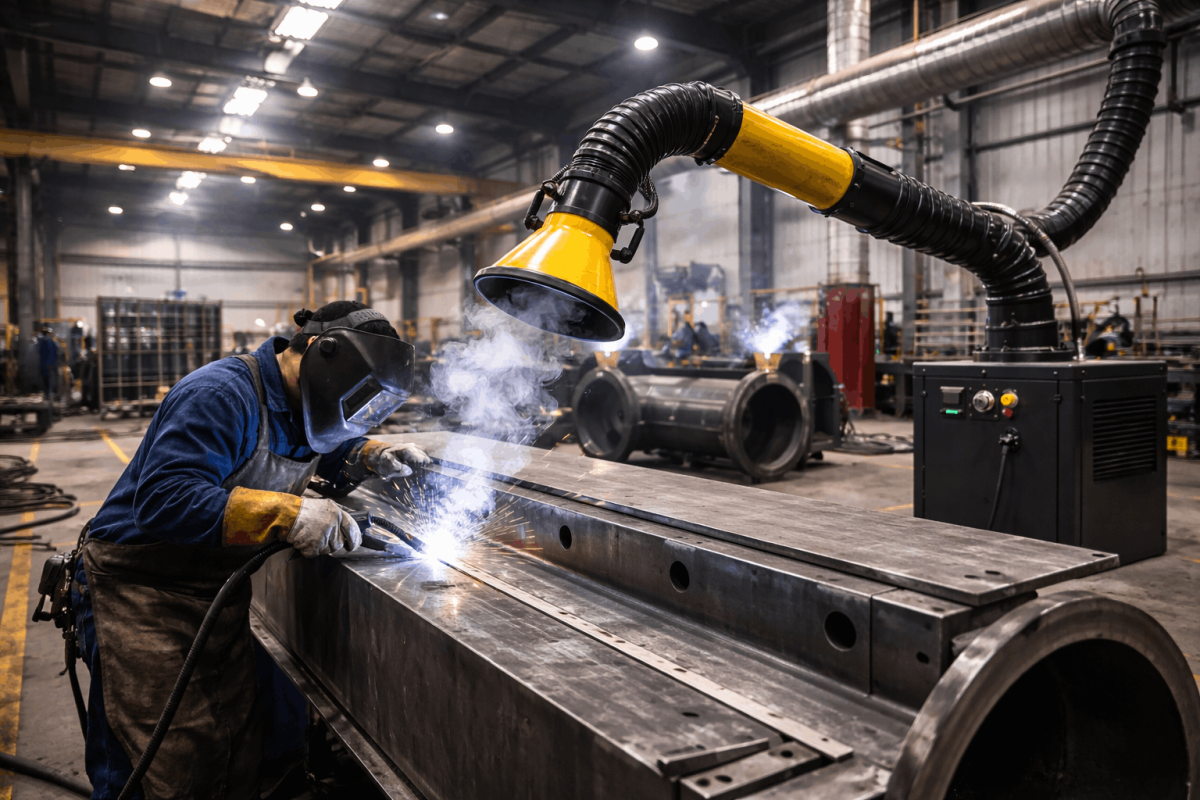
Welder using a fume extractor while welding a large steel structure in a heavy engineering workshop

Welding Fume Extraction Problems in Heavy Engineering Units

Heavy engineering shops work with big metal structures, thick materials, and long welding cycles. These conditions produce a large amount of welding fumes that spread out over large areas of production.

Heavy engineering units often have more complicated extraction problems than small fabrication shops. It’s hard to control fumes when there are big workpieces, moving equipment, and open spaces.

To keep the air clean and the work environment safe, a well-designed welding fume extraction system must be installed to deal with these problems.

Why Heavy Engineering Units Make More Welding Fumes

Heavy engineering processes usually include:

  • Welding with a lot of current
  • Parts of thick material
  • Long seams in the weld
  • Shifts in continuous welding

These conditions make more fumes. In a lot of cases, welding goes on for a long time without stopping.

Frames, pressure vessels, and structural assemblies are some of the big parts that also trap fumes around the weld zone.

Challenge 1: Big Workpieces Get in the Way of Fume Capture

Parts of the Structure Stop Airflow

Heavy engineering parts are often big and tall. Some examples are:

  • Industrial Frames
  • Bases for heavy machines
  • Structural Beams

These components can stop air from flowing naturally and keep fumes from rising freely. Because of this, fumes build up around the operator’s breathing zone.

Hard to Place the Hood

For extraction hoods to work well, they need to be close to the welding point. But big workpieces often make it hard to get the right position.

If the hood is too far away, the fumes spread out before they can be extracted.

Challenge 2: There are several welding stations in the same area.

Most of the time, heavy engineering units have many welding stations on one shop floor.

When multiple stations work together:

  • Fumes from different places get mixed.
  • The flow of air becomes hard to predict.
  • Local extraction systems fight for air flow

If the system isn’t set up right, fumes from one station can move to another.

Powertech Pollution Controls is a welding fume extractor manufacturer in Bangalore that often helps facilities figure out how much air needs to flow through different welding zones.

Challenge 3: Moving Welding Locations

Welding Doesn’t Always Happen in the Same Place

Welders in heavy engineering units often have to move around big parts while they are making them. For instance:

  • Welding around large tanks
  • Welding long beams
  • Welding internal parts

Fixed extraction hoods may not work well because the welding point moves around a lot and flexible extraction arms or mobile systems are often required.

Challenge 4: Workshops with High Roofs

A lot of heavy engineering plants have high roofs so that cranes and big buildings can fit. High ceilings give you more room, but they also let fumes build up at different levels. Instead of leaving the building, the fumes spread across the shop floor over time.

During long welding shifts, the air quality gets worse over time if extraction isn’t controlled.

Challenge 5: Big doors and fans that blow air across the room

Heavy engineering shops often leave their big doors open so that materials can move around. This makes the air move quickly inside the building causing cross drafts from:

  • Large doors
  • Cooling Fans
  • Crane Movement

These cross drafts can cause welding fumes to move away from the place where they are extracted. Even when equipment is in place, this makes extraction less effective.

Practical Solutions

When working with heavy machinery, extraction systems need to take into account the layout of the workshop to deal with fumes.

Some good ways to do this are:

Source Capture Systems

Operators can move the hood close to the weld location thanks to flexible extraction arms.

Centralized Extraction Systems

Central systems can work with more than one station at a time and keep the airflow balanced.

Mobile Extraction Units

Portable systems help collect fumes in places where welding positions change a lot.

Planning the flow of air

Before putting in extraction systems, you need to look at how air moves inside the shop. The right airflow design makes capture work better.

Q&A

Q1. Why is it harder to control welding fumes in heavy engineering units?

A. Source capture is harder because of big workpieces, moving welding locations, and open workshop layouts.

Q2. Are portable fume extractors helpful in these situations?

A. Yes. They help catch fumes when the places where you weld change often.

Q3. Do roofs that are high up lower the amount of welding fumes?

A. No. Instead of leaving the building, the fumes may spread throughout the workshop.

Q4. Is one extraction system enough for big workshops?

A. Many times, large facilities need more than one system that is based on the layout of the production area.

Final Thoughts

When it comes to controlling welding fumes, heavy engineering units have their own set of problems. Simple extraction systems don’t work well because of big buildings, many welding stations, and changing weld locations.

To control fumes well, the system must be designed correctly, the hood must be in the right place, and the airflow across the workshop must be balanced.

A good welding fume extractor keeps the welding area clear, makes the work environment better, and helps keep production steady in heavy engineering settings.

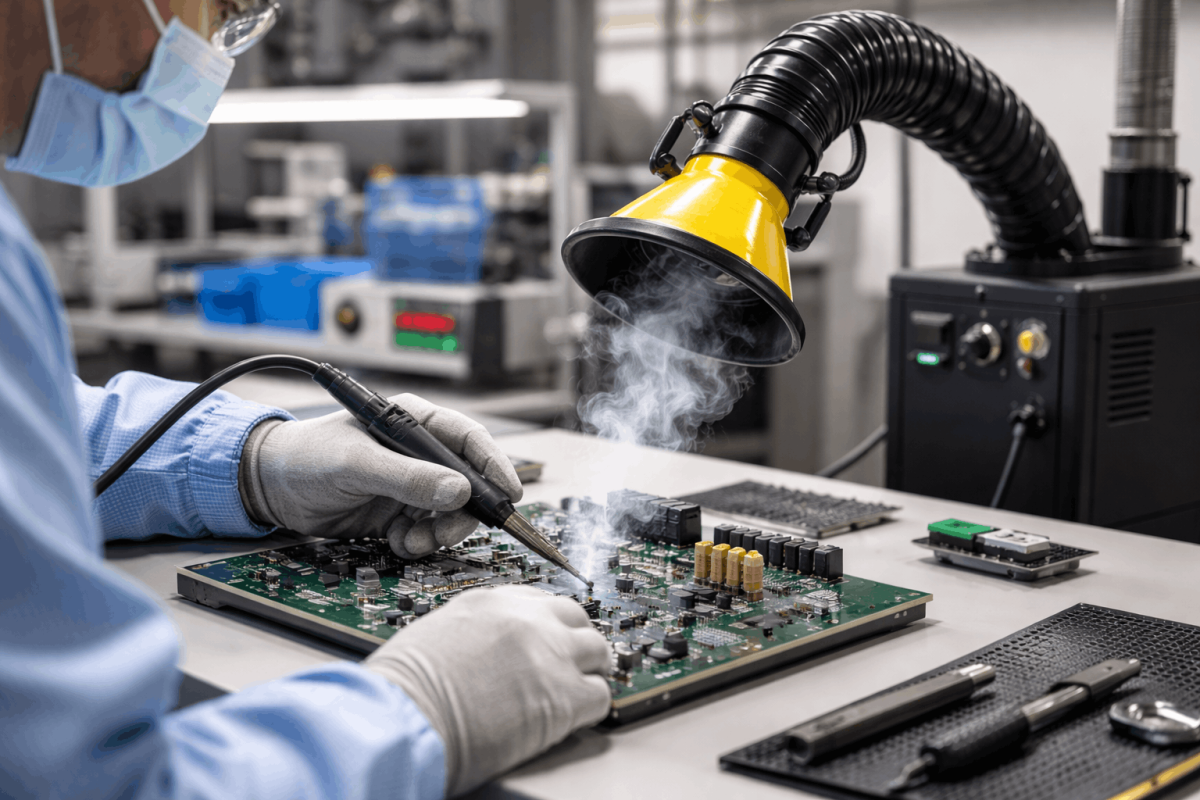
Technician soldering PCB with a soldering fume extractor capturing smoke at the workstation

Managing Fumes from Lead-Free Soldering Processes

Lead-free soldering is now the norm in making electronics. It gets rid of lead from the process, but not the fumes.

In many cases, soldering without lead makes more smoke than soldering with lead. Higher melting points and active flux compounds make more fumes come out.

Facilities must manage fumes at the source to limit exposure and keep the quality of the product.

Why soldering without lead makes more fumes

Lead-free alloys melt at higher temperatures than solder that contains lead. This hotter heat:

  • Increases the activation of flux
  • Makes more thermal breakdown happen
  • Makes fumes with tiny particles

The flux, not the metal itself, makes most of the fumes. When flux burns, it sends harmful particles into the air that go straight into the operator’s breathing zone.

Risks of Bad Fume Control

Operator Exposure

Fumes rise toward the face if they aren’t properly extracted. This can lead to:

  • Irritation of the eyes
  • Pain in the throat
  • Headaches
  • Less comfortable for the operator

Less visibility

It is harder to check if there is smoke around the solder joint:

  • Wetting the pad
  • Flow of solder
  • Bridging problems

Clear visibility helps with accurate hand soldering and rework.

Contamination of Residue and Surface

When fumes spread across the workstation, residue settles on:

  • Surfaces of PCBs
  • Lenses for optical inspection
  • Tools and fixtures

This has an impact on the quality of the product and how often it needs to be cleaned.


Source Capture Is the Best Method of Control

A soldering fume extractor that is in the right place catches fumes as soon as they come out of the solder joint.

Capture at the Tip

The extraction nozzle should be close to the soldering point but not get in the way of hand movement.

This keeps fumes from getting into the breathing zone.

Airflow that is controlled

Airflow needs to be strong enough to catch fumes, but not so strong that it cools the solder joint or changes the flow of solder.

Balanced airflow makes sure that:

  • Temperature of soldering stays the same
  • A clear line of sight
  • Consistent joint formation

A lot of electronics companies require soldering fume extractor manufacturers to size their systems based on how many workstations there are and how much soldering they do.


Things to think about when laying out a workstation

There is more to fume control than just equipment.

Where to Put the Bench

Set up extraction units so that air flows away from the operator.

Don’t Let Cross Drafts Happen

Air conditioning or fans blowing across the bench can move fumes to the side and make it less effective at capturing them.

Planning for Multiple Stations

Central extraction systems may be better for balancing airflow in assembly lines with a lot of soldering stations than having a lot of separate units.

A correct layout makes things safer and more consistent.

Things to Keep an Eye on for Performance

To make sure that the fume control system works well:

  • Make sure the air is flowing well often.
  • Change the filters on time
  • Check the connections between the ducts
  • Watch the suction at the nozzle

Bad maintenance lowers the efficiency of capture and lets fumes spread again.

A Real-Life Example

In a PCB assembly unit that did manual soldering and rework, workers said there was a lot of smoke after they switched to lead-free solder.

After putting source capture extraction at each station:

  • The air was clearer.
  • Fewer complaints from operators
  • The accuracy of inspections went up.
  • Less frequent cleaning

The improvement came from putting the nozzles in the right places and balancing the airflow.

Q & A

Q1. Is the smoke from lead-free solder less dangerous than the smoke from leaded solder?

  1. They get rid of lead exposure, but they still need to control flux fumes.

Q2. What are the main sources of soldering fumes?

  1. Mostly from the flux that is used to solder.

Q3. Can extraction make the solder joint cooler?

  1. Yes, if the airflow is too strong. This won’t happen if the system is the right size.

Q4. Is portable extraction good enough for small labs?

  1. Yes, for work that doesn’t require a lot of volume. Larger assembly lines might need systems that are all in one place.


Conclusion:

Lead-free soldering makes materials safer, but it doesn’t get rid of fumes. Higher temperatures in the process often make more smoke.

Controlling fumes at the source keeps workers safe, makes it easier to see, and helps with the accuracy of solder joints.

A well-chosen soldering fume extractor, along with a well-organized and well-maintained workstation, keeps the air clean and production running smoothly.