
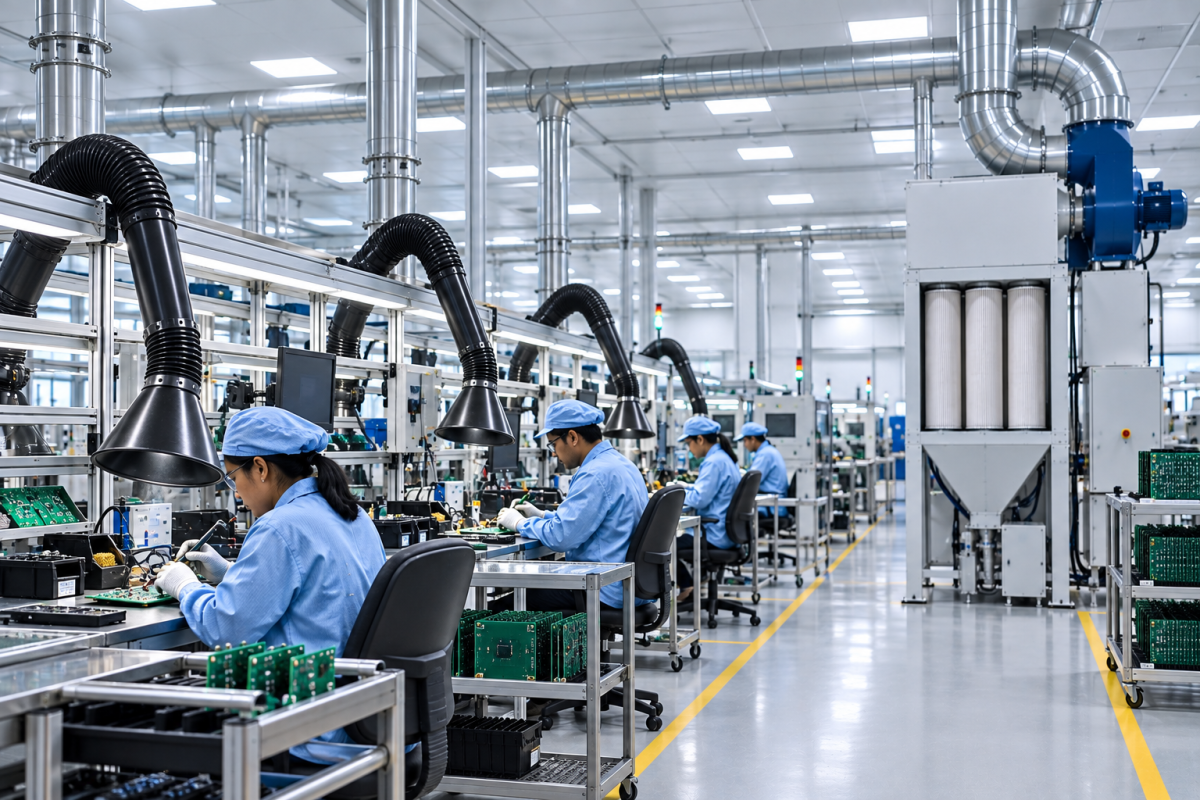
Electronics manufacturing involves processes such as soldering, reflow, PCB assembly, component cleaning, laser processing, and adhesive application. These operations can generate soldering fumes, flux vapours, fine particulate, smoke, and other airborne contaminants.
Effective electronics factory air filtration focuses on controlling these contaminants close to where they are generated. Depending on the process, this can involve soldering fume extractors, localized extraction systems, industrial air filtration, and facility-wide ventilation.
The right system depends on the contaminant, process, production volume, workspace configuration, and required level of air cleanliness.
Key Takeaways
- Electronics manufacturing can generate fumes, fine particulate, smoke, and vapours.
- Source capture is particularly important for soldering and other localized emission processes.
- Soldering fume extractors can capture fumes close to the soldering point.
- Electronics fume extraction systems can be configured for individual workstations, production lines, or larger facilities.
- General ventilation can support overall air quality but should not replace source extraction where concentrated emissions are generated.
- Filter selection should be based on the specific contaminant rather than using the same technology for every process.
Why Air Filtration Matters in Electronics Manufacturing
Electronics production often involves processes that generate relatively small quantities of contaminants at individual workstations.
Although an individual soldering station may produce limited emissions, hundreds of workstations operating simultaneously can create a significant cumulative contaminant load.
Airborne contaminants can potentially settle on:
- PCB assemblies
- Components
- Production equipment
- Work surfaces
- Electrical systems
- Finished products
Effective extraction helps prevent these contaminants from spreading throughout the production environment.
Common Airborne Contaminants in Electronics Manufacturing
Soldering Fumes
Soldering can produce visible and invisible airborne emissions depending on the solder, flux, temperature, and process.
Manual soldering operations can release fumes directly in front of the operator.
A soldering fume extractor positioned close to the soldering point can capture these emissions before they disperse into the surrounding workspace.
Flux Fumes
Flux used during soldering and assembly processes can generate vapours and particulate when heated.
The extraction system should be selected based on the specific flux chemistry and process conditions.
Fine Particulate Matter
Processes such as:
- PCB cutting
- Drilling
- Grinding
- Component preparation
- Mechanical finishing
can generate fine particulate matter that may require dedicated extraction and filtration.
Laser and Thermal Process Emissions
Laser marking, cutting, and other thermal processes can produce smoke and fine particulate.
These applications may require dedicated source extraction designed around the equipment and emission characteristics.
What Is Electronics Factory Air Filtration?
Electronics factory air filtration refers to systems used to capture and remove airborne contaminants generated during electronics manufacturing and assembly.
A typical extraction system may include:
- Capture hood or extraction arm
- Flexible duct or rigid ductwork
- Filtration stages
- Blower
- Collection or discharge arrangement
- Monitoring and control equipment
The filtration equipment should be selected according to the type and concentration of contaminants generated by the process.
Electronics Fume Extraction
Electronics fume extraction is primarily concerned with capturing fumes and process emissions at their source.
This can be particularly important for:
- Manual soldering
- PCB assembly
- Rework stations
- Soldering lines
- Flux application
- Thermal processing
- Laser processing
The capture hood or extraction arm should be positioned as close as practical to the emission point.
The farther a contaminant travels before capture, the more opportunity it has to disperse into the operator’s breathing zone and surrounding workspace.
Soldering Fume Extractors
A soldering fume extractor typically uses a localized capture hood or flexible extraction arm connected to a filtration unit.
The basic process is:
Soldering → Source capture → Filtration → Cleaned air
Depending on the system design, filtration may include multiple stages.
Pre-Filtration
A preliminary filter can capture larger particulate and protect downstream filtration.
Fine Particulate Filtration
A finer filter can capture smaller airborne particles generated during soldering.
Gas/Vapour Filtration
Where appropriate, activated carbon or another suitable adsorption stage may be used for certain gaseous or vapour-phase contaminants.
The required configuration depends on the soldering materials and process.
Point-of-Use vs Centralized Extraction
Electronics facilities can use different extraction configurations.
Point-of-Use Extraction
A filtration unit is positioned close to an individual workstation.
This can be suitable for:
- Individual soldering stations
- Repair benches
- Prototype areas
- Small production areas
Advantages can include:
- Simple installation
- Flexible workstation arrangement
- Localized filtration
- No extensive duct network
Centralized Extraction
Multiple workstations are connected to a common extraction and filtration system.
This can be suitable for:
- Large assembly lines
- Multiple soldering stations
- High-volume production
- Fixed workstation layouts
A centralized system requires careful consideration of duct sizing, airflow balancing, static pressure, and the number of simultaneously operating extraction points.
Source Capture vs General Factory Ventilation
General ventilation and local extraction serve different purposes.
| Factor | Source Extraction | General Ventilation |
|---|---|---|
| Capture location | At emission source | Throughout facility |
| Main purpose | Prevent contaminant dispersion | Manage overall air |
| Airflow | Targeted | Facility-wide |
| Soldering fumes | Highly suitable | Supplementary |
| Localized emissions | Suitable | Less targeted |
| Large production areas | Can be centralized | Useful as supporting system |
For localized emissions such as soldering fumes, source capture should generally be considered before relying solely on room-wide air filtration.
Industrial Air Filtration for Electronics
Industrial air filtration electronics applications can require different technologies depending on the manufacturing process.
Particulate Filtration
Used to remove airborne solid particles generated by mechanical or thermal processes.
Fine Filtration
Used where smaller particulate requires additional filtration efficiency.
Activated Carbon
Can be considered for certain vapours and gaseous contaminants when compatible with the specific process.
Multi-Stage Filtration
Combining different filtration stages can provide more comprehensive treatment when both particulate and vapour-phase contaminants are present.
Designing an Electronics Fume Extraction System
A properly designed system should begin with the process rather than the filtration equipment.
Step 1: Identify the Emission Source
Determine whether emissions originate from:
- Manual soldering
- Automated soldering
- Rework
- PCB cutting
- Laser processing
- Adhesive application
- Cleaning processes
- Other thermal operations
Step 2: Characterize the Contaminant
Consider:
- Particle size
- Fume concentration
- Vapour content
- Temperature
- Chemical composition
- Operating duration
Step 3: Select the Capture Method
Possible approaches include:
- Flexible extraction arms
- Bench hoods
- Machine-integrated extraction
- Enclosures
- Canopy or process hoods
- Centralized extraction
Step 4: Determine Airflow
Airflow should be sufficient to capture and transport the contaminant without creating unnecessary disturbance to the process.
Step 5: Select Filtration
Choose filtration based on the contaminant characteristics and required level of control.
Step 6: Design the Ductwork
For centralized systems, duct diameter, length, bends, branches, airflow velocity, and static pressure should be considered together.
Factors That Affect Soldering Fume Extraction
Several factors can influence the effectiveness of a soldering fume extraction system.
Distance from the Source
The extraction point should be as close as practical to the soldering operation.
Hood Design
A hood that is appropriately sized and positioned can improve capture without obstructing the operator.
Airflow
Insufficient airflow can allow fumes to escape the capture zone.
Workstation Layout
The extraction arrangement should account for operator movement and the position of the PCB and soldering equipment.
Production Volume
A high-volume assembly line may require a different system from a small repair workstation.
Filter Loading
As filters become loaded, system resistance can increase and airflow may decline.
Benefits of Effective Electronics Fume Extraction
Cleaner Work Areas
Capturing fumes at the source can reduce airborne contamination around production workstations.
Reduced Equipment Contamination
Fine particulate and process emissions can settle on electronics, machinery, and work surfaces.
Source extraction can help reduce this deposition.
Better Workplace Air Management
Localized extraction reduces the amount of contaminant released into the general production environment.
Reduced Housekeeping Requirements
Controlling contaminants at the source can reduce accumulation on surfaces.
Flexible Production
Portable or point-of-use extractors can be useful where workstation layouts change frequently.
Common Mistakes
Relying Only on General Ventilation
Large fans or room filtration systems may not capture soldering fumes before they disperse.
Positioning the Extraction Hood Too Far Away
Increasing the distance from the emission source can reduce capture effectiveness.
Using the Same Filter for Every Process
Soldering fumes, dry particulate, and chemical vapours have different characteristics.
Ignoring Filter Loading
A loaded filter can increase system resistance and reduce airflow.
Undersizing a Centralized System
Adding more workstations without reassessing airflow can affect extraction performance.
Neglecting Maintenance
Filters, ductwork, extraction arms, seals, and blowers should be inspected periodically.
Point-of-Use vs Centralized Soldering Fume Extraction
| Factor | Point-of-Use | Centralized |
|---|---|---|
| Installation | Relatively simple | More complex |
| Ductwork | Minimal | Required |
| Number of workstations | Small to moderate | Moderate to large |
| Flexibility | High | Lower |
| Expansion | Easy for individual stations | Requires system capacity |
| Maintenance | Distributed | Centralized |
| Suitable applications | Repair, prototyping, small lines | Large fixed production lines |
The appropriate arrangement depends on the production layout, number of workstations, operating schedule, and required airflow.
Powertech’s Approach
Powertech develops source-capture pollution control solutions for industrial applications where localized contaminants need to be removed before they disperse.
For electronics manufacturing, an appropriate solution may incorporate:
- Source-capture fume extraction
- Flexible extraction arms
- Bench-level extraction
- Portable filtration units
- Centralized extraction
- Multi-stage filtration
- Customized ductwork
The system should be matched to the soldering process, contaminant characteristics, workstation arrangement, airflow requirements, and operating conditions.
Electronics factory air filtration refers to systems designed to capture and filter fumes, fine particulate, smoke, vapours, and other airborne contaminants generated during electronics manufacturing.
A soldering fume extractor is a localized extraction and filtration system designed to capture fumes generated during soldering close to the point of emission.
Source extraction captures soldering fumes before they disperse throughout the workspace, making it more targeted than relying solely on general room ventilation.
Yes. Multiple fixed workstations can be connected to a centralized system when the ductwork, airflow, filtration capacity, and blower are appropriately designed.
The appropriate filtration depends on the materials and contaminants involved. Systems may use particulate filtration, fine filtration, activated carbon, or combinations of filtration stages.
General ventilation can support overall facility air management, but localized emissions such as soldering fumes are generally better addressed with source-capture extraction.
Maintenance frequency depends on operating hours, contaminant loading, filter type, and system design. Filters, airflow, extraction arms, seals, and mechanical components should be inspected according to the equipment and application requirements.
Effective electronics factory air filtration requires a process-specific approach. Soldering, PCB processing, laser operations, and other electronics manufacturing activities can generate different airborne contaminants, making the choice of filtration technology important. For localized emissions, electronics fume extraction provides targeted control by capturing contaminants close to their source. A properly selected soldering fume extractor can help prevent soldering fumes from dispersing through the production environment. General ventilation and facility-wide industrial air filtration electronics systems can complement source extraction, particularly in larger manufacturing facilities. By combining appropriate capture methods, airflow, filtration, and maintenance, electronics manufacturers can establish a more effective approach to controlling airborne contaminants.