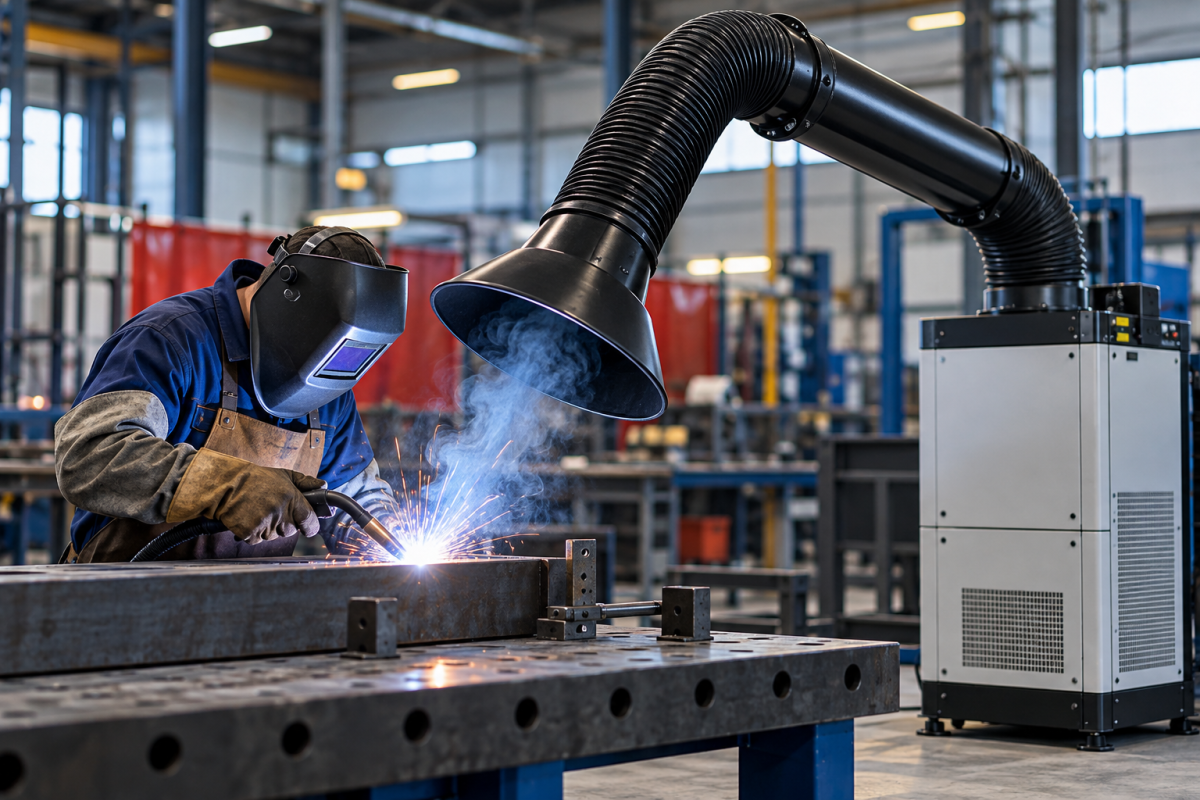
How to Choose the Right Welding Fume Extractor for Your Workshop

Welding fume is generated whenever metals, coatings, fluxes, and other materials are heated to welding temperatures. The amount and composition of the fume can vary significantly depending on the welding process, material, consumables, production volume, and working environment.

Choosing a welding fume extractor therefore requires more than simply selecting a machine based on airflow or motor capacity. The extraction method, capture distance, number of welding stations, filtration technology, operator movement, and workshop layout all influence whether a system will provide effective welding fume extraction.

For a small fabrication shop, a portable source-capture unit may be appropriate. A production facility with several permanent welding stations may require a centralized extraction system. In some applications, an extraction arm positioned close to the arc may be more practical than a large general ventilation system.

This guide explains the key factors to consider when selecting a welding fume extractor for your workshop.

Why Choosing the Right Welding Fume Extractor Matters

Welding fumes should ideally be captured at or close to their source, before they disperse throughout the workplace.

Once fumes rise away from the welding arc and mix with the surrounding air, capturing them becomes more difficult. A system may then require substantially more airflow to control the same contaminant.

Effective welding fume extraction is therefore based on two fundamental principles:

  1. Capture the fume as close to the source as practical.
  2. Move the captured fume through an appropriately designed filtration system.

This is why simply choosing an extractor with a high airflow rating does not necessarily guarantee effective fume control.

A properly selected system should match the actual welding operation rather than relying on airflow alone.

8 Factors to Consider When Choosing a Welding Fume Extractor

1. Identify the Welding Processes Used

Start by identifying the welding processes carried out in your workshop.

Common processes include:

  1. MIG/MAG welding
  2. TIG welding
  3. Stick or SMAW welding
  4. Gas welding
  5. Flux-cored arc welding
  6. Robotic welding
  7. Plasma cutting and related thermal processes

Each process can produce different levels and characteristics of fume.

For example, a workshop carrying out occasional TIG welding on small components has very different extraction requirements from a fabrication facility performing continuous MIG welding on large structures.

The type of consumable, welding current, shielding gas, base material, and production rate can also influence fume generation.

Your welding fume extractor should therefore be selected after understanding the actual welding processes rather than simply specifying a standard machine for every application.

2. Consider the Material Being Welded

The material being welded is another important consideration.

Common materials include:

  1. Mild steel
  2. Stainless steel
  3. Aluminium
  4. Galvanized steel
  5. Painted or coated metals
  6. Special alloys

The base material itself can affect the composition of the welding fume. Coatings, paints, plating, oils, and surface treatments can also introduce additional contaminants during welding.

This makes material identification an important part of the extraction-system design process.

For example, welding stainless steel requires different consideration from welding untreated mild steel because the composition of the fume can differ.

Before specifying an industrial fume extractor, identify not only the metal being welded but also any coatings or treatments present on the workpiece.

3. Decide Where the Fume Should Be Captured

One of the most important decisions is the capture method.

The objective is to capture the fume before it spreads into the operator’s breathing zone or the wider workshop.

Common approaches include:

Extraction Arms

A movable extraction arm can be positioned near the welding operation.

This approach is useful where:

  1. Welding takes place at fixed or semi-fixed stations
  2. Operators need flexibility
  3. The workpieces vary in size
  4. Individual workstations can accommodate extraction arms

The hood should be positioned as close to the welding point as practical without interfering with the welding operation.

The further the hood is from the source, the greater the challenge of capturing the rising fume effectively.

Portable Extraction Units

Portable systems can be useful where welding takes place at multiple locations.

They can be moved between work areas and are particularly relevant to workshops where permanent ducting is impractical.

Centralized Extraction Systems

A centralized system can serve multiple welding stations through a common extraction network.

This can be appropriate for:

  1. Production facilities
  2. Fabrication plants
  3. Multiple permanent welding booths
  4. Workshops with several extraction points

The ductwork, fan capacity, extraction points, and number of simultaneous users must be engineered as a system.

4. Determine the Number of Welding Stations

The number of welding stations directly affects the design of the extraction system.

A workshop with one welding station does not have the same requirements as a facility with 10, 20, or more stations.

However, the number of stations alone should not determine the required extractor capacity.

You also need to establish:

  1. How many stations operate simultaneously?
  2. How long does each station operate?
  3. Are all welding processes the same?
  4. Are extraction arms used at every station?
  5. Is the system centralized or individual?
  6. Are some stations used only occasionally?

For example, a centralized system serving eight welding stations should be designed based on the expected simultaneous operating conditions rather than simply multiplying a nominal airflow figure by eight.

This is where professional system design becomes important.

5. Evaluate Operator Movement and Workpiece Size

The ideal extraction solution for a small welding bench may not work for heavy fabrication.

Consider how operators actually move around the workpiece.

Small Components

For small components at fixed workstations, a close-positioned extraction arm may provide practical source capture.

Large Fabricated Structures

For large structures, the welder may move around the workpiece continuously.

In such situations, keeping a fixed extraction hood close to every welding point can be difficult.

The system may therefore need a different configuration, such as:

  1. Multiple extraction points
  2. Movable extraction arms
  3. Flexible extraction arrangements
  4. A combination of source capture and appropriate general ventilation

The extraction system should accommodate the production process rather than forcing the production process to work around the extraction equipment.

6. Look at the Required Airflow and Static Pressure

Airflow is one of the specifications buyers commonly focus on when selecting a welding fume extractor.

However, airflow alone is not enough.

A system has to deliver the required airflow at the actual operating conditions of the extraction network.

Static pressure losses can occur because of:

  1. Duct length
  2. Duct diameter
  3. Bends and elbows
  4. Branches
  5. Filters
  6. Extraction arms
  7. Hoods
  8. Dampers
  9. Other components in the system

A fan rated for a particular airflow under one pressure condition may deliver considerably less airflow when connected to a restrictive duct system.

Therefore, the selection process should consider both:

Required airflow + required static pressure

rather than choosing equipment solely on the basis of the largest CFM or m³/hr number.

This becomes especially important when designing centralized welding fume extraction for multiple stations.

7. Select the Appropriate Filtration Technology

Once the fume has been captured, it needs to be treated appropriately before the cleaned air is handled according to the system design.

Different filtration technologies are available for industrial fume extraction.

The appropriate technology depends on the contaminant characteristics and application.

For example, electrostatic filtration can be used in certain welding and industrial fume applications because the particles can be electrically charged and collected on collector plates.

Powertech’s FumeKiller range uses electrostatic filtration for applications including welding and soldering fumes, with configurations also positioned for certain oil-mist applications.

The company’s published product information describes filtration performance in the range of 90–98% for applicable systems and refers to very fine particle filtration capability. These figures should be understood as product/system specifications rather than universal performance guarantees for every welding application.

For applications where additional gaseous contaminants or odours need consideration, an activated-carbon post-filter can also be incorporated into suitable configurations.

The key point is that filtration technology should be selected based on the actual contaminant and process, not simply on a headline efficiency percentage.

8. Consider Maintenance Requirements

A welding fume extractor is only useful when it continues to operate effectively.

Maintenance should therefore be considered before purchasing the system.

Ask:

  1. How is the filtration system cleaned?
  2. How frequently does it need servicing?
  3. How is collected contamination removed?
  4. How easy is it to access the filter or collector?
  5. Are replacement components readily available?
  6. How is airflow performance checked?
  7. What indicators show that maintenance is required?

The maintenance requirements can vary considerably between filtration technologies.

A system that appears inexpensive initially may have higher operating or maintenance requirements over its lifetime.

When comparing systems, look beyond the purchase price and consider the total operating requirements.

Source Capture vs General Workshop Ventilation

One of the most important distinctions when designing a welding fume control system is the difference between source capture and general ventilation.

General ventilation attempts to dilute and remove contaminated air from the wider workspace.

Source capture attempts to remove the contaminant before it disperses.

For welding, source capture is generally the more direct approach because the contaminant can be intercepted close to where it is generated.

This does not mean general ventilation has no role.

A well-designed workshop may require both:

Source capture + appropriate general ventilation

The exact combination depends on the welding processes, building layout, production conditions, and extraction design.

Should You Choose a Portable or Centralized Welding Fume Extractor?

There is no single configuration that suits every workshop.

Requirement Portable System Centralized System
Small number of welding stations Suitable May be unnecessary
Frequently changing work locations Useful Less flexible
Multiple permanent stations Limited Suitable
Large production facility Application dependent Often considered
Permanent ducting Usually minimal Required
Multiple extraction points Limited by design Suitable
Expansion of welding stations Depends on unit Can be engineered for expansion

The decision should be based on the production environment rather than simply the number of machines.

For example, a fabrication shop with several welding stations but highly mobile workpieces may require a different solution from an electronics or manufacturing facility with fixed production stations.

When Does a Workshop Need an Industrial Fume Extractor?

An industrial fume extractor becomes particularly relevant when welding is a regular part of production rather than an occasional maintenance activity.

Factors that may indicate the need for an engineered extraction solution include:

  1. Multiple welding stations
  2. Continuous or high-volume welding
  3. Large fabrication areas
  4. Multiple operators welding simultaneously
  5. Limited natural ventilation
  6. Welding of coated or treated metals
  7. Production processes where welding fumes are consistently generated
  8. Requirements for controlled workplace air quality

For larger facilities, the solution may involve multiple source-capture points connected to a centralized filtration system.

Common Mistakes When Choosing a Welding Fume Extractor

Choosing Based Only on Airflow

A higher airflow number does not automatically mean better fume capture.

The hood position, capture distance, system pressure, duct design, and filtration system all matter.

Placing the Extraction Hood Too Far Away

Source capture becomes increasingly difficult as the distance between the hood and welding point increases.

The extraction hood should be positioned as close to the source as practical while allowing the operator to work safely and efficiently.

Ignoring the Welding Process

A system designed for occasional welding may not be suitable for continuous production welding.

The welding process and production volume should form part of the initial equipment specification.

Treating All Welding Fumes as the Same

Different materials, coatings, consumables, and welding processes can produce different contaminants.

Filtration should therefore be selected based on the application.

Forgetting Future Expansion

If the workshop is expected to add welding stations, increase production, or change its manufacturing process, the extraction system should be evaluated with those potential changes in mind.

Retrofitting ductwork and filtration capacity later can be more complicated than considering expansion during the initial design.

A Practical Checklist for Selecting a Welding Fume Extractor

Before contacting an equipment supplier, collect the following information:

Welding Process

  1. MIG/MAG
  2. TIG
  3. Stick
  4. Flux-cored
  5. Robotic
  6. Other processes

Materials

  1. Mild steel
  2. Stainless steel
  3. Aluminium
  4. Galvanized/coated materials
  5. Other alloys

Production

  1. Number of welding stations
  2. Number of simultaneous operators
  3. Hours of welding per shift
  4. Number of shifts
  5. Continuous or intermittent welding

Workplace

  1. Workshop dimensions
  2. Ceiling height
  3. Workstation arrangement
  4. Operator movement
  5. Workpiece dimensions
  6. Existing ventilation

Extraction

  1. Fixed or mobile extraction
  2. Extraction arm requirements
  3. Number of extraction points
  4. Proposed duct arrangement
  5. Required airflow
  6. Static pressure requirements

Filtration

  1. Type of welding fume
  2. Required filtration technology
  3. Filter/collector maintenance
  4. Potential requirement for additional filtration stages

Providing this information allows an extraction-system supplier to recommend equipment based on the actual application rather than relying on a generic machine specification.

Powertech Welding Fume Extraction Solutions

Powertech Pollution Controls provides industrial air pollution control solutions for applications including welding and soldering fume extraction.

Its FumeKiller range uses electrostatic filtration and is available in configurations designed for different industrial applications. For workshops with multiple welding stations, the extraction system can be designed around the number of extraction points, operating conditions, and workshop layout.

Powertech also provides fume extraction arms for source capture, allowing fumes to be captured close to the point of generation.

For example, Powertech has documented a welding application involving eight welding stations and a FumeKiller FK3600VEM, demonstrating how a multi-station welding environment can be approached through an engineered extraction system rather than treating every workstation as an isolated application.

The appropriate equipment, however, depends on the specific welding process, material, workstation configuration, and operating conditions.

Final Thoughts

Choosing a welding fume extractor is fundamentally an application-engineering decision.

The right system depends on more than the size of the workshop or the advertised airflow of an extraction unit. You need to consider the welding process, materials, production volume, operator movement, number of stations, capture method, airflow, static pressure, filtration technology, and maintenance requirements.

For many workshops, the starting point should be source capture: identify where the welding fume is generated and determine how it can be captured as close to that point as practical.

From there, the extraction and filtration system can be designed around the actual operating conditions.

A properly specified welding fume extraction system can provide a more controlled approach to managing welding fumes while fitting into the way the workshop actually operates.

If you are planning a new welding fume extraction system or upgrading an existing one, the best starting point is to evaluate your welding processes, number of stations, workpiece sizes, and workshop layout before selecting the equipment.

Looking for a welding fume extraction solution for your workshop? Contact Powertech Pollution Controls to discuss your application and determine the appropriate extraction and filtration configuration.
Air Pollution Control in Automotive Manufacturing Plants

Introduction

Automotive manufacturing involves a wide range of processes that can generate airborne contaminants, including welding fumes, metal dust, oil mist, coolant mist, grinding particles, smoke, and process emissions. With multiple production lines operating simultaneously, controlling these contaminants requires a carefully engineered air pollution control strategy.

Effective automotive factory air pollution control focuses on capturing contaminants as close as possible to where they are generated. This can involve welding fume extraction, dust collection, oil mist collection, local exhaust ventilation, and appropriately designed factory ventilation systems.

A properly designed system can help maintain cleaner production areas, protect machinery, reduce contamination, and provide better workplace air quality.

Key Takeaways

  1. Automotive plants generate several different types of airborne contaminants.
  2. Source capture is generally the preferred method for controlling concentrated emissions.
  3. Automotive welding ventilation is particularly important in body shops and fabrication areas.
  4. Industrial fume extraction systems should be designed around the welding process and plant layout.
  5. Oil mist and dust require different collection technologies.
  6. General factory ventilation can complement, but should not replace, local exhaust extraction.

Common Air Pollution Sources in Automotive Manufacturing

Automotive production involves numerous processes that generate airborne contaminants.

Welding

Body-in-white manufacturing and component fabrication can generate welding fumes and fine particulate matter.

Common processes include:

  1. MIG/MAG welding
  2. TIG welding
  3. Spot welding
  4. Robotic welding
  5. Laser welding

Grinding and Finishing

Grinding, deburring, polishing, and surface finishing can generate fine metal dust and particles.

CNC Machining

Turning, milling, drilling, and other machining processes can produce:

  1. Oil mist
  2. Coolant mist
  3. Fine metal particles

Cutting and Fabrication

Plasma cutting, laser cutting, sawing, and other thermal or mechanical processes can release smoke, dust, and fine particulate.

Paint and Surface Treatment

Certain coating and surface-treatment operations can generate vapours, aerosols, or other process emissions requiring application-specific extraction.

What Is Automotive Factory Air Pollution Control?

Automotive factory air pollution control involves the combination of equipment and engineering practices used to capture and manage airborne contaminants generated throughout an automotive manufacturing facility.

A complete strategy may include:

  1. Source-capture hoods
  2. Welding fume extraction
  3. Dust collectors
  4. Mist collectors
  5. Extraction ductwork
  6. Industrial blowers
  7. Filtration systems
  8. General ventilation
  9. Monitoring and control equipment

The system should be designed according to the specific processes rather than using the same extraction method throughout the plant.

Automotive Welding Ventilation

Welding is one of the most significant sources of airborne contamination in many automotive manufacturing facilities.

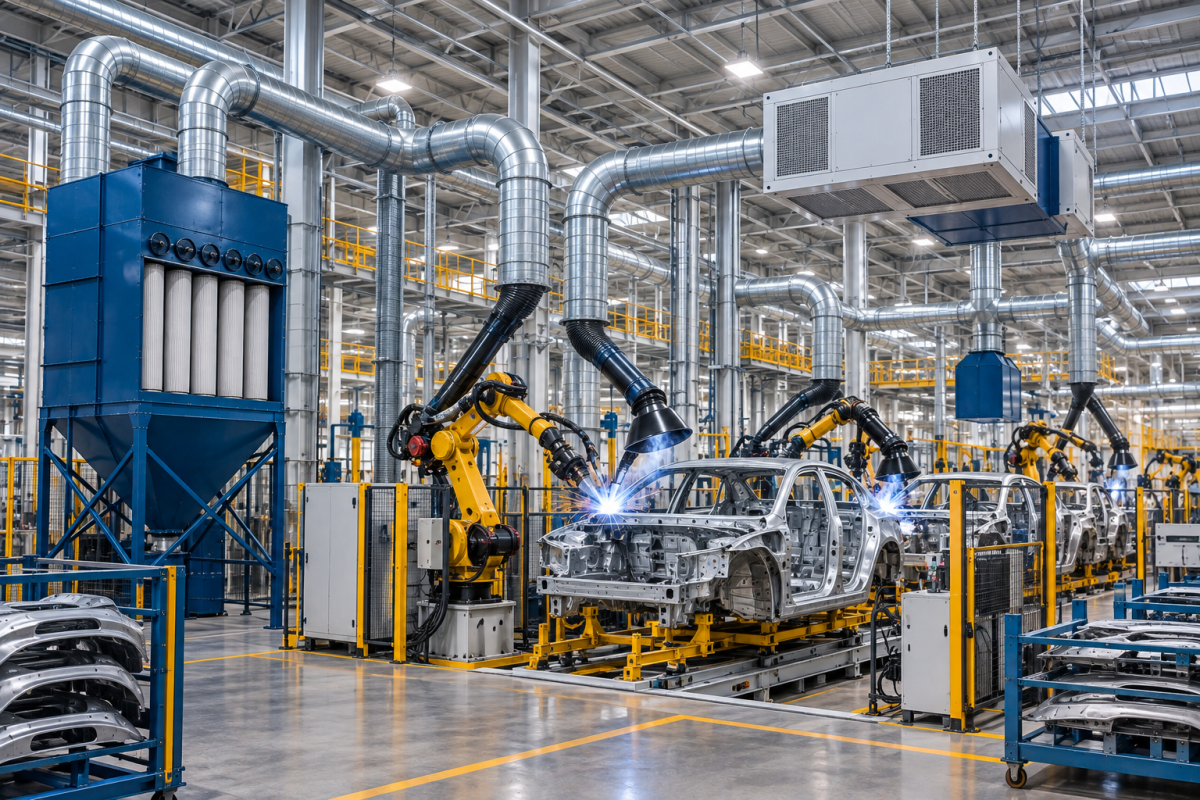
Effective automotive welding ventilation should prioritize source capture.

Extraction can be provided through:

  1. Flexible extraction arms
  2. Welding hoods
  3. Machine-integrated extraction
  4. Robotic-cell extraction
  5. Centralized extraction systems
  6. Portable welding fume extractors

The extraction point should be positioned as close as practical to the welding plume without interfering with the welding process or shielding gas.

Industrial Fume Extraction for Automotive Applications

Industrial fume extraction automotive systems need to accommodate the unique requirements of automotive manufacturing.

Large production facilities may have:

  1. Hundreds of welding points
  2. Robotic welding cells
  3. Moving production lines
  4. High production rates
  5. Multiple shifts
  6. Restricted installation space

For these applications, centralized extraction can connect multiple capture points to a common filtration system.

For smaller or maintenance operations, portable extraction units may provide greater flexibility.

Robotic Welding Fume Extraction

Automotive plants increasingly use robotic welding for high-volume production.

Because robotic welding is repetitive and continuous, extraction can be integrated into the cell design.

Possible approaches include:

Extraction at the Welding Cell

Hoods or enclosures capture fumes from the robotic welding area.

Machine-Integrated Extraction

Extraction is incorporated into the equipment or tooling arrangement.

Centralized Extraction

Multiple robotic cells can be connected to a central filtration system.

The correct configuration depends on cell design, production rate, welding process, and available space.

Dust Control in Automotive Manufacturing

Automotive production also generates dust during:

  1. Grinding
  2. Sanding
  3. Deburring
  4. Cutting
  5. Polishing
  6. Material handling

An appropriately sized industrial dust collector can capture these contaminants at the source.

Source extraction helps prevent dust from spreading to:

  1. CNC machines
  2. Assembly areas
  3. Electrical equipment
  4. Finished components
  5. Operator workstations

Oil Mist and Coolant Mist Control

CNC machining operations can generate airborne oil and coolant aerosols.

These contaminants can settle on:

  1. Machine surfaces
  2. Electrical components
  3. Floors
  4. Finished parts
  5. Ventilation equipment

Mist collectors installed directly on or near CNC machining centers can capture these aerosols before they spread throughout the machine shop.

For automotive component machining, source-capture mist collection can therefore form an important part of the overall air pollution control strategy.

Factory Ventilation Systems

Factory ventilation systems have an important supporting role in automotive manufacturing.

General ventilation can help manage:

  1. Overall air movement
  2. Heat
  3. Residual airborne contamination
  4. General workplace conditions

However, general ventilation should not be relied upon as the primary control for concentrated welding fumes, dust, or oil mist.

A more effective approach is typically:

Source capture → filtration → general ventilation

This layered approach reduces contaminant dispersion while maintaining overall factory air quality.

Source Capture vs General Ventilation

FeatureSource CaptureGeneral Factory Ventilation
Capture locationAt emission sourceEntire workspace
Main purposePrevent dispersionManage overall air
Airflow requirementTargetedLarger air volume
Welding fumesHighly suitableSupplementary
DustHighly suitableSupplementary
Oil mistHighly suitableSupplementary
Plant-wide air managementLimitedSuitable

Designing an Automotive Air Pollution Control System

A successful system should begin with an assessment of the plant.

1. Map Contaminant Sources

Identify:

  1. Welding stations
  2. Robotic cells
  3. Grinding areas
  4. CNC machines
  5. Cutting operations
  6. Material handling points
  7. Other emission sources

2. Characterize the Contaminants

Determine:

  1. Particle size
  2. Concentration
  3. Temperature
  4. Moisture
  5. Chemical characteristics
  6. Generation rate

3. Select the Capture Method

Determine whether the process requires:

  1. Extraction arms
  2. Enclosures
  3. Hoods
  4. Downdraft tables
  5. Machine-integrated extraction
  6. Centralized ducted extraction

4. Calculate Airflow

Airflow requirements depend on:

  1. Capture geometry
  2. Source characteristics
  3. Hood dimensions
  4. Capture distance
  5. Number of extraction points
  6. Simultaneous operation

5. Design the Ductwork

Duct diameter, length, branches, bends, airflow velocity, and static pressure must be evaluated as part of the overall design.

6. Select Filtration Technology

The filtration system should match the contaminant.

For example:

  1. Dust → dust collection
  2. Welding fumes → fume extraction
  3. Oil/coolant mist → mist collection

Benefits of Effective Air Pollution Control

A properly engineered system can provide several operational benefits.

Cleaner Production Areas

Effective source capture reduces airborne contamination and surface deposition.

Reduced Equipment Contamination

Contaminants can settle on machinery, sensors, electrical components, and production equipment. Extraction helps reduce this buildup.

Lower Housekeeping Requirements

Controlling contaminants at the source can reduce the amount of material settling throughout the facility.

Improved Product Cleanliness

Reduced airborne contamination can help maintain cleaner components and production areas.

Better Workplace Air Quality

Effective extraction reduces the concentration of airborne contaminants around production operations.

Improved Operational Reliability

Cleaner equipment and controlled production environments can help reduce contamination-related maintenance problems.

Common Mistakes in Automotive Air Pollution Control

Relying Only on General Ventilation

Large fans may move considerable quantities of air without effectively capturing contaminants at the source.

Positioning Extraction Too Far Away

Source capture becomes less effective as the distance between the hood and emission point increases.

Using One Filtration Technology for Everything

Dust, welding fumes, and oil mist have different characteristics and may require different collection technologies.

Undersizing the Extraction System

Insufficient airflow can result in poor capture and contaminant escape.

Ignoring Production Changes

Adding welding cells or CNC machines can change the airflow requirements of an existing system.

Neglecting Maintenance

Loaded filters, blocked ductwork, damaged seals, and malfunctioning components can gradually reduce extraction performance.

Powertech’s Approach

Powertech provides application-specific pollution control solutions for automotive and engineering manufacturing environments.

Depending on the process, solutions can include:

  1. FumeKiller welding fume extraction systems
  2. MistKiller oil and coolant mist collectors
  3. DustBag industrial dust collection systems
  4. Local exhaust ventilation
  5. Centralized extraction systems
  6. Customized ductwork and filtration

The objective is to match the collection technology to the contaminant and capture it as close as practical to its source.

What are the main air pollutants generated in automotive manufacturing?

Common contaminants include welding fumes, metal dust, grinding particles, oil mist, coolant mist, smoke, and process-specific vapours.

Why is automotive welding ventilation important?

Automotive welding can generate fine airborne fumes and particles. Source-capture ventilation helps remove these contaminants close to the welding operation before they disperse throughout the production area.

What is the best method for industrial fume extraction in automotive plants?

The appropriate method depends on the welding process and production layout. Extraction arms, cell hoods, machine-integrated extraction, and centralized systems can all be suitable for different applications.

Are factory ventilation systems enough for automotive plants?

General factory ventilation can support overall air management, but concentrated emissions are generally better controlled through local source extraction.

Can one extraction system serve multiple automotive production stations?

Yes. Centralized extraction systems can serve multiple fixed workstations or production cells when the airflow, ductwork, filtration, and blower are properly engineered.

How can CNC machining mist be controlled in automotive plants?

Mist collectors installed at CNC machines can capture airborne oil and coolant mist at the source, reducing its spread throughout the machining area.

Conclusion

Effective automotive factory air pollution control requires an integrated approach to the different contaminants generated throughout the production process. Welding fumes, grinding dust, oil mist, coolant mist, and other emissions should not be treated as a single air-quality problem. Automotive welding ventilation and industrial fume extraction automotive systems can provide targeted source capture for welding operations, while dust collectors and mist collectors address other process-specific contaminants. General factory ventilation systems can complement these technologies by managing overall air movement and residual contamination. However, capturing pollutants at their source should remain the foundation of an effective automotive manufacturing air pollution control strategy. Powertech’s FumeKiller, MistKiller, and DustBag solutions provide manufacturers with application-specific options for controlling welding fumes, machining mist, and industrial dust across automotive production environments.

Industrial Air Pollution Control Systems in Manufacturing

Introduction

Manufacturing processes can release a wide range of airborne contaminants, including dust, welding fumes, oil mist, coolant mist, smoke, vapours, and fine particulate matter. If these contaminants are not effectively controlled, they can affect workplace air quality, contaminate machinery, increase maintenance requirements, and create challenging operating conditions.

An effective industrial air pollution control strategy captures contaminants as close as possible to their source and removes them through appropriately selected filtration or separation equipment.

For manufacturing facilities, this may involve industrial air filtration systems, local exhaust ventilation, dust collectors, mist collectors, fume extraction systems, or a combination of technologies.

The right solution depends on the contaminant, process, airflow requirements, facility layout, and operating conditions.

Key Takeaways

  1. Different manufacturing processes generate different types of airborne contaminants.
  2. Source capture is generally more effective than attempting to clean contaminated air after it has dispersed.
  3. Industrial air filtration systems should be selected based on the specific contaminant.
  4. Dust, fumes, mist, and vapours require different collection and filtration technologies.
  5. Properly designed industrial ventilation systems improve contaminant control and workplace air quality.
  6. An integrated factory air pollution control strategy can reduce equipment contamination, maintenance, and housekeeping requirements.

What Is Industrial Air Pollution Control?

Industrial air pollution control refers to the systems and engineering practices used to capture, filter, separate, or otherwise control airborne contaminants generated by industrial processes.

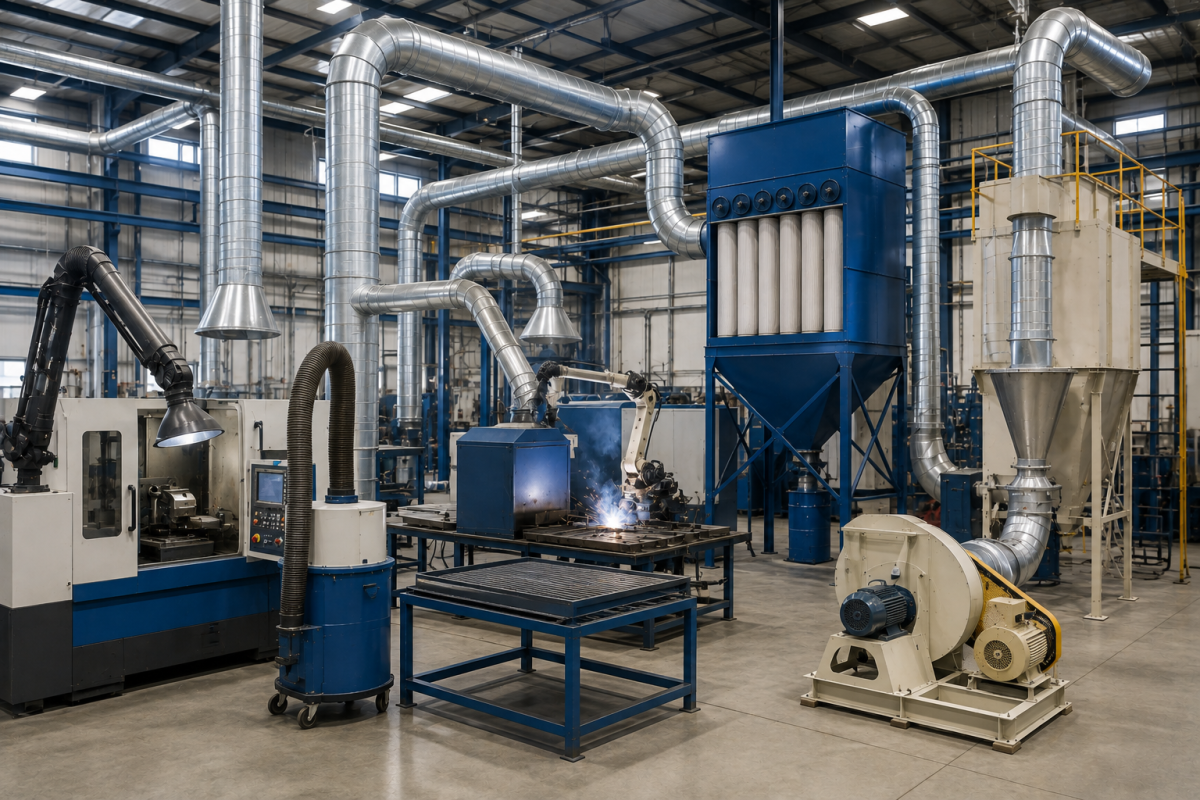
A typical system may include:

  1. Source-capture hood or enclosure
  2. Extraction ductwork
  3. Filtration or separation equipment
  4. Industrial blower
  5. Dust or contaminant discharge system
  6. Monitoring and control equipment

The objective is to prevent contaminants from spreading into the production environment while maintaining the required airflow at the source.

Common Air Pollutants in Manufacturing

Different manufacturing processes produce different contaminants.

Dust

Generated during:

  1. Grinding
  2. Cutting
  3. Sanding
  4. Polishing
  5. Crushing
  6. Material handling
  7. Powder processing

Dust collectors are typically used to capture and filter these particles.

Welding Fumes

Welding and thermal cutting can generate fine particulate fumes and gases.

Source-capture welding fume extractors can remove these contaminants close to the welding operation.

Oil and Coolant Mist

CNC machining and metalworking operations can generate airborne oil and coolant droplets.

Mist collectors are designed to capture these aerosols before they spread throughout the machine shop.

Smoke and Fine Particles

Processes involving heating, thermal treatment, soldering, and other high-temperature operations can produce smoke and fine particulate emissions.

The filtration system should be selected according to the characteristics of the contaminant.

Why Source Capture Is Important

One of the fundamental principles of factory air pollution control is to capture contaminants before they disperse.

Consider a grinding machine generating fine metal dust.

If an extraction hood is positioned close to the grinding operation, the dust can be captured almost immediately.

If the facility instead relies on general room ventilation, the dust can spread throughout the workspace before eventually reaching the filtration system.

Source capture generally provides:

  1. Better contaminant control
  2. Lower required airflow
  3. Reduced workplace contamination
  4. Less equipment fouling
  5. Lower housekeeping requirements
  6. More targeted extraction

Types of Industrial Air Filtration Systems

There is no single filtration technology suitable for every manufacturing application.

1. Baghouse Dust Collectors

Baghouse systems use fabric filter bags to separate dust particles from an air stream.

They are commonly used for applications involving:

  1. High dust loading
  2. Grinding
  3. Material handling
  4. Mineral processing
  5. Large manufacturing operations

2. Cartridge Dust Collectors

Cartridge collectors use pleated filter elements that provide a large filtration surface within a relatively compact system.

They can be suitable for many fine, dry particulate applications.

3. Mist Collectors

Mist collectors remove airborne oil and coolant droplets generated during machining.

They are particularly relevant to:

  1. CNC machining
  2. Turning
  3. Milling
  4. Grinding
  5. Metalworking

Powertech’s MistKiller range is designed for industrial oil and coolant mist extraction applications.

4. Welding Fume Extractors

Welding fume extraction systems capture fumes directly at the welding source.

Depending on the application, systems may use:

  1. Flexible extraction arms
  2. Portable extractors
  3. Centralized extraction
  4. Source-capture hoods
  5. Specialized extraction arrangements

Powertech’s FumeKiller systems are designed for source-capture welding fume extraction.

5. Multi-Stage Filtration

Some industrial processes require more than one filtration stage.

A system may combine:

  1. Pre-filtration
  2. Particle filtration
  3. Fine filtration
  4. Gas or vapour filtration

The configuration depends on the contaminants and required air quality.

Industrial Ventilation Systems vs Local Exhaust

Industrial ventilation systems generally fall into two broad categories.

General or Dilution Ventilation

General ventilation replaces or dilutes contaminated air throughout a facility.

It can help manage overall environmental conditions but may not effectively control contaminants at their source.

Local Exhaust Ventilation

Local exhaust captures contaminants directly at the point where they are generated.

For concentrated industrial emissions, local exhaust is generally the preferred primary control strategy.

The two approaches can be used together where appropriate.

Designing a Factory Air Pollution Control System

A successful system should be designed around the actual manufacturing process.

Step 1: Identify Contaminant Sources

Determine where dust, fumes, mist, smoke, or other pollutants are generated.

Step 2: Characterize the Contaminant

Consider:

  1. Particle size
  2. Concentration
  3. Temperature
  4. Moisture
  5. Chemical properties
  6. Density
  7. Combustibility
  8. Required filtration level

Step 3: Select the Capture Method

Determine whether the process requires:

  1. Enclosure
  2. Extraction hood
  3. Extraction arm
  4. Downdraft extraction
  5. Side-draft extraction
  6. Machine-integrated extraction

Step 4: Calculate Airflow

The required airflow depends on the capture method, source geometry, process conditions, and number of extraction points.

Step 5: Design the Ductwork

Duct diameter, length, bends, branches, and airflow velocity all affect system resistance and performance.

Step 6: Select the Filtration Technology

Choose the appropriate dust collector, mist collector, fume extractor, or multi-stage filtration system.

Step 7: Select the Blower

The blower should be capable of delivering the required airflow at the calculated system static pressure.

Factors That Affect System Performance

Even a high-quality filtration unit can underperform if the overall system is poorly designed.

Important factors include:

Hood Position

The extraction point should be located as close as practical to the contaminant source.

Airflow

Insufficient airflow can result in poor capture.

Static Pressure

The blower must overcome resistance from the hood, ductwork, filters, fittings, and exhaust arrangement.

Filter Condition

Loaded or damaged filters can affect airflow and filtration performance.

Ductwork

Leaks, blockages, poor sizing, and excessive bends can reduce system efficiency.

Maintenance

Regular inspection is essential for maintaining long-term performance.

Benefits of Effective Industrial Air Pollution Control

A properly designed system can provide several operational benefits.

Cleaner Production Areas

Source capture reduces the amount of airborne contamination circulating through the facility.

Reduced Equipment Contamination

Dust, oil mist, and fumes can settle on machinery, electrical systems, and production equipment.

Effective extraction helps minimize this buildup.

Lower Housekeeping Requirements

Reducing airborne contaminants can reduce the amount of material settling on floors, equipment, and surfaces.

Improved Product Quality

Contamination can affect certain manufacturing and finishing processes. Better air control can help maintain cleaner production conditions.

Reduced Maintenance

Less contamination around equipment can contribute to lower cleaning and maintenance requirements.

Improved Working Environment

Effective contaminant control contributes to cleaner workplace conditions and better overall environmental management.

Common Industrial Air Pollution Control Mistakes

Relying Only on General Ventilation

General ventilation cannot always control concentrated emissions effectively.

Installing the Wrong Filtration Technology

A filter designed for dry dust may not be appropriate for oil mist or chemical vapours.

Using Insufficient Airflow

Inadequate airflow can result in contaminants escaping the capture zone.

Poor Hood Positioning

Increasing the distance between the hood and source can significantly reduce capture effectiveness.

Ignoring Duct Design

Even an appropriately sized collector can perform poorly when connected to an inefficient duct network.

Neglecting Maintenance

Loaded filters, damaged seals, blocked ducts, and malfunctioning cleaning systems can gradually reduce performance.

Choosing the Right Industrial Air Pollution Control System

Before selecting equipment, manufacturers should evaluate:

FactorWhat to Consider
ContaminantDust, fume, mist, smoke, vapour
Particle sizeCoarse, fine, or ultrafine
SourceMachine, process, workstation, transfer point
AirflowRequired CFM
Static pressureTotal system resistance
Operating hoursIntermittent or continuous
Number of sourcesSingle or multiple
FiltrationRequired filtration technology
Plant layoutPortable, local, or centralized
MaintenanceFilter and equipment servicing
Future expansionAdditional machines or processes

Powertech’s Approach to Industrial Air Pollution Control

Powertech develops application-specific pollution control solutions rather than relying on a single filtration technology for every manufacturing process.

Depending on the application, the solution may involve:

  1. FumeKiller welding fume extraction systems
  2. MistKiller oil and coolant mist collectors
  3. DustBag industrial dust collection systems
  4. Local exhaust ventilation
  5. Centralized extraction systems
  6. Customized ductwork and filtration arrangements

The system can be engineered around the contaminant characteristics, production process, airflow requirements, plant layout, and operating conditions.

What is industrial air pollution control?

Industrial air pollution control involves capturing, filtering, separating, or otherwise controlling airborne contaminants generated by manufacturing and industrial processes.

What are industrial air filtration systems used for?

Industrial air filtration systems are used to remove contaminants such as dust, welding fumes, smoke, oil mist, coolant mist, and other airborne particles from industrial environments.

What is the difference between dust collection and air filtration?

Dust collection typically focuses on capturing and removing particulate generated by a specific process, while industrial air filtration can refer more broadly to systems that clean contaminated air, including dust, fumes, mist, and other pollutants.

Are industrial ventilation systems enough to control factory pollution?

General ventilation can support overall air management, but it may not provide effective source control for concentrated emissions. Local exhaust extraction is generally more effective for capturing contaminants at their source.

How do I choose an industrial air pollution control system?

The system should be selected based on the contaminant type, particle characteristics, process, required airflow, static pressure, operating conditions, filtration requirements, and facility layout.

Can one system control multiple industrial pollutants?

In some facilities, multiple contaminants can be managed through a coordinated system, but different pollutants may require different collection or filtration technologies. The system should be engineered based on the specific application.

Conclusion

Effective industrial air pollution control is an important part of modern manufacturing. Dust, welding fumes, oil mist, coolant mist, and other airborne contaminants require different approaches, making application-specific engineering essential. The most effective strategy is generally to capture contaminants close to their source and transport them through a properly designed extraction and filtration system. Industrial air filtration systems, local exhaust, and industrial ventilation systems can then work together to maintain cleaner production environments. For manufacturers, the right factory air pollution control solution can reduce airborne contamination, protect equipment, lower housekeeping requirements, and support more reliable production. Powertech provides engineered pollution control solutions across dust, mist, and welding fume applications, helping manufacturers select the appropriate technology for their specific processes.

Successful Application of FumeKiller® as a Welding Fume Extractor

Introduction:

The FumeKiller® on multiple occasions was able to prove its worth with the effective capture and control of fumes generated from industrial processes. One of the most common processes which has employed the FumeKiller® is in welding. In this post, we look into a project where the FumeKiller® was successfully implemented as a welding fume extractor.

The Challenge: Control of Welding Fumes generated during manufacture and assembly of commercial vehicles.

The customer was an established company in the automotive sector and was faced with a very tricky problem – During the welding process conducted on commercial vehicles like trucks, fumes were generated from multiple points. The fumes were being generated from different points based on where the welding was being done and it was impractical and expensive to create a large extraction hood / station that would be capable of effectively capturing the generated fumes. The customer therefore needed a novel and custom designed solution to ensure successful extraction of the generated welding fumes.

The Solution: Single FumeKiller® model FK3600VEM equipped with Flexible Extractor Arm.

Due to the tricky nature of the problem, our team had to approach the issue with a creative mindset to ensure a viable solution for the same. After careful investigation and study of the workspace(s), we decided that the best solution to the issue would be to use a portable welding fume extractor equipped with a Flexible Extractor Arm and based on our study of the process, it was decided that the FumeKiller® model FK3600VEM would be used for the extraction of welding fumes. Some of the benefits of this solution include:

  • Portable FumeKiller® Unit: The FumeKiller® model FK3600VEM is a vertically oriented variation of the standard model. The unit itself is mounted on wheels and can be moved to different location depending on where the welding process is taking place.
  • Flexible Extractor Arm: Although not a part of our standard line of products, the Flexible Extractor Arm is one that is used specifically in situation like what the client was facing. The arm along with the portable fume extractor, allowed for adjustment of the extraction hood close to the welding point. This therefore, would ensure effective and efficient extraction of the generated welding fumesdirectly from the source, without spreading to the rest of the shopfloor.

Results and Impact:

The implementation of the FumeKiller® was a success which allowed for multiple benefits to our client:

Improvement in Air Quality: Since the fumes that were generated from the process were being extracted directly from the source, the remainder of the shopfloor remained pollution free. The direct result of this was a safer and healthier work environment for the staff.

Operational Efficiency: The FumeKiller® model FK3600VEM is a single portable fume extractor unit that allowed for a mobile extraction system that could be deployed to any location, as and when required. This negated the requirement of a bulky and expensive fume extraction station which may not have provided the same efficiency of extraction. The solution was therefore not only efficient but allowed the customer to benefit from significant cost savings as well.

Regulatory Compliance: The successful implementation of the FumeKiller® as a welding fume extractor resulted in the customer meeting the required air quality standards within the shopfloor.

Conclusion:

The success of the project is a clear example of how we use a unique approach to every single client and provide custom built solution for each requirement. We are committed to providing every customer with the most effective, efficient, and economical solution for their air pollution control needs. With our portable fume extraction system, we were able to address the welding fume issues faced by our customer and help to enhance the air quality and thereby worker safety within the shopfloor. The transformative impact of the FumeKiller® in this project clearly demonstrated its potential to create cleaner and safer workspaces. If you are facing a challenging issue to do with air pollution control, get in touch with us today and we will work with you to find the best possible solution.

Visit us: https://www.powertechindia.com