
Introduction
Printed Circuit Board (PCB) assembly is one of the most common applications where soldering fumes are generated continuously throughout the production process. Whether through manual soldering, selective soldering, wave soldering, or rework operations, flux vapors and solder smoke are released directly into the operator’s breathing zone. Without proper ventilation, these contaminants can accumulate rapidly and affect workplace air quality.
A properly designed PCB soldering fume extractor is essential for maintaining safe working conditions and ensuring compliance with workplace air quality standards. Effective electronics soldering ventilation captures contaminants at the source before they disperse into the production environment.
Modern fume extraction PCB manufacturing solutions combine source capture, multi-stage filtration, and efficient airflow management to provide reliable solder smoke control in electronics assembly facilities.
With over 30 years of experience in industrial air pollution control, Powertech has implemented specialized fume extraction systems for PCB assembly lines, electronics manufacturing plants, and precision soldering workstations.
Key Takeaways
- PCB assembly operations generate flux vapors, solder smoke, and VOCs.
- A PCB soldering fume extractor captures contaminants directly at the source.
- Proper electronics soldering ventilation improves operator safety and air quality.
- Multi-stage filtration removes particulate matter, odors, and gaseous contaminants.
- Effective solder smoke control improves workplace comfort and productivity.
The Problem: Soldering Fumes in PCB Assembly
PCB manufacturing environments often involve continuous soldering operations across multiple workstations.
Causes
- Flux vaporization during soldering
- Manual and automated soldering processes
- Rework and repair stations
- Inadequate source capture ventilation
Workplace Impact
- Poor indoor air quality
- Eye and throat irritation
- Unpleasant odors
- Reduced operator comfort
Safety Risks
According to the Occupational Safety and Health Administration (OSHA), soldering operations can generate airborne contaminants that require effective ventilation controls.
The National Institute for Occupational Safety and Health (NIOSH) recommends local exhaust ventilation as the preferred method for controlling soldering fumes.
Technical Explanation: How PCB Soldering Fume Extraction Works
Step 1: Source Capture
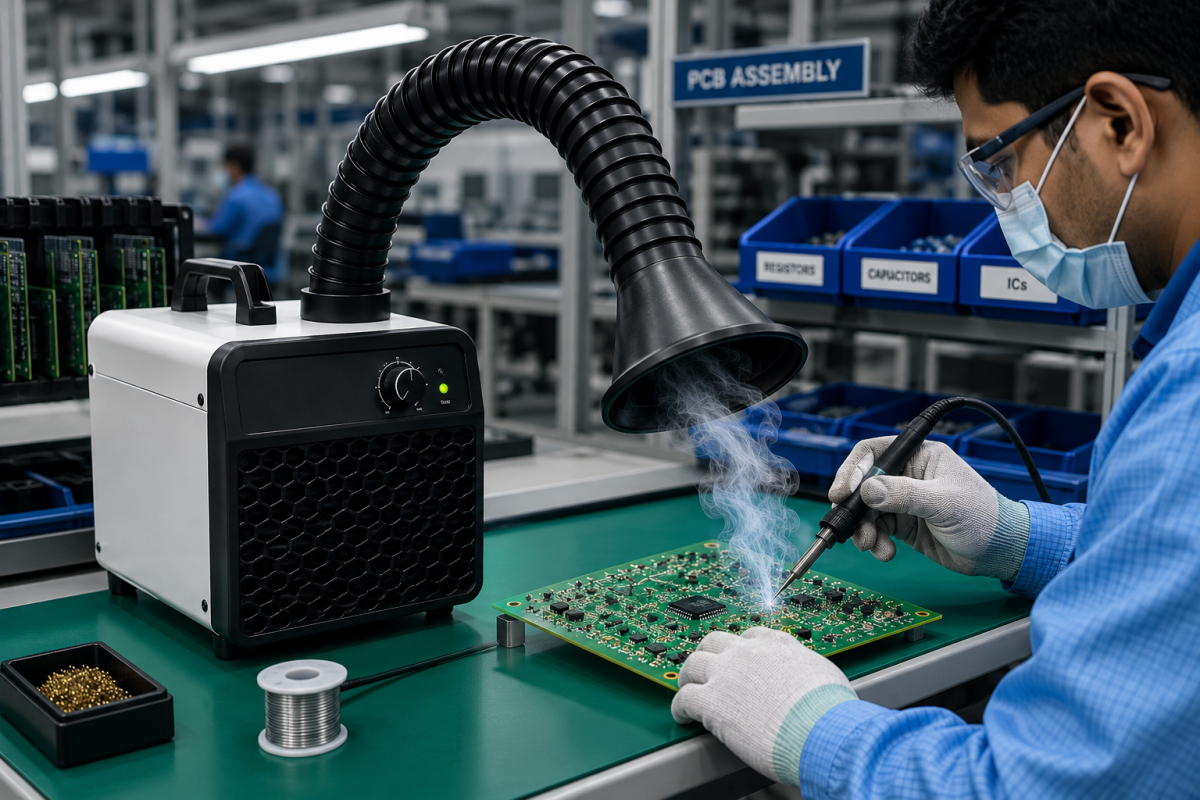
The extraction nozzle or hood is positioned close to the soldering point.
Recommended Position
- 50–150 mm from the soldering source
- Aligned with natural fume movement
Capturing fumes at the source prevents workplace contamination.
Step 2: Airflow Generation
A fan or blower creates suction that draws fumes into the extraction system.
Design Considerations
- Stable airflow
- Low noise levels
- Consistent extraction performance
Step 3: Multi-Stage Filtration
Most PCB soldering extraction systems use multiple filtration stages.
Typical Filtration Process
- Pre-filter for larger particles
- HEPA filter for fine solder smoke
- Activated carbon filter for VOCs and odors
Activated carbon filtration is critical for flux vapor control.
Step 4: Clean Air Discharge
After filtration:
- Air is safely discharged
- Or recirculated where filtration efficiency permits
PCB Assembly Applications
Manual Soldering Stations
- Individual source capture systems
- Flexible extraction arms
PCB Production Lines
- Multiple soldering operators
- Centralized or workstation-based extraction
Rework Stations
- Portable extraction units
- Adjustable nozzles
Electronics Repair Centers
- Compact bench-top extraction systems
- Flexible workstation layouts
Filtration Requirements for PCB Manufacturing
| Filtration Stage | Function | Contaminants Removed |
|---|---|---|
| Pre-filter | Larger particle removal | Dust and coarse particulate |
| HEPA Filter | Fine particulate removal | Solder smoke |
| Activated Carbon Filter | Gas adsorption | VOCs, flux vapors, odors |
| Multi-stage System | Comprehensive filtration | Mixed contaminants |
Expert Insight
From Powertech’s experience, many PCB assembly facilities focus on productivity improvements while overlooking ventilation effectiveness.
Key observations:
- Poor nozzle positioning can reduce capture efficiency dramatically.
- Activated carbon filtration is often underestimated despite its importance for odor and VOC control.
- Portable workstation extractors are highly effective when centralized systems are impractical.
In several electronics manufacturing facilities, optimized electronics soldering ventilation has improved operator comfort and workstation air quality without requiring major production changes.
It captures solder smoke, flux vapors, and airborne contaminants before they reach the operator’s breathing zone.
Most systems use pre-filters, HEPA filters, and activated carbon filters.
While primarily a health concern, poor ventilation can also reduce operator visibility and comfort, potentially affecting work quality.
Typically between 50–150 mm for effective source capture.
Yes, portable and bench-top extractors are commonly used for PCB assembly and rework stations.
A properly designed PCB soldering fume extractor is essential for maintaining safe and productive PCB assembly operations. Effective electronics soldering ventilation systems capture contaminants at the source, improve air quality, and provide reliable solder smoke control throughout the manufacturing process. By implementing engineered fume extraction PCB manufacturing solutions with proper source capture and multi-stage filtration, electronics manufacturers can significantly improve workplace safety and operator comfort. With decades of experience in industrial air pollution control, Powertech continues to provide customized extraction solutions that support cleaner, safer, and more efficient PCB assembly environments.