
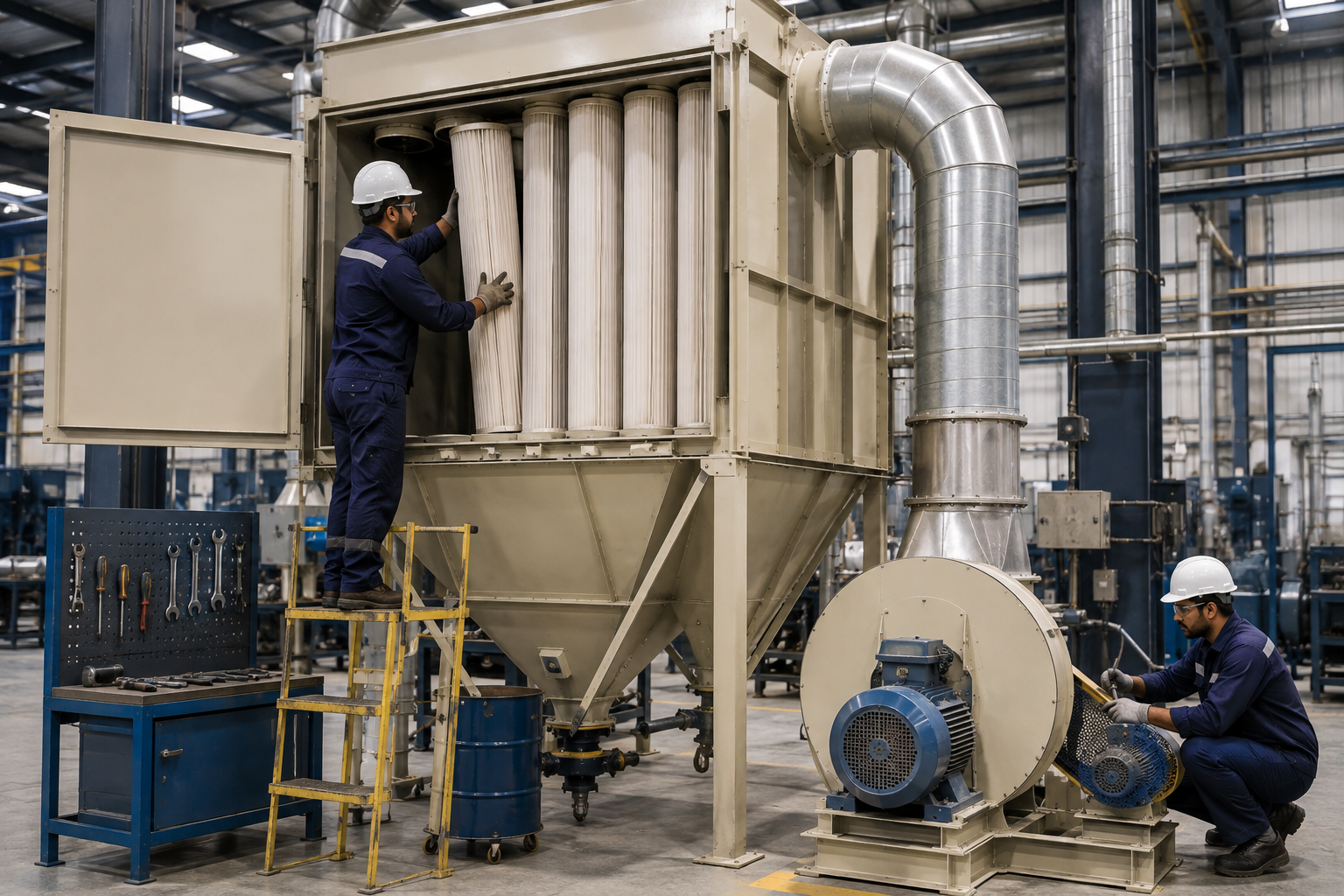
Introduction
An industrial dust collection system is designed to operate continuously in demanding manufacturing environments. Over time, dust accumulation, filter loading, airflow changes, mechanical wear, and duct contamination can reduce system performance if routine maintenance is neglected.
Proper dust collector maintenance helps maintain consistent extraction performance, extend filter and equipment life, reduce unexpected downtime, and control operating costs. Regular inspection is particularly important for facilities where dust collection systems operate for long hours or handle abrasive, fine, or heavy dust loads.
A structured maintenance program should cover the dust collector, filters, blower, ductwork, hoppers, dust discharge equipment, and control systems rather than focusing only on filter replacement.
This guide explains practical industrial dust collector service and dust extraction system maintenance practices that can help manufacturers keep their systems operating reliably.
Key Takeaways
- Regular maintenance is essential for consistent dust collection performance.
- Filter condition directly affects airflow and system efficiency.
- Dust filter replacement should be based on operating condition rather than an arbitrary schedule alone.
- Ductwork, hoppers, blowers, and controls also require periodic inspection.
- Monitoring pressure drop and airflow can help identify problems early.
- Preventive maintenance is generally more cost-effective than emergency repairs.
Why Dust Collector Maintenance Matters
A dust collector may continue running even when its performance has gradually deteriorated.
Common signs of a poorly maintained system include:
- Reduced suction at extraction points
- Increasing pressure drop
- Frequent filter clogging
- Dust escaping from the collector
- Excessive blower noise
- Dust accumulation inside ducts
- Increased energy consumption
- Poor workplace air quality
Routine maintenance allows these problems to be identified before they result in major production disruptions.
What Does Dust Collector Maintenance Include?
A comprehensive maintenance program should cover:
- Filters
- Dust hopper and discharge system
- Blower and motor
- Ductwork
- Extraction hoods
- Differential pressure monitoring
- Pulse-jet cleaning system
- Electrical controls
- Seals and gaskets
- Structural components
The exact maintenance frequency depends on the dust type, operating hours, collector design, and process conditions.
1. Inspect Filters Regularly
Filters are among the most critical components of any dust collection system.
Inspect filters for:
- Excessive dust loading
- Physical damage
- Holes or tears
- Blinding
- Moisture contamination
- Uneven dust accumulation
- Incorrect installation
Damaged filter media can allow dust to pass through the collector and contaminate the clean-air side.
2. Monitor Differential Pressure
Differential pressure is a useful indicator of filter condition.
As dust accumulates on filter media, resistance to airflow can increase.
A steadily increasing pressure drop may indicate:
- Loaded filters
- Ineffective filter cleaning
- Blocked ductwork
- Incorrect operating conditions
- Damaged or malfunctioning cleaning components
Monitoring pressure trends can help maintenance teams identify problems before extraction performance is seriously affected.
3. Follow the Correct Dust Filter Replacement Procedure
Dust filter replacement should not be based only on a fixed calendar interval.
Filter life depends on:
- Dust concentration
- Particle characteristics
- Operating hours
- Filter media
- Cleaning system performance
- Air-to-cloth ratio
- Process conditions
When replacement is necessary, filters should be replaced with the correct specification and installed carefully to prevent bypass leakage.
4. Inspect the Pulse-Jet Cleaning System
For collectors using pulse-jet cleaning, inspect:
- Compressed-air pressure
- Solenoid valves
- Diaphragm valves
- Air lines
- Pulse controllers
- Nozzles
- Air receiver condition
If the cleaning system does not operate correctly, filters can load prematurely and airflow can deteriorate.
5. Check the Dust Hopper
Dust should not be allowed to accumulate excessively inside the hopper.
Inspect for:
- Material buildup
- Bridging
- Blockages
- Leakage
- Damaged components
- Improper discharge
A blocked hopper can reduce collection efficiency and may eventually interfere with filter operation.
6. Inspect the Dust Discharge System
Depending on the collector, dust may be discharged using:
- Collection bins
- Rotary airlocks
- Screw conveyors
- Valves
- Continuous discharge systems
Check that the discharge mechanism operates smoothly and does not allow excessive air leakage into the collector.
7. Maintain the Blower and Motor
The blower is responsible for maintaining the airflow required by the extraction system.
During industrial dust collector service, inspect:
- Motor condition
- Bearings
- Belt tension
- Couplings
- Fan impeller
- Vibration
- Unusual noise
- Motor temperature
Excessive vibration or unusual noise should be investigated rather than ignored.
8. Inspect Ductwork
Ductwork can gradually accumulate dust, particularly when airflow is below the required transport velocity.
Inspect for:
- Dust buildup
- Leaks
- Corrosion
- Damaged joints
- Loose connections
- Blockages
- Excessive pressure loss
Poor duct condition can reduce airflow at extraction points even when the dust collector itself is operating correctly.
9. Check Extraction Hoods
The hood is the first point of dust capture.
Inspect hoods for:
- Damage
- Blockages
- Incorrect positioning
- Excessive wear
- Loose connections
For processes involving source capture, maintaining the correct distance and orientation between the hood and dust source is particularly important.
10. Inspect Electrical and Control Systems
Dust collection systems often operate with automated controls.
Inspect:
- Control panels
- Sensors
- Pressure switches
- Timers
- Solenoid controls
- Motor starters
- Variable-frequency drives
- Wiring and connections
Electrical inspection should be carried out by qualified personnel according to the equipment manufacturer’s requirements.
11. Check Seals and Gaskets
Air leakage can significantly reduce extraction performance.
Inspect:
- Access doors
- Filter seals
- Inspection covers
- Duct connections
- Hopper joints
- Collector panels
Damaged seals should be repaired or replaced promptly.
Recommended Maintenance Schedule
| Component | Recommended Check |
|---|---|
| Extraction hood | Regular visual inspection |
| Differential pressure | Monitor during operation |
| Filters | Inspect regularly; replace based on condition |
| Pulse-jet system | Regular functional inspection |
| Hopper | Check for buildup and blockage |
| Dust discharge | Inspect regularly |
| Blower | Check vibration, bearings, and performance |
| Motor | Inspect condition and temperature |
| Ductwork | Periodic inspection and cleaning |
| Electrical controls | Periodic inspection |
| Seals and gaskets | Inspect for air leakage |
The exact intervals should be established according to the collector design, dust characteristics, operating hours, and manufacturer’s recommendations.
Preventive vs Reactive Maintenance
Waiting for a dust collector to fail before servicing it can result in:
- Unexpected downtime
- Emergency filter replacement
- Higher repair costs
- Production interruptions
- Reduced equipment life
- Poor dust control
Preventive maintenance identifies deterioration early and allows repairs to be scheduled around production requirements.
Common Dust Collector Maintenance Mistakes
Replacing Filters Too Early
Replacing filters before they are actually at the end of their useful life can unnecessarily increase operating costs.
Waiting Too Long to Replace Filters
Continuing to operate severely loaded or damaged filters can reduce airflow and increase energy consumption.
Ignoring Differential Pressure
Pressure trends provide valuable information about filter and system condition.
Cleaning Only the Collector
The dust collector is only one part of the extraction system. Ductwork, hoods, blowers, and discharge equipment also require attention.
Ignoring Small Air Leaks
Minor leaks can reduce system performance and increase fan energy requirements.
How to Improve Dust Extraction System Maintenance
A reliable maintenance program should include:
Daily or Routine Checks
- Observe airflow performance
- Check abnormal noise or vibration
- Monitor differential pressure
- Inspect visible dust leakage
- Check dust discharge
Periodic Checks
- Inspect filters
- Test pulse cleaning
- Inspect ductwork
- Check blower and motor
- Inspect electrical controls
- Check seals and access doors
Scheduled Servicing
- Replace filters when required
- Clean accumulated dust
- Service bearings and mechanical components
- Inspect the complete extraction network
- Verify system airflow
When Should You Consider Professional Industrial Dust Collector Service?
Professional servicing may be appropriate when:
- Airflow has significantly decreased
- Pressure drop remains unusually high
- Filters require unusually frequent replacement
- Dust is escaping from the collector
- Blower vibration has increased
- Ductwork requires major cleaning
- The system has been modified
- New machines have been connected
- Production requirements have changed
A professional assessment can determine whether the problem is related to filtration, airflow, ductwork, blower performance, or system configuration.
Powertech’s Approach to Dust Collector Maintenance
Powertech recommends treating maintenance as an ongoing part of dust collection system performance rather than an occasional repair activity.
A proper service assessment can examine:
- Filter condition
- Airflow
- Differential pressure
- Blower performance
- Ductwork
- Pulse-jet operation
- Dust discharge
- Electrical controls
- Air leakage
- Overall system condition
For DustBag systems, maintenance requirements can be evaluated according to the actual dust characteristics and operating conditions of the installation.
The required frequency depends on the dust type, operating hours, filter technology, dust loading, and system design. Routine inspections should be combined with condition-based servicing.
Filters should generally be replaced when they reach the end of their useful operating life, become damaged, or can no longer maintain the required airflow and filtration performance.
Monitoring airflow and differential pressure is particularly useful because changes can indicate filter loading, cleaning-system problems, or other restrictions.
Reduced suction, increasing pressure drop, visible dust leakage, unusual blower noise, excessive vibration, and frequent filter loading can all indicate a problem.
Yes. Ductwork should be inspected for leaks, corrosion, blockages, and dust accumulation because these problems can significantly affect extraction performance.
Yes. Correct pulse cleaning, appropriate airflow, proper system operation, and timely servicing can help filters operate effectively for longer.
Effective dust collector maintenance is essential for maintaining reliable extraction performance and protecting the investment made in an industrial dust collection system. Regular inspection of filters, airflow, pressure drop, ductwork, blowers, hoppers, controls, and dust discharge equipment helps identify problems before they become costly failures. A structured industrial dust collector service program also makes dust filter replacement more predictable and helps ensure that the entire dust extraction system continues to operate efficiently. For manufacturers, preventive maintenance should be treated as an integral part of dust control—not simply as a response to equipment failure. With proper inspection, servicing, and condition monitoring, Powertech DustBag systems can continue delivering dependable dust collection performance throughout their operating life.