
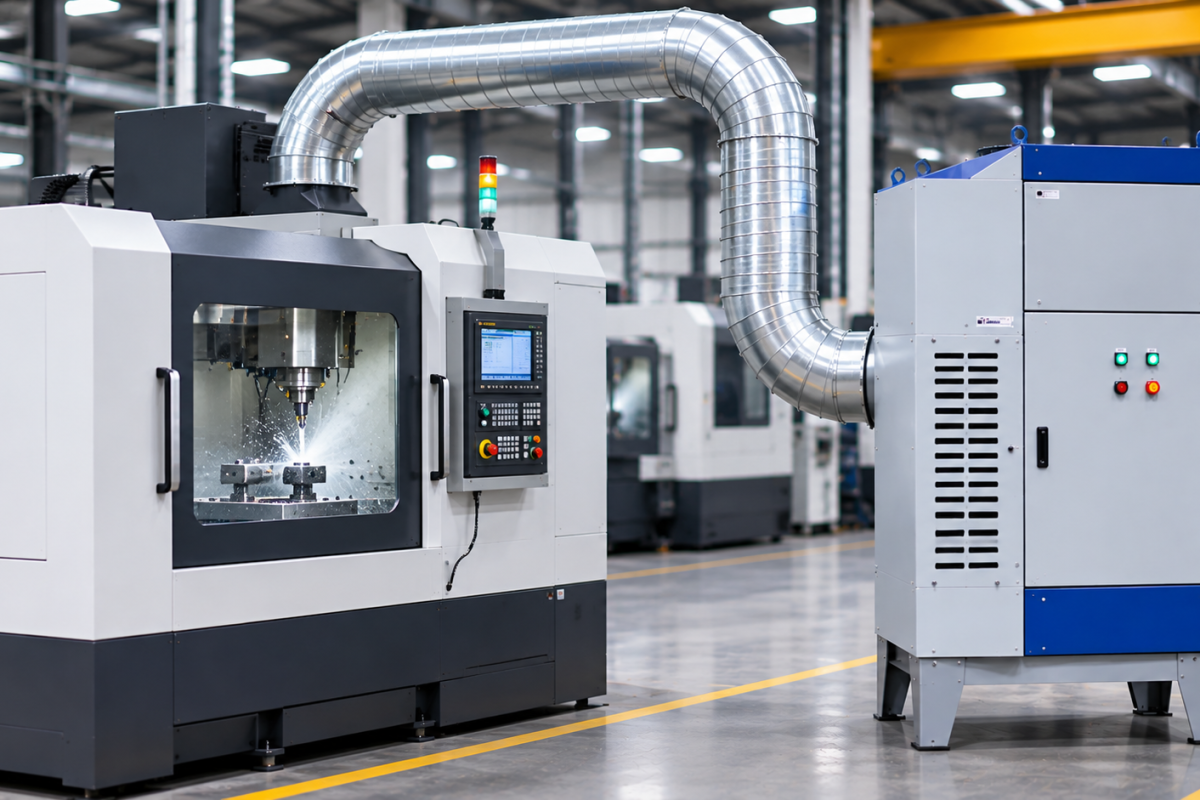
Oil mist is a common by-product of several CNC machining operations, particularly when machines use neat cutting oils for lubrication and cooling. During high-speed machining, rotating tools, moving workpieces and pressurised lubrication systems can generate fine oil droplets that become suspended in the air inside the machine enclosure.
When this mist escapes into the surrounding workshop, it can affect indoor air quality, settle on floors and equipment, increase cleaning requirements and create an uncomfortable working environment.
An oil mist collector for CNC machining is designed to capture and filter these airborne oil droplets before they spread throughout the production area. However, not every CNC machine requires the same type of mist collection system. The need depends on the machining process, cutting fluid, operating conditions, enclosure design and amount of mist generated.
This guide explains when an oil mist collector is needed, how oil mist develops during CNC machining, which filtration technologies are suitable and what manufacturers should consider when selecting an extraction system.
1. What Is Oil Mist in CNC Machining?
Oil mist is an airborne mixture of very small liquid oil droplets suspended in the surrounding air.
It is generated when cutting oil is exposed to mechanical forces, high-speed rotation, turbulence and temperature changes during machining.
In CNC machines, oil mist can develop through several mechanisms:
- High-speed rotation of spindles and cutting tools
- Contact between rotating components and cutting oil
- High-pressure oil delivery and lubrication systems
- Splashing and atomisation of cutting fluid
- Turbulence created inside the machine enclosure
- Movement of workpieces and rotating chucks
The resulting droplets can vary in size. Larger droplets may settle on internal machine surfaces, while finer droplets can remain suspended in the air and escape through enclosure openings or during machine access.
Over time, airborne oil mist can accumulate in the workshop if it is not adequately controlled.
An oil mist collector captures this contaminated air, separates or filters the oil droplets and manages the collected liquid according to the equipment design.
2. Which CNC Machining Processes Generate Oil Mist?
Not every CNC machining operation produces the same quantity of oil mist. The amount depends on the machining process, fluid delivery method, spindle speed, cutting conditions and enclosure design.
Oil mist can be generated in several applications.
CNC turning
CNC turning involves rotating the workpiece while cutting tools remove material. Oil mist may develop due to the interaction between cutting oil, the rotating chuck, the workpiece and the cutting tool.
High spindle speeds and continuous machining can increase the amount of airborne oil droplets generated.
CNC milling
During CNC milling, rotating cutting tools interact with the workpiece while cutting fluid is supplied to the machining zone.
The combination of tool rotation, fluid impact and turbulence can generate airborne oil droplets, particularly when neat cutting oil is used.
CNC grinding
Grinding operations can generate fine airborne liquid droplets when cutting oil is used for lubrication and cooling.
The high-speed movement of the grinding wheel and the interaction between the wheel, workpiece and fluid can contribute to mist formation.
High-speed machining
High-speed machining operations can create significant turbulence within the machine enclosure.
Depending on the cutting fluid and operating conditions, this turbulence can increase the formation and dispersion of fine oil droplets.
Multi-machine CNC facilities
Manufacturing facilities operating several CNC machines may experience oil mist accumulation across production areas.
Even when individual machines have relatively low mist emissions, multiple machines operating simultaneously can create a substantial combined load on the workshop environment.
For these facilities, a properly designed extraction arrangement becomes particularly important.
3. Oil Mist vs Water-Based Coolant Mist: Why the Difference Matters
One of the most important considerations when selecting a CNC mist collector is identifying the type of machining fluid being used.
Oil mist generated by neat cutting oil has different characteristics from mist generated by water-based coolant emulsions. The filtration technology should therefore be selected according to the actual liquid and application.
Oil mist from neat cutting oils
Neat cutting oils are used without dilution with water. They are commonly selected for machining applications where lubrication and cutting performance are important.
Mist generated from these oils consists of airborne oil droplets that may remain suspended in the machine enclosure and surrounding air.
For suitable neat-oil mist applications, electrostatic filtration can be an effective collection approach.
Mist from water-based coolants
Water-based coolants are typically emulsions or solutions containing water and other additives.
Mist generated during machining with these fluids has different liquid characteristics and may require a different collection approach.
Powertech’s Mistkiller™ is a centrifugal mist collector primarily designed for applications involving water-based coolant mist.
The distinction is important:
- Neat cutting-oil mist: An electrostatic mist filtration system such as Powertech’s Fumekiller® may be suitable, depending on the application.
- Water-based coolant mist: A centrifugal mist collector such as Mistkiller™ is designed for this application.
The two systems should not be treated as interchangeable. The correct selection depends on the machining fluid and operating conditions.
For a broader understanding of the available technologies, explore Powertech’s industrial mist collection solutions.
4. When Does a CNC Machine Need an Oil Mist Collector?
An oil mist collector becomes important when machining operations generate airborne oil droplets that are not adequately contained within the machine enclosure.
The following conditions can indicate that additional mist collection is needed.
Visible oil mist escaping from the machine
One of the most noticeable signs is a visible haze around the CNC machine, particularly near enclosure doors, ventilation openings and access panels.
Although not all airborne oil mist is visible, persistent visible emissions can indicate that the existing containment or extraction arrangement is inadequate.
Oil deposits on surrounding equipment
Oil mist can travel beyond the machine and settle on nearby surfaces.
Common signs include:
- Oily deposits on control panels and machine exteriors
- Oil accumulation on overhead surfaces
- Sticky residue on nearby equipment
- Frequent cleaning requirements
- Oil contamination around ventilation outlets
These deposits can indicate that airborne oil droplets are escaping from the machining enclosure.
Slippery workshop floors
Oil mist that escapes into the production area can settle on floors and other surfaces.
This can increase housekeeping requirements and create slip hazards, particularly in facilities where several CNC machines operate continuously.
Frequent machine door opening
Opening CNC machine doors during loading, unloading, inspection and tool changes can release mist that has accumulated inside the enclosure.
Where these operations occur frequently, effective enclosure extraction can help manage the mist before it escapes into the surrounding workspace.
Multiple CNC machines operating simultaneously
A facility with several oil-based CNC machining operations may experience a combined mist load that is difficult to manage through general ventilation alone.
In these situations, dedicated mist collection can help control emissions closer to their source.
Inadequate existing ventilation
General workshop ventilation may help manage overall air movement, but it does not necessarily capture oil mist at the machine where it is generated.
A dedicated extraction system is worth evaluating when mist continues to escape despite the presence of general ventilation.
5. How Does an Oil Mist Collector Work?
An oil mist collector draws contaminated air from the CNC machine enclosure and passes it through a filtration arrangement designed to remove airborne oil droplets.
The general process involves three stages:
Stage 1: Mist capture
Air containing oil droplets is drawn from the machine enclosure through a designated extraction connection.
The extraction arrangement may be connected to the machine’s ventilation outlet or another suitable capture point.
The objective is to capture mist before it escapes into the workshop.
Stage 2: Oil mist filtration
The contaminated air enters the mist collector, where the filtration technology removes oil droplets from the airstream.
Different collectors use different separation principles.
For suitable oil mist applications, electrostatic filtration works by electrically charging airborne droplets and attracting them to oppositely charged collection plates.
As the droplets accumulate, they combine into larger liquid deposits that can drain into a collection arrangement.
The performance of the system depends on its design, operating conditions, particle characteristics and maintenance condition.
Stage 3: Cleaned air discharge
After passing through the filtration stages, the treated air is discharged according to the system configuration.
Depending on the installation and applicable requirements, the air may be returned to the indoor environment or discharged through an appropriate exhaust arrangement.
The discharge arrangement should be determined through an application-specific assessment rather than assuming that every installation can recirculate air.
6. Why Electrostatic Filtration Is Used for Oil Mist Collection
Electrostatic filtration is widely used in suitable industrial oil mist applications because it uses an electrical collection mechanism rather than relying exclusively on conventional mechanical filtration.
The basic operating principle involves two main actions:
- Airborne oil droplets pass through an ionising section where they receive an electrical charge.
- The charged droplets are attracted to collection plates carrying the opposite charge.
The collected oil accumulates on the plates and can be drained or removed during maintenance, depending on the equipment design.
Potential advantages of electrostatic oil mist filtration
Collection of fine airborne droplets
Electrostatic filtration can collect fine oil droplets that may remain suspended in the air for extended periods.
Reduced dependence on disposable filter media
Electrostatic systems use collection components that can be cleaned and reused, depending on the design and maintenance procedure.
Oil collection and drainage
Collected oil can be managed through a drainage arrangement, subject to the system configuration and oil condition.
Suitability for industrial operating environments
Electrostatic mist collectors can be configured for suitable CNC machining applications where oil mist is generated continuously or intermittently.
However, electrostatic filtration is not automatically suitable for every airborne contaminant. Application assessment is necessary to establish the appropriate equipment configuration and any additional filtration requirements.
7. Fumekiller®: Electrostatic Filtration for Suitable Oil Mist Applications
Powertech’s Fumekiller® technology uses electrostatic filtration for suitable industrial fume and oil mist applications.
For CNC machining operations involving neat cutting oils, an electrostatic collection approach can be considered based on the characteristics of the generated mist and the machine’s operating conditions.
The selection process should consider:
- Type of neat cutting oil
- Number of CNC machines
- Oil mist generation rate
- Machine enclosure and extraction connection
- Required airflow
- Operating hours
- Installation arrangement
- Maintenance requirements
A suitable system should be selected based on the actual mist load and extraction conditions rather than choosing equipment solely by its nominal capacity.
Powertech’s mist collector solution provides further information about the distinction between centrifugal and electrostatic mist collection technologies.
8. How to Select an Oil Mist Collector for CNC Machining
Selecting the correct CNC oil mist collector requires an understanding of the machining operation and the conditions under which mist is generated.
The following factors should be evaluated before finalising the system.
Identify the cutting fluid
Start by confirming whether the CNC machine uses neat cutting oil or a water-based coolant.
This is one of the most important selection criteria because different liquids can require different collection technologies.
Determine the number of machines
Establish whether the extraction system will serve one CNC machine or multiple machines.
For multi-machine installations, determine whether individual collectors or a centralized arrangement is more appropriate.
Evaluate mist generation
Consider the machining process, spindle speed, fluid delivery method, production schedule and amount of mist escaping from the enclosure.
These factors help establish the required extraction capacity.
Assess the machine enclosure
The enclosure design affects how easily mist can be captured.
Check:
- Available extraction connection points
- Existing ventilation openings
- Door opening frequency
- Internal air movement
- Space available for collector installation
- Duct routing possibilities
Determine airflow requirements
The required airflow depends on the machine enclosure, extraction connection, mist generation and duct resistance.
The collector and fan should be selected to deliver the required airflow under actual operating conditions.
Consider maintenance access
Mist collectors require periodic inspection and cleaning.
Before installation, consider access to collection components, drainage arrangements, electrical components and other service points.
A system that is difficult to maintain may create unnecessary operating challenges.
9. Individual CNC Oil Mist Collectors vs Centralized Systems
Manufacturing facilities can use individual collectors for each CNC machine or a centralized extraction system serving multiple machines.
The appropriate configuration depends on the plant layout, number of machines and operating pattern.
Individual oil mist collectors
An individual collector is installed directly on or near a CNC machine.
This arrangement can be suitable when:
- Only a limited number of machines require extraction
- Machines operate independently
- The facility layout changes frequently
- Individual machine control is preferred
- Space is available near each machine
Individual systems can simplify the extraction arrangement because each collector serves a specific machine.
However, multiple machines may require multiple collectors, increasing the number of units that need inspection and maintenance.
Centralized oil mist extraction
A centralized system uses a common collection arrangement connected to multiple CNC machines through ductwork.
This configuration may be considered when:
- Several machines operate within a defined production area
- The machines use similar machining fluids
- The operating schedule is suitable for a shared system
- A central location is available for filtration equipment
- Duct routing can be designed effectively
The system must be engineered to account for the airflow requirements of connected machines, simultaneous operation and pressure losses throughout the duct network.
Centralization should not be assumed to be less expensive in every situation. The installation cost, ductwork and operating requirements must be evaluated against individual collectors.
10. Common Mistakes When Selecting a CNC Oil Mist Collector
Choosing an unsuitable mist collector can result in inadequate capture, excessive maintenance or unnecessary investment.
Some common mistakes include:
Selecting equipment without identifying the machining fluid
A collector designed primarily for water-based coolant mist should not automatically be selected for neat cutting-oil mist.
The liquid characteristics must be considered before choosing the collection technology.
Focusing only on collector capacity
A collector’s nominal airflow rating does not guarantee effective performance at the CNC machine.
The extraction connection, duct resistance, fan performance and enclosure conditions must also be considered.
Ignoring source capture
Installing a filtration unit without an effective connection to the machine enclosure may not prevent mist from escaping.
The capture arrangement is as important as the filtration equipment.
Using general ventilation as the only control
General ventilation can help manage the overall workshop environment, but it may not provide effective control of mist generated inside individual CNC enclosures.
Source extraction should be evaluated where airborne oil mist is escaping.
Overlooking maintenance
Collection components and drainage arrangements require periodic maintenance.
Ignoring cleaning requirements can affect system performance over time.
Treating all mist collectors as interchangeable
Centrifugal and electrostatic collectors operate using different separation principles and are intended for different application requirements.
Technology selection should follow the machining fluid and mist characteristics.
11. What Information Should You Provide When Requesting an Oil Mist Collector?
Before requesting a quotation, manufacturers should prepare basic information about their CNC machining operations.
This helps the supplier assess the application and recommend a suitable system.
Useful information includes:
- Number of CNC machines
- Machine manufacturer and model, where available
- Type of machining operation
- Cutting fluid used
- Whether the fluid is neat oil or water-based coolant
- Spindle speed and operating conditions
- Number of operating shifts
- Existing ventilation or extraction arrangements
- Available installation space
- Preferred individual or centralized arrangement
Photographs of the machine, enclosure and available extraction connections can also help during the initial assessment.
For larger installations, a site inspection may be necessary to establish the airflow requirements, duct routing and equipment placement.
12. Frequently Asked Questions
1. What is an oil mist collector for CNC machining?
An oil mist collector is an industrial filtration system designed to capture airborne oil droplets generated during CNC machining. It draws contaminated air from the machine enclosure, removes oil mist through a suitable filtration process and manages the collected liquid.
2. When is an oil mist collector needed in a CNC machine shop?
An oil mist collector should be considered when neat cutting-oil mist escapes from machine enclosures, creates visible haze, deposits oil on nearby surfaces or contributes to poor workshop air quality. Multiple machines operating simultaneously can make dedicated mist collection particularly important.
3. Which type of mist collector is suitable for neat cutting oil?
Electrostatic mist collectors can be suitable for applications involving neat cutting-oil mist. The final selection depends on the oil characteristics, mist generation, airflow requirements and operating conditions.
4. What is the difference between an oil mist collector and a coolant mist collector?
An oil mist collector is intended for airborne oil droplets, often generated when neat cutting oil is used. A coolant mist collector may be designed for mist generated by water-based coolant emulsions. The collection technology should be selected according to the liquid and application.
5. Can one oil mist collector serve multiple CNC machines?
Yes, a suitably designed centralized extraction system can serve multiple CNC machines. Its capacity and duct network must account for the number of connected machines, simultaneous operation, airflow requirements and pressure losses.
6. Does every CNC machine require an oil mist collector?
No. The need depends on the machining fluid, process, mist generation, enclosure design and effectiveness of existing controls. Machines using neat cutting oil and generating airborne mist may require dedicated extraction, while other applications may have different requirements.
7. How do I choose the correct CNC oil mist collector?
Identify the cutting fluid, machining process, number of machines, mist generation rate, extraction arrangement and required airflow. Then select a collection technology and equipment configuration suitable for those conditions.
Conclusion
Oil mist collection is an important consideration for CNC machining facilities that use neat cutting oils.
When fine oil droplets escape from machine enclosures, they can spread into the surrounding workshop, settle on equipment and floors and increase cleaning requirements. A suitably designed oil mist collector helps capture these droplets at the source and manage the collected oil.
The correct system depends on the machining fluid, mist generation, machine enclosure, airflow requirements and number of operating machines.
For suitable neat cutting-oil applications, electrostatic filtration such as Powertech’s Fumekiller® technology can be considered. For water-based coolant mist, a centrifugal collector such as Mistkiller™ is designed for a different application.
Understanding this distinction is the first step towards selecting an effective mist collection system for CNC machining.