Industrial Welding Fume Extractor: Applications, Design and Selection

Welding is a critical operation in fabrication shops, automotive manufacturing, heavy engineering, infrastructure production, and metalworking industries. However, welding also generates fumes containing fine particles and metal oxides, along with gases that vary according to the welding process, base material, filler metal, and consumables used.

In an industrial environment, these emissions can spread beyond individual workstations, affecting operator exposure, workplace air quality, and the cleanliness of the production area. An industrial welding fume extractor helps control these emissions by capturing fumes near their source and passing the contaminated air through an appropriate filtration system.

Selecting the right equipment involves more than choosing a unit with sufficient airflow. Manufacturers must consider welding processes, the number of workstations, production volume, capture arrangements, filtration requirements, and future expansion.

This guide explains how industrial welding fume extraction systems work, where they are used, how they should be designed, and what to evaluate before purchasing one.

What Is an Industrial Welding Fume Extractor?

An industrial welding fume extractor is an air pollution control system designed to capture and filter fumes generated during welding operations. Depending on the application, it may serve a single welding station, several workstations, or an entire production area.

A typical system includes:

  1. Fume capture equipment: Extraction arms, hoods, enclosures, or integrated capture points positioned near the welding process.
  2. Air movement equipment: A fan or blower that draws contaminated air into the system.
  3. Filtration equipment: Filters selected to capture the particulate matter generated by the application.
  4. Ductwork, where required: A network that transports contaminated air from multiple capture points to a central filtration unit.
  5. Controls and monitoring: Components that help maintain operating conditions and identify performance problems.

The system’s effectiveness depends on how these components work together. Even a high-capacity filtration unit may perform poorly if fumes escape before reaching the capture point or if the ductwork does not deliver the required airflow.

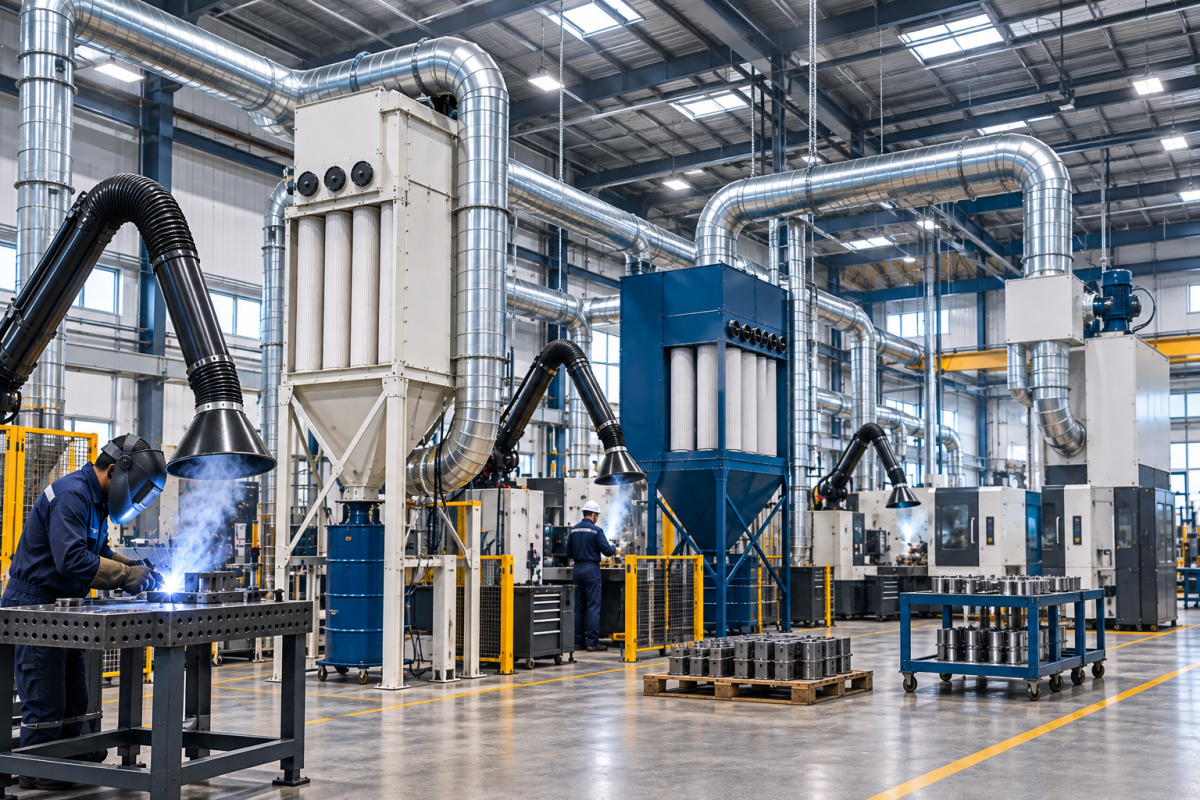
For a broader understanding of the available equipment configurations, an industrial welding fume extraction system should be evaluated according to the welding process, workspace layout, and expected operating conditions.

Why Is Industrial Welding Fume Extraction Important?

Welding fumes form when materials heated during welding vaporize and subsequently condense into fine airborne particles. Their composition depends on factors such as the metal being welded, electrode or filler material, coatings, shielding gases, and welding technique.

Stainless steel welding, for example, can generate fumes containing chromium and nickel compounds. Other welding applications may produce iron oxides, manganese-containing particles, or additional contaminants depending on the materials and consumables involved.

Effective extraction helps control these emissions before they disperse throughout the workplace.

Industrial welding fume extraction can support several operational objectives:

Reducing worker exposure: Capturing fumes close to the welding point helps limit the amount of airborne contamination reaching the operator’s breathing zone.

Improving workplace air quality: Source capture reduces the release of welding fumes into the surrounding production environment.

Maintaining cleaner equipment and work areas: Effective collection can reduce the deposition of airborne particulate matter on nearby surfaces and machinery.

Supporting workplace safety programmes: Properly designed extraction can form part of a broader occupational exposure-control strategy, alongside suitable work practices, exposure assessment, and other protective measures where necessary.

The NIOSH guidance on welding fumes and applicable occupational safety requirements can help businesses evaluate exposure-control measures for their particular welding operations.

Common Industrial Applications of Welding Fume Extractors

Different industries generate welding fumes under different operating conditions. Equipment selection should reflect the scale of production, the geometry of the workpieces, and how easily the capture point can be positioned.

1. Metal Fabrication and Manufacturing

Fabrication shops perform activities such as structural welding, sheet-metal fabrication, equipment manufacturing, and the assembly of metal components. Workpieces can vary significantly in size, and welding stations may change according to production requirements.

Flexible extraction arms, movable capture hoods, and portable extraction units can be suitable for selected applications where the operator can position the capture point close to the welding arc.

For facilities with multiple welding bays, a more coordinated system may be required. The design should account for station usage, workpiece dimensions, and the potential for fumes to escape when operators move around large components.

2. Heavy Fabrication and Structural Welding

Heavy fabrication involves large structures, frames, equipment housings, and other components that may require welding from several positions.

In these environments, a fixed hood may not consistently capture fumes from every weld location. Extraction arms with adequate reach, movable capture equipment, or purpose-designed local enclosures may offer greater flexibility.

Where operator mobility and changing workpiece positions are major concerns, the system should be selected around the actual welding workflow. The practical considerations involved in welding fume extraction for fabrication shops are especially relevant to these installations.

3. Automotive and Component Manufacturing

Automotive manufacturing and component production may involve repeated welding operations, dedicated fixtures, robotic cells, and multiple production stations.

Manual welding stations may use local capture equipment, while automated welding cells may be better suited to extraction integrated with the enclosure or designed around the location of the emissions.

For automated applications, designers should consider the welding cycle, enclosure openings, robot movement, and the airflow needed to capture fumes without interfering with the process.

4. Stainless Steel Welding

Stainless steel welding requires particular attention to fume composition because the emissions may contain chromium and nickel compounds, depending on the alloy and welding conditions.

An industrial welding fume extractor for these applications should be selected using an assessment of the materials, consumables, welding technique, and applicable exposure-control requirements.

Filtration specifications should be evaluated alongside capture performance. Selecting a filter based only on a general particle-size claim is insufficient to establish that the overall installation will adequately control worker exposure.

5. Robotic Welding and Automated Production

Robotic welding can produce concentrated fume emissions within a relatively defined work area. Depending on the cell design, extraction may be integrated into an enclosure, hood, or dedicated collection arrangement.

The system should accommodate the robot’s operating envelope, access for maintenance, and any openings through which fumes may escape.

The extraction design should also account for production demand and the number of robotic cells operating simultaneously. For facilities considering automation, robotic welding fume extraction should be assessed as part of the overall cell and ventilation design rather than as an isolated equipment purchase.

Industrial Welding Fume Extraction System Design

A reliable industrial welding fume extraction system starts with an assessment of the welding operation. The aim is to capture emissions effectively at the source and transport them to suitable filtration equipment without compromising production.

1. Assess the Welding Process

The first step is to document the welding processes used throughout the facility. MIG, TIG, stick, flux-cored, and other welding processes can generate different fume loads and contaminant compositions.

The assessment should also consider:

  1. Base metals and their coatings.
  2. Filler metals and electrode consumables.
  3. Welding current, duty cycle, and production rate.
  4. Workpiece dimensions and welding positions.
  5. Whether welding is manual, semi-automatic, or robotic.
  6. The number of stations operating simultaneously.

These details help establish the likely emissions profile and the most practical capture arrangement.

2. Choose the Capture Method

Source capture is generally the preferred starting point because it intercepts fumes before they disperse into the wider workspace.

Common capture arrangements include:

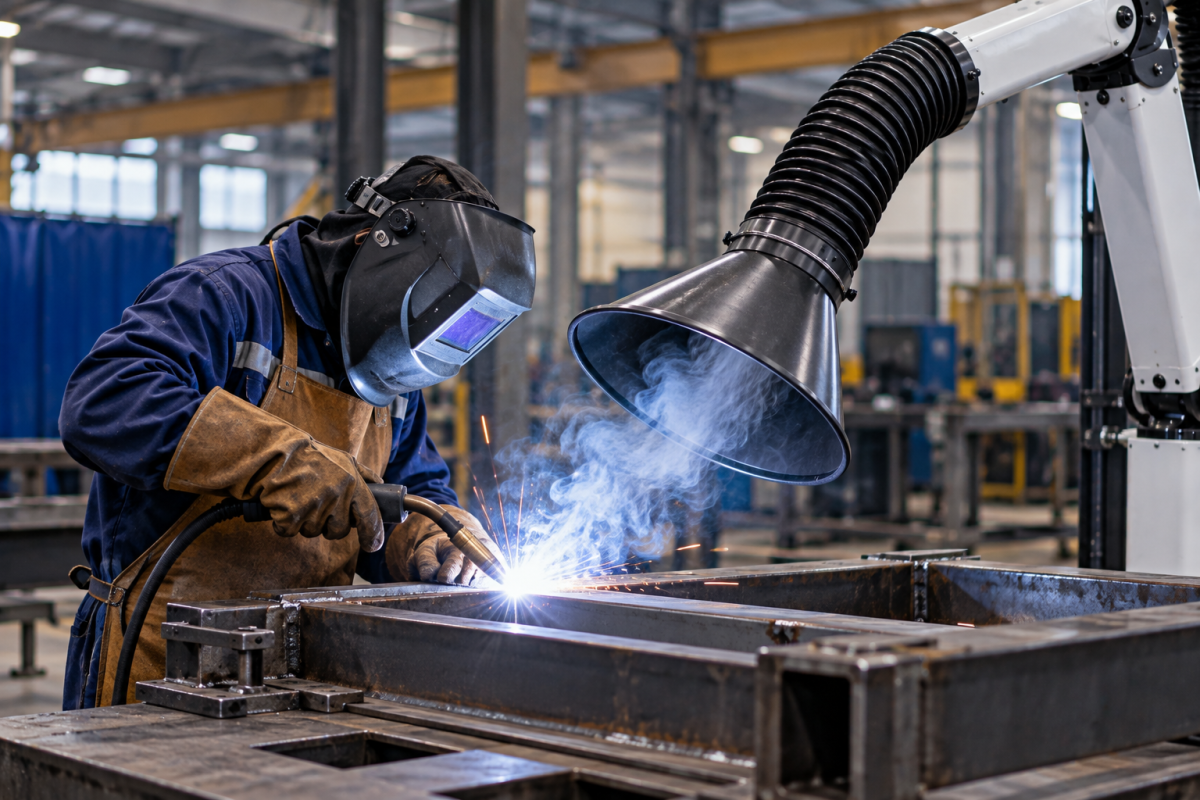
Extraction arms: Flexible arms with capture hoods that can be positioned near the welding arc. They are useful where welding positions and workpieces vary.

Fixed hoods: Suitable for repeatable operations where the capture position can be maintained consistently.

Enclosures and integrated extraction: Often appropriate for robotic welding cells or other processes that can be enclosed or partially enclosed.

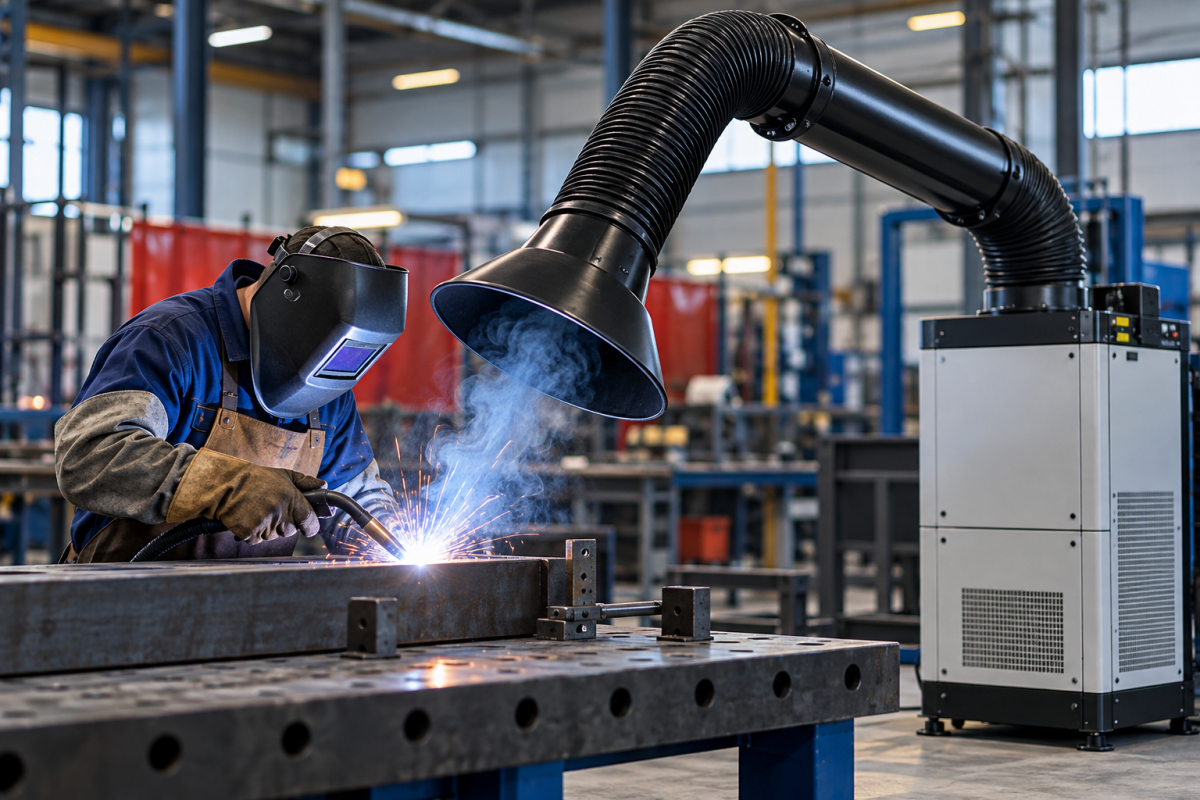
Portable extraction units: May suit smaller operations or workstations where fixed ductwork is impractical, provided the unit has adequate capacity and the capture point can be positioned effectively.

Centralized extraction: Connects multiple capture points to a shared filtration unit through a designed duct network.

The right arrangement depends on the workpiece, operator movement, capture distance, and the way fumes travel away from the source. The system should not obstruct welding access or force operators into awkward working positions.

3. Calculate Airflow Requirements

Airflow requirements depend on the capture method, hood geometry, distance from the source, and operating conditions.

A system designed for a single welding station may have very different requirements from one serving several fabrication bays. For a centralized installation, designers must also consider simultaneous usage, branch airflow, duct resistance, and the effect of filter loading.

Airflow should therefore be calculated for the intended system configuration rather than selected from the fan’s maximum advertised capacity alone.

A practical design assessment should establish:

  1. Required airflow at each capture point.
  2. Number of capture points expected to operate together.
  3. Duct dimensions, lengths, bends, and branch connections.
  4. Pressure losses through the capture equipment and filters.
  5. Expected changes in resistance as filters load.
  6. Provisions for checking airflow during commissioning and routine operation.

Insufficient airflow can allow fumes to escape. Excessive airflow may waste energy, increase noise, or disrupt the welding operation. The goal is effective capture at each point under realistic operating conditions.

4. Evaluate Static Pressure and Fan Selection

Static pressure is the resistance the fan must overcome as air moves through the capture hood, ductwork, filters, and other system components.

A fan should be selected using the required airflow at the system’s expected operating pressure. Choosing equipment based only on motor power or free-air airflow can lead to an installation that fails to deliver the required performance once connected to the complete system.

For centralized systems, pressure losses should be evaluated across the entire duct network. Poorly designed branches or unsuitable duct dimensions can create uneven airflow, leaving some stations with inadequate extraction.

Fan selection and duct design should therefore be treated as connected engineering decisions.

Industrial Welding Fume Filtration: What Should You Consider?

After fumes are captured, the filtration system must be suitable for the contaminants being collected and the operating conditions of the facility.

Filter Selection

Welding fumes contain fine particulate matter, so the filtration equipment must be selected for the expected particle characteristics and required collection performance.

Depending on the application, an industrial dust collector with an appropriate filter configuration may be suitable for welding fume particulate collection. However, equipment designed for coarse grinding dust should not automatically be assumed to provide suitable welding fume filtration.

The design should account for filter efficiency, airflow resistance, dust loading, cleaning requirements, and the manufacturer’s stated operating limits.

Filter Cleaning and Maintenance

Welding fume filters accumulate particulate matter during operation. As the filters load, airflow resistance may increase, potentially reducing capture performance if the system is not designed and maintained appropriately.

Depending on the filter design and operating conditions, maintenance arrangements may include manual filter replacement, periodic cleaning, or automatic cleaning systems.

A reverse-pulsed-jet dust collection system may be worth evaluating for compatible industrial particulate applications. Its suitability for a particular welding fume installation must be confirmed against the filter specifications, contaminant characteristics, and manufacturer’s recommendations.

Filtration Efficiency Is Not the Same as Exposure Control

A high-efficiency filter does not, by itself, guarantee effective control of welding fumes throughout the workplace.

Overall performance also depends on capture efficiency, leakage, airflow distribution, maintenance, and the way the system is operated. Where required, exposure monitoring and suitable verification should be used to evaluate whether the installation achieves its intended control objectives.

Portable vs Centralized Industrial Welding Fume Extractors

One of the main purchasing decisions is whether to use individual extraction units or a centralized system.

Factor Portable or individual units Centralized extraction
Best suited to Selected individual stations and changing work locations Multiple workstations or larger production areas
Installation Usually simpler for a small number of points Requires engineered ductwork and system planning
Flexibility Units can often be relocated Capture points are generally connected to fixed infrastructure
Airflow management Managed at each unit Requires balancing across branches and capture points
Maintenance Units can be serviced individually Shared equipment requires coordinated maintenance
Expansion Additional units may be required Expansion depends on available fan, filter, and duct capacity
Space Equipment may occupy floor or workstation space Main filtration equipment can be located away from workstations

Portable systems can be practical for intermittent welding and isolated stations. Centralized extraction can be advantageous where several stations need to operate within a coordinated system.

The choice should be based on the number of welding points, their operating schedules, the required capture method, and the long-term operating cost—not solely on the initial equipment price.

How to Select the Right Industrial Welding Fume Extractor

Before comparing suppliers, establish the technical and operational requirements of the application.

1. Define the Number of Welding Stations

Record the number of workstations and determine how many are expected to operate simultaneously. For centralized systems, simultaneous demand has a direct impact on airflow and fan sizing.

2. Identify the Materials and Welding Processes

Document the metals, coatings, electrodes, filler materials, and welding processes used. This information helps establish the contaminant profile and the filtration requirements.

3. Assess Operator Mobility

Determine whether welding occurs at fixed benches, large fabricated structures, moving workpieces, or robotic cells. This will help identify suitable extraction arms, hoods, enclosures, or integrated capture arrangements.

4. Verify Airflow and Filtration Specifications

Ask suppliers to explain the required airflow, operating static pressure, filter configuration, expected maintenance requirements, and limitations of the proposed equipment.

Specifications should relate to the actual installation rather than only to standalone unit performance.

5. Consider Installation and Operating Costs

The purchase price is only one part of the total cost. Evaluate installation, ductwork, electricity consumption, filter replacements, servicing, downtime, and future expansion.

6. Check Serviceability and Spare Parts

Ensure the filtration equipment can be inspected and maintained safely, and that suitable replacement filters and service support are available.

7. Plan for Future Capacity

If the facility expects to add welding stations or increase production, consider whether the system can accommodate that demand. Expansion may require additional fan capacity, filtration capacity, ductwork, or revised airflow balancing.

Common Mistakes to Avoid

Industrial welding fume extraction systems can underperform when important design factors are overlooked.

Selecting a system by motor power alone: Motor rating does not establish the airflow available at the capture point.

Positioning extraction equipment too far from the welding arc: Fumes can disperse before they reach the capture hood.

Using one generic design for every welding process: Different materials, consumables, and welding techniques produce different emissions and operating requirements.

Ignoring ductwork design: Poorly designed duct networks can result in uneven airflow across multiple stations.

Choosing filtration without understanding the contaminant profile: Filter suitability must be established for the actual application.

Neglecting maintenance: Loaded or damaged filters and poorly maintained capture equipment can compromise system performance.

Assuming extraction eliminates every exposure risk: Extraction is one component of a broader exposure-control programme. Additional controls may be needed based on the process and exposure assessment.

Industrial Welding Fume Extractor Selection Checklist

Use this checklist when preparing a technical specification or requesting quotations.

  1. Welding processes and materials identified.
  2. Fume-generating operations and work locations documented.
  3. Number of stations and simultaneous usage established.
  4. Capture method selected for each application.
  5. Airflow and static pressure requirements calculated.
  6. Filtration configuration matched to the contaminants.
  7. Filter cleaning and replacement requirements documented.
  8. Installation space, duct routing, and access assessed.
  9. Energy consumption and ongoing maintenance considered.
  10. Future production expansion evaluated.
  11. Commissioning and performance-verification requirements defined.

Conclusion

An industrial welding fume extractor should be selected as an engineered air pollution control solution, not simply as a fan-and-filter unit.

The right system depends on the welding process, materials, capture arrangement, airflow requirements, filtration performance, and production layout. Smaller operations may be served by individual extraction units, while larger facilities may benefit from a centralized system designed around multiple welding stations.

By evaluating these factors before purchasing, manufacturers can make better-informed decisions about system performance, maintenance, operating costs, and long-term suitability.

Powertech Pollution Controls provides industrial air pollution control solutions for manufacturing applications. To evaluate a suitable welding fume extraction configuration, discuss your welding processes, number of stations, workstation layout, and filtration requirements with the technical team.

The final system design should be based on the application’s engineering requirements and verified performance expectations.

‘
How to Choose the Right Welding Fume Extractor for Your Workshop

Welding fume is generated whenever metals, coatings, fluxes, and other materials are heated to welding temperatures. The amount and composition of the fume can vary significantly depending on the welding process, material, consumables, production volume, and working environment.

Choosing a welding fume extractor therefore requires more than simply selecting a machine based on airflow or motor capacity. The extraction method, capture distance, number of welding stations, filtration technology, operator movement, and workshop layout all influence whether a system will provide effective welding fume extraction.

For a small fabrication shop, a portable source-capture unit may be appropriate. A production facility with several permanent welding stations may require a centralized extraction system. In some applications, an extraction arm positioned close to the arc may be more practical than a large general ventilation system.

This guide explains the key factors to consider when selecting a welding fume extractor for your workshop.

Why Choosing the Right Welding Fume Extractor Matters

Welding fumes should ideally be captured at or close to their source, before they disperse throughout the workplace.

Once fumes rise away from the welding arc and mix with the surrounding air, capturing them becomes more difficult. A system may then require substantially more airflow to control the same contaminant.

Effective welding fume extraction is therefore based on two fundamental principles:

  1. Capture the fume as close to the source as practical.
  2. Move the captured fume through an appropriately designed filtration system.

This is why simply choosing an extractor with a high airflow rating does not necessarily guarantee effective fume control.

A properly selected system should match the actual welding operation rather than relying on airflow alone.

8 Factors to Consider When Choosing a Welding Fume Extractor

1. Identify the Welding Processes Used

Start by identifying the welding processes carried out in your workshop.

Common processes include:

  1. MIG/MAG welding
  2. TIG welding
  3. Stick or SMAW welding
  4. Gas welding
  5. Flux-cored arc welding
  6. Robotic welding
  7. Plasma cutting and related thermal processes

Each process can produce different levels and characteristics of fume.

For example, a workshop carrying out occasional TIG welding on small components has very different extraction requirements from a fabrication facility performing continuous MIG welding on large structures.

The type of consumable, welding current, shielding gas, base material, and production rate can also influence fume generation.

Your welding fume extractor should therefore be selected after understanding the actual welding processes rather than simply specifying a standard machine for every application.

2. Consider the Material Being Welded

The material being welded is another important consideration.

Common materials include:

  1. Mild steel
  2. Stainless steel
  3. Aluminium
  4. Galvanized steel
  5. Painted or coated metals
  6. Special alloys

The base material itself can affect the composition of the welding fume. Coatings, paints, plating, oils, and surface treatments can also introduce additional contaminants during welding.

This makes material identification an important part of the extraction-system design process.

For example, welding stainless steel requires different consideration from welding untreated mild steel because the composition of the fume can differ.

Before specifying an industrial fume extractor, identify not only the metal being welded but also any coatings or treatments present on the workpiece.

3. Decide Where the Fume Should Be Captured

One of the most important decisions is the capture method.

The objective is to capture the fume before it spreads into the operator’s breathing zone or the wider workshop.

Common approaches include:

Extraction Arms

A movable extraction arm can be positioned near the welding operation.

This approach is useful where:

  1. Welding takes place at fixed or semi-fixed stations
  2. Operators need flexibility
  3. The workpieces vary in size
  4. Individual workstations can accommodate extraction arms

The hood should be positioned as close to the welding point as practical without interfering with the welding operation.

The further the hood is from the source, the greater the challenge of capturing the rising fume effectively.

Portable Extraction Units

Portable systems can be useful where welding takes place at multiple locations.

They can be moved between work areas and are particularly relevant to workshops where permanent ducting is impractical.

Centralized Extraction Systems

A centralized system can serve multiple welding stations through a common extraction network.

This can be appropriate for:

  1. Production facilities
  2. Fabrication plants
  3. Multiple permanent welding booths
  4. Workshops with several extraction points

The ductwork, fan capacity, extraction points, and number of simultaneous users must be engineered as a system.

4. Determine the Number of Welding Stations

The number of welding stations directly affects the design of the extraction system.

A workshop with one welding station does not have the same requirements as a facility with 10, 20, or more stations.

However, the number of stations alone should not determine the required extractor capacity.

You also need to establish:

  1. How many stations operate simultaneously?
  2. How long does each station operate?
  3. Are all welding processes the same?
  4. Are extraction arms used at every station?
  5. Is the system centralized or individual?
  6. Are some stations used only occasionally?

For example, a centralized system serving eight welding stations should be designed based on the expected simultaneous operating conditions rather than simply multiplying a nominal airflow figure by eight.

This is where professional system design becomes important.

5. Evaluate Operator Movement and Workpiece Size

The ideal extraction solution for a small welding bench may not work for heavy fabrication.

Consider how operators actually move around the workpiece.

Small Components

For small components at fixed workstations, a close-positioned extraction arm may provide practical source capture.

Large Fabricated Structures

For large structures, the welder may move around the workpiece continuously.

In such situations, keeping a fixed extraction hood close to every welding point can be difficult.

The system may therefore need a different configuration, such as:

  1. Multiple extraction points
  2. Movable extraction arms
  3. Flexible extraction arrangements
  4. A combination of source capture and appropriate general ventilation

The extraction system should accommodate the production process rather than forcing the production process to work around the extraction equipment.

6. Look at the Required Airflow and Static Pressure

Airflow is one of the specifications buyers commonly focus on when selecting a welding fume extractor.

However, airflow alone is not enough.

A system has to deliver the required airflow at the actual operating conditions of the extraction network.

Static pressure losses can occur because of:

  1. Duct length
  2. Duct diameter
  3. Bends and elbows
  4. Branches
  5. Filters
  6. Extraction arms
  7. Hoods
  8. Dampers
  9. Other components in the system

A fan rated for a particular airflow under one pressure condition may deliver considerably less airflow when connected to a restrictive duct system.

Therefore, the selection process should consider both:

Required airflow + required static pressure

rather than choosing equipment solely on the basis of the largest CFM or m³/hr number.

This becomes especially important when designing centralized welding fume extraction for multiple stations.

7. Select the Appropriate Filtration Technology

Once the fume has been captured, it needs to be treated appropriately before the cleaned air is handled according to the system design.

Different filtration technologies are available for industrial fume extraction.

The appropriate technology depends on the contaminant characteristics and application.

For example, electrostatic filtration can be used in certain welding and industrial fume applications because the particles can be electrically charged and collected on collector plates.

Powertech’s FumeKiller range uses electrostatic filtration for applications including welding and soldering fumes, with configurations also positioned for certain oil-mist applications.

The company’s published product information describes filtration performance in the range of 90–98% for applicable systems and refers to very fine particle filtration capability. These figures should be understood as product/system specifications rather than universal performance guarantees for every welding application.

For applications where additional gaseous contaminants or odours need consideration, an activated-carbon post-filter can also be incorporated into suitable configurations.

The key point is that filtration technology should be selected based on the actual contaminant and process, not simply on a headline efficiency percentage.

8. Consider Maintenance Requirements

A welding fume extractor is only useful when it continues to operate effectively.

Maintenance should therefore be considered before purchasing the system.

Ask:

  1. How is the filtration system cleaned?
  2. How frequently does it need servicing?
  3. How is collected contamination removed?
  4. How easy is it to access the filter or collector?
  5. Are replacement components readily available?
  6. How is airflow performance checked?
  7. What indicators show that maintenance is required?

The maintenance requirements can vary considerably between filtration technologies.

A system that appears inexpensive initially may have higher operating or maintenance requirements over its lifetime.

When comparing systems, look beyond the purchase price and consider the total operating requirements.

Source Capture vs General Workshop Ventilation

One of the most important distinctions when designing a welding fume control system is the difference between source capture and general ventilation.

General ventilation attempts to dilute and remove contaminated air from the wider workspace.

Source capture attempts to remove the contaminant before it disperses.

For welding, source capture is generally the more direct approach because the contaminant can be intercepted close to where it is generated.

This does not mean general ventilation has no role.

A well-designed workshop may require both:

Source capture + appropriate general ventilation

The exact combination depends on the welding processes, building layout, production conditions, and extraction design.

Should You Choose a Portable or Centralized Welding Fume Extractor?

There is no single configuration that suits every workshop.

Requirement Portable System Centralized System
Small number of welding stations Suitable May be unnecessary
Frequently changing work locations Useful Less flexible
Multiple permanent stations Limited Suitable
Large production facility Application dependent Often considered
Permanent ducting Usually minimal Required
Multiple extraction points Limited by design Suitable
Expansion of welding stations Depends on unit Can be engineered for expansion

The decision should be based on the production environment rather than simply the number of machines.

For example, a fabrication shop with several welding stations but highly mobile workpieces may require a different solution from an electronics or manufacturing facility with fixed production stations.

When Does a Workshop Need an Industrial Fume Extractor?

An industrial fume extractor becomes particularly relevant when welding is a regular part of production rather than an occasional maintenance activity.

Factors that may indicate the need for an engineered extraction solution include:

  1. Multiple welding stations
  2. Continuous or high-volume welding
  3. Large fabrication areas
  4. Multiple operators welding simultaneously
  5. Limited natural ventilation
  6. Welding of coated or treated metals
  7. Production processes where welding fumes are consistently generated
  8. Requirements for controlled workplace air quality

For larger facilities, the solution may involve multiple source-capture points connected to a centralized filtration system.

Common Mistakes When Choosing a Welding Fume Extractor

Choosing Based Only on Airflow

A higher airflow number does not automatically mean better fume capture.

The hood position, capture distance, system pressure, duct design, and filtration system all matter.

Placing the Extraction Hood Too Far Away

Source capture becomes increasingly difficult as the distance between the hood and welding point increases.

The extraction hood should be positioned as close to the source as practical while allowing the operator to work safely and efficiently.

Ignoring the Welding Process

A system designed for occasional welding may not be suitable for continuous production welding.

The welding process and production volume should form part of the initial equipment specification.

Treating All Welding Fumes as the Same

Different materials, coatings, consumables, and welding processes can produce different contaminants.

Filtration should therefore be selected based on the application.

Forgetting Future Expansion

If the workshop is expected to add welding stations, increase production, or change its manufacturing process, the extraction system should be evaluated with those potential changes in mind.

Retrofitting ductwork and filtration capacity later can be more complicated than considering expansion during the initial design.

A Practical Checklist for Selecting a Welding Fume Extractor

Before contacting an equipment supplier, collect the following information:

Welding Process

  1. MIG/MAG
  2. TIG
  3. Stick
  4. Flux-cored
  5. Robotic
  6. Other processes

Materials

  1. Mild steel
  2. Stainless steel
  3. Aluminium
  4. Galvanized/coated materials
  5. Other alloys

Production

  1. Number of welding stations
  2. Number of simultaneous operators
  3. Hours of welding per shift
  4. Number of shifts
  5. Continuous or intermittent welding

Workplace

  1. Workshop dimensions
  2. Ceiling height
  3. Workstation arrangement
  4. Operator movement
  5. Workpiece dimensions
  6. Existing ventilation

Extraction

  1. Fixed or mobile extraction
  2. Extraction arm requirements
  3. Number of extraction points
  4. Proposed duct arrangement
  5. Required airflow
  6. Static pressure requirements

Filtration

  1. Type of welding fume
  2. Required filtration technology
  3. Filter/collector maintenance
  4. Potential requirement for additional filtration stages

Providing this information allows an extraction-system supplier to recommend equipment based on the actual application rather than relying on a generic machine specification.

Powertech Welding Fume Extraction Solutions

Powertech Pollution Controls provides industrial air pollution control solutions for applications including welding and soldering fume extraction.

Its FumeKiller range uses electrostatic filtration and is available in configurations designed for different industrial applications. For workshops with multiple welding stations, the extraction system can be designed around the number of extraction points, operating conditions, and workshop layout.

Powertech also provides fume extraction arms for source capture, allowing fumes to be captured close to the point of generation.

For example, Powertech has documented a welding application involving eight welding stations and a FumeKiller FK3600VEM, demonstrating how a multi-station welding environment can be approached through an engineered extraction system rather than treating every workstation as an isolated application.

The appropriate equipment, however, depends on the specific welding process, material, workstation configuration, and operating conditions.

Final Thoughts

Choosing a welding fume extractor is fundamentally an application-engineering decision.

The right system depends on more than the size of the workshop or the advertised airflow of an extraction unit. You need to consider the welding process, materials, production volume, operator movement, number of stations, capture method, airflow, static pressure, filtration technology, and maintenance requirements.

For many workshops, the starting point should be source capture: identify where the welding fume is generated and determine how it can be captured as close to that point as practical.

From there, the extraction and filtration system can be designed around the actual operating conditions.

A properly specified welding fume extraction system can provide a more controlled approach to managing welding fumes while fitting into the way the workshop actually operates.

If you are planning a new welding fume extraction system or upgrading an existing one, the best starting point is to evaluate your welding processes, number of stations, workpiece sizes, and workshop layout before selecting the equipment.

Looking for a welding fume extraction solution for your workshop? Contact Powertech Pollution Controls to discuss your application and determine the appropriate extraction and filtration configuration.

Industrial Air Filtration Technologies Explained

Industrial manufacturing processes generate different types of airborne contaminants, from coarse dust and fine particulate to welding fumes, oil mist, smoke, and vapours. Because these contaminants behave differently in an air stream, no single filtration technology is suitable for every industrial application.

Choosing the right industrial air filtration systems requires understanding the contaminant, particle characteristics, concentration, airflow, temperature, process conditions, and required level of filtration.

This guide explains the major industrial air filters, fume filtration systems, and dust filtration systems, and where each technology is typically used.

Key Takeaways

  1. Different industrial contaminants require different filtration technologies.
  2. Baghouse and cartridge collectors are commonly used for industrial dust collection.
  3. Fume filtration systems are designed for fine particulate generated by processes such as welding.
  4. Oil and coolant mist require mist-specific filtration rather than conventional dry dust filters.
  5. HEPA filtration can provide high-efficiency particulate filtration when the application requires it.
  6. Wet scrubbers can be suitable for certain particulate and gaseous contaminants.
  7. Filter selection should consider both filtration efficiency and the complete extraction system.

What Are Industrial Air Filtration Systems?

Industrial air filtration systems are engineered systems designed to remove airborne contaminants generated by manufacturing and industrial processes.

A typical system may include:

  1. Capture hood or enclosure
  2. Ductwork
  3. Pre-filtration or separation
  4. Main filtration stage
  5. Blower
  6. Dust or contaminant collection
  7. Control and monitoring equipment

The filtration equipment is only one part of the overall system. If contaminants are not captured effectively at the source or the airflow is inadequate, even a high-efficiency filter may not provide the expected results.

Why Filter Selection Matters

Industrial contaminants can vary significantly.

For example, grinding may generate relatively heavy metal particles, while welding can produce much finer fumes. CNC machining may generate an aerosol of oil or coolant droplets rather than dry particulate.

The filtration technology therefore needs to match the contaminant.

Important selection factors include:

  1. Particle size
  2. Dust loading
  3. Contaminant concentration
  4. Airflow
  5. Temperature
  6. Moisture
  7. Chemical characteristics
  8. Filter media compatibility
  9. Required filtration efficiency
  10. Pressure drop
  11. Operating hours
  12. Maintenance requirements

Major Industrial Air Filtration Technologies

1. Baghouse Dust Collectors

Baghouse collectors use fabric filter bags to separate particulate from an air stream.

Contaminated air enters the collector and passes through the filter bags. Dust accumulates on the filter surface while cleaner air passes through.

Baghouse systems are commonly used for applications involving:

  1. Grinding
  2. Material handling
  3. Foundries
  4. Mineral processing
  5. Wood processing
  6. Heavy manufacturing
  7. High dust loading

Their ability to handle substantial dust loads makes them an important category of industrial dust filtration systems.

2. Cartridge Dust Collectors

Cartridge collectors use pleated filter elements.

The pleated construction provides a large filtration area within a relatively compact housing, making cartridge systems suitable where installation space is limited.

They are commonly considered for:

  1. Fine dry dust
  2. Metalworking
  3. Grinding
  4. Cutting
  5. Welding
  6. Powder handling

Cartridge collectors can also incorporate automatic cleaning systems to remove accumulated dust from the filter surface.

3. Welding Fume Filtration Systems

Welding generates fine particulate that can remain airborne for extended periods.

Fume filtration systems are designed specifically for applications such as:

  1. MIG/MAG welding
  2. TIG welding
  3. Arc welding
  4. Robotic welding
  5. Plasma cutting
  6. Thermal cutting

Source capture is particularly important for welding because capturing the fume close to the welding operation prevents it from dispersing throughout the workspace.

Depending on the application, systems may use extraction arms, hoods, enclosures, portable extractors, or centralized extraction.

4. Oil and Coolant Mist Filtration

Oil mist and coolant mist generated during CNC machining are aerosols rather than conventional dry dust.

These applications require filtration technologies designed to separate liquid droplets from the air stream.

Mist collectors are commonly used for:

  1. CNC turning
  2. Milling
  3. Grinding
  4. Drilling
  5. High-speed machining
  6. Metalworking

The collector may incorporate multiple filtration stages to capture progressively finer droplets.

Using a dust collector designed for dry particulate does not automatically make it suitable for oil or coolant mist.

5. HEPA Filtration

HEPA filters are designed for high-efficiency removal of very small airborne particles.

They can be incorporated into industrial air filtration systems when the application requires a high level of particulate filtration.

Potential applications include:

  1. Fine particulate control
  2. Final filtration
  3. Controlled production environments
  4. Specialized manufacturing processes
  5. Supplementary filtration stages

However, HEPA filters are not automatically the best choice for every industrial dust application.

A heavily loaded process may require a pre-filter or primary dust collector upstream to prevent excessive loading of the HEPA stage.

6. Electrostatic Filtration

Electrostatic precipitators use electrical charges to collect particles from an air stream.

They can be used in certain applications involving:

  1. Smoke
  2. Fine particulate
  3. Oil mist
  4. Process emissions

Electrostatic systems can be attractive where specific contaminant characteristics and operating conditions make them appropriate.

However, their suitability depends on the application and the properties of the contaminant.

7. Wet Scrubbers

Wet scrubbers use a liquid to capture or absorb contaminants from an air stream.

Depending on their design, scrubbers can be used for certain:

  1. Dust
  2. Chemical contaminants
  3. Acid gases
  4. Process emissions
  5. Hot or moisture-laden streams

Wet scrubbers can be particularly useful where dry filtration is unsuitable because of contaminant characteristics or process conditions.

They also introduce additional considerations such as wastewater handling, corrosion, liquid management, and maintenance.

8. Activated Carbon Filtration

Activated carbon is primarily used to adsorb certain gases, vapours, and odorous compounds.

It can be incorporated into a multi-stage filtration system when the process produces contaminants that cannot be adequately controlled through particulate filtration alone.

Activated carbon is therefore fundamentally different from a conventional dust filter.

Comparing Industrial Air Filters

TechnologyTypical ContaminantCommon Application
BaghouseDry particulate, high dust loadingGrinding, material handling
CartridgeFine dry dust and particulateMetalworking, powder processing
Fume filtrationWelding and process fumesWelding and thermal processes
Mist collectorOil and coolant aerosolsCNC machining
HEPAVery fine particulateFinal/high-efficiency filtration
ElectrostaticFine particulate, smoke, some mistProcess emissions
Wet scrubberParticulate and selected gasesChemical/process applications
Activated carbonVapours and certain gasesOdour and VOC-related applications

Dust Filtration Systems

Dust filtration systems are primarily designed to remove solid particulate from industrial air.

The appropriate technology depends heavily on the characteristics of the dust.

Coarse Dust

Coarser particles may be relatively easy to separate using appropriate mechanical filtration or pre-separation.

Fine Dust

Fine particles require appropriately selected filter media and sufficient filtration area.

High Dust Loading

Processes producing large quantities of dust may require robust baghouse or cartridge collection systems with effective filter cleaning.

Abrasive Dust

Abrasive particles may require attention to collector construction, duct velocity, wear protection, and filter selection.

Fume Filtration Systems

Fumes are generally finer than conventional dust and can be generated through thermal processes.

Examples include:

  1. Welding
  2. Cutting
  3. Brazing
  4. Soldering
  5. Thermal processing

For these applications, the capture method is just as important as the filter.

A welding fume extractor positioned close to the source can prevent the fume from entering the surrounding workplace before filtration occurs.

Filtration Efficiency vs System Performance

A common mistake is to select filtration equipment based only on the filter’s efficiency rating.

Actual system performance also depends on:

Capture Efficiency

Can the system capture the contaminant before it escapes the source?

Airflow

Is sufficient airflow maintained at the extraction point?

Ductwork

Does the duct system transport contaminated air effectively?

Filter Loading

Does accumulated material cause excessive pressure drop?

Cleaning

Can the filter be cleaned effectively during operation?

Maintenance

Are filters, seals, blowers, and other components maintained properly?

A highly efficient filter cannot compensate for poor source capture or inadequate airflow.

Understanding Pressure Drop

As dust accumulates on a filter, resistance to airflow generally increases.

This resistance is commonly monitored through differential pressure.

Increasing pressure drop can indicate:

  1. Filter loading
  2. Poor filter cleaning
  3. Excessive dust loading
  4. Blocked airflow paths
  5. Filter deterioration

Monitoring pressure drop helps maintenance teams determine when investigation, cleaning, or filter replacement may be required.

How to Select the Right Industrial Air Filter

A practical selection process begins with the contaminant rather than the equipment.

Step 1: Identify the Contaminant

Determine whether the process produces:

  1. Dust
  2. Fume
  3. Oil mist
  4. Coolant mist
  5. Smoke
  6. Vapour
  7. Gas

Step 2: Understand Its Characteristics

Evaluate:

  1. Particle size
  2. Concentration
  3. Temperature
  4. Moisture
  5. Chemical composition
  6. Combustibility
  7. Stickiness
  8. Abrasiveness

Step 3: Determine Required Airflow

Calculate the airflow required to capture and transport the contaminant effectively.

Step 4: Select the Capture Method

Consider:

  1. Enclosures
  2. Extraction arms
  3. Hoods
  4. Downdraft tables
  5. Machine-integrated extraction
  6. Centralized extraction

Step 5: Select Filtration Technology

Match the filter to the contaminant and process conditions.

Step 6: Evaluate Pressure Drop

The filter and complete extraction system should be evaluated for pressure loss and blower requirements.

Step 7: Plan Maintenance

Consider filter cleaning, replacement, dust discharge, access, inspection, and service requirements before finalizing the system.

Centralized vs Point-of-Use Filtration

Industrial air filtration can be configured in different ways.

Point-of-Use Filtration

A collector is installed directly at or near an individual machine or workstation.

This approach can be useful for:

  1. Individual CNC machines
  2. Welding stations
  3. Small production areas
  4. Mobile operations

Centralized Filtration

Multiple extraction points are connected to a common filtration system.

This can be suitable for:

  1. Large manufacturing plants
  2. Multiple fixed machines
  3. Production lines
  4. Facilities requiring centralized dust collection

The choice depends on the number of sources, plant layout, operating schedules, and airflow requirements.

Common Filtration Selection Mistakes

Choosing a Filter Before Identifying the Contaminant

The filter should be selected based on the material being captured, not simply on the desired equipment category.

Focusing Only on Filtration Efficiency

A filter with excellent laboratory efficiency may still perform poorly if source capture and airflow are inadequate.

Ignoring Pressure Drop

Higher resistance increases the workload on the extraction blower and can reduce system performance.

Using the Same Filter for Dust and Mist

Oil and coolant mist behave differently from dry dust and require application-specific filtration.

Undersizing the Collector

Insufficient filtration area or airflow can lead to rapid filter loading and poor extraction.

Ignoring Maintenance

Even the correct filtration technology will lose effectiveness if filters and mechanical components are not maintained properly.

Powertech’s Industrial Filtration Solutions

Powertech develops industrial pollution control systems around the characteristics of the process and contaminant.

Its product categories include:

DustBag

Industrial dust collection systems for applications generating dry particulate and process dust.

FumeKiller

Welding fume extraction and filtration systems designed for source capture of welding and thermal process fumes. Also serves as an oil mist collector for CNC manufacturing processes.

MistKiller

Water-based coolant mist collection systems for CNC machining and metalworking applications.

The appropriate system depends on the contaminant, required airflow, capture arrangement, plant layout, and operating conditions.

What are industrial air filtration systems used for?

Industrial air filtration systems are used to capture and remove airborne contaminants such as dust, fumes, smoke, oil mist, coolant mist, and certain vapours from industrial processes.

What are the main types of industrial air filters?

Common technologies include baghouse filters, cartridge filters, mist collectors, HEPA filters, electrostatic filtration, wet scrubbers, and activated carbon filtration. Each is designed for particular contaminant and process conditions.

What is the difference between dust filtration and fume filtration?

Dust filtration generally addresses solid particulate generated by mechanical processes, while fume filtration is designed for finer particulate generated by thermal processes such as welding and cutting.

Which filter is best for industrial dust?

There is no single best filter for every dust application. Baghouse and cartridge systems are widely used, but the appropriate choice depends on dust characteristics, loading, airflow, temperature, and required filtration performance.

Can HEPA filters be used for industrial dust?

Yes, HEPA filters can be used when high-efficiency particulate filtration is required. However, they may need appropriate upstream filtration where dust loading is high.

What filtration is used for CNC oil mist?

CNC oil and coolant mist generally require dedicated mist collection technology designed to separate liquid aerosols from the air stream.

How do I choose an industrial air filtration system?

Start by identifying the contaminant and its characteristics. Then determine the required capture method, airflow, filtration efficiency, pressure drop, operating conditions, maintenance requirements, and plant layout.

Conclusion

Selecting the right industrial air filtration systems requires more than choosing a filter with a high efficiency rating. The contaminant, capture method, airflow, filter loading, pressure drop, and maintenance requirements all influence the performance of the complete system. Baghouse and cartridge collectors are widely used for dust filtration systems, while specialized fume filtration systems address welding and other thermal processes. Oil and coolant mist require dedicated mist collection technology, while HEPA, electrostatic, wet scrubbing, or activated carbon technologies may be appropriate for specific applications. The most effective approach is to begin with the manufacturing process and identify the contaminant before selecting the filtration technology. When capture, airflow, filtration, and maintenance are engineered together, an industrial air filtration system can provide reliable contaminant control while supporting cleaner and more efficient manufacturing operations.

Filtration Technologies Used in Welding Fume Extractors

Introduction

Welding fumes consist of submicron particulate matter, metal oxides, and gaseous byproducts that are difficult to remove without properly engineered filtration systems. While capture at the source is critical, the effectiveness of a welding fume extraction system ultimately depends on how efficiently these contaminants are filtered before the air is discharged or recirculated.

Different applications require different filtration approaches based on particle size, concentration, and process conditions. Selecting the right welding fume filtration technology is essential to ensure compliance with safety standards, protect worker health, and maintain system efficiency.

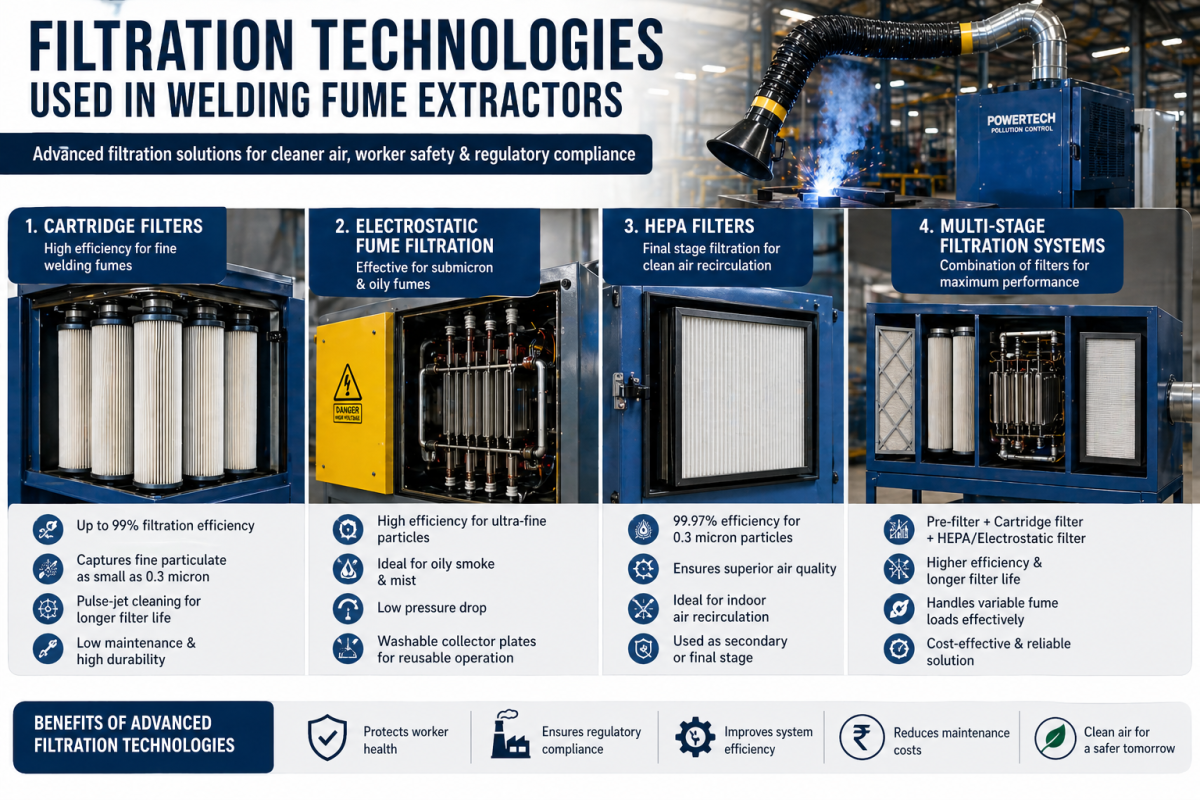
Modern extraction systems use a combination of industrial fume filters, including cartridge filters welding fumes and advanced methods such as electrostatic fume filtration, to achieve high levels of efficiency.

With over 30 years of experience, Powertech has implemented a range of filtration solutions tailored to industrial environments, ensuring reliable and consistent performance across diverse welding applications.

Key Takeaways

  1. Effective welding fume filtration requires selecting the right technology based on application.
  2. Cartridge filters are widely used for high-efficiency particulate removal.
  3. Electrostatic filtration is effective for fine and oily fumes.
  4. Multi-stage filtration systems provide optimal performance and reliability.

The Problem: Complexity of Welding Fume Filtration

Welding fumes contain a mix of particles with varying sizes and properties, making filtration challenging.

Causes

  1. Fine particulate size (often <1 micron)
  2. High temperature fumes
  3. Variation in welding processes
  4. Presence of oily or sticky particles

Workplace Impact

  1. Ineffective filtration leading to poor air quality
  2. Frequent filter clogging
  3. Increased maintenance costs
  4. Reduced system efficiency

Safety Risks

According to the Occupational Safety and Health Administration (OSHA), welding fumes can contain hazardous substances such as manganese and chromium.

The World Health Organization (WHO) highlights that exposure to fine particulate matter can lead to respiratory and cardiovascular diseases.

Technical Explanation: Types of Filtration Technologies

1. Cartridge Filters

Cartridge filters are the most widely used industrial fume filters for welding applications.

Working Principle

  1. Contaminated air passes through pleated filter media
  2. Particles are captured on the surface
  3. Clean air exits the system

Features

  1. High filtration efficiency (up to 99%)
  2. Suitable for fine particulate
  3. Pulse-jet cleaning for extended life

Applications

  1. Fabrication shops
  2. Automotive manufacturing
  3. General welding operations

2. Electrostatic Fume Filtration

Electrostatic fume filtration is used for capturing extremely fine particles and oily fumes.

Working Principle

  1. Particles are electrically charged
  2. Charged particles are attracted to collector plates
  3. Clean air is released

Features

  1. Effective for submicron particles
  2. Low pressure drop
  3. Suitable for oil mist and smoke

Applications

  1. Welding with oil-coated materials
  2. CNC machining environments
  3. High-precision industries

3. HEPA Filtration

High-Efficiency Particulate Air (HEPA) filters provide an additional level of filtration.

Features

  1. Efficiency up to 99.97% for very fine particles
  2. Used as secondary or final stage
  3. Ensures clean air recirculation

Applications

  1. Critical environments
  2. Indoor air recirculation systems

4. Multi-Stage Filtration Systems

Most industrial systems use a combination of filtration stages.

Typical Configuration

  1. Pre-filter (large particles)
  2. Cartridge filter (fine particles)
  3. HEPA or secondary filter (ultra-fine particles)

This approach improves overall efficiency and filter life.

Filtration Comparison Table

Filtration TypeEfficiencyParticle Size RangePressure DropBest Application
Cartridge FilterUp to 99%Fine particlesMediumGeneral welding
Electrostatic FilterHighSubmicron & oily fumesLowOil mist, smoke
HEPA Filter99.97%Ultra-fine particlesHighClean air recirculation
Multi-Stage SystemVery HighWide rangeVariableIndustrial applications

Practical Industrial Applications

Fabrication Shops

  1. Cartridge-based systems
  2. Moderate fume loads
  3. Flexible filtration requirements

Automotive Manufacturing

  1. Multi-stage filtration systems
  2. High-volume continuous operations
  3. Centralized systems

Maintenance Workshops

  1. Portable systems with cartridge filters
  2. Lower filtration complexity

Heavy Engineering

  1. High dust load
  2. Requires robust filter systems
  3. Frequent cleaning cycles

Expert Insight

From Powertech’s experience, one of the most common mistakes in welding fume filtration is selecting a filtration system based solely on efficiency ratings without considering operating conditions.

Key observations:

  1. High-efficiency filters can fail quickly if pre-filtration is inadequate
  2. Electrostatic systems perform best in specific applications, not all environments
  3. Multi-stage systems offer the best balance between efficiency and durability

In several installations, optimizing filter configuration has significantly reduced maintenance frequency and improved overall system performance.

What is the best filtration method for welding fumes?

Cartridge filters are widely used, but multi-stage systems provide the best overall performance.

When should electrostatic filtration be used?

For fine, oily, or sticky fumes where traditional filters may clog quickly.

Do welding fume extractors require HEPA filters?

HEPA filters are used when very high filtration efficiency or air recirculation is required.

How often should filters be replaced?

Depends on usage and dust load; monitoring pressure drop is the best method.

Can one filter type handle all applications?

No, filtration systems must be selected based on specific process requirements.

Conclusion

Effective welding fume filtration is essential for ensuring clean air, worker safety, and system efficiency. Different filtration technologies—such as cartridge filters, electrostatic fume filtration, and multi-stage systems—offer unique advantages depending on the application. A well-designed system combines appropriate filtration technologies with proper airflow and duct design to deliver optimal performance. With decades of experience in industrial fume filters, Powertech continues to emphasize tailored filtration solutions that meet the specific needs of industrial environments, ensuring reliable and long-term air pollution control.