
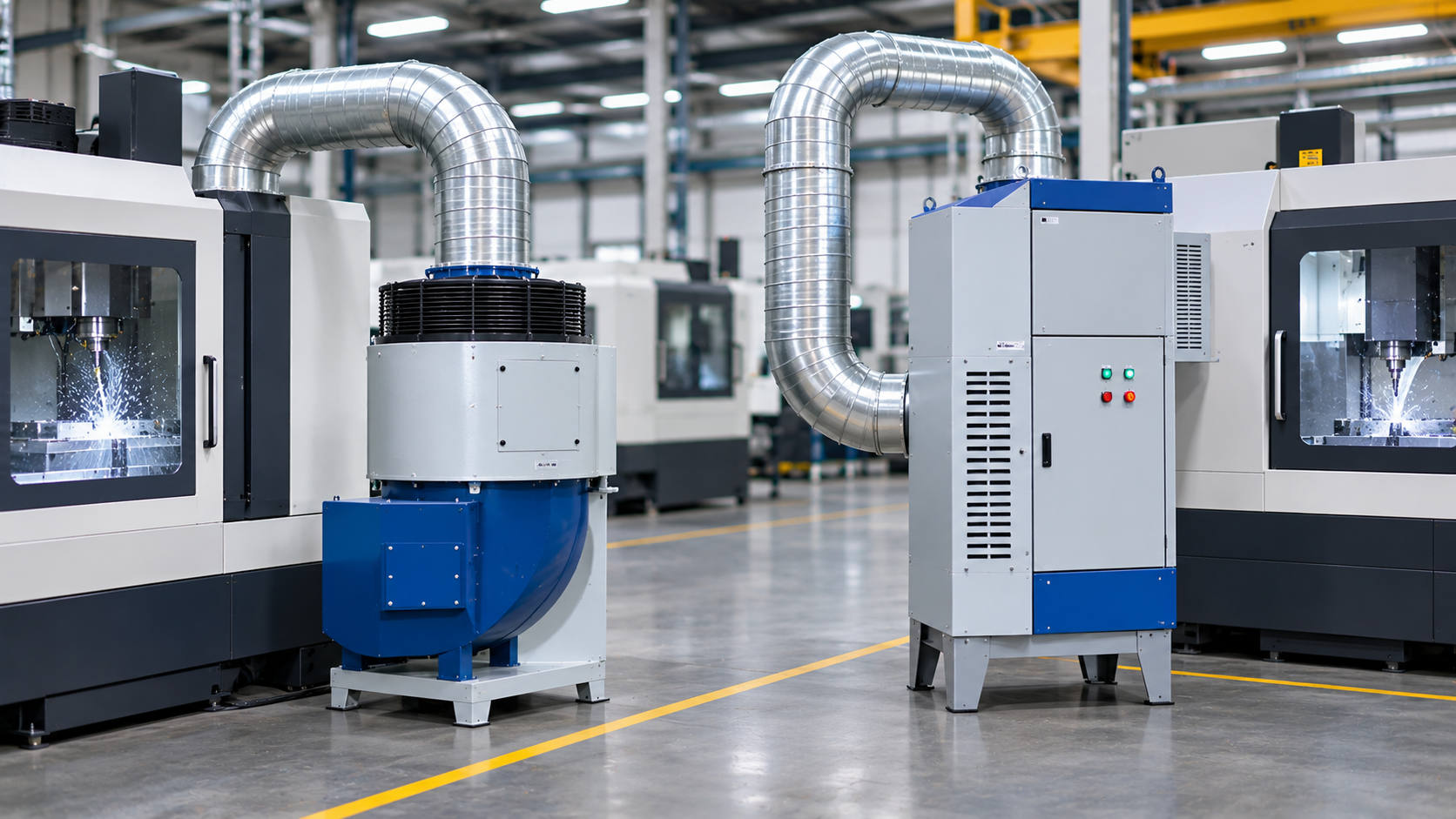
Machining operations such as CNC turning, milling, grinding, drilling, and metal cutting can generate airborne liquid aerosols when cutting fluids and coolants are exposed to high-speed tools and rotating workpieces.
These aerosols are commonly referred to as machining mist. If not captured effectively, they can escape from machine enclosures, settle on surrounding equipment, contaminate floors, and affect workplace air quality.
Selecting the right mist collection technology is therefore an important part of industrial ventilation planning.
Two technologies commonly considered for machining applications are centrifugal mist collection and electrostatic mist collection. Although both are designed to remove airborne contaminants, they operate on different principles and are suited to different applications.
The most important distinction is the type of machining fluid generating the mist. Centrifugal collection is particularly relevant for water-based coolant mist, while electrostatic collection is suitable for selected oil-mist applications, including mist generated by neat cutting oils.
Understanding this difference helps manufacturers choose an appropriate system instead of selecting equipment based only on airflow ratings or filtration claims.
Understanding the Two Mist Collection Technologies
Before comparing their performance, it is useful to understand how centrifugal and electrostatic collection work.
What Is a Centrifugal Mist Collector?
A centrifugal mist collector uses rotational motion to separate liquid droplets from an air stream.
Contaminated air is drawn from the machining enclosure into the collector. A high-speed rotating component generates centrifugal force, which pushes the entrained liquid droplets towards the internal collection surfaces.
The separated liquid condenses and drains into a collection area. Depending on the equipment design and the condition of the recovered fluid, it may be returned to the machining equipment for reuse.
Powertech’s Mistkiller™ uses this principle and is designed primarily for mist generated by water-based coolants and other water-based liquids.
Its operating arrangement includes:
- A suction fan that draws contaminated air from the machining equipment.
- A centrifugal separation stage that removes liquid droplets.
- Optional prefiltration for initial separation of larger droplets or contaminants.
- Post-filtration media for additional treatment.
- A drainage arrangement for collected liquid.
One of the practical advantages of this arrangement is the potential to recover separated water-based coolant rather than allowing it to accumulate around the machine.
The Mistkiller™ centrifugal mist collector is designed for CNC and non-CNC machining applications involving water-based liquids.
What Is an Electrostatic Mist Collector?
An electrostatic mist collector uses electrical charging and collection surfaces to remove suitable airborne particles and liquid aerosols.
Contaminated air passes through an ionisation section where particles receive an electrical charge. These charged particles then move through a collection section containing oppositely charged plates.
The electrical attraction causes the particles to deposit on the collection surfaces, separating them from the air stream.
Powertech uses this technology in its Fumekiller® electrostatic filtration system, which is also positioned for selected oil-mist applications generated during CNC machining.
An electrostatic collection arrangement generally involves:
- A prefilter to remove larger contaminants.
- An ionisation section to electrically charge airborne particles.
- Collection plates that attract and retain charged particles.
- A fan to maintain the required airflow.
- Optional post-filtration where additional treatment is required.
The collected material accumulates on the collection modules and requires periodic cleaning according to the equipment configuration and operating conditions.
The Fumekiller® electrostatic fume extraction system is used for industrial fume applications and can also be configured for suitable CNC oil-mist extraction requirements.
Centrifugal vs Electrostatic Mist Collector: The Main Differences
Although both technologies remove airborne contaminants, their separation mechanisms and typical machining applications differ.
1. Working Principle
A centrifugal collector relies on mechanical separation. The rotating component generates centrifugal force, causing liquid droplets to move towards the collector’s internal surfaces.
An electrostatic collector uses an electrical field to charge and collect airborne particles.
The distinction is important because the technologies interact differently with the characteristics of the liquid aerosols generated by machining processes.
2. Suitability for Water-Based Coolant Mist
Water-based coolants are widely used in CNC machining, milling, drilling, and grinding.
During machining, the coolant can become atomised into airborne droplets. These droplets can escape through machine openings or remain suspended inside the enclosure.
Centrifugal collection is particularly suitable for this application.
Mistkiller™ is designed to draw contaminated air from the machine and separate water-based coolant mist through centrifugal action. The collected liquid can drain back towards the generating equipment where the installation and fluid condition permit reuse.
For manufacturers using water-based coolants, this can offer an effective approach to controlling machining mist while supporting coolant recovery.
3. Suitability for Neat Cutting-Oil Mist
Some machining operations use neat cutting oils rather than water-based or water-soluble coolants.
These oils can generate airborne aerosols during high-speed machining, turning, and other metalworking processes.
For mist generated by neat cutting oil, Powertech recommends electrostatic extraction rather than its centrifugal Mistkiller™ configuration.
Fumekiller® uses electrostatic collection to capture suitable airborne oil particles and droplets.
This makes the distinction between water-based coolant mist and neat cutting-oil mist particularly important when selecting an industrial mist collection system.
4. Liquid Recovery
Liquid recovery is an important consideration for facilities using water-based machining coolants.
With Mistkiller™, the centrifugal collection process separates liquid droplets, which condense and drain through the equipment’s drainage arrangement. The recovered coolant may be returned to the machining equipment if its condition remains suitable for reuse.
With electrostatic collection, particles and droplets accumulate on collection surfaces. Liquid recovery is dependent on the system configuration and the characteristics of the collected material.
The two technologies should therefore not be compared solely on the basis of whether they separate liquid. The intended application and recovery requirements must also be considered.
5. Maintenance Requirements
Both technologies require maintenance, although the nature of the work differs.
A centrifugal collector such as Mistkiller™ requires periodic cleaning of the relevant prefilter and post-filter media, where fitted. The drainage arrangement should also be inspected to ensure that collected coolant can flow correctly.
Electrostatic systems require inspection and cleaning of their collection modules. Deposits on collection plates can affect performance if they are allowed to accumulate.
Maintenance frequency depends on the machining fluid, contaminant loading, operating hours, and equipment configuration.
Manufacturers should evaluate maintenance access and servicing requirements before finalising their selection.
How to Choose Between Centrifugal and Electrostatic Collection
The choice should begin with the machining fluid rather than the collector technology.
For most applications, the following decision process provides a useful starting point.
If the Machine Uses Water-Based Coolant
Consider a centrifugal mist collector.
This is the application for which Powertech positions Mistkiller™. It is designed to collect mist generated by water-based liquids in CNC and non-CNC machining operations.
Typical applications include:
- CNC turning with water-based coolant.
- CNC milling operations.
- Drilling and metal cutting.
- Wet grinding.
- Machining centres using water-based metalworking fluids.
- Industrial cleaning chambers using water-based liquids.
The potential for coolant recovery is an additional consideration, particularly in facilities where fluid consumption and housekeeping are important operating costs.
If the Machine Uses Neat Cutting Oil
Consider an electrostatic extraction system suitable for oil-mist applications.
Powertech recommends Fumekiller® for mist generated by oil-based liquids such as neat cutting oil.
Potential applications include selected CNC machining operations where straight cutting oils generate airborne aerosols.
The final configuration should account for the oil characteristics, aerosol loading, operating conditions, required airflow, and system safety requirements.
If the Facility Uses Multiple Types of Machining Fluids
Some manufacturing facilities operate different CNC machines using different cutting fluids.
For example, one production line may use water-based coolant while another uses neat cutting oil.
In such cases, the extraction systems should be selected for each application rather than assuming one collector technology can serve every machine.
The machining fluid, aerosol characteristics, machine enclosure, and extraction requirements should be evaluated separately.
Other Factors That Influence Mist Collector Performance
Choosing the correct collection technology is essential, but it is not the only factor that determines system performance.
Even an appropriately selected collector may perform poorly if the machine enclosure, ductwork, or airflow arrangement is inadequate.
Machine Enclosure and Source Capture
The collector should draw contaminated air directly from the machining equipment wherever practical.
CNC machines generally have an enclosure that helps contain coolant mist during operation. The extraction connection should be positioned to remove contaminated air effectively without interfering with machining operations.
Poorly designed extraction openings or excessive leakage can reduce the effectiveness of source capture.
The objective is to prevent mist from escaping into the surrounding production area, particularly when machine doors are opened after a machining cycle.
Airflow Requirements
The required airflow depends on the machine’s internal volume, enclosure openings, mist generation rate, extraction connection, and operating cycle.
A collector should not be selected based solely on the maximum airflow specified in its product literature.
The design should establish the airflow required at the machine connection and verify that the selected unit can deliver it under actual operating conditions.
Ductwork and Static Pressure
For installations involving duct connections, the designer must account for resistance created by duct length, diameter, bends, fittings, and other components.
These factors influence static pressure and the airflow available at the machine.
Where several machines are connected to a common extraction network, the system also requires appropriate branch balancing and capacity planning.
Operating Conditions
Machining speed, coolant delivery pressure, tool geometry, and the type of operation can all influence aerosol generation.
A high-speed machining process may produce a different mist profile from a low-speed drilling or grinding application.
The collector should therefore be selected after understanding how the process generates mist rather than relying on machine size alone.
For a more detailed discussion of system sizing, refer to Powertech’s guide on mist collector airflow and CFM requirements for CNC machines.
Common Mistakes When Selecting Mist Filtration Technology
Treating All Machining Mist as the Same
Water-based coolant mist and neat cutting-oil mist are not interchangeable applications.
Selecting equipment without identifying the machining fluid can result in an unsuitable collection arrangement.
Assuming Electrostatic Filtration Is Always Better
Electrostatic collection can be suitable for particular fine oil-mist applications, but this does not make it the best choice for every machining process.
For water-based coolant mist, a centrifugal system such as Mistkiller™ is Powertech’s designated solution.
Assuming Centrifugal Collection Is Suitable for Every Oil Mist
Centrifugal separation is useful for the intended water-based coolant applications, but Powertech does not recommend Mistkiller™ for neat cutting-oil mist.
For these applications, an electrostatic extraction arrangement should be evaluated instead.
Ignoring the Machine Enclosure
Even the right collector may not capture mist effectively if the machine is poorly enclosed or the extraction connection is incorrectly positioned.
The collector and machine ventilation arrangement must be considered together.
Selecting Equipment Only by Airflow
Higher airflow does not automatically mean better mist collection.
The system must deliver the required airflow at the machine connection while maintaining appropriate pressure conditions and capture performance.
Overlooking Maintenance
Filters, collection plates, drainage arrangements, and other components need periodic inspection.
Maintenance requirements should be included in the equipment selection process rather than considered only after installation.
How Powertech Approaches Mist Collection for Machining Applications
Powertech’s mist collection approach distinguishes between the two major machining-fluid categories.
For water-based coolant mist, the company offers Mistkiller™, which uses centrifugal separation to collect airborne liquid droplets. The collected coolant may be returned to the machine where the fluid remains suitable for reuse.
For neat cutting-oil mist, Powertech recommends Fumekiller® electrostatic extraction. Its collection modules use electrical charging and collection plates to remove suitable airborne particles and aerosols.
This application-based approach avoids treating centrifugal and electrostatic collection as competing technologies for exactly the same duty.
The right configuration depends on:
- Type of machining fluid.
- CNC machine and machining process.
- Mist generation characteristics.
- Machine enclosure and extraction opening.
- Required airflow and static pressure.
- Number of machines requiring extraction.
- Operating hours and maintenance access.
- Liquid recovery requirements.
To understand the available configurations and applications in more detail, explore Powertech’s industrial mist collector solutions.
A centrifugal mist collector uses rotational force to separate liquid droplets from an air stream. An electrostatic mist collector charges airborne particles and collects them on oppositely charged plates. Their suitability depends on the machining fluid and aerosol characteristics.
Yes. Centrifugal mist collection is suitable for many CNC machining applications involving water-based coolants. Powertech’s Mistkiller™ is designed specifically for this type of application.
An electrostatic collector can be considered for suitable fine oil-mist applications, including mist generated by neat cutting oils during CNC machining. Powertech positions Fumekiller® for these applications.
Yes. Mistkiller™ separates water-based coolant droplets through centrifugal action. The collected liquid may drain back towards the generating equipment, provided the installation supports recovery and the fluid remains suitable for reuse.
Neither technology is universally better. Centrifugal collection is the relevant choice for Powertech’s water-based coolant mist applications, while electrostatic collection is recommended for selected neat cutting-oil mist applications.
The suitability depends on the equipment design and the fluids involved. Powertech’s current product positioning differentiates between these applications. Mistkiller™ is intended primarily for water-based liquids, while Fumekiller® is recommended for neat cutting-oil mist. A combined or shared installation should only be considered after a detailed application assessment.
Centrifugal and electrostatic mist collection technologies both play an important role in industrial machining ventilation, but they are suited to different applications. For water-based coolant mist generated during CNC machining, centrifugal separation offers a practical collection approach. Powertech’s Mistkiller™ uses this principle to separate coolant droplets and supports potential coolant recovery. For mist generated by neat cutting oils, electrostatic collection is the recommended approach. Powertech’s Fumekiller® uses electrostatic filtration to capture suitable airborne oil-mist particles and aerosols. The most important step is to identify the machining fluid and understand the conditions under which mist is generated. The machine enclosure, extraction airflow, ductwork, and maintenance requirements must then be considered when selecting the final system. By matching the collection technology to the actual machining application, manufacturers can establish a more effective mist extraction arrangement and maintain cleaner production environments. Explore Powertech’s mist collector solutions to understand the available technologies, or review the Mistkiller™ and Fumekiller® for application-specific information.