
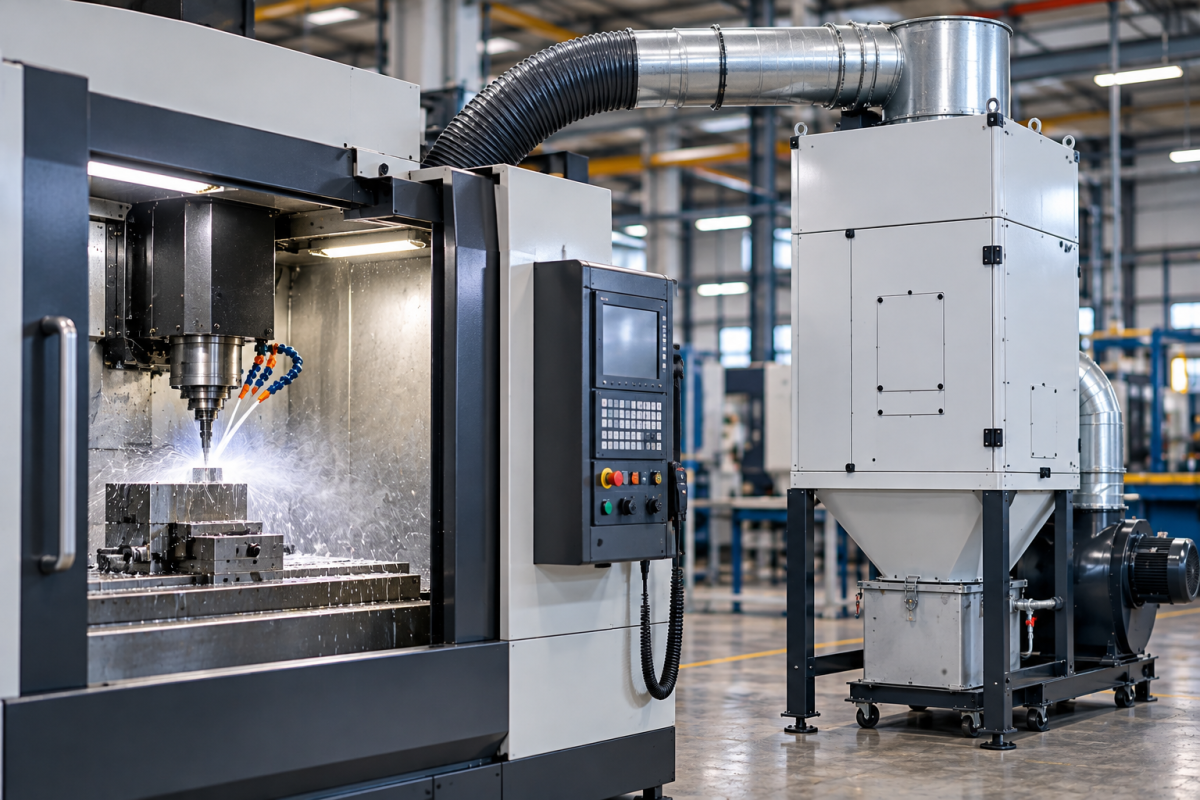
Choosing the right mist collector for a CNC machine requires more than matching a machine to a catalogue airflow rating. The correct solution depends on the machining process, coolant or cutting fluid being used, machine enclosure, mist generation rate, extraction arrangement, operating conditions, and the type of filtration technology required.
A CNC turning centre producing a fine coolant aerosol under high-pressure machining conditions may have very different extraction requirements from a milling machine operating intermittently with a water-based coolant.
The selection process should therefore begin with the contaminant and machining application, followed by airflow, capture, filtration, installation, and maintenance considerations.
This guide explains the key factors to evaluate when making a CNC mist collector selection.
Why Choosing the Right Mist Collector Matters
CNC machining can generate airborne droplets when cutting fluids are sprayed, recirculated, or atomized during machining.
If the mist is not effectively contained, it can:
- Escape from the machine enclosure
- Settle on surrounding equipment
- Increase housekeeping requirements
- Contaminate nearby surfaces
- Affect the cleanliness of the production area
- Increase the need for machine and ventilation maintenance
A properly designed mist collection system captures the contaminant as close to the source as practical and separates the liquid droplets from the extracted air.
However, simply installing a high-capacity collector does not guarantee effective performance.
The collector, machine enclosure, extraction connection, ductwork, airflow, and filtration method need to work together.
1. Start With the Coolant or Cutting Fluid
The first question when selecting a CNC mist collector should be:
What type of machining fluid is generating the mist?
Common categories include:
- Water-based coolants
- Water-soluble cutting fluids
- Semi-synthetic coolants
- Synthetic coolants
- Neat cutting oils
- Oil-based machining fluids
This distinction is particularly important because different fluids can produce different types of airborne aerosols.
For example, Powertech’s Mistkiller™ is specifically positioned for mist generated by water-based coolants and water-based liquids used in CNC and other machining applications. Its published product information states that the system uses centrifugal collection to condense the captured mist, with the collected liquid capable of being drained back toward the generating equipment for reuse.
For mist generated by neat cutting oil, Powertech recommends an electrostatic fume extraction approach rather than the MistKiller configuration.
Therefore, coolant type should be established before selecting the filtration technology.
2. Understand the CNC Machining Process
The machining operation itself influences the amount and characteristics of airborne mist.
Consider whether the machine performs:
- CNC turning
- CNC milling
- CNC grinding
- Drilling
- High-speed machining
- Multi-axis machining
- Heavy material removal
- Precision finishing
The intensity of the machining operation, cutting speed, coolant application, tool geometry, and fluid pressure can all influence mist generation.
For example, high-pressure coolant application can generate finer airborne droplets than a lower-energy machining process.
This means two CNC machines using the same coolant may still require different mist collection arrangements.
A good coolant mist collector selection should therefore consider the complete machining process rather than the coolant type alone.
3. Evaluate the Machine Enclosure
The machine enclosure is an important part of the mist-control system.
A CNC enclosure helps contain airborne coolant generated during machining. The extraction system then creates controlled airflow through the enclosure so that the mist can be removed.
Consider:
- Enclosure volume
- Number and size of doors
- Available extraction ports
- Door-opening frequency
- Sealing around the enclosure
- Existing ventilation openings
- Internal obstructions
- Location of the coolant spray
A well-contained machine can generally provide a more controlled extraction environment than an open machining process.
The objective is not simply to extract the maximum possible amount of air. The system needs to provide appropriate airflow through the machine while limiting unnecessary air movement and energy consumption.
4. Determine the Required Airflow
Airflow is one of the most commonly used specifications when comparing mist collectors.
It is generally expressed in:
- m³/hr or CMH
- CFM
However, selecting a mist collector based solely on its maximum airflow can be misleading.
Required airflow depends on factors such as:
- Machine enclosure size
- Enclosure configuration
- Mist generation rate
- Machining process
- Coolant pressure
- Extraction connection
- Duct length
- Duct diameter
- Number of extraction points
- Operating conditions
The collector needs to deliver appropriate airflow under the actual system resistance, not simply at an unrestricted outlet.
This is particularly important when comparing different models.
A larger airflow rating is not automatically an indication that the unit is better suited to a particular CNC machine.
5. Consider the Extraction Connection
The way the collector is connected to the CNC machine can significantly affect system performance.
Mist extraction may involve:
- A direct machine-mounted connection
- A flexible duct
- Rigid ductwork
- A dedicated extraction port
- Multiple extraction points
The extraction connection should be designed to minimize unnecessary pressure losses and prevent leakage.
Powertech’s Mistkiller™ system, for example, can be machine-mounted or installed on a separate stand, with the generating equipment connected through flexible or rigid PVC ducting.
The extraction port should also be positioned appropriately relative to the machine enclosure and mist-generation area.
6. Choose the Right Mist Collection Technology
The filtration or separation technology should match the type of mist being generated.
Several approaches are available for industrial mist collection, including:
Centrifugal Collection
Centrifugal systems use rotational forces to separate liquid droplets from the extracted air.
This approach is used in Powertech’s Mistkiller™ range for water-based coolant mist applications. The system uses a high-speed centrifugal collection principle, followed by secondary filtration media.
Mechanical Filtration
Mechanical mist collectors use filter media to capture airborne droplets.
They can be suitable for particular applications, but filter loading, pressure drop, cleaning requirements, and replacement costs need to be considered.
Electrostatic Filtration
Electrostatic systems use electrical charging and collection principles to capture fine particulate or aerosol contaminants.
This type of air filtration technology can be relevant to certain oil-mist applications. Powertech positions its FumeKiller electrostatic system for oil mist from CNC processes, while MistKiller is positioned primarily for water-based coolant mist.
The important point is that machining mist filtration should be selected according to the actual fluid and aerosol characteristics, rather than choosing a technology based only on its name or advertised efficiency.
7. Consider the Size of the Mist Droplets
Mist consists of airborne liquid droplets, and droplet characteristics can vary considerably.
Factors that influence droplet formation include:
- Coolant pressure
- Cutting speed
- Tool speed
- Tool geometry
- Machining process
- Coolant application method
- Fluid characteristics
Finer aerosols can be more difficult to capture and may require a different filtration approach from larger droplets.
Therefore, if the machining process generates particularly fine mist, discuss the application with the equipment supplier before selecting the collector.
The question should not simply be:
"How much airflow does this machine need?"
It should also be:
"What type of aerosol is this machining process generating?"
8. Consider Whether the Collector Should Be Machine-Mounted
For individual CNC machines, a machine-mounted mist collector can offer a compact and direct extraction arrangement.
This can be useful where:
- Each machine operates independently
- Floor space is limited
- Machines are located throughout the facility
- Dedicated extraction is preferred
- The production layout changes periodically
Powertech’s Mistkiller™ units are available with machine-mounted configurations as well as separate mounting arrangements.
The final decision should consider machine layout, access, maintenance requirements, noise, duct routing, and available installation space.
9. Evaluate Whether Centralized Extraction Is Appropriate
Not every CNC facility needs an individual collector for every machine.
A centralized arrangement may be considered when:
- Several machines operate in a defined production area
- Multiple extraction points can be connected efficiently
- The plant layout supports common ductwork
- Centralized maintenance is desirable
- Production requirements justify a larger system
However, centralized extraction introduces additional engineering considerations.
The system must account for:
- Total airflow
- Simultaneous machine operation
- Duct pressure losses
- Branch connections
- Balancing
- Damper arrangements
- Future expansion
A centralized system should therefore be engineered as a complete installation rather than created simply by connecting multiple machines to one collector.
10. Look at Static Pressure and Ductwork
Airflow is only part of the extraction equation.
The collector must overcome resistance from:
- Machine connection
- Flexible ducting
- Rigid ducting
- Bends
- Branches
- Dampers
- Filters
- Other components
As duct length and system complexity increase, pressure losses can also increase.
This means a collector that provides a particular airflow under low resistance may provide less airflow once installed into an actual CNC extraction system.
For a simple machine-mounted installation, this may be relatively straightforward.
For multiple machines connected through a duct network, professional airflow and pressure calculations become increasingly important.
11. Consider Mist Recovery and Drainage
One advantage of liquid-mist collection is the possibility of recovering the collected fluid.
When selecting a system, determine:
- Where will the collected liquid go?
- Can it be drained safely?
- Can the fluid be reused?
- Does the system require a collection container?
- How frequently does it need to be emptied?
- Is there a risk of fluid accumulation in ductwork?
Powertech’s Mistkiller™ uses centrifugal separation to condense captured water-based coolant mist, with collected liquid designed to flow down and potentially return to the generating equipment for reuse.
The actual suitability of fluid reuse depends on the coolant condition, contamination, and the manufacturer’s process requirements.
12. Compare Maintenance Requirements
Maintenance should be considered before purchasing a mist collector.
A system that is difficult to clean or service can become a maintenance burden even if its initial performance is satisfactory.
Consider:
- Filter cleaning requirements
- Filter replacement frequency
- Access to filtration components
- Drainage requirements
- Duct inspection
- Fan maintenance
- Motor maintenance
- Pressure-drop monitoring
Powertech’s published Mistkiller™ information describes periodic washing of its mesh prefilter, where fitted, and foam/steel post-filter with a high-pressure water jet.
The maintenance procedure will vary depending on the technology and application, so it should be established before installation.
13. Consider Operating Hours and Production Intensity
A CNC machine operating for one shift intermittently will have different cumulative extraction requirements from a machine operating continuously across multiple shifts.
Consider:
- Hours per shift
- Number of shifts
- Machine utilization
- Coolant application frequency
- Production volume
- Expected future production
Continuous operation makes reliability and maintenance particularly important.
It may also influence the choice between different filtration technologies and collection configurations.
14. Don’t Select a Mist Collector Based on Machine Horsepower
Machine horsepower can provide useful information about the machining operation, but it should not be used as the sole basis for mist collector selection.
Two machines with similar spindle power may generate different levels of mist because of differences in:
- Coolant pressure
- Machining speed
- Tooling
- Enclosure design
- Cutting fluid
- Machining process
Similarly, a smaller CNC machine operating at high coolant pressure may generate more challenging mist conditions than a larger machine performing a lower-intensity process.
The extraction system should therefore be specified based on mist generation and containment conditions, not simply machine horsepower.
15. Think About the Overall Machine Shop Ventilation Strategy
A mist collector provides local source capture. It should not automatically be treated as a replacement for the facility’s overall ventilation strategy.
A well-designed machining environment may require:
- Source capture at CNC machines
- Appropriate make-up air
- General ventilation
- Suitable machine enclosure design
- Regular equipment maintenance
- Proper housekeeping
Source capture is particularly valuable because it removes the contaminant near its point of generation rather than relying entirely on dilution throughout the workshop.
The exact ventilation arrangement should depend on the facility, process, equipment layout, and applicable workplace requirements.
Mist Collector Selection Checklist
Before approaching a supplier, gather the following information.
CNC Machine
- Machine type
- Manufacturer and model
- Enclosure dimensions
- Number of doors
- Existing extraction port
- Available mounting location
Machining Process
- Turning
- Milling
- Grinding
- Drilling
- High-speed machining
- Other processes
Coolant
- Water-based
- Semi-synthetic
- Synthetic
- Neat cutting oil
- Other machining fluid
Operating Conditions
- Coolant pressure
- Machine operating hours
- Number of shifts
- Production intensity
- Simultaneous operation
Extraction
- Required airflow
- Extraction-port size
- Duct length
- Duct diameter
- Number of bends
- Number of extraction points
Installation
- Machine-mounted or separate installation
- Available floor space
- Maintenance access
- Drainage requirements
- Future expansion
Providing these details makes CNC mist collector selection considerably more precise.
How Powertech Approaches Mist Collector Selection
Powertech’s Mistkiller™ is positioned as a centrifugal mist collection system primarily for water-based coolant and water-based liquid applications in CNC and other machining environments. The system uses centrifugal separation, with optional prefiltration and post-filtration, and is designed for source capture from the machining equipment.
Powertech’s current product information also distinguishes water-based coolant mist from oil-based mist: for neat cutting oil applications, it recommends an electrostatic fume extraction system like the FumeKiller®.
This distinction is important when evaluating a coolant mist collector because the fluid being used can influence the appropriate collection technology.
The selection should ultimately be based on:
- CNC machine configuration
- Machining process
- Coolant characteristics
- Mist generation conditions
- Required airflow
- Extraction arrangement
- Duct resistance
- Operating hours
- Maintenance requirements
- Installation constraints
Common Mistakes When Choosing a Mist Collector
Selecting Only by Airflow
A high airflow rating does not automatically mean better mist collection.
The airflow must be appropriate for the machine and available at the required system pressure.
Ignoring the Coolant Type
Water-based coolant mist and neat oil mist may require different collection technologies.
Selecting by Machine Size Alone
Machine dimensions and horsepower do not directly determine mist generation.
The machining process and coolant application are equally important.
Ignoring the Enclosure
The machine enclosure plays an important role in containing the mist and establishing controlled extraction.
Overlooking Maintenance
The cost and practicality of filter cleaning, drainage, inspection, and replacement should be considered before selecting the equipment.
Installing Without Considering Duct Resistance
Long duct runs, multiple bends, and branches can significantly influence system pressure and airflow.
Final Thoughts
Choosing the right mist collector for a CNC machine starts with understanding what the machine is actually generating.
The coolant type, machining process, enclosure design, coolant pressure, mist characteristics, airflow requirement, extraction connection, filtration technology, and operating conditions all influence the final selection.
There is no universal mist collector that is automatically appropriate for every CNC application.
For coolant mist collector selection, begin by identifying the machining fluid and understanding how the mist is generated. Then evaluate the machine enclosure, required airflow, extraction arrangement, pressure losses, collection technology, maintenance requirements, and installation conditions.
Most importantly, avoid selecting equipment solely by airflow, motor power, or machine horsepower.
A properly matched CNC mist collector should be selected as part of an integrated extraction and machining mist filtration solution, with the collection technology matched to the actual contaminant.
For facilities using water-based coolants, Powertech’s MistKiller provides a centrifugal mist collection approach designed specifically for this application. For neat cutting-oil applications, a different filtration technology may be appropriate.
Planning mist extraction for a CNC machine or machining facility? Contact Powertech Pollution Controls with your machine details, coolant type, machining process, and extraction requirements to discuss the appropriate mist collection configuration.