
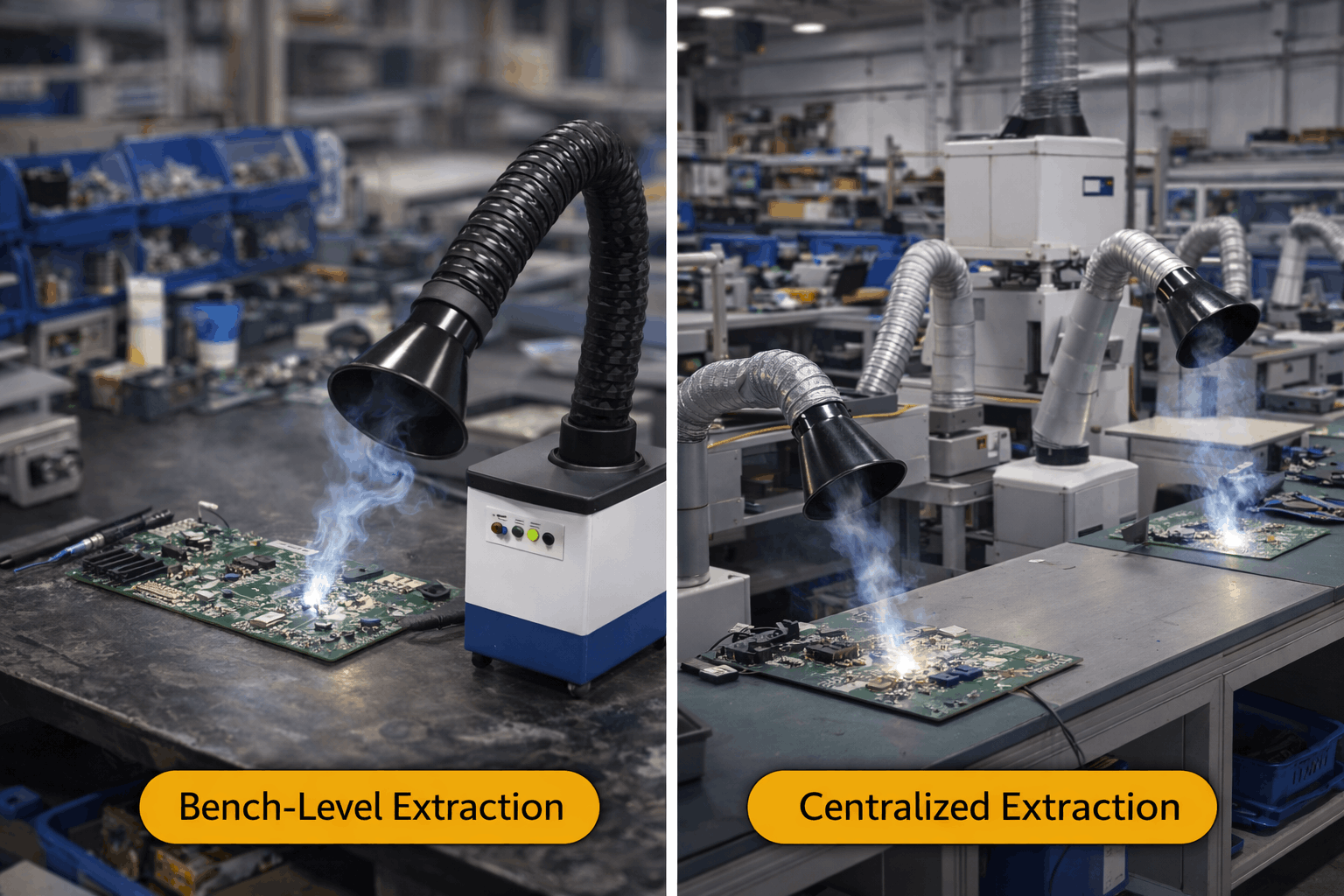
Fumes are made at every workstation when soldering. In small setups, only one or two stations may be able to work at a time. Dozens of workers work at the same time on big assembly lines.
The right soldering fume extractor system for you will depend on how big your business is, how your workspace is set up, and how much air flow you need. There are two main types of systems: centralized and bench-level.
What is a bench-level soldering fume extractor?
A bench-level system is set up at each workstation. It usually has a small unit with one or two suction arms that are close to the soldering point.
Best For:
- Small groups of people working together
- Benches for repairs and service
- Layouts that can change
- Low to moderate density of solder
Advantages:
- Each station has its own control.
- Simple to put together
- Needs very little ducting
- Lower cost to set up at first
Limitations
- More equipment in big setups
- Individual upkeep for each unit
What Is a Centralized Soldering Fume Extraction System?
A centralized system has one big extraction unit that is connected to several soldering stations by ducting. There is a suction point on each bench that connects to the central unit.
Best Suited For
- High-density electronics assembly
- Production lines with set layouts
- Places where soldering is done all the time
Benefits
- Maintenance at one point
- Airflow that is the same at all stations
- Less noise at each bench
- A cleaner place to work in general
Limitations
- More expensive to install
- Needs careful planning of the ducts
- Less flexible after installation
Before suggesting a centralized solution, an experienced soldering fume extractor manufacturer looks at the number of stations and the amount of fumes.
Key Things to Think About: Number of Workstations:
Bench-level systems work best with a small number of workstations. A centralized setup is usually justified by many stations.
Production Volume
More fume load comes from continuous soldering. Central systems are better at handling heavy and constant demand.
Planning for Maintenance
Central systems make maintenance easier. Separate service schedules are needed for bench systems.
Future Growth
Centralized systems make it easier to grow if growth is likely.
Practical Use Cases
Case 1: Small Service Workshop
Bench-level soldering fume extractors are flexible and easy to move.
Case 2: A Mid-Size Electronics Unit
A mix of bench-level and centralized systems might work for phased growth.
Case 3: Big Assembly Line
Centralized extraction makes sure that the airflow is stable and the air quality is the same at all stations.
Q&A: Centralized vs. Bench-Level Systems
Q1: Is it stronger to extract from a single source?
A: When sized correctly, it can handle more air flow.
Q2: Do bench-level systems give you more control?
A: Yes. At their own stations, operators can change the flow of air.
Q 3: Which system costs less?
A: For small setups, bench systems are cheaper. Central systems work better when they are bigger.
Q4: Who should help you choose a system?
A: A qualified soldering fume extractor manufacturer can look at the layout and suggest the best setup.
Conclusion
Bench-level and centralized soldering fume extractors are made for different purposes. Compact, stand-alone units are good for small setups. Centralized systems are needed for stable and consistent fume control on large assembly lines.
Choosing the right system makes sure that the air is clean, the operator is comfortable, and production runs smoothly.