
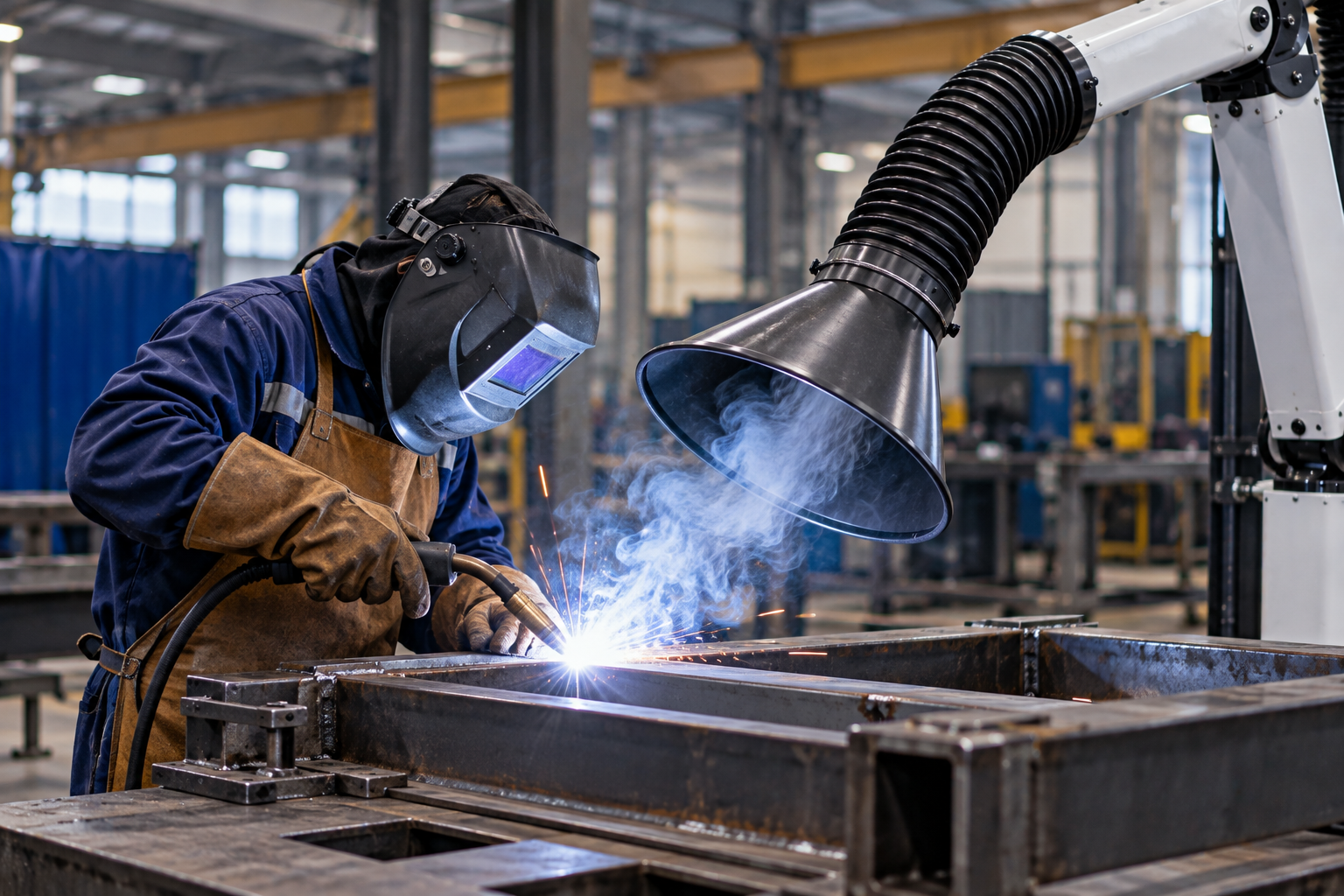
Welding is a critical operation in fabrication shops, automotive manufacturing, heavy engineering, infrastructure production, and metalworking industries. However, welding also generates fumes containing fine particles and metal oxides, along with gases that vary according to the welding process, base material, filler metal, and consumables used.
In an industrial environment, these emissions can spread beyond individual workstations, affecting operator exposure, workplace air quality, and the cleanliness of the production area. An industrial welding fume extractor helps control these emissions by capturing fumes near their source and passing the contaminated air through an appropriate filtration system.
Selecting the right equipment involves more than choosing a unit with sufficient airflow. Manufacturers must consider welding processes, the number of workstations, production volume, capture arrangements, filtration requirements, and future expansion.
This guide explains how industrial welding fume extraction systems work, where they are used, how they should be designed, and what to evaluate before purchasing one.
What Is an Industrial Welding Fume Extractor?
An industrial welding fume extractor is an air pollution control system designed to capture and filter fumes generated during welding operations. Depending on the application, it may serve a single welding station, several workstations, or an entire production area.
A typical system includes:
- Fume capture equipment: Extraction arms, hoods, enclosures, or integrated capture points positioned near the welding process.
- Air movement equipment: A fan or blower that draws contaminated air into the system.
- Filtration equipment: Filters selected to capture the particulate matter generated by the application.
- Ductwork, where required: A network that transports contaminated air from multiple capture points to a central filtration unit.
- Controls and monitoring: Components that help maintain operating conditions and identify performance problems.
The system’s effectiveness depends on how these components work together. Even a high-capacity filtration unit may perform poorly if fumes escape before reaching the capture point or if the ductwork does not deliver the required airflow.
For a broader understanding of the available equipment configurations, an industrial welding fume extraction system should be evaluated according to the welding process, workspace layout, and expected operating conditions.
Why Is Industrial Welding Fume Extraction Important?
Welding fumes form when materials heated during welding vaporize and subsequently condense into fine airborne particles. Their composition depends on factors such as the metal being welded, electrode or filler material, coatings, shielding gases, and welding technique.
Stainless steel welding, for example, can generate fumes containing chromium and nickel compounds. Other welding applications may produce iron oxides, manganese-containing particles, or additional contaminants depending on the materials and consumables involved.
Effective extraction helps control these emissions before they disperse throughout the workplace.
Industrial welding fume extraction can support several operational objectives:
Reducing worker exposure: Capturing fumes close to the welding point helps limit the amount of airborne contamination reaching the operator’s breathing zone.
Improving workplace air quality: Source capture reduces the release of welding fumes into the surrounding production environment.
Maintaining cleaner equipment and work areas: Effective collection can reduce the deposition of airborne particulate matter on nearby surfaces and machinery.
Supporting workplace safety programmes: Properly designed extraction can form part of a broader occupational exposure-control strategy, alongside suitable work practices, exposure assessment, and other protective measures where necessary.
The NIOSH guidance on welding fumes and applicable occupational safety requirements can help businesses evaluate exposure-control measures for their particular welding operations.
Common Industrial Applications of Welding Fume Extractors
Different industries generate welding fumes under different operating conditions. Equipment selection should reflect the scale of production, the geometry of the workpieces, and how easily the capture point can be positioned.
1. Metal Fabrication and Manufacturing
Fabrication shops perform activities such as structural welding, sheet-metal fabrication, equipment manufacturing, and the assembly of metal components. Workpieces can vary significantly in size, and welding stations may change according to production requirements.
Flexible extraction arms, movable capture hoods, and portable extraction units can be suitable for selected applications where the operator can position the capture point close to the welding arc.
For facilities with multiple welding bays, a more coordinated system may be required. The design should account for station usage, workpiece dimensions, and the potential for fumes to escape when operators move around large components.
2. Heavy Fabrication and Structural Welding
Heavy fabrication involves large structures, frames, equipment housings, and other components that may require welding from several positions.
In these environments, a fixed hood may not consistently capture fumes from every weld location. Extraction arms with adequate reach, movable capture equipment, or purpose-designed local enclosures may offer greater flexibility.
Where operator mobility and changing workpiece positions are major concerns, the system should be selected around the actual welding workflow. The practical considerations involved in welding fume extraction for fabrication shops are especially relevant to these installations.
3. Automotive and Component Manufacturing
Automotive manufacturing and component production may involve repeated welding operations, dedicated fixtures, robotic cells, and multiple production stations.
Manual welding stations may use local capture equipment, while automated welding cells may be better suited to extraction integrated with the enclosure or designed around the location of the emissions.
For automated applications, designers should consider the welding cycle, enclosure openings, robot movement, and the airflow needed to capture fumes without interfering with the process.
4. Stainless Steel Welding
Stainless steel welding requires particular attention to fume composition because the emissions may contain chromium and nickel compounds, depending on the alloy and welding conditions.
An industrial welding fume extractor for these applications should be selected using an assessment of the materials, consumables, welding technique, and applicable exposure-control requirements.
Filtration specifications should be evaluated alongside capture performance. Selecting a filter based only on a general particle-size claim is insufficient to establish that the overall installation will adequately control worker exposure.
5. Robotic Welding and Automated Production
Robotic welding can produce concentrated fume emissions within a relatively defined work area. Depending on the cell design, extraction may be integrated into an enclosure, hood, or dedicated collection arrangement.
The system should accommodate the robot’s operating envelope, access for maintenance, and any openings through which fumes may escape.
The extraction design should also account for production demand and the number of robotic cells operating simultaneously. For facilities considering automation, robotic welding fume extraction should be assessed as part of the overall cell and ventilation design rather than as an isolated equipment purchase.
Industrial Welding Fume Extraction System Design
A reliable industrial welding fume extraction system starts with an assessment of the welding operation. The aim is to capture emissions effectively at the source and transport them to suitable filtration equipment without compromising production.
1. Assess the Welding Process
The first step is to document the welding processes used throughout the facility. MIG, TIG, stick, flux-cored, and other welding processes can generate different fume loads and contaminant compositions.
The assessment should also consider:
- Base metals and their coatings.
- Filler metals and electrode consumables.
- Welding current, duty cycle, and production rate.
- Workpiece dimensions and welding positions.
- Whether welding is manual, semi-automatic, or robotic.
- The number of stations operating simultaneously.
These details help establish the likely emissions profile and the most practical capture arrangement.
2. Choose the Capture Method
Source capture is generally the preferred starting point because it intercepts fumes before they disperse into the wider workspace.
Common capture arrangements include:
Extraction arms: Flexible arms with capture hoods that can be positioned near the welding arc. They are useful where welding positions and workpieces vary.
Fixed hoods: Suitable for repeatable operations where the capture position can be maintained consistently.
Enclosures and integrated extraction: Often appropriate for robotic welding cells or other processes that can be enclosed or partially enclosed.
Portable extraction units: May suit smaller operations or workstations where fixed ductwork is impractical, provided the unit has adequate capacity and the capture point can be positioned effectively.
Centralized extraction: Connects multiple capture points to a shared filtration unit through a designed duct network.
The right arrangement depends on the workpiece, operator movement, capture distance, and the way fumes travel away from the source. The system should not obstruct welding access or force operators into awkward working positions.
3. Calculate Airflow Requirements
Airflow requirements depend on the capture method, hood geometry, distance from the source, and operating conditions.
A system designed for a single welding station may have very different requirements from one serving several fabrication bays. For a centralized installation, designers must also consider simultaneous usage, branch airflow, duct resistance, and the effect of filter loading.
Airflow should therefore be calculated for the intended system configuration rather than selected from the fan’s maximum advertised capacity alone.
A practical design assessment should establish:
- Required airflow at each capture point.
- Number of capture points expected to operate together.
- Duct dimensions, lengths, bends, and branch connections.
- Pressure losses through the capture equipment and filters.
- Expected changes in resistance as filters load.
- Provisions for checking airflow during commissioning and routine operation.
Insufficient airflow can allow fumes to escape. Excessive airflow may waste energy, increase noise, or disrupt the welding operation. The goal is effective capture at each point under realistic operating conditions.
4. Evaluate Static Pressure and Fan Selection
Static pressure is the resistance the fan must overcome as air moves through the capture hood, ductwork, filters, and other system components.
A fan should be selected using the required airflow at the system’s expected operating pressure. Choosing equipment based only on motor power or free-air airflow can lead to an installation that fails to deliver the required performance once connected to the complete system.
For centralized systems, pressure losses should be evaluated across the entire duct network. Poorly designed branches or unsuitable duct dimensions can create uneven airflow, leaving some stations with inadequate extraction.
Fan selection and duct design should therefore be treated as connected engineering decisions.
Industrial Welding Fume Filtration: What Should You Consider?
After fumes are captured, the filtration system must be suitable for the contaminants being collected and the operating conditions of the facility.
Filter Selection
Welding fumes contain fine particulate matter, so the filtration equipment must be selected for the expected particle characteristics and required collection performance.
Depending on the application, an industrial dust collector with an appropriate filter configuration may be suitable for welding fume particulate collection. However, equipment designed for coarse grinding dust should not automatically be assumed to provide suitable welding fume filtration.
The design should account for filter efficiency, airflow resistance, dust loading, cleaning requirements, and the manufacturer’s stated operating limits.
Filter Cleaning and Maintenance
Welding fume filters accumulate particulate matter during operation. As the filters load, airflow resistance may increase, potentially reducing capture performance if the system is not designed and maintained appropriately.
Depending on the filter design and operating conditions, maintenance arrangements may include manual filter replacement, periodic cleaning, or automatic cleaning systems.
A reverse-pulsed-jet dust collection system may be worth evaluating for compatible industrial particulate applications. Its suitability for a particular welding fume installation must be confirmed against the filter specifications, contaminant characteristics, and manufacturer’s recommendations.
Filtration Efficiency Is Not the Same as Exposure Control
A high-efficiency filter does not, by itself, guarantee effective control of welding fumes throughout the workplace.
Overall performance also depends on capture efficiency, leakage, airflow distribution, maintenance, and the way the system is operated. Where required, exposure monitoring and suitable verification should be used to evaluate whether the installation achieves its intended control objectives.
Portable vs Centralized Industrial Welding Fume Extractors
One of the main purchasing decisions is whether to use individual extraction units or a centralized system.
| Factor | Portable or individual units | Centralized extraction |
|---|---|---|
| Best suited to | Selected individual stations and changing work locations | Multiple workstations or larger production areas |
| Installation | Usually simpler for a small number of points | Requires engineered ductwork and system planning |
| Flexibility | Units can often be relocated | Capture points are generally connected to fixed infrastructure |
| Airflow management | Managed at each unit | Requires balancing across branches and capture points |
| Maintenance | Units can be serviced individually | Shared equipment requires coordinated maintenance |
| Expansion | Additional units may be required | Expansion depends on available fan, filter, and duct capacity |
| Space | Equipment may occupy floor or workstation space | Main filtration equipment can be located away from workstations |
Portable systems can be practical for intermittent welding and isolated stations. Centralized extraction can be advantageous where several stations need to operate within a coordinated system.
The choice should be based on the number of welding points, their operating schedules, the required capture method, and the long-term operating cost—not solely on the initial equipment price.
How to Select the Right Industrial Welding Fume Extractor
Before comparing suppliers, establish the technical and operational requirements of the application.
1. Define the Number of Welding Stations
Record the number of workstations and determine how many are expected to operate simultaneously. For centralized systems, simultaneous demand has a direct impact on airflow and fan sizing.
2. Identify the Materials and Welding Processes
Document the metals, coatings, electrodes, filler materials, and welding processes used. This information helps establish the contaminant profile and the filtration requirements.
3. Assess Operator Mobility
Determine whether welding occurs at fixed benches, large fabricated structures, moving workpieces, or robotic cells. This will help identify suitable extraction arms, hoods, enclosures, or integrated capture arrangements.
4. Verify Airflow and Filtration Specifications
Ask suppliers to explain the required airflow, operating static pressure, filter configuration, expected maintenance requirements, and limitations of the proposed equipment.
Specifications should relate to the actual installation rather than only to standalone unit performance.
5. Consider Installation and Operating Costs
The purchase price is only one part of the total cost. Evaluate installation, ductwork, electricity consumption, filter replacements, servicing, downtime, and future expansion.
6. Check Serviceability and Spare Parts
Ensure the filtration equipment can be inspected and maintained safely, and that suitable replacement filters and service support are available.
7. Plan for Future Capacity
If the facility expects to add welding stations or increase production, consider whether the system can accommodate that demand. Expansion may require additional fan capacity, filtration capacity, ductwork, or revised airflow balancing.
Common Mistakes to Avoid
Industrial welding fume extraction systems can underperform when important design factors are overlooked.
Selecting a system by motor power alone: Motor rating does not establish the airflow available at the capture point.
Positioning extraction equipment too far from the welding arc: Fumes can disperse before they reach the capture hood.
Using one generic design for every welding process: Different materials, consumables, and welding techniques produce different emissions and operating requirements.
Ignoring ductwork design: Poorly designed duct networks can result in uneven airflow across multiple stations.
Choosing filtration without understanding the contaminant profile: Filter suitability must be established for the actual application.
Neglecting maintenance: Loaded or damaged filters and poorly maintained capture equipment can compromise system performance.
Assuming extraction eliminates every exposure risk: Extraction is one component of a broader exposure-control programme. Additional controls may be needed based on the process and exposure assessment.
Industrial Welding Fume Extractor Selection Checklist
Use this checklist when preparing a technical specification or requesting quotations.
- Welding processes and materials identified.
- Fume-generating operations and work locations documented.
- Number of stations and simultaneous usage established.
- Capture method selected for each application.
- Airflow and static pressure requirements calculated.
- Filtration configuration matched to the contaminants.
- Filter cleaning and replacement requirements documented.
- Installation space, duct routing, and access assessed.
- Energy consumption and ongoing maintenance considered.
- Future production expansion evaluated.
- Commissioning and performance-verification requirements defined.
Conclusion
An industrial welding fume extractor should be selected as an engineered air pollution control solution, not simply as a fan-and-filter unit.
The right system depends on the welding process, materials, capture arrangement, airflow requirements, filtration performance, and production layout. Smaller operations may be served by individual extraction units, while larger facilities may benefit from a centralized system designed around multiple welding stations.
By evaluating these factors before purchasing, manufacturers can make better-informed decisions about system performance, maintenance, operating costs, and long-term suitability.
Powertech Pollution Controls provides industrial air pollution control solutions for manufacturing applications. To evaluate a suitable welding fume extraction configuration, discuss your welding processes, number of stations, workstation layout, and filtration requirements with the technical team.
The final system design should be based on the application’s engineering requirements and verified performance expectations.
‘