
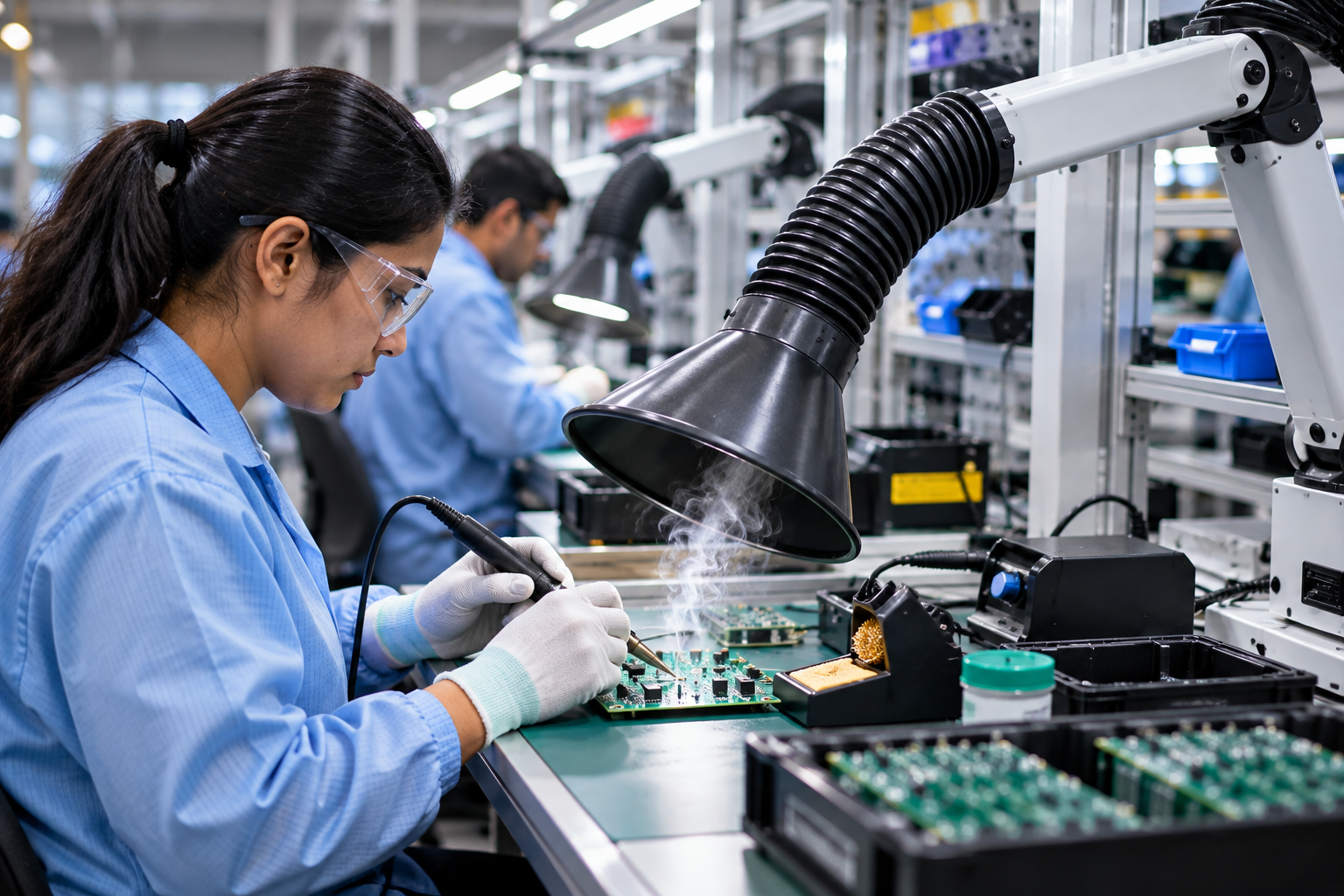
Soldering is an essential process in electronics manufacturing, from PCB assembly and component rework to high-volume production lines. However, soldering fumes can contain airborne particles and chemical compounds released when flux is heated. Without suitable extraction, these contaminants can accumulate around workstations and expose operators during routine production.
Choosing the right soldering fume extractor requires more than comparing motor ratings or filter specifications. The system must match the soldering process, flux chemistry, number of workstations, production volume, and required level of contaminant control.
This guide explains the key factors electronics manufacturers should evaluate when selecting a soldering fume extraction system.
1. Identify the Soldering Process and Fume Source
The first step is to identify where fumes are generated and how the soldering operation is performed. Different processes produce different fume loads and require different extraction arrangements.
Common applications include:
- Manual PCB soldering: Individual operators solder components at benches, often using hand-held soldering irons.
- PCB rework and repair: Operators remove or replace components, frequently working on localized areas of a circuit board.
- Wave soldering: Flux is applied before circuit boards pass over a wave of molten solder.
- Selective soldering: Automated equipment solders specific areas of a PCB.
- High-volume electronics assembly: Multiple workstations operate simultaneously, potentially requiring coordinated extraction across the production area.
For manual assembly and repair, a PCB soldering fume extractor may be suitable for capturing fumes close to the operator’s work area. Automated processes may require extraction integrated with the equipment enclosure or process hood.
The extraction method should be selected according to the actual source of emissions rather than assuming that one system will work equally well for every soldering operation.
2. Consider the Solder and Flux Being Used
The soldering process alone does not determine the appropriate filtration system. The type of flux and the chemicals released during heating also influence the selection.
Rosin-based, resin-based, and other flux formulations can release airborne particulate matter and chemical vapours when heated. Lead-free soldering can also involve flux-related emissions, so changing to lead-free solder does not eliminate the need for suitable extraction.
Manufacturers should review the flux safety data sheet (SDS) to understand its composition and relevant exposure-control requirements. The health and safety aspects of soldering and brazing are also relevant when evaluating workplace exposure controls.
A suitable soldering fume filtration system may require:
- Particulate filtration to capture airborne particles generated during soldering.
- Activated carbon or other suitable sorbent media to adsorb certain gaseous compounds.
- Multi-stage filtration where both particles and specific gaseous contaminants need to be controlled.
The appropriate configuration depends on the contaminants, filter media, operating conditions, and maintenance requirements. Activated carbon should not be treated as a universal solution for every gas or vapour.
3. Choose the Right Fume Capture Method
Even an advanced filter cannot perform effectively if fumes are not captured before they spread into the surrounding workspace. Capture arrangement is therefore one of the most important selection factors.
Bench-level extraction
Bench-level systems are typically suited to individual soldering stations, small assembly areas, and repair workbenches. A local extraction unit or appropriately positioned capture nozzle can draw fumes away from the operator’s breathing zone.
Flexible extraction arms
A flexible fume extraction arm allows operators to position the capture hood close to the soldering point. This can be useful where workpieces vary in size or operators frequently change their working positions.
The hood must remain close enough to capture fumes effectively without obstructing soldering, inspection, or component handling.
Machine-integrated extraction
Wave soldering, selective soldering, and other automated processes may benefit from extraction connected directly to the equipment enclosure or a dedicated capture hood. The design should account for the location and direction of the emissions, access requirements, and any airflow effects created by the process equipment.
Centralized extraction
Where many soldering stations operate simultaneously, a centralized system can connect several capture points to a common extraction and filtration unit. The ductwork and fan must be designed for the required airflow, pressure losses, and expected simultaneous usage.
The distinction between centralized and bench-level soldering fume extraction is particularly important when planning new production lines or expanding existing facilities.
4. Decide Between Individual and Centralized Extraction
The number of stations is an important consideration, but it should not be the only factor determining the system configuration.
| Selection factor | Individual extraction | Centralized extraction |
|---|---|---|
| Typical application | Isolated benches and repair stations | Multiple connected workstations |
| Installation | Usually simpler at a small number of stations | Requires ductwork and coordinated system design |
| Expansion | Additional units may be needed for new stations | Additional points may be possible if capacity is planned |
| Maintenance | Units can be serviced separately | Shared equipment requires planned maintenance |
| Airflow control | Managed at individual stations | Requires suitable balancing and control across branches |
| Space requirements | Equipment may occupy bench or floor space | Main unit can be located away from workstations |
Individual systems may be practical for smaller operations or workstations with different usage patterns. Centralized systems may be more appropriate for larger production areas where several capture points need to be managed together.
For either configuration, assess the total required airflow, the number of stations likely to operate simultaneously, the consequences of a system shutdown, and the maintenance resources available.
5. Evaluate Airflow and Static Pressure
Airflow determines how much air the system can move, while static pressure represents the resistance the fan must overcome as air travels through the capture hood, ductwork, filters, and other components.
A system should be selected using the airflow required at each capture point under actual operating conditions—not simply the maximum airflow stated in a product brochure.
For individual extraction, consider the capture arrangement and the distance between the hood and the soldering point. For centralized systems, also account for duct diameter, bends, branch connections, simultaneous operation, and filter loading.
Important questions include:
- What airflow is required at each soldering station?
- How many stations will operate at the same time?
- What pressure losses will occur across the ductwork and filters?
- Will airflow remain adequate as filters load during use?
- Can airflow be adjusted to suit different workstations?
Undersized systems may fail to capture fumes effectively. Excessive airflow, on the other hand, may disturb lightweight components, interfere with operator comfort, or increase energy consumption unnecessarily.
The objective is to achieve effective capture at the source while maintaining stable performance across the intended operating range.
6. Select Filtration Based on the Contaminants
Filter selection should follow the contaminant assessment, not precede it. A filter that captures particles may not adequately control gaseous compounds, and a sorbent intended for certain vapours may not provide the required particulate filtration.
Particulate filters
These filters capture airborne particles within their specified performance range. Their suitability depends on particle characteristics, filter efficiency, airflow, and the required service life.
Activated carbon filtration
Activated carbon can adsorb certain gaseous compounds. Its effectiveness depends on the type and quantity of carbon, the contaminants present, humidity, contact time, and the point at which the media becomes exhausted.
A system’s ability to capture particles should not be confused with its ability to remove every gaseous contaminant.
Multi-stage filtration
Where the process generates both particles and gaseous compounds, a multi-stage arrangement may be appropriate. Each stage should have a defined purpose and be selected for the contaminants it is expected to control.
For electronics manufacturers, activated carbon filtration in soldering fume extractors is an important consideration when assessing systems intended to address specific flux-related emissions.
Ask suppliers for the relevant filter specifications, test conditions, replacement criteria, and limitations. Where the contaminants are not fully characterized, obtain an appropriate assessment before finalizing the filtration configuration.
7. Match the System to Production Volume
A soldering fume extractor selected for a single repair bench may not be suitable for a production line with dozens of continuously operating stations.
Consider the following factors:
- Number of active soldering stations.
- Hours of operation per shift.
- Type and frequency of soldering tasks.
- Simultaneous demand across the production area.
- Variations in production schedules.
- Expected future expansion.
For example, a facility with 60 soldering stations needs to consider how airflow is distributed across the complete installation, how the system responds when multiple stations operate together, and how maintenance can be performed without unnecessary disruption.
Powertech’s soldering fume extraction installation for a 60-station manufacturing operation provides a relevant example of extraction planning for a multi-station industrial environment.
The correct capacity should be determined from the application and operating requirements rather than extrapolated from the number of stations alone.
8. Consider Noise, Space, and Operator Comfort
A technically suitable extraction system must also work within the realities of the production floor.
Equipment installed near operators should be evaluated for noise, vibration, accessibility, and its impact on the available workspace. Bench-level units should not interfere with inspection, component placement, or other precision tasks.
For centralized installations, assess the space required for the main unit, duct routing, electrical connections, filter servicing, and replacement components.
Operator acceptance also matters. Capture hoods that are difficult to position or regularly obstruct work may be moved away from the source, reducing their practical effectiveness.
The most appropriate design is one that supports reliable fume capture without making routine production tasks unnecessarily difficult.
9. Check Maintenance Requirements and Filter Replacement
Maintenance affects both system performance and long-term operating cost. A system that is difficult to service or has unclear filter replacement criteria may be poorly suited to a busy electronics manufacturing environment.
Before purchasing, establish:
- How filters are inspected and replaced.
- How the system indicates reduced airflow or filter loading.
- The expected filter service life under the proposed operating conditions.
- Whether replacement filters are readily available.
- How maintenance can be completed safely.
- What routine checks operators should perform.
Filter life depends on the contaminant load, hours of operation, filter design, and maintenance practices. Avoid relying on a fixed replacement interval unless it is supported by the manufacturer’s recommendations and actual operating experience.
Following appropriate maintenance practices for soldering fume extractors helps manufacturers plan servicing and identify performance changes before they affect routine operation.
10. Avoid These Common Selection Mistakes
Several mistakes can lead to poor capture performance or unnecessary operating costs.
Choosing solely by motor power: Motor ratings do not establish the airflow available at the capture point or demonstrate effective contaminant control.
Selecting filtration without identifying contaminants: Particulate filters and sorbent media serve different purposes. The filter configuration must match the emissions.
Positioning the hood too far away: Fumes can disperse before reaching a poorly positioned capture point.
Ignoring simultaneous station usage: A centralized system must be designed for the expected operating demand, not just the total number of connected outlets.
Overlooking maintenance access: Filter replacement, inspections, and servicing should be practical for the people responsible for the equipment.
Assuming lead-free soldering eliminates fume hazards: Flux emissions may still require effective extraction and appropriate filtration.
Failing to plan for expansion: New stations can change airflow requirements and may exceed the capacity of the original system if future demand is not considered.
11. Use a Practical Selection Checklist
Before requesting a quotation, document the following information:
- Soldering processes used: manual, rework, wave, selective, or automated.
- Solder and flux formulations, supported by relevant safety data sheets.
- Number of workstations and expected simultaneous usage.
- Desired capture arrangement at each workstation.
- Required airflow and expected system pressure losses.
- Filtration requirements based on identified contaminants.
- Available installation space and acceptable noise levels.
- Filter inspection, replacement, and maintenance arrangements.
- Expected production expansion.
- Required performance documentation and commissioning checks.
Providing these details helps suppliers recommend a system based on the actual application rather than a generic equipment specification.
12. Choosing a Soldering Fume Extraction Solution for Your Facility
For electronics manufacturing, the right soldering fume extractor is one that captures emissions effectively at the source, uses filtration appropriate to the contaminants, and maintains the required performance under real production conditions.
Powertech’s FumeKiller fume extraction range can be evaluated for suitable soldering and electronics manufacturing applications. Final selection should account for the process, extraction configuration, airflow requirements, filter specification, and installation conditions.
For multi-station production lines, the design should also consider duct balancing, simultaneous operation, maintenance access, and future capacity requirements.
The most reliable way to select a system is to document the application, assess the emissions, establish the capture requirements, and verify that the proposed equipment can meet those requirements.
Planning a soldering fume extraction system? Contact Powertech to discuss your workstation layout, soldering processes, production volume, and filtration requirements so that a suitable configuration can be evaluated for your facility.