
Introduction
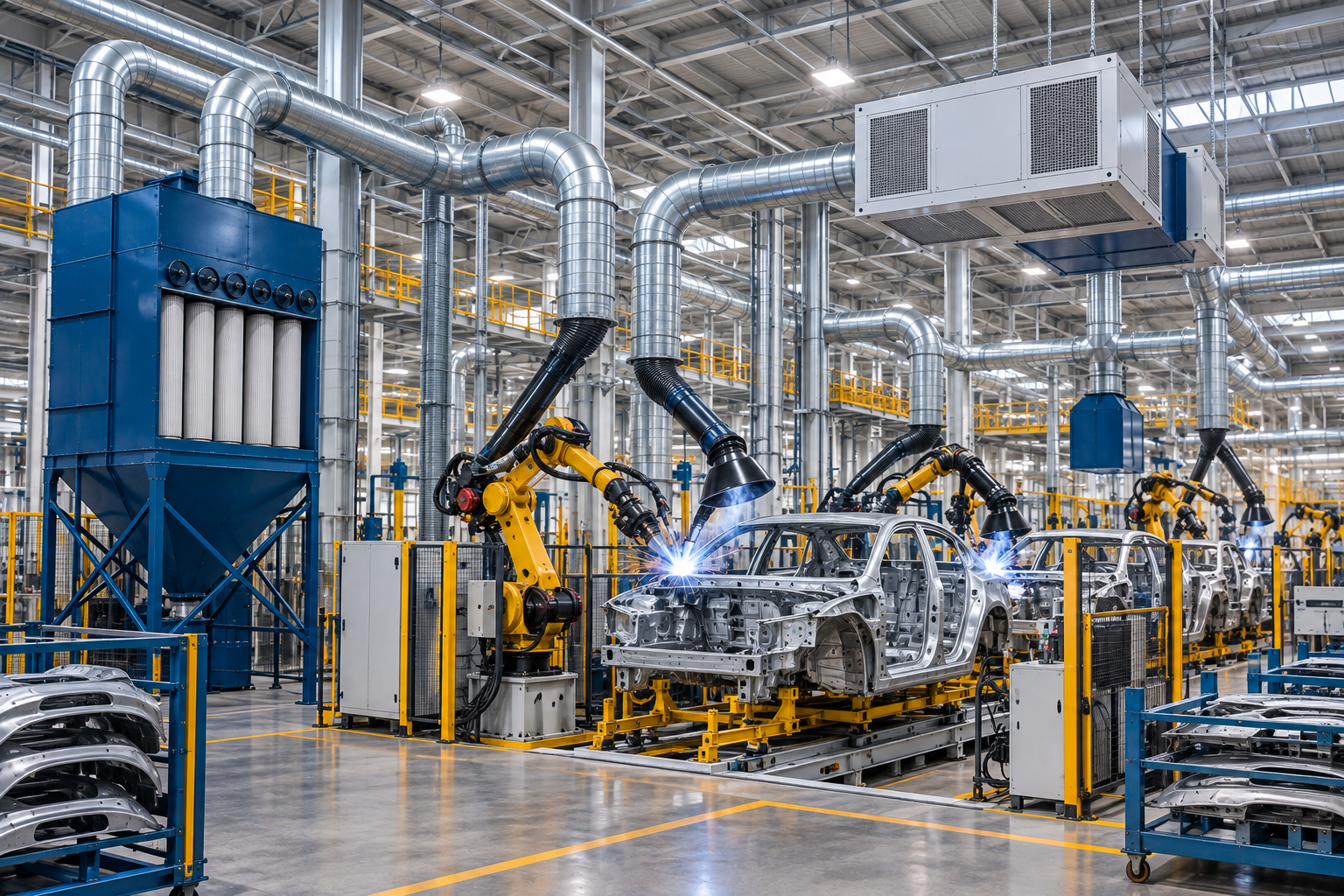
Automotive manufacturing involves a wide range of processes that can generate airborne contaminants, including welding fumes, metal dust, oil mist, coolant mist, grinding particles, smoke, and process emissions. With multiple production lines operating simultaneously, controlling these contaminants requires a carefully engineered air pollution control strategy.
Effective automotive factory air pollution control focuses on capturing contaminants as close as possible to where they are generated. This can involve welding fume extraction, dust collection, oil mist collection, local exhaust ventilation, and appropriately designed factory ventilation systems.
A properly designed system can help maintain cleaner production areas, protect machinery, reduce contamination, and provide better workplace air quality.
Key Takeaways
- Automotive plants generate several different types of airborne contaminants.
- Source capture is generally the preferred method for controlling concentrated emissions.
- Automotive welding ventilation is particularly important in body shops and fabrication areas.
- Industrial fume extraction systems should be designed around the welding process and plant layout.
- Oil mist and dust require different collection technologies.
- General factory ventilation can complement, but should not replace, local exhaust extraction.
Common Air Pollution Sources in Automotive Manufacturing
Automotive production involves numerous processes that generate airborne contaminants.
Welding
Body-in-white manufacturing and component fabrication can generate welding fumes and fine particulate matter.
Common processes include:
- MIG/MAG welding
- TIG welding
- Spot welding
- Robotic welding
- Laser welding
Grinding and Finishing
Grinding, deburring, polishing, and surface finishing can generate fine metal dust and particles.
CNC Machining
Turning, milling, drilling, and other machining processes can produce:
- Oil mist
- Coolant mist
- Fine metal particles
Cutting and Fabrication
Plasma cutting, laser cutting, sawing, and other thermal or mechanical processes can release smoke, dust, and fine particulate.
Paint and Surface Treatment
Certain coating and surface-treatment operations can generate vapours, aerosols, or other process emissions requiring application-specific extraction.
What Is Automotive Factory Air Pollution Control?
Automotive factory air pollution control involves the combination of equipment and engineering practices used to capture and manage airborne contaminants generated throughout an automotive manufacturing facility.
A complete strategy may include:
- Source-capture hoods
- Welding fume extraction
- Dust collectors
- Mist collectors
- Extraction ductwork
- Industrial blowers
- Filtration systems
- General ventilation
- Monitoring and control equipment
The system should be designed according to the specific processes rather than using the same extraction method throughout the plant.
Automotive Welding Ventilation
Welding is one of the most significant sources of airborne contamination in many automotive manufacturing facilities.
Effective automotive welding ventilation should prioritize source capture.
Extraction can be provided through:
- Flexible extraction arms
- Welding hoods
- Machine-integrated extraction
- Robotic-cell extraction
- Centralized extraction systems
- Portable welding fume extractors
The extraction point should be positioned as close as practical to the welding plume without interfering with the welding process or shielding gas.
Industrial Fume Extraction for Automotive Applications
Industrial fume extraction automotive systems need to accommodate the unique requirements of automotive manufacturing.
Large production facilities may have:
- Hundreds of welding points
- Robotic welding cells
- Moving production lines
- High production rates
- Multiple shifts
- Restricted installation space
For these applications, centralized extraction can connect multiple capture points to a common filtration system.
For smaller or maintenance operations, portable extraction units may provide greater flexibility.
Robotic Welding Fume Extraction
Automotive plants increasingly use robotic welding for high-volume production.
Because robotic welding is repetitive and continuous, extraction can be integrated into the cell design.
Possible approaches include:
Extraction at the Welding Cell
Hoods or enclosures capture fumes from the robotic welding area.
Machine-Integrated Extraction
Extraction is incorporated into the equipment or tooling arrangement.
Centralized Extraction
Multiple robotic cells can be connected to a central filtration system.
The correct configuration depends on cell design, production rate, welding process, and available space.
Dust Control in Automotive Manufacturing
Automotive production also generates dust during:
- Grinding
- Sanding
- Deburring
- Cutting
- Polishing
- Material handling
An appropriately sized industrial dust collector can capture these contaminants at the source.
Source extraction helps prevent dust from spreading to:
- CNC machines
- Assembly areas
- Electrical equipment
- Finished components
- Operator workstations
Oil Mist and Coolant Mist Control
CNC machining operations can generate airborne oil and coolant aerosols.
These contaminants can settle on:
- Machine surfaces
- Electrical components
- Floors
- Finished parts
- Ventilation equipment
Mist collectors installed directly on or near CNC machining centers can capture these aerosols before they spread throughout the machine shop.
For automotive component machining, source-capture mist collection can therefore form an important part of the overall air pollution control strategy.
Factory Ventilation Systems
Factory ventilation systems have an important supporting role in automotive manufacturing.
General ventilation can help manage:
- Overall air movement
- Heat
- Residual airborne contamination
- General workplace conditions
However, general ventilation should not be relied upon as the primary control for concentrated welding fumes, dust, or oil mist.
A more effective approach is typically:
Source capture → filtration → general ventilation
This layered approach reduces contaminant dispersion while maintaining overall factory air quality.
Source Capture vs General Ventilation
| Feature | Source Capture | General Factory Ventilation |
|---|---|---|
| Capture location | At emission source | Entire workspace |
| Main purpose | Prevent dispersion | Manage overall air |
| Airflow requirement | Targeted | Larger air volume |
| Welding fumes | Highly suitable | Supplementary |
| Dust | Highly suitable | Supplementary |
| Oil mist | Highly suitable | Supplementary |
| Plant-wide air management | Limited | Suitable |
Designing an Automotive Air Pollution Control System
A successful system should begin with an assessment of the plant.
1. Map Contaminant Sources
Identify:
- Welding stations
- Robotic cells
- Grinding areas
- CNC machines
- Cutting operations
- Material handling points
- Other emission sources
2. Characterize the Contaminants
Determine:
- Particle size
- Concentration
- Temperature
- Moisture
- Chemical characteristics
- Generation rate
3. Select the Capture Method
Determine whether the process requires:
- Extraction arms
- Enclosures
- Hoods
- Downdraft tables
- Machine-integrated extraction
- Centralized ducted extraction
4. Calculate Airflow
Airflow requirements depend on:
- Capture geometry
- Source characteristics
- Hood dimensions
- Capture distance
- Number of extraction points
- Simultaneous operation
5. Design the Ductwork
Duct diameter, length, branches, bends, airflow velocity, and static pressure must be evaluated as part of the overall design.
6. Select Filtration Technology
The filtration system should match the contaminant.
For example:
- Dust → dust collection
- Welding fumes → fume extraction
- Oil/coolant mist → mist collection
Benefits of Effective Air Pollution Control
A properly engineered system can provide several operational benefits.
Cleaner Production Areas
Effective source capture reduces airborne contamination and surface deposition.
Reduced Equipment Contamination
Contaminants can settle on machinery, sensors, electrical components, and production equipment. Extraction helps reduce this buildup.
Lower Housekeeping Requirements
Controlling contaminants at the source can reduce the amount of material settling throughout the facility.
Improved Product Cleanliness
Reduced airborne contamination can help maintain cleaner components and production areas.
Better Workplace Air Quality
Effective extraction reduces the concentration of airborne contaminants around production operations.
Improved Operational Reliability
Cleaner equipment and controlled production environments can help reduce contamination-related maintenance problems.
Common Mistakes in Automotive Air Pollution Control
Relying Only on General Ventilation
Large fans may move considerable quantities of air without effectively capturing contaminants at the source.
Positioning Extraction Too Far Away
Source capture becomes less effective as the distance between the hood and emission point increases.
Using One Filtration Technology for Everything
Dust, welding fumes, and oil mist have different characteristics and may require different collection technologies.
Undersizing the Extraction System
Insufficient airflow can result in poor capture and contaminant escape.
Ignoring Production Changes
Adding welding cells or CNC machines can change the airflow requirements of an existing system.
Neglecting Maintenance
Loaded filters, blocked ductwork, damaged seals, and malfunctioning components can gradually reduce extraction performance.
Powertech’s Approach
Powertech provides application-specific pollution control solutions for automotive and engineering manufacturing environments.
Depending on the process, solutions can include:
- FumeKiller welding fume extraction systems
- MistKiller oil and coolant mist collectors
- DustBag industrial dust collection systems
- Local exhaust ventilation
- Centralized extraction systems
- Customized ductwork and filtration
The objective is to match the collection technology to the contaminant and capture it as close as practical to its source.
Common contaminants include welding fumes, metal dust, grinding particles, oil mist, coolant mist, smoke, and process-specific vapours.
Automotive welding can generate fine airborne fumes and particles. Source-capture ventilation helps remove these contaminants close to the welding operation before they disperse throughout the production area.
The appropriate method depends on the welding process and production layout. Extraction arms, cell hoods, machine-integrated extraction, and centralized systems can all be suitable for different applications.
General factory ventilation can support overall air management, but concentrated emissions are generally better controlled through local source extraction.
Yes. Centralized extraction systems can serve multiple fixed workstations or production cells when the airflow, ductwork, filtration, and blower are properly engineered.
Mist collectors installed at CNC machines can capture airborne oil and coolant mist at the source, reducing its spread throughout the machining area.
Effective automotive factory air pollution control requires an integrated approach to the different contaminants generated throughout the production process. Welding fumes, grinding dust, oil mist, coolant mist, and other emissions should not be treated as a single air-quality problem. Automotive welding ventilation and industrial fume extraction automotive systems can provide targeted source capture for welding operations, while dust collectors and mist collectors address other process-specific contaminants. General factory ventilation systems can complement these technologies by managing overall air movement and residual contamination. However, capturing pollutants at their source should remain the foundation of an effective automotive manufacturing air pollution control strategy. Powertech’s FumeKiller, MistKiller, and DustBag solutions provide manufacturers with application-specific options for controlling welding fumes, machining mist, and industrial dust across automotive production environments.