
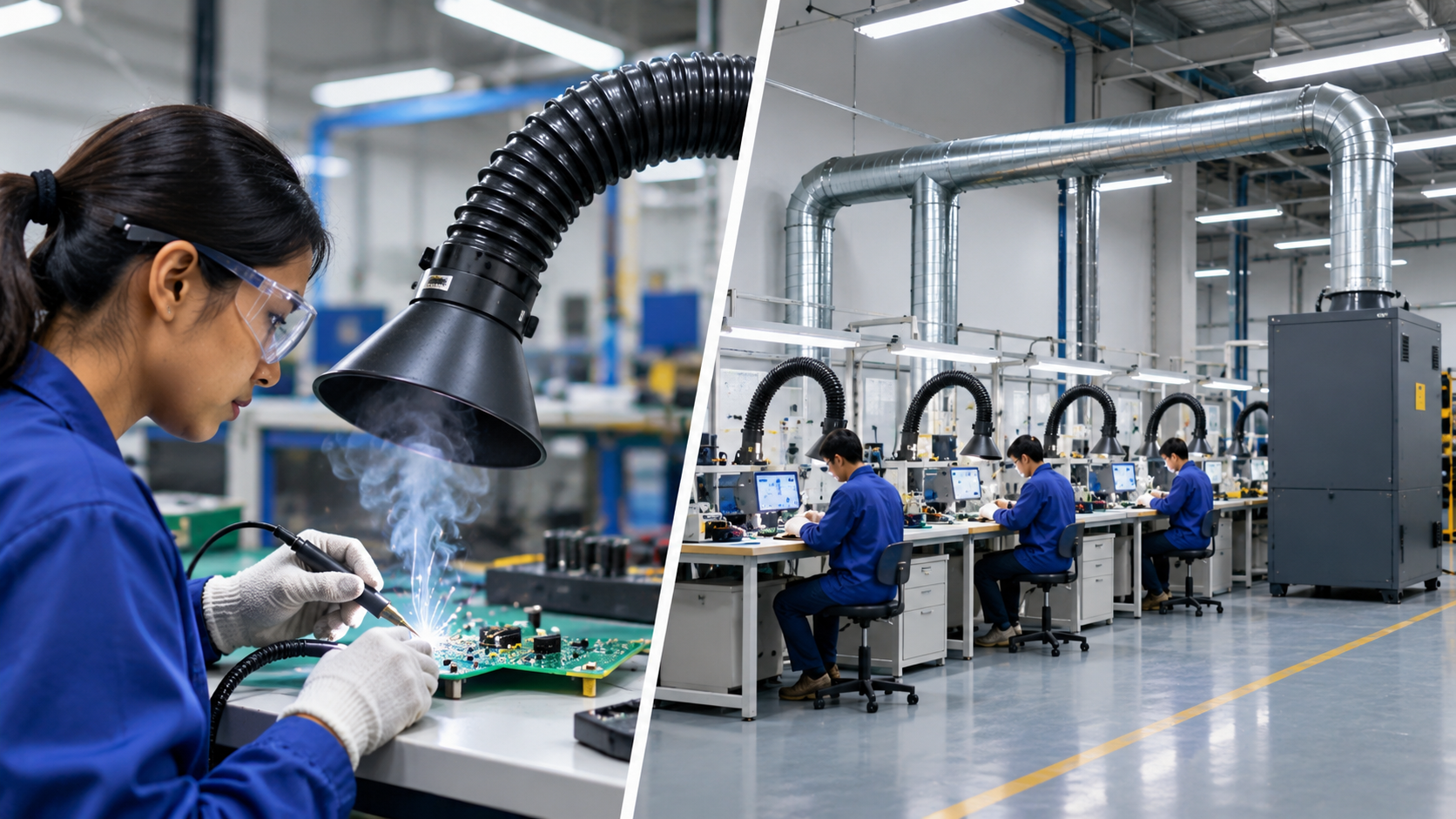
Soldering operations generate fumes from the fluxes and other materials used during the process. In electronics manufacturing, these emissions can accumulate around workstations when they are not captured effectively at the source. As production expands, managing fumes across multiple benches becomes an important part of workplace ventilation planning.
Two common approaches are bench-level soldering fume extraction and a centralized soldering fume extraction system. Bench-level units provide extraction close to individual workstations, while centralized systems connect multiple capture points to a shared extraction and filtration unit.
The right choice depends on more than the number of soldering stations. Production hours, workstation layout, simultaneous demand, capture requirements, maintenance resources, and future expansion all influence the decision.
What Is Bench-Level Soldering Fume Extraction?
A bench-level soldering fume extractor is installed at or near an individual workstation. Depending on the design, it may use a compact extraction unit, a flexible suction arm, or a capture hood positioned near the soldering point.
The objective is to draw fumes away before they disperse into the operator’s breathing zone.
Bench-level systems are often suitable for:
- Electronics repair and rework benches
- Small PCB assembly areas
- Prototyping and testing departments
- Workstations with changing layouts
- Operations where only a few benches run simultaneously
Advantages of bench-level extraction
Independent workstation control: Operators can use and adjust their extraction arrangements according to the task and equipment provided.
Simpler installation for small setups: Individual units generally require less centralized ductwork, making them practical for small facilities and existing workbenches.
Flexibility: Portable units can be repositioned when production requirements change, provided the capture arrangement remains suitable for the task.
Localized maintenance: A unit can often be serviced without taking an entire extraction network out of operation.
Limitations to consider
As the number of workstations increases, providing an individual unit for every bench can create a larger equipment footprint. Multiple units also mean multiple maintenance schedules, electrical connections, and components to inspect.
The total cost may become less attractive when many stations operate continuously. However, this depends on the equipment selected, the number of extraction points served by each unit, and the actual operating schedule.
What Is a Centralized Soldering Fume Extraction System?
A centralized soldering fume extraction system uses a common extraction and filtration unit connected to multiple soldering workstations through a duct network.
Each workstation has a suitable capture point, such as a hood or extraction arm. The ductwork carries contaminated air to the central unit, where the selected filtration stages treat the air according to the application.
Centralized systems are commonly considered for:
- High-volume electronics manufacturing
- Large PCB assembly lines
- Fixed production layouts with many soldering benches
- Facilities where several extraction points operate for extended periods
- Manufacturing plants seeking coordinated maintenance and airflow management
Advantages of centralized extraction
Shared extraction equipment: Multiple workstations can connect to a common system rather than each requiring a complete standalone unit.
Centralized maintenance: The main filtration equipment can be inspected and serviced at a common location, although the individual capture points and ductwork still need periodic checks.
Reduced equipment at the benches: Locating the main unit away from operators can free up workbench or floor space.
Coordinated airflow design: A properly engineered network can distribute extraction capacity across several stations according to their individual requirements and expected usage.
Potential for planned expansion: Additional branches may be possible when the original system has adequate fan, filter, and duct capacity. Expansion is not automatic; it must be checked against the available capacity.
Limitations to consider
A centralized system typically requires more design and installation work. Duct routing, branch sizing, pressure losses, balancing, access for maintenance, and the number of simultaneously operating stations must all be considered.
The system may also be less convenient when benches are frequently relocated. Because multiple workstations depend on shared equipment, the consequences of a central-unit shutdown should be considered during system selection.
Centralized vs Bench-Level Soldering Fume Extraction: Key Differences
| Selection factor | Bench-level extraction | Centralized extraction |
|---|---|---|
| Typical application | Individual benches and smaller work areas | Multiple connected stations and production lines |
| Installation | Usually simpler for a small number of stations | Requires ductwork and system-level engineering |
| Initial investment | Often lower for small setups | May be higher due to ductwork and central equipment |
| Workbench space | Units may occupy bench or nearby floor space | Main unit can be positioned away from workstations |
| Airflow management | Managed at each individual unit | Requires balancing across duct branches and capture points |
| Maintenance | Multiple units may need separate servicing | Main equipment is serviced centrally, with branch maintenance still required |
| Layout flexibility | Generally easier to relocate | Fixed ductwork can limit relocation |
| Expansion | Additional individual units may be needed | Possible if the original system has sufficient spare capacity |
| Downtime considerations | A fault may affect one unit or its connected stations | A central-unit fault may affect multiple connected stations |
Neither configuration is automatically superior. The appropriate solution is the one that provides effective capture at the required workstations while fitting the facility’s operational and maintenance needs.
1. Consider the Number of Soldering Stations
The number of stations is an important starting point, but it should not be the only selection criterion.
A facility with three benches used intermittently may find individual extraction units practical. A facility with several production lines and dozens of active soldering points may benefit from a centralized arrangement.
The important distinction is how many stations need extraction simultaneously and how consistently they operate.
Before choosing a configuration, establish:
- The total number of soldering stations
- The number likely to operate at the same time
- The hours of operation per shift
- The type and frequency of soldering tasks
- Whether production demand changes significantly during the day
- Whether additional benches are planned
These details help determine whether individual units, a centralized system, or a combination of both is more appropriate.
2. Evaluate the Soldering Process and Fume Capture Method
Not every soldering operation produces the same emissions or requires the same capture arrangement.
Manual soldering and PCB rework may be served by flexible extraction arms positioned close to the work. Automated processes such as wave soldering or selective soldering may require extraction integrated with a machine enclosure or a dedicated capture hood.
The capture point should intercept fumes close to where they are generated without obstructing the operator’s hands, visibility, component placement, or inspection.
This principle applies to both system configurations. A centralized unit cannot compensate for poorly positioned capture hoods, and an individual extractor will not perform effectively if fumes escape before reaching the intake.
Facilities planning a new extraction layout can also benefit from reviewing the principles of fume extraction layout design for industrial facilities.
3. Check Airflow and Static Pressure Requirements
A centralized soldering fume extraction system must deliver the required airflow to the connected capture points under actual operating conditions.
Airflow indicates the volume of air moved by the system. Static pressure represents the resistance the fan must overcome as air travels through the hoods, ductwork, fittings, filters, and other components.
A centralized network should be designed around:
- The required airflow at each capture point
- The number of stations expected to operate simultaneously
- Duct lengths, diameters, bends, and branch connections
- Pressure losses through the filtration stages
- Airflow balancing across the network
- The effect of filter loading during operation
Simply adding together the maximum airflow ratings of individual extraction points may not produce a reliable system design. The fan and duct network must be selected as a complete system.
Bench-level units also need suitable airflow and capture positioning, but they generally involve less shared ductwork when each unit serves its own workstation.
For a deeper explanation of the relationship between airflow and suction, see understanding airflow and suction in extraction systems.
4. Match Filtration to the Contaminants
The system configuration and the filtration technology are separate decisions. Both centralized and bench-level equipment must use filtration suitable for the contaminants generated by the soldering process.
Soldering fumes can include fine airborne particles and gaseous compounds associated with flux and other process materials. The appropriate filtration arrangement depends on the actual emissions, the equipment design, and the required performance.
When evaluating a system, ask:
- What contaminants are expected from the process?
- Which filtration stages are included?
- Is particulate filtration required, and is additional gas-phase treatment appropriate?
- How will the condition of the filter be monitored?
- What maintenance and replacement procedures are recommended?
- Is the filtration arrangement suitable for the intended duty cycle?
For example, particulate filters and activated carbon media perform different functions and should not be treated as interchangeable. The correct combination should be selected according to the application rather than assumed to be the same for every soldering line.
Powertech’s guide to best practices for soldering fume extraction systems provides further guidance on capture positioning, airflow, filtration, and maintenance.
5. Compare Installation Cost With Total Operating Cost
Bench-level extraction can be economical when only a few workstations require extraction. As the operation grows, however, the cost of providing and maintaining multiple units may become a significant consideration.
A centralized installation may involve a higher initial investment in ductwork, fan capacity, filtration equipment, controls, and commissioning. It may also consolidate some maintenance activities and reduce the number of standalone units around the production floor.
Compare both options over their expected service life rather than looking only at the initial equipment price.
Include:
- Equipment purchase and installation
- Ductwork and electrical work
- Energy consumption
- Filter cleaning and replacement
- Inspection and preventive maintenance
- Downtime and production disruption
- Costs associated with future expansion
A centralized system is not guaranteed to have lower operating costs. The result depends on the design, operating hours, energy demand, filtration requirements, and maintenance arrangements.
6. Plan for Maintenance and Production Continuity
Maintenance planning becomes especially important when multiple stations depend on the same extraction equipment.
For bench-level systems, servicing can often be distributed across individual units. This can make it easier to isolate a single unit for maintenance, although the number of units may increase the total servicing workload.
With centralized extraction, maintenance is concentrated around shared equipment. This can simplify access and coordination, but a major service event or central-unit fault may affect several connected stations.
A maintenance plan should cover:
- Routine inspection of capture hoods and extraction arms
- Checks for damaged or obstructed ductwork
- Monitoring of airflow and pressure changes
- Inspection and servicing of filters according to manufacturer guidance
- Access to replacement parts
- Procedures for handling a unit or system shutdown
Where uninterrupted production is important, discuss isolation arrangements, backup provisions, and the consequences of shared-system downtime before finalizing the design.
7. Consider Future Expansion and Layout Changes
A growing electronics manufacturer should consider not only its current production line but also its likely future requirements.
Bench-level systems can be convenient where workbenches move frequently or production is reorganized often. Additional units can be introduced as new stations are added, subject to the suitability of the new extraction arrangement.
A centralized system can support expansion when the initial design accounts for future branches, fan capacity, filtration capacity, and the pressure losses associated with additional ductwork. Spare connection points alone do not guarantee that the system can support more stations.
A hybrid approach may be useful when a facility has a fixed, high-volume assembly line alongside separate repair, testing, or prototype benches. A centralized system can serve the fixed production area while individual units support workstations that need greater flexibility.
A Real-World Example: Extraction for 60 Soldering Stations
Powertech’s soldering fume extraction case study for a leading power infrastructure manufacturer illustrates the planning challenges involved in high-volume soldering operations.
The facility had 60 soldering stations and needed to manage fumes without overcrowding the work area or creating an unnecessarily complicated maintenance burden.
The selected arrangement used 30 FumeKiller FK500IM units, each equipped with twin flexible extraction arms, allowing each unit to serve two workstations.
This example demonstrates that a large multi-station operation does not necessarily require one standalone extractor per bench or a single centralized unit for the entire facility. A distributed arrangement can also be appropriate when the number of capture points, equipment configuration, layout, and operating requirements support it.
The important lesson is to evaluate the actual extraction design rather than assuming that every large production line needs the same configuration.
Which Setup Should You Choose?
Use the following guide as a starting point for selecting a system.
Choose bench-level extraction when:
- You have a small number of soldering stations.
- Workbenches are frequently moved or reorganized.
- Different benches have substantially different usage patterns.
- You prefer to maintain independent extraction units.
Consider centralized extraction when:
- Many workstations operate within a fixed production layout.
- Shared extraction equipment fits the facility’s space and maintenance plans.
- The duct network can be designed to deliver the required airflow to all intended capture points.
- Future expansion can be planned into the original design.
Consider a hybrid arrangement when:
- A fixed production line operates alongside flexible repair or rework benches.
- Some workstations have predictable, continuous demand while others are used intermittently.
- Different parts of the facility require different extraction arrangements.
These are selection guidelines rather than fixed rules. The final configuration should be based on the process, contaminants, capture requirements, airflow calculations, layout, and operating conditions.
Not in every situation. Centralized systems may suit larger facilities with many fixed workstations, while bench-level units are often practical for smaller or more flexible operations. The best choice depends on operating demand, capture requirements, layout, and lifecycle cost.
Yes. A properly engineered system can connect multiple capture points to a shared extraction and filtration unit. Its capacity must be checked against the required airflow, duct resistance, filter configuration, and expected simultaneous station usage.
No. Centralized systems can consolidate equipment and maintenance, but they require ductwork and coordinated system design. A cost comparison should include installation, energy, maintenance, downtime, and future expansion.
Potentially. Expansion depends on available fan and filtration capacity, duct sizing, pressure losses, and the original design. Additional stations should be assessed before being connected.
Identify the soldering processes and contaminants, required capture arrangements, number of simultaneously active stations, airflow and pressure requirements, filtration needs, maintenance resources, and expected production changes.
Choosing between a centralized soldering fume extraction system and bench-level extraction is an engineering and operational decision, not simply a comparison of equipment prices. Bench-level units offer flexibility and can be practical for smaller or changing work areas. Centralized systems can suit larger, fixed production layouts where multiple capture points can be served by a properly designed network. Hybrid arrangements may be appropriate when one facility has different requirements across its production and repair areas. For electronics manufacturers, the priority should be reliable source capture, suitable filtration, balanced airflow, practical maintenance, and a configuration that supports production without obstructing the work. Powertech Pollution Controls provides industrial fume extraction solutions for soldering and other manufacturing applications. To assess the appropriate configuration, evaluate your workstation count, production schedule, layout, and extraction requirements before selecting the system.