
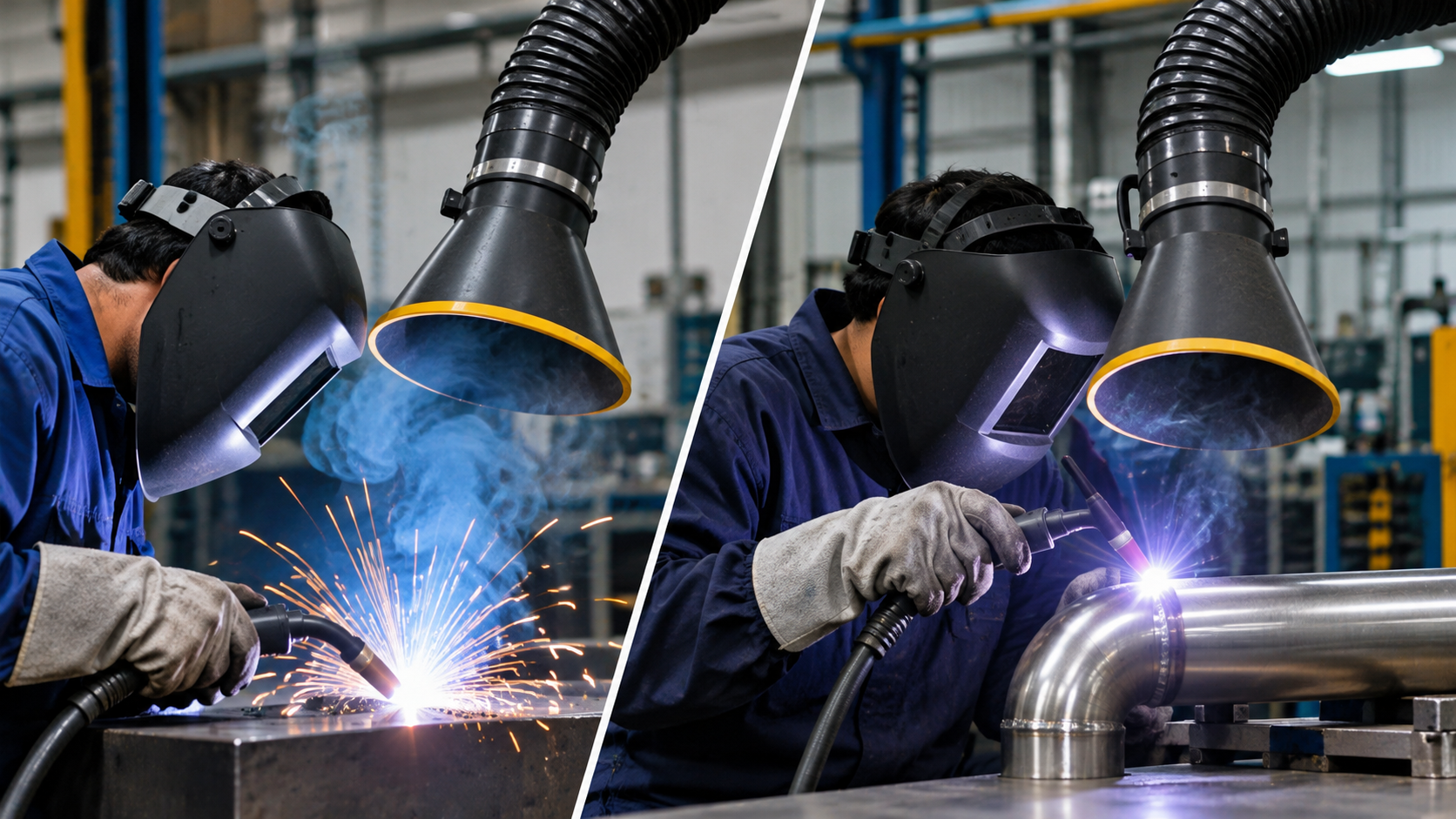
MIG and TIG welding are widely used in industrial fabrication, equipment manufacturing, automotive production, and metalworking. Although both processes use an electric arc to join metals, they differ in their operating characteristics, consumables, typical applications, and the way fumes are generated.
These differences matter when selecting a welding fume extractor for a MIG or TIG system in a production facility. The extraction system must account for the actual welding process, the materials being joined, the location of the fume source, and how consistently the fumes can be captured.
MIG welding can generate substantial fume emissions under some operating conditions, making extraction close to the welding arc particularly important. TIG welding often produces less visible particulate fumes, but that does not mean it is risk-free. The process can generate gases such as ozone, and emissions vary with the material, current, shielding gas, and surrounding conditions.
For manufacturers using both processes, the objective is not necessarily to install two completely different extraction systems. It is to determine whether the same equipment configuration can meet the requirements of both operations or whether different capture arrangements are needed.
What Is the Difference Between MIG and TIG Welding?
Before comparing extraction systems, it helps to understand the processes themselves.
MIG welding (Metal Inert Gas welding) uses a continuously fed consumable wire electrode. The wire melts to form the weld, while shielding gas protects the molten weld pool. Depending on the wire, base material, transfer mode, current, and operating settings, MIG welding can generate significant quantities of airborne fume and spatter.
TIG welding (Tungsten Inert Gas welding) uses a non-consumable tungsten electrode. Filler material may be added separately when required. TIG is often selected for applications requiring precise control and high-quality welds, including work on stainless steel and aluminium.
The distinction affects extraction planning because the quantity and composition of emissions can differ.
For MIG welding, the consumable wire, welding current, transfer mode, and base material can influence fume generation. For TIG welding, particulate emissions may be lower in many applications, but ozone and other process-related gases may still require consideration.
The appropriate extraction design should therefore be based on the actual welding operation rather than the process name alone.
1. MIG vs TIG Welding Fumes: What Changes?
Fume Generation and Composition
MIG welding can produce airborne particulate matter containing metal oxides and other compounds derived from the base metal, wire electrode, and any surface coatings or contaminants.
Fume generation can vary considerably with welding current, wire composition, transfer mode, shielding gas, and the metal being welded. Higher production intensity can increase the overall quantity of emissions generated across a shift.
TIG welding generally produces less visible particulate fume than many higher-fume welding processes under comparable conditions. However, its emissions are not necessarily harmless. High-temperature arc conditions can generate ozone, particularly when welding materials and operating conditions favour its formation.
Material selection also matters. Stainless steel welding may produce fumes containing chromium and nickel compounds, while other alloys and coated materials introduce different potential contaminants.
The NIOSH guidance on welding fumes and extraction guns explains how welding fumes originate from the base metal, electrode, and flux materials, and why exposure risks depend on the specific substances involved.
For manufacturers, the practical implication is clear: lower visible fume does not automatically mean lower overall exposure risk.
Welding Speed and Production Intensity
MIG welding is frequently used for repetitive production and longer weld runs. Depending on the application, high duty cycles can produce a sustained fume load that must be controlled throughout the working period.
TIG welding is often used for precision work, thinner materials, specialised joints, and applications where weld quality is a priority. However, TIG operations can also run for extended periods, particularly in fabrication and component manufacturing.
When evaluating extraction requirements, consider:
- Welding duration per shift.
- Number of operators working simultaneously.
- Welding current and process settings.
- Length and position of weld runs.
- Material and consumable specifications.
- Whether the process is manual, automated, or robotic.
A TIG station operating continuously on stainless steel may need more careful exposure assessment than an occasional, low-intensity MIG repair task. Process labels alone are insufficient to establish the required extraction capacity.
2. Does MIG Welding Need a Different Fume Extractor from TIG Welding?
Not always. The extraction equipment should be selected according to the emissions, capture requirements, and operating conditions.
A suitable industrial fume extraction system may serve both MIG and TIG operations if it can provide effective capture and appropriate filtration for each application. However, the capture arrangement may need to differ between stations.
For example, MIG welding may benefit from an extraction gun or a movable capture hood positioned close to the arc. TIG welding may require a carefully positioned local exhaust hood, suitable ventilation, or additional controls where gaseous emissions such as ozone are a concern.
The main selection factors are:
- The amount and composition of the emissions.
- The distance between the fume source and capture point.
- The operator’s working position.
- The size and geometry of the workpiece.
- The required airflow and system resistance.
- The filtration and exposure-control requirements.
Powertech’s industrial welding fume extractor applications and selection guide provides a broader framework for assessing welding processes, capture arrangements, airflow, and filtration requirements.
The key is to specify the system around the application instead of assuming that MIG always needs one collector type and TIG another.
3. MIG Fume Extraction: Choosing the Right Capture Method
For MIG welding, effective source capture is particularly important when the operation generates sustained or concentrated fume emissions.
On-torch extraction
An extraction gun draws fumes close to the point of generation. When appropriately designed and used, this arrangement can capture fumes before they disperse widely.
It can be useful for suitable MIG welding applications, especially where operators perform repetitive welding and the extraction equipment can be integrated without compromising welding access or process performance.
However, the gun design must be compatible with the welding process. Extraction flow should not interfere with shielding-gas coverage or weld quality.
Movable extraction arms
A flexible extraction arm allows the operator to position a hood near the welding arc. This is useful for varied workpieces, maintenance welding, and fabrication operations where the source location changes.
Its performance depends heavily on hood positioning. If the hood is too far from the arc or placed outside the fume plume, some emissions may escape into the work area.
Welding booths and enclosures
An extracted welding booth can provide a defined working area and a consistent capture arrangement. It may be appropriate for repeated welding tasks or smaller components.
The design must provide suitable airflow without disturbing the welding process or creating uncomfortable conditions for the operator.
The NIOSH technical example of local exhaust ventilation for welding operations describes portable extraction equipment using flexible arms to capture welding fumes near the source.
4. TIG Fume Extraction: Why Lower Visible Fume Can Be Misleading
TIG welding often produces less visible particulate fume than MIG welding, but visible smoke is not a reliable measure of the overall exposure risk.
The TIG arc can generate ozone, and the emissions depend on the process, material, current, shielding conditions, and the surrounding airflow. TIG welding on stainless steel, for example, requires consideration of both particulate contaminants and potentially relevant gaseous emissions.
Local extraction near the weld
A suitable hood or local extraction arrangement can capture airborne contaminants near the source. Positioning matters because fumes and gases can move away from the arc under the influence of thermal currents and surrounding ventilation.
General ventilation
General ventilation can support workplace air quality by supplying fresh air and controlling the accumulation of contaminants. However, it should not automatically be treated as a replacement for source capture when local extraction is required.
Gas-specific exposure assessment
Particulate filters do not remove every gaseous contaminant. Where ozone or other gases are relevant, the control strategy must account for those contaminants rather than relying solely on a collector’s particulate-filtration specification.
The HSE guidance on protecting workers from welding fumes recommends considering local exhaust ventilation and other appropriate controls, including additional respiratory protection where exposure cannot be adequately controlled.
5. MIG vs TIG Extraction: Key Design Differences
| Design consideration | MIG welding | TIG welding |
|---|---|---|
| Typical particulate fume | Can be substantial depending on settings and materials | Often lower, but varies by application |
| Other contaminants | Depends on base metal, wire, coatings, and process | May include ozone as well as material-related fumes |
| Capture options | Extraction gun, movable hood, booth, or enclosure | Local hood, suitable enclosure, or other process-specific ventilation |
| Production pattern | Often repetitive or high-duty-cycle | Frequently precision-oriented, but may also be continuous |
| Main design priority | Capture the fume plume effectively and maintain performance | Assess both particulate and gaseous contaminants and position capture appropriately |
| Filtration considerations | Suitable particulate filtration and any additional stages required by the application | Filtration and gas-control requirements based on the actual contaminants |
| Verification | Confirm capture performance under production conditions | Confirm control of relevant particulates and gases, not just visible smoke |
These are general tendencies, not universal rules. The actual process, consumables, workpiece, and production conditions determine the extraction requirements.
6. How Much Airflow Is Needed for MIG and TIG Welding?
There is no single airflow figure that applies to every MIG or TIG welding station.
Required airflow depends on the extraction method, hood geometry, capture distance, ductwork, fan performance, and the operating conditions of the system.
An extraction gun, a movable hood, and a welding booth may require different airflow arrangements even when used for the same welding process.
When specifying airflow, evaluate:
Capture requirements: How close can the extraction point be positioned to the weld, and how effectively can it capture the fume plume?
Ductwork resistance: How much pressure loss occurs through hoses, ducts, bends, filters, and other components?
Simultaneous operation: How many welding stations will operate at the same time?
Filter loading: Can the system maintain the required airflow as filters accumulate particulate matter?
Process compatibility: Will the extraction arrangement interfere with shielding gas, weld quality, or operator movement?
For a multi-station fabrication shop, the combined airflow demand should be calculated from the individual capture-point requirements and the expected simultaneous operating conditions.
The fan must then be selected to deliver the required airflow at the system’s operating static pressure. Maximum advertised CFM alone is not a sufficient basis for selection.
7. Can One Centralized System Serve Both MIG and TIG Stations?
A centralized welding fume extraction system can serve both MIG and TIG stations when it is engineered to accommodate their combined requirements.
This can be practical for facilities that operate several welding processes across a common production area. However, the design should not assume that every station has identical airflow or filtration needs.
A suitable centralized system should consider:
- The number and type of welding stations.
- The required capture method at each station.
- Expected simultaneous usage.
- Branch duct dimensions and pressure losses.
- Airflow balancing and control.
- The contaminants generated by each process.
- Maintenance access and future expansion.
Some facilities may benefit from a combination of centralized extraction and dedicated capture equipment for particular stations.
The choice between portable and centralized welding fume extraction systems depends on the workshop layout, flexibility requirements, number of stations, and the engineering requirements of the installation.
A centralized arrangement is not automatically more effective than individual units. Its performance depends on the design and operation of the complete system.
8. Filtration Requirements for MIG and TIG Welding
Filtration should be selected according to the contaminants captured and the intended operating conditions.
Particulate filtration
Welding fume particulates contain fine particles, so the collector must use suitable filter media and be designed for the expected dust loading and airflow.
The filtration specification should be considered alongside capture effectiveness, filter sealing, operating pressure, and maintenance requirements.
Gaseous contaminants
Some welding processes can produce gases that are not adequately controlled by particulate filters alone. If the assessment identifies gaseous contaminants, the system may need additional controls designed for those substances.
Do not assume that a high particulate-filtration rating proves that a collector controls ozone or every other gas associated with welding.
Filter maintenance
Filter loading can increase pressure drop and reduce airflow if the system is not designed and maintained appropriately. Facilities should establish inspection, cleaning, and replacement procedures in line with the equipment manufacturer’s instructions.
The overall goal is to maintain the intended capture performance over the system’s operating life, not simply to install a collector with a high initial filtration specification.
9. Common Mistakes When Comparing MIG and TIG Fume Extraction
Assuming TIG welding does not need extraction
Lower visible fumes does not prove that the exposure risk is negligible. Evaluate the actual contaminants, welding conditions, and ventilation arrangements.
Selecting equipment by CFM alone
Airflow is important, but the capture hood, source distance, ductwork, filtration, and operating pressure determine how effectively the system works.
Using the same capture arrangement everywhere
A movable hood may suit one station, while another may benefit from on-torch extraction or an enclosure. The design should reflect the workpiece and welding process.
Ignoring shielding-gas effects
Poorly designed extraction near the arc can interfere with shielding-gas coverage and weld quality. Verify compatibility with the welding equipment and operating procedure.
Treating particulate filtration as universal protection
Particulate filters do not necessarily control gaseous contaminants. Select the control method according to the actual emissions.
Assuming centralized extraction automatically solves every problem
A centralized system can underperform if the ductwork is poorly balanced or the fan cannot deliver the required airflow at operating pressure.
10. Practical Selection Checklist for MIG and TIG Welding
Before selecting an extraction system, document:
- Welding process: MIG, TIG, or both.
- Base metals, coatings, filler materials, and consumables.
- Welding current, duty cycle, and production volume.
- Number of operators and simultaneous welding stations.
- Workpiece dimensions and welding positions.
- Appropriate capture method for each station.
- Airflow and static pressure requirements.
- Filtration requirements based on the identified contaminants.
- Compatibility with shielding gas and welding quality.
- Maintenance access and replacement-filter availability.
- Performance verification and any required exposure assessment.
These details help suppliers recommend a system based on actual conditions rather than making assumptions from the MIG or TIG label alone.
Conclusion
MIG and TIG welding differ in their typical fume-generation patterns, operating characteristics, and potential contaminant profiles. These differences influence the capture method, airflow requirements, filtration strategy, and verification process.
MIG welding may require robust source capture where fume generation is sustained or substantial. TIG welding often produces less visible particulate fume, but ozone and other process-related contaminants still need to be considered where relevant.
The right industrial welding fume extraction system is the one designed for the actual process, materials, workstation layout, and exposure-control requirements. A single system may serve both MIG and TIG stations, provided it can deliver suitable capture and control for every connected operation.
Powertech Pollution Controls provides industrial fume extraction solutions for manufacturing applications. Before selecting equipment, assess the welding processes, number of stations, workpiece layout, and filtration requirements to determine a suitable configuration.
Effective extraction starts with understanding what each welding operation produces and how those emissions can be captured reliably at the source.