
Selecting the right industrial dust collector is not simply a matter of choosing a machine with the highest airflow or largest motor. An effective dust collection system has to match the dust being generated, the manufacturing process, the number of extraction points, the required airflow, the ductwork, filtration requirements, and the way the facility operates.
A grinding machine, powder-handling line, polishing station, CNC machine, and material-transfer point can all generate dust, but the characteristics of that dust and the way it enters the air stream can be very different.
The right selection process therefore starts with the application, not the collector.
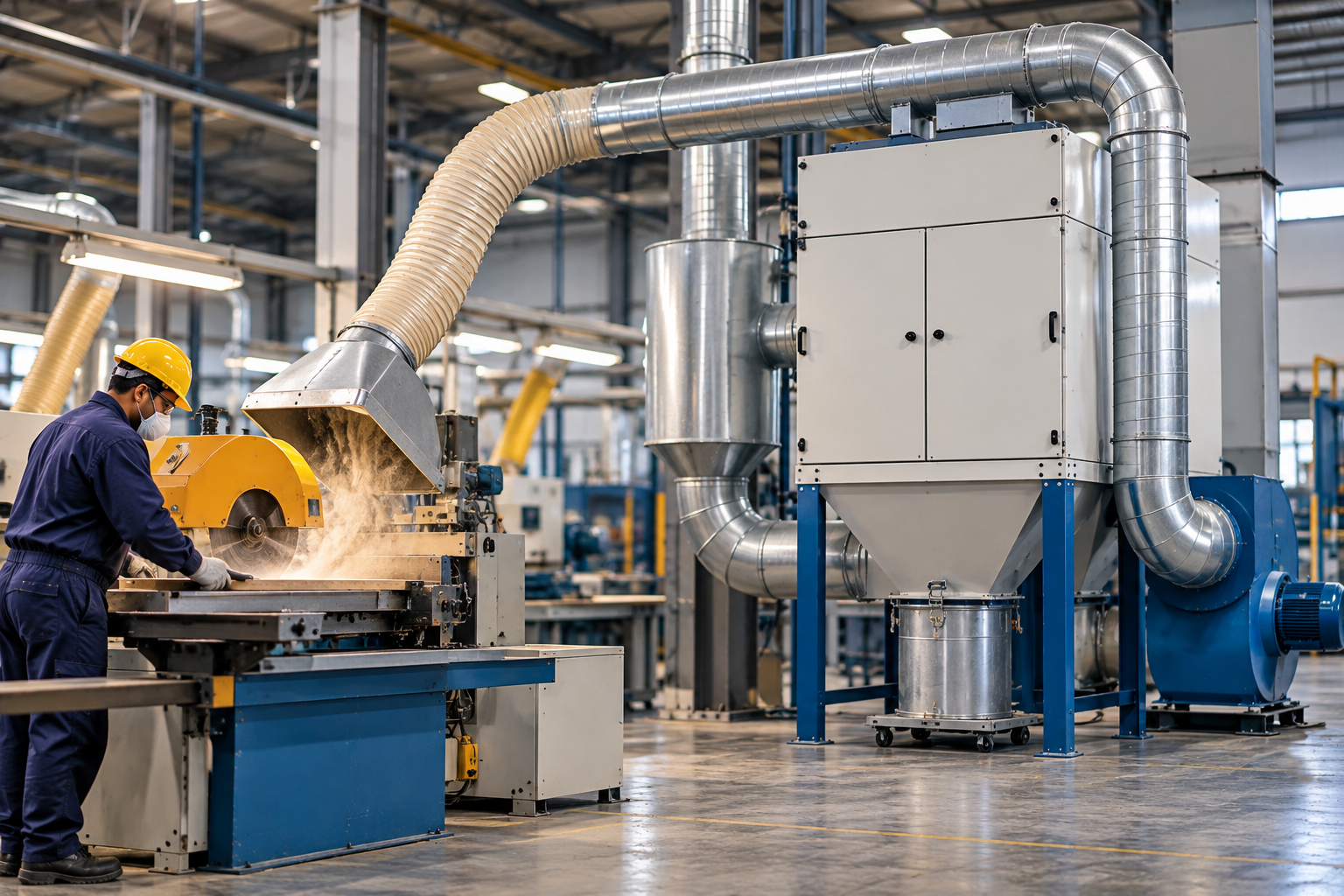
A properly designed dust collection system captures dust as close to its source as practical, transports it through appropriately designed ductwork, separates it using suitable filtration, and provides a reliable method of collecting and discharging the captured material. Powertech’s own dust collection system guidance similarly treats the collector, hoods, ductwork, airflow, static pressure, filtration, and dust discharge as parts of one integrated system.
This guide explains the key factors manufacturers should consider when choosing an industrial dust collector.
What Is an Industrial Dust Collector?
An industrial dust collector is a filtration system designed to remove airborne particulate generated by manufacturing and processing operations.
A typical system can include:
- Source-capture hood or enclosure
- Extraction ductwork
- Dust collector
- Filter media
- Exhaust blower
- Dust collection or discharge arrangement
- Electrical and control components
The contaminated air is drawn from the dust-generating process, transported through the extraction system, and passed through filtration media that separates the particulate from the air.
However, the dust collector is only one component of the overall system.
A high-capacity collector cannot compensate for an incorrectly positioned hood, inadequate airflow, poorly designed ductwork, excessive static pressure, or filtration media that is unsuitable for the application.
That is why industrial dust extraction should be designed as a complete system rather than as an isolated piece of equipment.
1. Start With the Dust-Generating Process
The first question should be:
Where is the dust being generated, and how is it entering the air?
Common industrial dust-generating processes include:
- Grinding
- Cutting
- Sanding
- Polishing
- Buffing
- Deburring
- Drilling
- Milling
- Mixing
- Powder handling
- Material transfer
- Machining
- Crushing
- Screening
The process determines how the dust behaves and how it should be captured.
For example, dust generated directly at a grinding wheel may require a different hood arrangement from dust released during powder transfer.
Similarly, a process that generates dust intermittently may have different airflow requirements from a continuous production operation.
Before selecting a collector, document:
- The process generating the dust
- The location of each dust source
- How frequently the process operates
- Production volume
- Operating hours
- Whether multiple machines operate simultaneously
This information forms the foundation of the equipment selection process.
2. Understand the Characteristics of the Dust
Not all industrial dust behaves in the same way.
Important characteristics include:
Particle Size
Dust may range from relatively coarse particles to very fine particulate matter.
Particle size influences filtration requirements and how easily the material remains suspended in the air.
Particle Density
A dense metal particle behaves differently from a lightweight powder.
Density can influence how material is transported through the extraction system and how it is collected.
Moisture Content
Moisture can affect filter performance and may create problems with certain dry filtration systems.
Abrasiveness
Abrasive dust can cause wear to ductwork, fans, and other components.
Temperature
Hot process air may require filtration equipment and materials suitable for elevated temperatures.
Chemical Properties
Some dust may be chemically reactive or corrosive and therefore require compatible materials and filtration components.
Combustibility
Certain combustible dusts require additional engineering and safety considerations. The dust characteristics should be assessed before selecting equipment rather than assuming that a standard collector is suitable.
The dust itself is therefore one of the most important inputs when selecting an industrial dust collector.
3. Choose the Right Capture Method
Effective dust control starts at the source.
The objective is to capture the dust before it disperses throughout the production area.
Depending on the process, source capture may involve:
- Enclosures
- Extraction hoods
- Machine-integrated extraction
- Downdraft tables
- Side-draft hoods
- Capture booths
- Extraction arms
Where practical, enclosing the process can make contaminant capture easier because the extraction system is controlling the air within a defined area.
For open processes, the extraction hood needs to be positioned appropriately relative to the dust source.
The greater the distance between the source and capture point, the more difficult it generally becomes to control the contaminant effectively.
Powertech’s published dust-collection guidance emphasizes source capture and identifies hood design and capture distance as important elements of system performance.
4. Calculate the Required Airflow
Airflow is one of the most important specifications when selecting an industrial dust collector.
It is commonly expressed in:
- CFM — cubic feet per minute
- m³/hr — cubic metres per hour
However, simply choosing the collector with the highest CFM rating is not the correct approach.
The required airflow depends on factors such as:
- Hood design
- Hood opening
- Capture distance
- Dust-generating process
- Number of extraction points
- Simultaneous operation
- Ductwork
- System configuration
For a centralized system, the airflow requirement must also account for how many extraction points are expected to operate at the same time.
For example, a system serving ten machines does not necessarily need to operate all ten extraction points at maximum airflow simultaneously. The actual operating pattern and system design need to be evaluated.
Powertech’s existing airflow guidance also distinguishes between airflow capacity and the airflow actually available once system resistance is taken into account.
5. Don’t Ignore Static Pressure
Airflow and static pressure need to be considered together.
The blower has to overcome the resistance created by the complete extraction system.
Pressure losses can occur through:
- Extraction hoods
- Ductwork
- Elbows
- Branches
- Dampers
- Filters
- Pre-separators
- Exhaust arrangements
A blower may have a high maximum airflow rating but fail to deliver the required airflow once connected to a restrictive duct network.
This is why an industrial dust extraction system should be designed around:
Required airflow + required operating static pressure
rather than airflow alone.
For a centralized installation, calculating the pressure losses throughout the duct network is particularly important.
6. Consider the Number of Extraction Points
A single-machine dust collection application is relatively different from a centralized system serving multiple machines.
Before choosing the collector, determine:
- Number of machines
- Number of extraction points
- Required airflow at each point
- Which points operate simultaneously
- Whether some machines operate intermittently
- Whether additional machines will be added later
A centralized dust collection system can be appropriate for manufacturing facilities with multiple dust-generating machines, provided that the collector, blower, ductwork, and controls are properly engineered.
The system may also require balancing so that individual extraction points receive the required airflow.
Simply connecting multiple machines to a collector without considering the complete duct network can lead to uneven extraction.
7. Select the Appropriate Filtration Technology
The filtration system needs to match the dust characteristics and operating conditions.
Different industrial dust filtration technologies are used for different applications.
Fabric or Bag Filtration
Fabric filters can be used for a wide range of industrial dust applications and can be suitable where dust loading and continuous operation require substantial filtration capacity.
Cartridge Filtration
Cartridge filters use pleated filter elements that provide a large filtration surface within a relatively compact housing.
They can be considered for many fine, dry dust applications where space and filtration-area requirements are important.
Multi-Stage Filtration
Some applications may benefit from pre-separation before the air reaches the primary filter.
For example, larger or heavier particles may be separated before fine filtration.
The correct configuration depends on the dust, process, airflow, loading, and required performance.
There is therefore no single filtration technology that should be treated as the universal solution for every industrial dust application.
8. Match the Dust Collector to the Dust Loading
Dust loading is another important selection factor.
Two processes may require similar airflow but generate very different quantities of particulate.
A process that produces a large amount of dust continuously may place substantially greater demands on the filtration system than an intermittent operation.
Consider:
- Dust generation rate
- Operating hours
- Production volume
- Filter loading
- Dust discharge frequency
- Cleaning requirements
The collector should be capable of handling the expected dust load without excessive filter loading or frequent interruptions.
This is particularly important in high-production manufacturing environments where the extraction system may operate for long periods each day.
9. Consider the Dust Discharge Arrangement
Collecting the dust is only part of the process.
The system also needs an appropriate method for removing the collected material.
Depending on the collector and application, this may involve:
- Collection bins
- Hoppers
- Rotary airlocks
- Valves
- Screw conveyors
- Continuous discharge systems
The appropriate arrangement depends on the quantity and characteristics of the collected dust.
For smaller applications, a collection bin may be practical.
For higher-volume continuous operations, a more automated discharge arrangement may be appropriate.
The disposal or recovery method should be considered during the initial design rather than treated as an afterthought.
10. Consider the Available Space
The physical layout of the facility can influence collector selection.
Consider:
- Available floor space
- Ceiling height
- Distance from dust-generating machines
- Duct routing
- Access for maintenance
- Electrical requirements
- Dust discharge access
- Noise considerations
- Future expansion
A compact collector may be preferable where installation space is restricted.
In larger facilities, the collector may be positioned separately from the production area with ductwork connecting multiple extraction points.
The equipment should fit into the plant layout without creating unnecessary duct runs or difficult maintenance access.
11. Think About Maintenance Before Buying
An industrial dust collector is a long-term operating asset, so maintenance requirements should be considered alongside the initial purchase price.
Ask:
- How are the filters cleaned?
- How often do filters typically require inspection?
- How is pressure drop monitored?
- How is collected dust removed?
- Can filters be accessed safely?
- How easily can components be replaced?
- How is blower performance monitored?
- What maintenance is required for the ductwork?
Filter condition is particularly important because loading can increase resistance and affect airflow.
A comprehensive maintenance program should also cover the blower, ductwork, extraction hoods, dust discharge system, controls, seals, and other components rather than focusing only on filter replacement.
12. Consider Future Expansion
A dust collection system should ideally be considered alongside the facility’s future production plans.
Ask:
- Will additional machines be installed?
- Will production volume increase?
- Will new dust-generating processes be introduced?
- Could the layout change?
- Will additional extraction points be required?
If expansion is likely, the initial system design can take future requirements into account.
This does not necessarily mean installing a substantially oversized collector from day one. Instead, the system can be engineered with appropriate provisions for future changes.
This approach can make later expansion more practical without unnecessarily increasing the initial equipment and operating costs.
Industrial Dust Collector vs Complete Dust Collection System
One of the most important distinctions for manufacturers is the difference between purchasing a dust collector and designing a complete dust collection system.
A collector is the filtration unit.
A complete system can include:
Dust source → capture hood → ductwork → dust collector → blower → dust discharge
Every component affects overall performance.
For example, a high-capacity collector connected to poorly designed ductwork may not provide effective extraction at the machine.
Similarly, an appropriately sized collector may perform poorly if the hood is positioned too far from the dust source.
For this reason, manufacturers should evaluate the complete extraction system rather than comparing dust collectors based solely on motor size or airflow.
Common Mistakes When Choosing an Industrial Dust Collector
Choosing the Largest Available Collector
Bigger is not automatically better.
Excessive airflow can increase equipment and operating costs without providing a corresponding improvement in capture.
The goal is to provide the required airflow at the required system pressure.
Selecting Based Only on CFM
CFM is important, but it is only one part of the system design.
Static pressure, hood design, ductwork, filtration, and simultaneous operating conditions also matter.
Ignoring Dust Characteristics
A collector designed for one type of dust may not be appropriate for another.
Particle size, moisture, temperature, abrasiveness, chemical characteristics, and dust loading should all be considered.
Treating the Collector as a Standalone Machine
The dust collector cannot compensate for poor source capture or badly designed ductwork.
The complete system needs to work together.
Forgetting Maintenance Access
Filters and other components will eventually require inspection or servicing.
If maintenance access is difficult, routine servicing can become unnecessarily complicated.
Ignoring Future Expansion
If the manufacturing facility is expected to expand, the extraction design should account for that possibility.
A Practical Industrial Dust Collector Selection Checklist
Before approaching a dust collection equipment supplier, prepare the following information.
Process
- What process generates the dust?
- Is the process continuous or intermittent?
- What is the production volume?
Dust
- What material generates the dust?
- What is the approximate particle size?
- Is the dust abrasive?
- Is it dry or moist?
- Is it hot?
- Is it combustible or chemically reactive?
Extraction
- Where are the dust sources?
- Can the process be enclosed?
- What type of hood or capture arrangement is required?
- How far is the capture point from the source?
Airflow
- How much airflow is required at each extraction point?
- How many points operate simultaneously?
- What is the required total airflow?
System Resistance
- What is the duct length?
- How many bends and branches are present?
- What filter resistance should be considered?
- What static pressure must the blower overcome?
Collector
- Which filtration technology is appropriate?
- What filter area is required?
- How will filters be cleaned?
- How will collected dust be discharged?
Installation
- Where will the collector be installed?
- How much space is available?
- How will ductwork be routed?
- How will maintenance access be provided?
Future Requirements
- Will additional machines be added?
- Will production increase?
- Is the system likely to expand?
This information gives an equipment supplier a much clearer basis for recommending an appropriate industrial dust collector.
Powertech Industrial Dust Collection Solutions
Powertech Pollution Controls develops dust collection solutions for manufacturing and industrial applications.
Our DustBag® range is designed for applications including grinding, cutting, sanding, polishing, deburring, machining, and other dust-generating processes. The published DustBag specifications include models with airflow capacities ranging from approximately 425 to 4,500 m³/hr, with polyester non-woven filtration and applications covering processes such as tool and cutter grinding, surface grinding, drilling, milling, deburring, and polishing.
For applications requiring reverse-pulse filter cleaning, Powertech also offers the DustBag RPJ configuration.
The appropriate model and system configuration depend on the process, dust characteristics, required airflow, number of extraction points, duct arrangement, and operating conditions.
Rather than selecting equipment based on a single specification, these factors should be evaluated together when designing the extraction system.
Final Thoughts
Choosing the right industrial dust collector starts with understanding the application.
The dust characteristics, generation process, capture method, airflow, static pressure, number of extraction points, filtration technology, dust discharge arrangement, maintenance requirements, and future production plans all influence the final selection.
The most important principle is to think beyond the collector itself.
An effective dust collection system combines source capture, appropriately designed ductwork, the correct filtration technology, a properly selected blower, and reliable dust discharge.
For manufacturers evaluating an industrial dust extraction solution, an application-specific assessment is therefore more useful than simply comparing machines by CFM, motor power, or physical size.
The objective should be a system that captures dust effectively at its source, maintains the required airflow under operating conditions, provides appropriate dust filtration, and can be maintained reliably over its service life.
Planning a new industrial dust collection system or upgrading an existing one? Contact Powertech Pollution Controls to discuss your process, dust characteristics, airflow requirements, and plant layout.