
Introduction
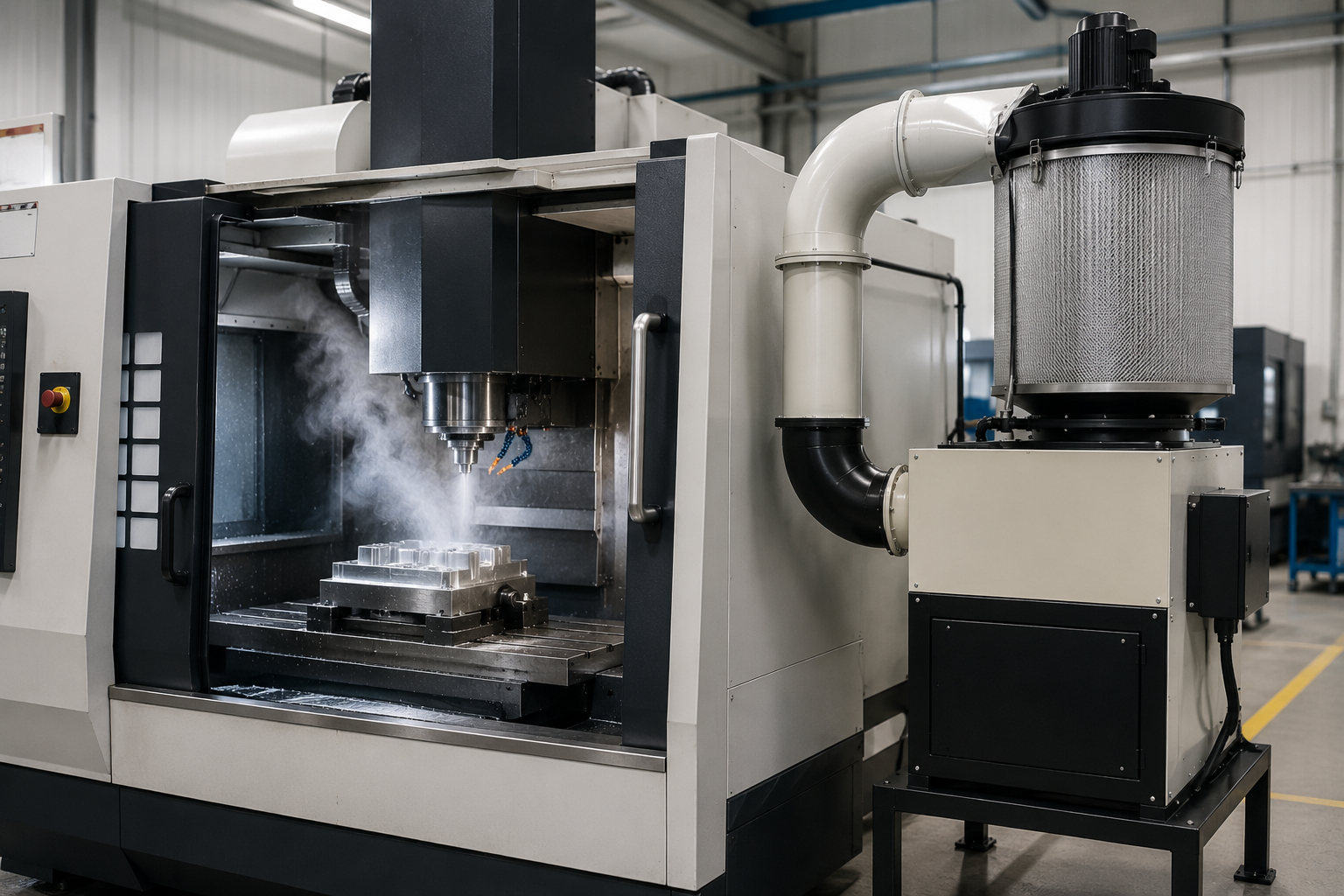
Modern CNC machining centers operate at high spindle speeds and use high-pressure coolant systems to achieve exceptional machining accuracy and productivity. While these processes improve manufacturing efficiency, they also generate airborne oil mist, coolant mist, fine metal particles, and other contaminants that can accumulate throughout the machine and surrounding workspace. Without an effective mist collector, these contaminants can reduce equipment reliability, increase maintenance costs, and negatively impact product quality.
A properly engineered mist collection system captures airborne contaminants before they spread throughout the machining center, helping manufacturers maintain cleaner equipment, improve air quality, and extend machine life.
Key Takeaways
- CNC machining centers generate oil mist, coolant mist, and fine metal particles.
- Airborne contaminants can damage machine components and electrical systems.
- A mist collector captures contaminants directly at the source.
- Proper mist extraction reduces maintenance and improves machine reliability.
- Preventive contamination control increases productivity and equipment lifespan.
Common Contamination Risks in CNC Machining Centers
1. Oil Mist Accumulation
During machining, rotating tools and high-pressure coolant atomize lubricants into microscopic airborne droplets.
Oil mist can settle on:
- Machine enclosures
- CNC controls
- Windows
- Workholding fixtures
- Tool magazines
Over time, this creates oily residue that attracts additional contaminants.
2. Coolant Mist
High-pressure coolant systems generate fine aerosol droplets that remain suspended inside the machining enclosure.
Without a mist collector, coolant mist can:
- Escape when machine doors open
- Reduce operator visibility
- Increase machine cleaning requirements
- Spread throughout the workshop
3. Fine Metal Particles
Grinding, milling, drilling, and turning produce microscopic metallic particles.
These particles may contaminate:
- Bearings
- Ball screws
- Guideways
- Linear rails
- Tool changers
Accumulation increases mechanical wear over time.
4. Electrical Component Contamination
Airborne oil and coolant mist can enter:
- CNC control cabinets
- Servo drives
- Electrical panels
- Sensors
- Connectors
Contamination increases the risk of overheating and electrical failures.
5. Filter Blockage
Without effective extraction, contaminants accumulate inside:
- Machine ventilation filters
- Cooling fans
- Heat exchangers
Restricted airflow reduces cooling efficiency and increases maintenance frequency.
6. Workpiece Contamination
Airborne mist settling on machined parts can:
- Affect dimensional inspection
- Require additional cleaning
- Delay downstream assembly
- Reduce finishing quality
7. Tool Contamination
Oil residue and fine particles accumulate on:
- Tool holders
- Automatic tool changers
- Cutting tools
This can affect machining accuracy and tool life.
How a Mist Collector Reduces Contamination
A properly designed mist collector captures contaminants directly from the CNC enclosure before they spread into the workplace.
The process typically includes:
- Extraction of contaminated air from the machine enclosure
- Separation of oil and coolant droplets
- Collection of recovered fluids
- Discharge of cleaned air
Powertech’s MistKiller centrifugal mist collectors perform this process continuously while requiring minimal maintenance.
Benefits of Effective Mist Collection
Installing a properly sized mist collector provides several advantages:
- Cleaner CNC machines
- Reduced oil residue
- Improved operator visibility
- Lower maintenance costs
- Longer equipment life
- Cleaner electrical components
- Better indoor air quality
- Reduced housekeeping
- Improved production efficiency
Industries Most Affected by CNC Contamination
Mist collection is particularly important in:
- Automotive manufacturing
- Aerospace machining
- Precision engineering
- Medical device manufacturing
- Tool and die shops
- General metal fabrication
- High-speed machining facilities
Best Practices for Contamination Control
To minimize contamination risks:
- Install a source-capture mist collector on every enclosed CNC machine.
- Perform regular mist collector maintenance.
- Keep machine doors closed during machining.
- Inspect coolant systems regularly.
- Clean machine enclosures and tool changers periodically.
- Monitor airflow to ensure consistent extraction performance.
Expert Insight
From Powertech’s experience, contamination inside CNC machining centers often develops gradually and goes unnoticed until maintenance issues begin to appear. Facilities that install properly engineered source-capture mist collectors experience cleaner machines, fewer electrical failures, lower maintenance costs, and significantly improved equipment reliability. Preventing contaminants from circulating is far more effective than cleaning them after they have settled.
Oil mist and coolant mist are the most common contaminants because they remain airborne and spread throughout the machine and workshop.
A mist collector removes airborne oil and coolant mist before contaminants settle on machine components, electrical systems, and finished parts.
Yes. Over time, coolant and oil mist can contaminate electrical cabinets, sensors, cooling fans, and control systems, increasing maintenance requirements.
Yes. By reducing airborne contamination, mist collectors help keep machined parts cleaner and minimize contamination during inspection and assembly.
High-speed milling, CNC turning, grinding, drilling, tapping, and machining with high-pressure coolant systems generate the greatest amount of airborne mist.
Powertech’s MistKiller centrifugal mist collectors provide efficient source-capture extraction, low-maintenance operation, coolant recovery capability, and reliable performance for demanding CNC machining applications.
Contamination from oil mist, coolant mist, and fine metal particles can significantly affect the performance and reliability of CNC machining centers. Installing a properly engineered mist collector is one of the most effective ways to control airborne contaminants, protect valuable equipment, reduce maintenance, and maintain cleaner production environments. With Powertech’s MistKiller centrifugal mist collectors, manufacturers can improve air quality, extend machine life, and achieve more efficient, reliable machining operations.