
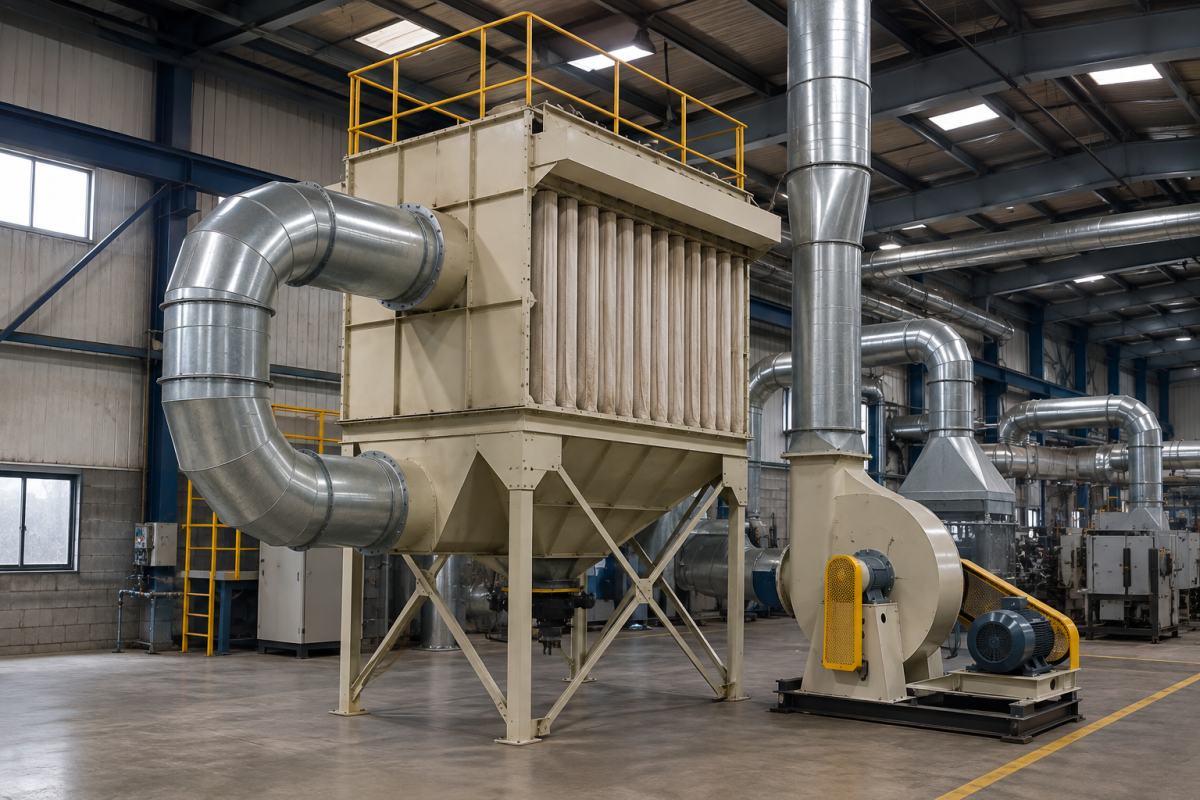
Introduction
Selecting the correct airflow capacity is one of the most important steps when designing an industrial dust collection system. An undersized system may fail to capture dust effectively, while an oversized system can increase energy consumption, equipment costs, and operating expenses.
Understanding dust collector airflow calculation helps manufacturers determine how much air a dust collection system needs to move to effectively capture and transport airborne contaminants. The required airflow is commonly expressed in CFM (cubic feet per minute) and depends on factors such as the dust-generating process, hood design, capture velocity, ductwork, number of extraction points, and system configuration.
For manufacturers planning a new installation or upgrading an existing system, understanding dust collection CFM, industrial ventilation airflow, and dust collector sizing provides a useful starting point for system design.
Powertech Pollution Controls engineers dust collection systems based on the characteristics of the application rather than simply selecting a collector based on machine size or motor capacity.
Key Takeaways
- CFM represents the volume of air moved by a dust collection system.
- Required airflow depends on the capture point, dust characteristics, hood design, and ductwork.
- Capture velocity is different from duct transport velocity.
- Multiple extraction points require careful airflow and system balancing.
- Correct dust collector sizing improves capture efficiency and reduces unnecessary energy consumption.
- A complete engineering assessment should be performed before selecting the final collector and blower.
What Is Dust Collector CFM?
CFM, or cubic feet per minute, measures the volume of air that a dust collection system moves through its extraction network.
In simple terms:
Higher CFM = greater volume of air moved per minute.
However, higher CFM does not automatically mean better dust collection.
The system must generate sufficient airflow at the point of dust generation and maintain appropriate airflow throughout the ductwork.
This is why dust collector sizing should consider the complete extraction system rather than only the collector’s rated airflow.
The Basic Dust Collector Airflow Calculation
For a simple extraction point, airflow can be estimated using the relationship between capture area and capture velocity:
CFM = Capture Area × Capture Velocity × 60
Where:
- CFM = airflow requirement in cubic feet per minute
- Capture Area = effective capture area in square feet
- Capture Velocity = required air velocity in feet per second
- 60 = conversion from seconds to minutes
Example
Suppose an extraction hood has an effective capture area of 1 square foot and the process requires a capture velocity of 100 feet per minute.
The approximate airflow requirement would be:
CFM = 1 × 100 = 100 CFM
In real industrial systems, however, the calculation must account for hood geometry, distance from the contaminant source, duct losses, fittings, filters, and other system resistance.
Capture Velocity vs Duct Velocity
These two terms are often confused during dust collection system design.
Capture Velocity
Capture velocity is the air velocity required at the source to pull airborne dust into the extraction hood.
The required value depends heavily on the process.
A relatively calm dust-generating operation may require less capture velocity than a high-energy grinding, cutting, or material-transfer process.
Duct Transport Velocity
Duct velocity refers to the velocity required to transport captured dust through the ductwork without allowing particles to settle.
The required transport velocity depends on:
- Dust particle size
- Dust density
- Moisture
- Material characteristics
- Duct orientation
- Process conditions
Therefore, airflow should never be selected solely from the capture hood requirement.
Factors That Affect Dust Collection CFM
1. Type of Dust
Different materials behave differently in an extraction system.
Examples include:
- Fine metal dust
- Wood dust
- Plastic particles
- Food powders
- Chemical powders
- Mineral dust
- Grinding dust
Particle size, density, moisture, and abrasiveness all influence system design.
2. Dust-Generating Process
The energy of the process affects how aggressively contaminants are released.
Processes such as:
- Grinding
- Cutting
- Sanding
- Polishing
- Mixing
- Crushing
- Material transfer
may require substantially different extraction approaches.
3. Hood Design
The hood is one of the most important components of the system.
A poorly designed or incorrectly positioned hood can require substantially more airflow to achieve effective capture.
Source capture generally provides better efficiency than attempting to remove dust after it has dispersed throughout the facility.
4. Distance From the Dust Source
As the distance between the extraction point and dust source increases, the airflow requirement generally increases.
This is why extraction hoods should be positioned as close to the emission point as practical.
5. Number of Extraction Points
A system serving one machine will have very different airflow requirements from a centralized system serving ten or twenty machines.
The design must determine:
- Which points operate simultaneously
- Required airflow at each point
- Diversity of operation
- Branch duct dimensions
- Main duct capacity
Calculating Airflow for Multiple Machines
Suppose a manufacturing facility has four extraction points:
| Extraction Point | Required Airflow |
|---|---|
| Grinding machine | 1,500 CFM |
| Cutting machine | 1,200 CFM |
| Sanding station | 900 CFM |
| Material transfer point | 700 CFM |
If all four operate simultaneously:
Total airflow = 1,500 + 1,200 + 900 + 700
Total = 4,300 CFM
However, the final dust collector and blower should not automatically be selected at exactly 4,300 CFM.
The system designer must also evaluate duct losses, filter resistance, fittings, hood performance, operating conditions, and the possibility that not all extraction points operate simultaneously.
Understanding Static Pressure
CFM tells you how much air the system moves.
Static pressure tells you how much resistance the blower must overcome to move that air.
A dust collector therefore needs both:
- Adequate airflow
- Adequate pressure capability
Resistance can come from:
- Extraction hoods
- Ductwork
- Elbows
- Branches
- Dampers
- Filters
- Cyclones or pre-separators
- Exhaust arrangements
A blower capable of delivering a high CFM at low resistance may not deliver the required airflow once connected to a long, complex duct network.
Dust Collector Sizing: What Should Be Considered?
Correct dust collector sizing requires more than selecting a filter based on airflow.
Engineers should evaluate:
Dust Characteristics
- Particle size
- Density
- Moisture
- Temperature
- Abrasiveness
- Combustibility
Process Conditions
- Production rate
- Operating hours
- Dust generation rate
- Number of machines
- Simultaneous operation
System Requirements
- Required CFM
- Static pressure
- Duct length
- Number of bends
- Filter type
- Dust discharge arrangement
Why Oversizing a Dust Collector Isn’t Always Better
It may seem logical to select the largest available dust collector, but excessive airflow can create unnecessary costs.
Potential disadvantages include:
- Higher fan power consumption
- Larger ductwork
- Higher initial equipment cost
- Greater filter area requirements
- Increased operating costs
- Excessive airflow at individual machines
The objective should be adequate airflow at the correct pressure, not simply maximum airflow.
Why Undersizing Is a Problem
An undersized dust collection system can result in:
- Poor dust capture
- Dust escaping into the workplace
- Dust settling inside ductwork
- Filter overload
- Increased maintenance
- Reduced equipment life
- Poor workplace air quality
In severe cases, inadequate airflow can cause the entire collection system to perform poorly even when the dust collector itself is functioning correctly.
Industrial Ventilation Airflow vs Dust Extraction
General industrial ventilation airflow and localized dust extraction serve different purposes.
General Ventilation
Moves and replaces air throughout the facility.
Local Dust Extraction
Captures contaminants directly where they are generated.
For manufacturing processes that generate concentrated dust emissions, local exhaust ventilation is generally the more effective approach for contaminant control.
General ventilation can complement source extraction, but it should not automatically be considered a replacement for properly designed dust collection.
How Duct Design Affects CFM
Ductwork has a major influence on dust collection performance.
Poor duct design can create:
- Excessive pressure losses
- Uneven airflow
- Dust accumulation
- Higher fan energy consumption
- Poor capture at remote extraction points
Important design considerations include:
- Duct diameter
- Branch arrangement
- Elbow configuration
- Duct length
- Air velocity
- Balancing dampers
- Transition geometry
A properly engineered duct network ensures that the required airflow reaches each extraction point.
Signs That Your Dust Collector May Be Undersized
Existing systems may show several warning signs:
Visible Dust Escaping
Dust remains airborne even when the extraction system is operating.
Weak Suction
Operators notice inadequate airflow at extraction hoods.
Dust Accumulation in Ducts
Particles settle because transport velocity is insufficient.
Frequent Filter Loading
Filters become clogged faster than expected.
Inconsistent Performance
Some machines extract effectively while others perform poorly.
These symptoms can indicate airflow, static pressure, duct design, filter loading, or system balancing problems.
How Powertech Approaches Dust Collector Sizing
Powertech does not recommend selecting a dust collector based solely on a machine’s dimensions or motor rating.
A properly engineered system considers:
- Dust-generating process
- Dust characteristics
- Number of extraction points
- Required capture conditions
- Airflow requirements
- Duct network
- Static pressure
- Filtration requirements
- Dust discharge requirements
- Future production requirements
This application-specific approach helps ensure that the resulting DustBag system delivers reliable extraction without unnecessarily increasing energy or equipment costs.
Dust collector airflow calculation is the process of determining the amount of air required to capture and transport airborne dust effectively through an extraction system.
For a basic extraction point, airflow can be estimated from the effective capture area and required capture velocity. Complete industrial calculations must also consider hood design, ductwork, filter resistance, static pressure, and process conditions.
CFM means cubic feet per minute and represents the volume of air moved by the dust collection system.
No. The system needs sufficient airflow at the required static pressure. Excessive airflow can increase energy consumption and equipment costs without improving dust capture.
Dust collector sizing requires evaluation of dust characteristics, process conditions, number of extraction points, required airflow, ductwork, static pressure, filtration requirements, and operating conditions.
Yes. A centralized dust collection system can serve multiple machines when the collector, blower, ductwork, and control system are properly engineered for the required operating conditions.
Accurate dust collector airflow calculation is essential for designing an effective industrial dust extraction system. While CFM provides a useful measure of airflow capacity, proper dust collection CFM calculations must be combined with capture velocity, duct transport requirements, static pressure, filtration resistance, and the characteristics of the dust-generating process. Correct dust collector sizing is therefore an engineering exercise rather than simply selecting the largest available unit. By designing the hood, ductwork, blower, filtration system, and dust collector as one integrated system, manufacturers can achieve reliable dust capture, better workplace air quality, and more efficient long-term operation. Powertech’s engineering team can evaluate the specific process, airflow requirements, and plant layout to develop a DustBag industrial dust collection system suited to the application’s actual operating conditions.