
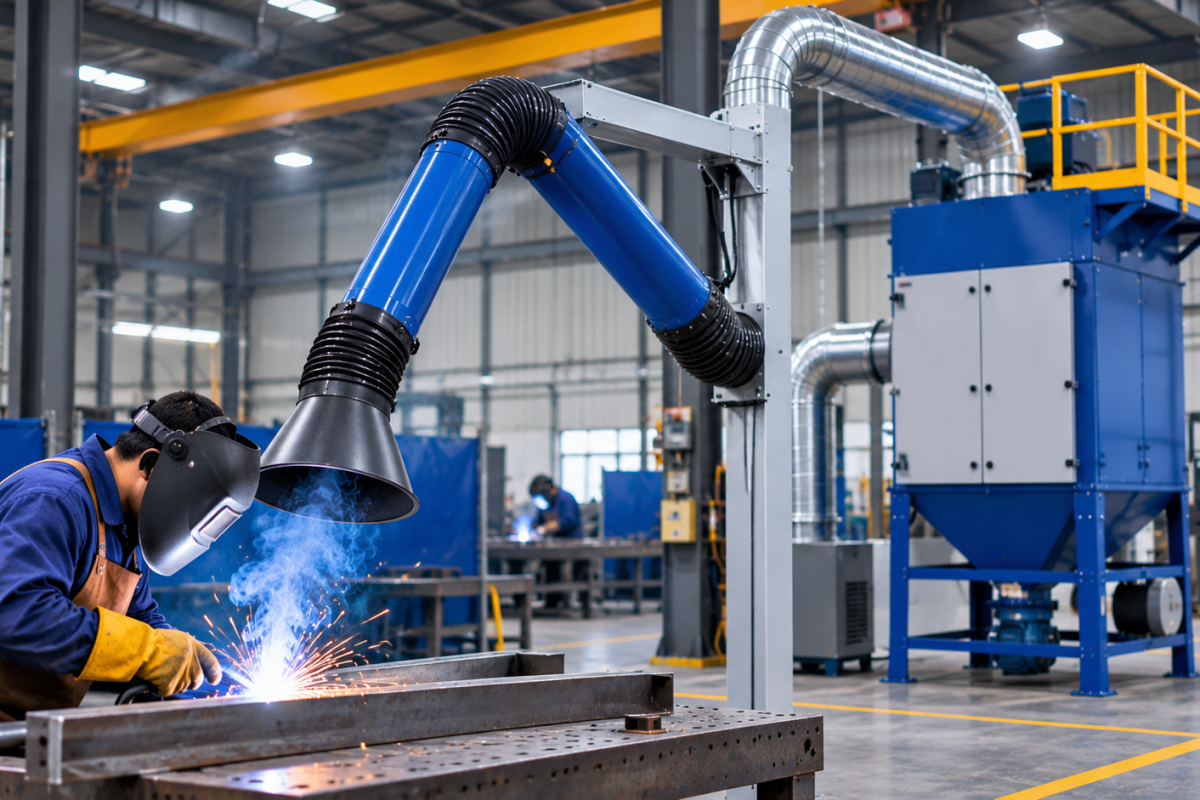
The cost of a welding fume extractor depends on more than the price of the extraction unit itself. The type of welding process, number of workstations, fume generation rate, capture arrangement, filtration requirements and installation complexity all influence the total investment.
A portable welding fume extractor serving a single workstation will have a very different cost structure from a centralized welding fume extraction system designed to serve multiple welding bays across a fabrication facility.
For manufacturers planning to install or upgrade an extraction system, understanding these cost factors is essential. It helps avoid choosing equipment based solely on its purchase price and ensures that the selected system can provide effective fume capture under actual operating conditions.
This guide explains the major factors that determine welding fume extractor cost, how different system configurations affect pricing and what to evaluate when comparing supplier quotations.
1. Type of Welding Fume Extraction System
The extraction system configuration is one of the most important factors influencing overall cost.
Different workshops have different requirements. A small fabrication unit with one or two welding stations may need a portable extraction arrangement, while a large manufacturing plant with several welding bays may benefit from a centralized system.
Portable welding fume extractors
Portable systems are generally designed for individual workstations or applications where welding locations change frequently.
Depending on the configuration, they may include:
- A dedicated extraction unit
- A movable extraction arm or hood
- A filtration arrangement
- A fan and motor assembly
- Filter access for maintenance
Portable systems can be suitable for smaller workshops, maintenance operations and individual welding stations.
Their initial investment may be lower than that of a large centralized installation. However, the number of units required and the need to reposition extraction equipment can affect the overall cost.
Centralized welding fume extraction systems
Centralized systems use a common extraction and filtration arrangement to serve multiple workstations.
They typically involve:
- A central filtration unit
- A network of extraction ducts
- Branch connections to individual welding stations
- Extraction arms, hoods or other capture devices
- A fan selected for the required airflow and system resistance
- Control arrangements for the extraction network
The initial project cost is generally higher because of the additional equipment, ductwork, engineering and installation involved.
However, centralized extraction can be appropriate for facilities with multiple welding stations operating across a defined production area.
Learn more about the types of industrial welding fume extractors and their design, applications and selection before deciding which configuration suits your facility.
2. Number of Welding Stations
The number of welding stations directly affects the size and configuration of the extraction system.
A single workstation may require one extraction arm and a suitably sized filtration unit. A facility with ten or twenty welding stations may need a larger extraction network, multiple collection points and a higher-capacity filtration arrangement.
However, the cost does not always increase in direct proportion to the number of stations.
For example, a centralized system may serve several workstations through a common filtration unit. Its design must account for how many stations are expected to operate simultaneously.
Important considerations include:
- Total number of welding stations
- Number of stations operating at the same time
- Welding duration and production shifts
- Distance between workstations
- Required airflow at each extraction point
- Whether all stations need individual extraction controls
A supplier should establish the expected operating pattern before recommending the system capacity. Sizing a central unit for every workstation operating simultaneously when that is not the actual production scenario can result in unnecessary capital expenditure.
On the other hand, underestimating simultaneous usage can compromise extraction performance.
3. Welding Process and Fume Generation
The welding process influences the amount and characteristics of the fumes generated, which affects the extraction and filtration requirements.
Different welding applications produce different fume loads depending on the process, consumables, base material and operating parameters.
Common applications include:
- MIG/MAG welding
- TIG welding
- Manual metal arc welding
- Flux-cored arc welding
- Stainless steel welding
- Heavy fabrication and structural welding
For example, high-production welding operations may generate substantial quantities of fume over extended periods. Stainless steel welding can also require particular attention to the composition of the generated fume.
The extraction system must be selected according to the actual application rather than relying on a generic equipment specification.
Relevant design factors include:
- Fume generation rate
- Welding current and operating conditions
- Base metal and filler material
- Welding consumables
- Number of active welding processes
- Duration and frequency of welding
These factors influence the required airflow, filter arrangement and overall system capacity.
4. Extraction Arm, Hood and Capture Arrangement
The method used to capture welding fumes is another significant cost consideration.
A filtration unit cannot perform effectively if fumes are not captured close to the welding source. The extraction hood, arm or enclosure must be positioned to intercept the rising fume plume before it spreads into the surrounding workspace.
Flexible extraction arms
Extraction arms are commonly used in fabrication shops where operators need to move the capture point according to the workpiece and welding position.
The cost depends on:
- Arm length and diameter
- Required airflow
- Reach and positioning flexibility
- Hood design
- Mounting arrangement
- Material and construction
Longer arms and specialized mounting arrangements can increase project cost.
Fixed hoods and canopy extraction
Fixed hoods may be considered for applications where welding takes place in a defined position or within a dedicated production area.
Their design must account for the size of the workpiece, the position of the welding operation and the movement of the fume plume.
Enclosed welding areas
For automated welding cells or dedicated welding enclosures, extraction may be integrated into the enclosure design.
The arrangement can require additional ducting, extraction points and coordination with the welding equipment.
The most expensive capture arrangement is not necessarily the most effective. The objective is to achieve reliable source capture without interfering with the welding operation.
5. Filtration Technology and Filter Configuration
The filtration system has a direct influence on the cost of a welding fume extractor.
The appropriate filter arrangement depends on the fume characteristics, expected dust loading, operating hours and required maintenance intervals.
A typical industrial welding fume extraction system may incorporate:
- A pre-separation stage where appropriate
- Primary particulate filtration
- High-efficiency final filtration where specified
- A filter cleaning arrangement
- Dust collection and disposal provisions
The filter media, filtration area, construction quality and cleaning mechanism all influence the equipment cost.
Manual filter cleaning
Some smaller systems use filters that require periodic manual cleaning or replacement.
These arrangements may have a simpler initial configuration, but maintenance frequency and operator involvement should be considered when evaluating their long-term cost.
Automatic filter cleaning
Industrial systems may incorporate automatic cleaning mechanisms, such as pulse-jet cleaning, to remove accumulated dust from filter surfaces.
These systems can be useful in applications with higher dust loading or longer operating hours.
The additional cleaning mechanism, compressed-air requirements and associated controls can increase the initial investment.
However, the selection should be based on the actual application and expected maintenance requirements rather than assuming that automatic cleaning is always necessary.
6. Airflow Capacity and Fan Selection
The required airflow has a major influence on the size and cost of the extraction equipment.
A system serving one welding station will generally have different airflow requirements from a centralized installation serving several workstations.
Airflow selection must consider:
- Number of extraction points
- Required capture airflow at each point
- Simultaneous operation
- Duct diameter and length
- Number of bends and branches
- Pressure losses across filters and ductwork
- Required operating pressure
The fan must be selected to deliver the required airflow against the total system resistance.
Simply selecting a fan with a high airflow rating is not sufficient. A fan may have a high free-air capacity but fail to deliver the required airflow once connected to the actual duct network and filtration equipment.
An incorrectly sized fan can result in inadequate capture, excessive energy consumption or unnecessary capital expenditure.
A properly engineered system balances airflow, static pressure and capture requirements.
7. Ductwork and Installation Complexity
For centralized welding fume extraction systems, ductwork can represent a substantial portion of the total project cost.
The installation cost depends on the layout of the facility and the distance between the welding stations and the filtration unit.
Factors include:
- Total duct length
- Duct diameter and material
- Number of branches and bends
- Overhead or floor-level routing
- Structural supports and mounting arrangements
- Roof or wall penetrations
- Access for inspection and maintenance
- Electrical and compressed-air connections
A straightforward installation with short duct runs may be less expensive than a project involving long duct networks, multiple branches and difficult routing.
Existing buildings may also require additional fabrication or structural work to accommodate the extraction network.
For this reason, equipment-only quotations should not be compared directly with complete installed-system quotations.
8. Operating Hours and Duty Requirements
The expected operating schedule affects the equipment specification and its long-term cost.
A welding fume extractor used intermittently in a maintenance workshop may have different requirements from a system operating across multiple production shifts.
For continuous or high-duty applications, the system should be designed with appropriate consideration for:
- Fan and motor duty
- Filter loading
- Cleaning cycles
- Thermal and operating conditions
- Maintenance access
- Equipment reliability
- Availability of replacement filters
A lower-priced system may not necessarily provide the best value if it is not designed for the required operating conditions.
The objective should be to match the equipment specification to the production environment.
9. Automation and Control Requirements
The level of automation can also influence the welding fume extraction system price.
Basic installations may operate with manual switching, while more advanced systems can incorporate controls that coordinate extraction with production requirements.
Possible features include:
- Individual extraction point controls
- Automatic start and stop
- Fan speed control
- Variable frequency drives
- Differential pressure monitoring
- Filter condition indicators
- Operating status monitoring
- Interlocking with welding equipment, where appropriate
For facilities with multiple welding stations, demand-based operation may help avoid running the entire extraction system at full capacity when only a limited number of stations are active.
However, control strategies must be engineered to maintain the required capture performance at active workstations.
10. Installation, Commissioning and After-Sales Support
The purchase price of the filtration equipment is only one component of the total project investment.
A complete installation may also involve:
- Site inspection and application assessment
- System engineering and layout design
- Equipment transportation
- Ductwork fabrication and installation
- Electrical connections
- Mechanical installation
- Commissioning and airflow checks
- Operator training
- Maintenance documentation
The scope of commissioning is particularly important. A system should be checked under realistic operating conditions to establish whether the extraction points are receiving the intended airflow.
After-sales support also matters. Availability of replacement filters, technical assistance and maintenance services can influence the total cost of ownership.
11. Initial Purchase Price vs Total Cost of Ownership
When evaluating welding fume extractor price, buyers should consider the long-term cost of operating the system rather than focusing exclusively on the initial quotation.
The total cost of ownership includes:
Initial investment
- Filtration equipment
- Extraction arms and hoods
- Fan and motor
- Ductwork
- Electrical and control systems
- Installation and commissioning
Recurring operating costs
- Electricity consumption
- Filter replacement
- Compressed air, where applicable
- Routine maintenance
- Dust disposal
- Repairs and servicing
A system with a lower initial price may have higher operating costs if it requires frequent filter replacement, consumes more power or needs extensive maintenance.
Similarly, a more expensive system may not necessarily be more economical if its additional features are unnecessary for the application.
The correct comparison is between systems designed to deliver equivalent extraction performance under the same operating conditions.
12. How to Compare Welding Fume Extractor Quotations
Before selecting a supplier, ensure that each quotation covers the same technical and commercial requirements.
A useful quotation comparison should include:
- Number of welding stations covered
- Welding processes and materials considered
- Required airflow per extraction point
- Total system airflow
- Fan performance at the specified static pressure
- Filter type and filtration specifications
- Filter cleaning mechanism
- Extraction arm or hood specifications
- Ductwork and installation scope
- Electrical and control requirements
- Commissioning and performance checks
- Warranty and after-sales support
- Replacement filter availability
Pay particular attention to whether the supplier has included the ductwork, installation and commissioning costs.
A quotation covering only the filtration unit may appear considerably cheaper than a complete turnkey system, but the two proposals are not directly comparable.
13. How to Reduce Welding Fume Extraction Costs Without Compromising Performance
There are several ways to control project expenditure while maintaining effective extraction.
Start with an application assessment
Identify the actual welding processes, fume generation points, production schedule and number of simultaneously operating stations before selecting equipment.
This prevents unnecessary oversizing and helps establish the correct system configuration.
Prioritize source capture
Capturing fumes close to the welding point is generally more effective than relying on general ventilation to dilute fumes after they have spread.
Well-positioned extraction arms, hoods and enclosures can improve capture performance and reduce the need for unnecessarily large extraction arrangements.
Evaluate centralized and individual systems
Compare portable or individual extraction units with centralized systems based on the plant layout, number of stations, operating pattern and maintenance requirements.
A centralized system may be suitable for a facility with several fixed welding stations, while individual units may be more practical for operations with changing work locations.
Avoid unnecessary airflow capacity
Oversizing equipment can increase fan power requirements and capital expenditure.
However, reducing airflow below the level required for effective capture can compromise performance. Airflow should be determined through engineering calculations and application assessment.
Consider maintenance from the beginning
Select a filtration arrangement that suits the expected dust loading and operating schedule.
Ensure that filters, dust collection components and service access are considered during the initial design.
14. Choosing the Right Welding Fume Extraction System for Your Facility
The right system depends on the production environment, not simply the available budget.
For example:
- Small fabrication workshops: Portable extraction units or individual extraction arrangements may be appropriate where welding locations change frequently.
- Multiple fixed welding stations: A centralized system may provide a practical way to serve several workstations through a common filtration arrangement.
- Heavy fabrication facilities: Higher fume loads, larger workpieces and longer operating hours may require a more substantial extraction design.
- Automated welding cells: Enclosure-based or integrated extraction may be appropriate depending on cell design and fume generation.
- Stainless steel welding: The filtration and capture design should account for the specific characteristics of the welding fume and materials involved.
Powertech Pollution Controls provides industrial air pollution control solutions for manufacturing environments. Its welding fume extraction solutions can be considered when evaluating extraction requirements for fabrication and welding operations.
A site-specific assessment is the best starting point for determining the appropriate equipment configuration, airflow capacity and installation scope.
The cost varies according to the extraction capacity, number of welding stations, filtration technology, capture arrangement and installation requirements. Portable systems and large centralized installations have substantially different cost structures. A reliable quotation requires an assessment of the actual welding application.
The major cost factors include fan capacity, filter configuration, filtration area, extraction arms, ductwork, automation, installation complexity and operating requirements. The number of workstations and their simultaneous usage also influence system sizing.
A portable system may require a lower initial investment for a single workstation. However, a facility with several welding stations may need multiple portable units. A centralized system can be more suitable in some multi-station facilities, depending on the layout and operating pattern.
Higher-capacity systems generally require larger fans, filtration arrangements and supporting components. However, capacity alone does not determine price. The system configuration, filtration specification, ductwork and controls also contribute to the total investment.
A complete quotation should specify the filtration unit, fan performance, extraction points, arms or hoods, ductwork, electrical and control arrangements, installation, commissioning, warranty and maintenance requirements.
Operating costs can be controlled through appropriate system sizing, effective source capture, suitable filter selection, proper maintenance and efficient fan operation. Demand-based controls may also help reduce energy consumption where the system design supports them.
Start by identifying the welding processes, materials, number of workstations, operating hours, fume generation and plant layout. Then evaluate the required capture arrangement, airflow, filtration technology and installation requirements with an experienced system supplier.
Welding fume extractor cost is determined by the complete extraction requirement, not just the price of the filtration equipment. The number of welding stations, welding process, fume generation, capture arrangement, airflow, filtration technology, ductwork and installation complexity all contribute to the final project investment. For manufacturers, the most effective approach is to define the application requirements first and compare quotations based on equivalent technical specifications. A properly designed welding fume extraction system should provide reliable source capture, suitable filtration and manageable operating costs throughout its service life.