Dust Control in Powder Handling Operations

Introduction

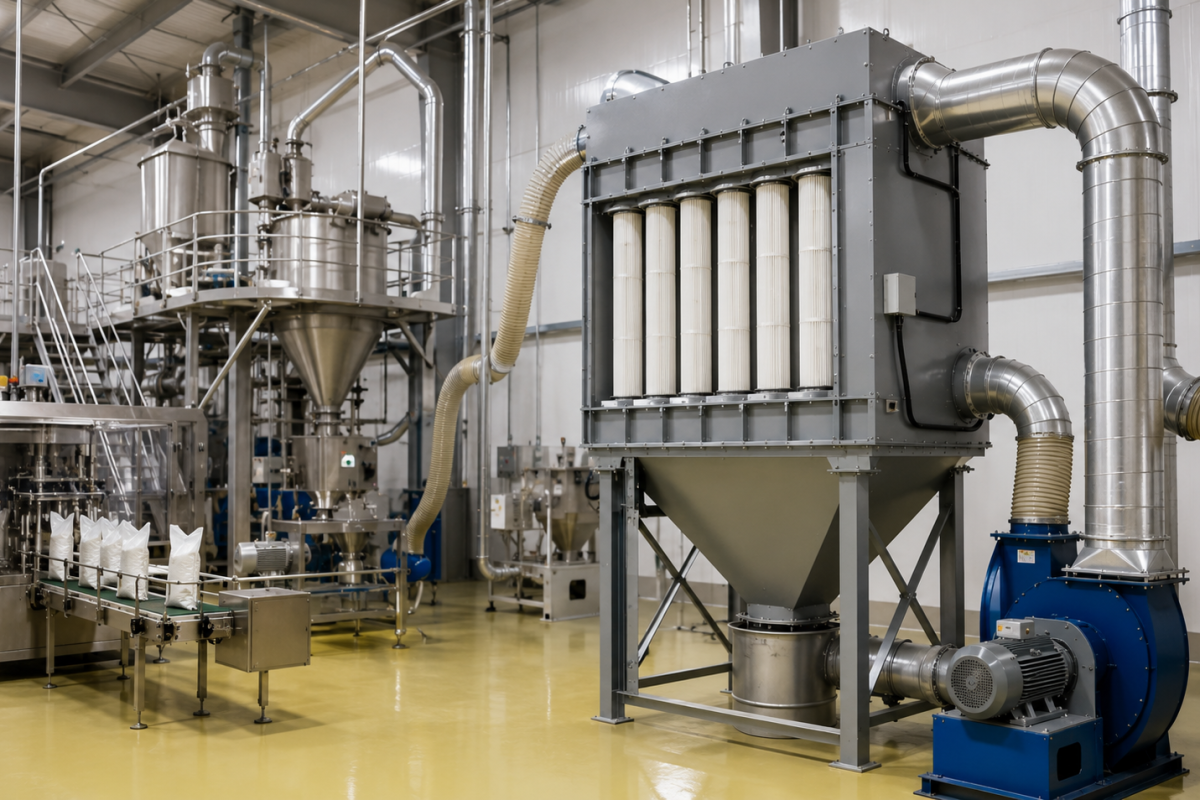
Powder handling is an essential part of many manufacturing processes, including food processing, pharmaceuticals, chemicals, plastics, minerals, and specialty materials. Activities such as conveying, transferring, weighing, mixing, blending, loading, unloading, and packaging can release fine airborne particles into the production environment.

Because many powders are lightweight and easily dispersed, controlling them at the source is critical. A properly selected powder dust collector can capture airborne particles before they spread throughout the facility, helping maintain cleaner production areas, reduce product loss, protect equipment, and improve workplace air quality.

Effective powder handling dust control requires more than installing a filtration unit. The extraction hood, airflow, ductwork, filtration system, and dust discharge arrangement must be designed around the characteristics of the powder and the process generating it.

This article explains the key considerations for effective fine dust extraction and industrial powder ventilation in powder handling operations.

Key Takeaways

  1. Powder handling can generate significant quantities of airborne fine dust.
  2. Source capture is generally more effective than trying to remove dust after it has dispersed.
  3. Powder characteristics must be considered when selecting a dust collector.
  4. Correct airflow and duct design are essential for reliable extraction.
  5. Filtration technology should match the particle size and loading conditions.
  6. Properly designed dust control can reduce housekeeping, product loss, and equipment contamination.

Why Does Powder Handling Generate Dust?

Powders can become airborne whenever material is disturbed or transferred.

Common dust-generating activities include:

  1. Bag unloading
  2. Bulk material transfer
  3. Pneumatic conveying
  4. Weighing and dispensing
  5. Mixing and blending
  6. Milling and grinding
  7. Sieving
  8. Screening
  9. Filling and packaging
  10. Hopper loading
  11. Drum and container filling

Fine particles can remain suspended in the air for extended periods and may travel beyond the immediate process area.

This makes early capture particularly important.

What Is a Powder Dust Collector?

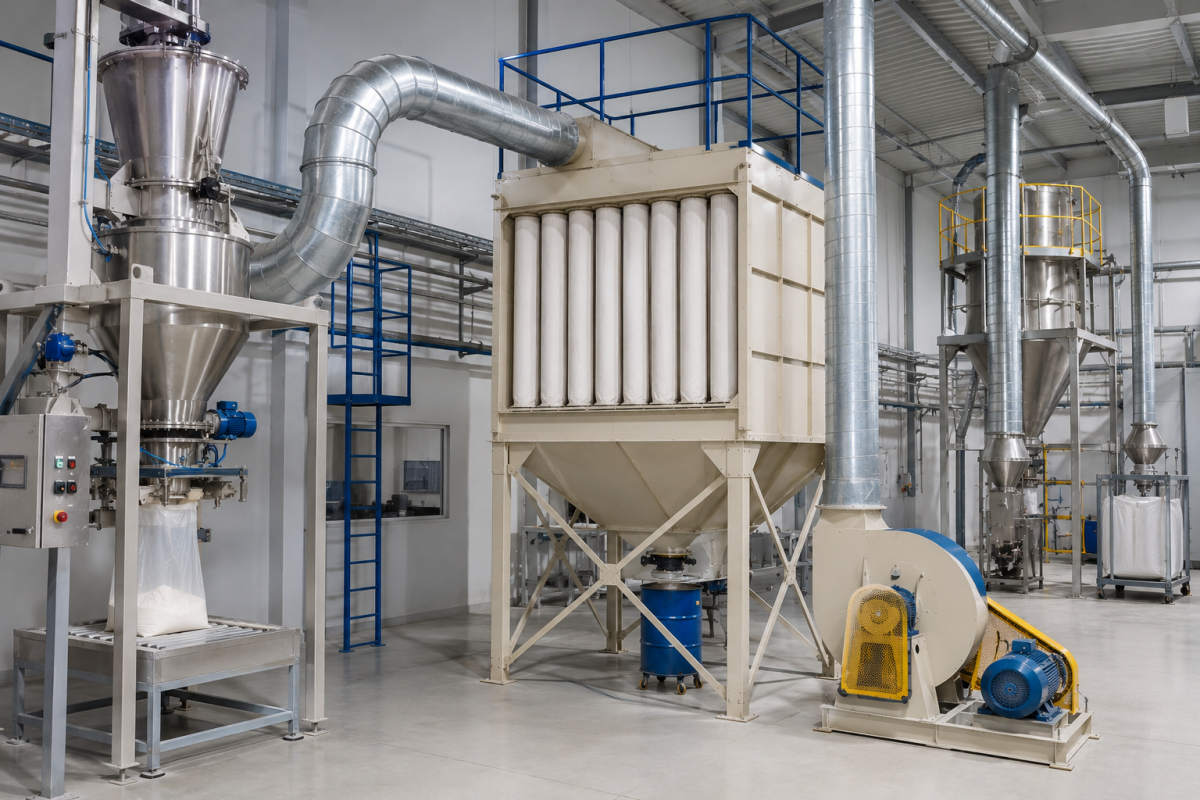
A powder dust collector is an industrial filtration system designed to capture airborne particulate generated during powder processing and handling.

A typical system consists of:

  1. Extraction hood or enclosure
  2. Ductwork
  3. Dust collector
  4. Filter media
  5. Exhaust blower
  6. Dust discharge system
  7. Control system

The extraction system draws contaminated air away from the process, separates the powder from the air using filtration media, and collects the material for appropriate handling.

Why Source Capture Matters

The most effective dust control strategy is generally to capture particles as close as possible to their point of generation.

For example, consider a powder being discharged from a bag into a mixing vessel.

If extraction is installed directly around the charging point, airborne powder can be captured before it spreads into the surrounding workspace.

If extraction is positioned far away, the same dust may already have dispersed throughout the room, requiring substantially more airflow to control it.

Source capture provides several advantages:

  1. Better contaminant control
  2. Lower required room airflow
  3. Reduced dust dispersion
  4. Less equipment contamination
  5. Lower housekeeping requirements
  6. Improved operator working conditions

Common Powder Handling Applications

Bag Dumping

Opening and emptying bags can release a cloud of fine powder.

A properly designed extraction hood or enclosed bag-dump station can capture the dust generated during unloading.

Bulk Bag Unloading

Large bags used for bulk ingredients and raw materials can generate dust during connection, discharge, and bag replacement.

Extraction should be integrated into the unloading station.

Mixing and Blending

Opening mixers or adding dry ingredients can release significant quantities of powder.

Local extraction around charging points can reduce airborne emissions.

Weighing and Dispensing

Small quantities of powders may be weighed or manually transferred at open workstations.

Compact extraction hoods can provide localized fine dust extraction.

Screening and Sieving

Mechanical agitation can release fine particles around screening equipment.

Enclosures combined with extraction can help contain these emissions.

Packaging

Powder can become airborne during filling, bag sealing, container transfer, and product handling.

Extraction at the filling point can help control fugitive emissions.

Powder Handling Dust Control: Key Design Factors

1. Powder Characteristics

The material being handled is one of the most important factors in system design.

Engineers should evaluate:

  1. Particle size
  2. Particle density
  3. Moisture content
  4. Flow characteristics
  5. Abrasiveness
  6. Temperature
  7. Chemical properties
  8. Dust loading
  9. Combustibility

Different powders can require substantially different collection approaches.

2. Required Airflow

The dust collector must provide sufficient airflow to capture the powder at the source.

Required airflow depends on:

  1. Hood design
  2. Opening size
  3. Capture distance
  4. Process energy
  5. Dust characteristics
  6. Number of extraction points

Simply selecting a collector with a high CFM rating does not guarantee effective capture.

The airflow must be appropriate for the complete extraction system.

3. Hood and Enclosure Design

The extraction hood is the first point of control.

Where practical, enclosing the dust-generating process can significantly improve containment.

Examples include:

  1. Enclosed transfer points
  2. Bag-dump stations
  3. Hooded filling machines
  4. Enclosed mixers
  5. Extraction booths

The closer the extraction point is to the dust source, the easier it generally is to control the contaminant.

4. Ductwork Design

Ductwork transports contaminated air from the process to the collector.

Poor duct design can lead to:

  1. Airflow losses
  2. Dust settling
  3. Uneven extraction
  4. Increased energy consumption
  5. Frequent maintenance

Duct diameter, airflow velocity, length, bends, branches, and transitions should all be considered during system design.

5. Filter Selection

The filtration technology should be selected based on the powder characteristics and required performance.

Cartridge Filters

Pleated cartridges provide a large filtration area in a compact housing and can be suitable for many fine, dry powder applications.

Bag Filters

Fabric filter bags can provide reliable filtration for applications involving larger dust loads and continuous industrial operation.

Multi-Stage Filtration

Some applications may benefit from pre-separation or multiple filtration stages before final air discharge.

The correct approach depends on the material and process.

Fine Dust Extraction for Different Industries

Food Processing

Common dust sources include:

  1. Flour
  2. Sugar
  3. Starch
  4. Spices
  5. Cocoa
  6. Milk powder
  7. Seasonings

Dust control can help maintain cleaner production areas and reduce product contamination.

Pharmaceutical Manufacturing

Powder handling may occur during:

  1. Ingredient dispensing
  2. Blending
  3. Tablet production
  4. Material transfer
  5. Packaging

Containment and filtration requirements can be particularly important because of the characteristics and value of pharmaceutical materials.

Chemical Processing

Chemical powders can be generated during:

  1. Mixing
  2. Charging
  3. Bag unloading
  4. Material transfer
  5. Packaging

The chemical characteristics of the dust should be considered when selecting filtration and construction materials.

Plastics and Polymer Processing

Powdered polymers and additives can become airborne during weighing, conveying, and blending.

Source extraction can help prevent accumulation around processing equipment.

Mineral and Industrial Materials

Mineral powders and other abrasive materials can generate heavy dust loads during crushing, screening, conveying, and transfer.

These applications may require robust industrial dust collection equipment.

Industrial Powder Ventilation vs Local Extraction

General industrial powder ventilation and local exhaust serve different purposes.

General Ventilation

General ventilation manages air throughout a facility by introducing clean air and removing or diluting contaminated air.

Local Extraction

Local extraction captures dust directly at its source.

For powder handling, source extraction is generally the preferred primary control method because it prevents the contaminant from spreading throughout the workspace.

General ventilation can complement local extraction but should not be considered a substitute for effective source capture.

Problems Caused by Poor Powder Dust Control

Inadequate dust extraction can result in:

Dust Accumulation

Powder settles on floors, machinery, structures, and other surfaces.

Increased Housekeeping

More frequent manual cleaning may be required.

Equipment Contamination

Fine particles can accumulate on motors, electrical components, sensors, and production equipment.

Product Loss

Material escaping during transfer or processing may represent unnecessary product loss.

Reduced Visibility

High airborne dust concentrations can affect visibility around the process.

Inconsistent Extraction

Poorly balanced systems may provide adequate airflow at one point while leaving another poorly controlled.

How to Improve Powder Dust Collection

Manufacturers can improve performance by:

  1. Capturing dust at the source.
  2. Enclosing the process wherever practical.
  3. Keeping extraction points close to emission sources.
  4. Correctly sizing airflow and ductwork.
  5. Selecting filtration media appropriate for the powder.
  6. Monitoring filter condition.
  7. Inspecting ductwork and extraction points.
  8. Maintaining the dust discharge system.
  9. Balancing centralized extraction networks.
  10. Reviewing the system when production processes change.

Choosing the Right Powder Dust Collector

Before selecting a powder dust collector, consider:

Material

What type of powder is being handled?

Particle Size

Is the material coarse, fine, or extremely fine?

Dust Loading

How much material becomes airborne during normal operation?

Process

Is the dust generated during mixing, transfer, filling, grinding, or packaging?

Airflow

How much extraction airflow is required at each capture point?

Temperature

Is the process operating at ambient or elevated temperatures?

Filtration

Which filter media and filtration arrangement are appropriate?

Dust Discharge

How will the collected powder be removed from the collector?

Future Requirements

Will production volumes or extraction points increase?

Powertech’s Approach to Powder Dust Collection

Powertech approaches powder extraction as an application-specific engineering problem.

The design of a DustBag system can be based on:

  1. Powder characteristics
  2. Dust generation rate
  3. Required airflow
  4. Capture point configuration
  5. Ductwork layout
  6. Filtration requirements
  7. Operating conditions
  8. Dust discharge requirements
  9. Plant layout
  10. Future expansion

This ensures the collector is designed around the actual production process rather than relying on a generic dust collection configuration.

What is a powder dust collector?

A powder dust collector is an industrial filtration system designed to capture airborne particles generated during powder handling, processing, transfer, mixing, and packaging.

How does powder handling dust control work?

Powder handling dust control typically combines source-capture hoods or enclosures, ductwork, a filtration system, a blower, and a suitable dust discharge arrangement.

What is the best method for fine dust extraction?

Source capture close to the point where fine dust is generated is generally the most effective approach. The filtration technology should then be selected based on the powder’s characteristics and the process conditions.

Can one dust collector serve multiple powder handling stations?

Yes. A centralized system can serve multiple stations when the airflow, ductwork, filtration capacity, and operating conditions are properly engineered.

Is general ventilation enough for powder handling?

General ventilation can supplement local extraction, but it is generally less effective than source capture for controlling concentrated powder emissions.

How do I select a powder dust collector?

Selection should consider the powder’s particle size, density, moisture, dust loading, process conditions, required airflow, filtration requirements, and method of dust discharge.

Conclusion

Effective powder handling dust control starts with preventing airborne particles from spreading. A properly engineered powder dust collector, combined with effective source capture, correctly sized ductwork, appropriate filtration, and reliable dust discharge, can significantly improve control of airborne powders. For applications involving flour, spices, pharmaceutical ingredients, chemicals, polymers, minerals, and other fine materials, effective fine dust extraction should be designed around the specific characteristics of the process. Powertech’s application-focused approach to industrial dust collection enables manufacturers to develop DustBag systems tailored to their powder handling requirements, helping create cleaner, more efficient, and better-controlled production environments.
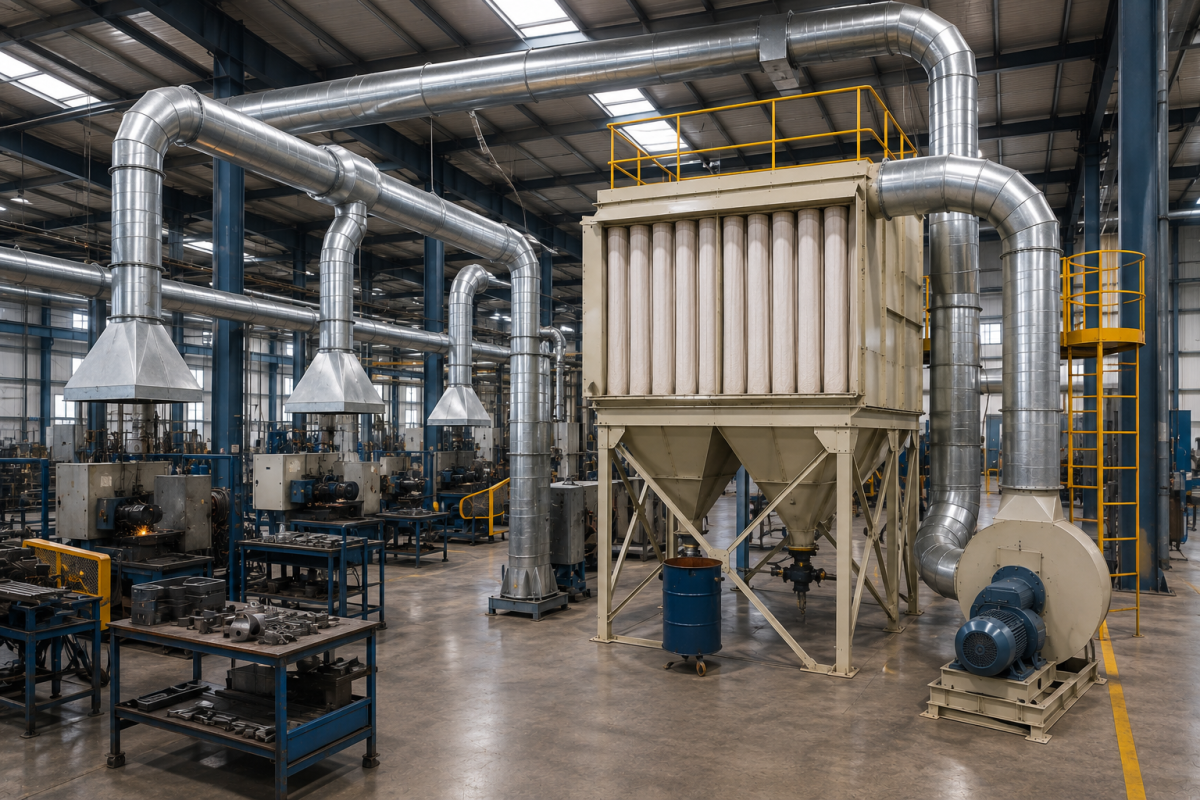
Dust Collector Airflow and CFM Calculation

Introduction

Selecting the correct airflow capacity is one of the most important steps when designing an industrial dust collection system. An undersized system may fail to capture dust effectively, while an oversized system can increase energy consumption, equipment costs, and operating expenses.

Understanding dust collector airflow calculation helps manufacturers determine how much air a dust collection system needs to move to effectively capture and transport airborne contaminants. The required airflow is commonly expressed in CFM (cubic feet per minute) and depends on factors such as the dust-generating process, hood design, capture velocity, ductwork, number of extraction points, and system configuration.

For manufacturers planning a new installation or upgrading an existing system, understanding dust collection CFM, industrial ventilation airflow, and dust collector sizing provides a useful starting point for system design.

Powertech Pollution Controls engineers dust collection systems based on the characteristics of the application rather than simply selecting a collector based on machine size or motor capacity.

Key Takeaways

  1. CFM represents the volume of air moved by a dust collection system.
  2. Required airflow depends on the capture point, dust characteristics, hood design, and ductwork.
  3. Capture velocity is different from duct transport velocity.
  4. Multiple extraction points require careful airflow and system balancing.
  5. Correct dust collector sizing improves capture efficiency and reduces unnecessary energy consumption.
  6. A complete engineering assessment should be performed before selecting the final collector and blower.

What Is Dust Collector CFM?

CFM, or cubic feet per minute, measures the volume of air that a dust collection system moves through its extraction network.

In simple terms:

Higher CFM = greater volume of air moved per minute.

However, higher CFM does not automatically mean better dust collection.

The system must generate sufficient airflow at the point of dust generation and maintain appropriate airflow throughout the ductwork.

This is why dust collector sizing should consider the complete extraction system rather than only the collector’s rated airflow.

The Basic Dust Collector Airflow Calculation

For a simple extraction point, airflow can be estimated using the relationship between capture area and capture velocity:

CFM = Capture Area × Capture Velocity × 60

Where:

  1. CFM = airflow requirement in cubic feet per minute
  2. Capture Area = effective capture area in square feet
  3. Capture Velocity = required air velocity in feet per second
  4. 60 = conversion from seconds to minutes

Example

Suppose an extraction hood has an effective capture area of 1 square foot and the process requires a capture velocity of 100 feet per minute.

The approximate airflow requirement would be:

CFM = 1 × 100 = 100 CFM

In real industrial systems, however, the calculation must account for hood geometry, distance from the contaminant source, duct losses, fittings, filters, and other system resistance.

Capture Velocity vs Duct Velocity

These two terms are often confused during dust collection system design.

Capture Velocity

Capture velocity is the air velocity required at the source to pull airborne dust into the extraction hood.

The required value depends heavily on the process.

A relatively calm dust-generating operation may require less capture velocity than a high-energy grinding, cutting, or material-transfer process.

Duct Transport Velocity

Duct velocity refers to the velocity required to transport captured dust through the ductwork without allowing particles to settle.

The required transport velocity depends on:

  1. Dust particle size
  2. Dust density
  3. Moisture
  4. Material characteristics
  5. Duct orientation
  6. Process conditions

Therefore, airflow should never be selected solely from the capture hood requirement.

Factors That Affect Dust Collection CFM

1. Type of Dust

Different materials behave differently in an extraction system.

Examples include:

  1. Fine metal dust
  2. Wood dust
  3. Plastic particles
  4. Food powders
  5. Chemical powders
  6. Mineral dust
  7. Grinding dust

Particle size, density, moisture, and abrasiveness all influence system design.

2. Dust-Generating Process

The energy of the process affects how aggressively contaminants are released.

Processes such as:

  1. Grinding
  2. Cutting
  3. Sanding
  4. Polishing
  5. Mixing
  6. Crushing
  7. Material transfer

may require substantially different extraction approaches.

3. Hood Design

The hood is one of the most important components of the system.

A poorly designed or incorrectly positioned hood can require substantially more airflow to achieve effective capture.

Source capture generally provides better efficiency than attempting to remove dust after it has dispersed throughout the facility.

4. Distance From the Dust Source

As the distance between the extraction point and dust source increases, the airflow requirement generally increases.

This is why extraction hoods should be positioned as close to the emission point as practical.

5. Number of Extraction Points

A system serving one machine will have very different airflow requirements from a centralized system serving ten or twenty machines.

The design must determine:

  1. Which points operate simultaneously
  2. Required airflow at each point
  3. Diversity of operation
  4. Branch duct dimensions
  5. Main duct capacity

Calculating Airflow for Multiple Machines

Suppose a manufacturing facility has four extraction points:

Extraction PointRequired Airflow
Grinding machine1,500 CFM
Cutting machine1,200 CFM
Sanding station900 CFM
Material transfer point700 CFM

If all four operate simultaneously:

Total airflow = 1,500 + 1,200 + 900 + 700

Total = 4,300 CFM

However, the final dust collector and blower should not automatically be selected at exactly 4,300 CFM.

The system designer must also evaluate duct losses, filter resistance, fittings, hood performance, operating conditions, and the possibility that not all extraction points operate simultaneously.

Understanding Static Pressure

CFM tells you how much air the system moves.

Static pressure tells you how much resistance the blower must overcome to move that air.

A dust collector therefore needs both:

  1. Adequate airflow
  2. Adequate pressure capability

Resistance can come from:

  1. Extraction hoods
  2. Ductwork
  3. Elbows
  4. Branches
  5. Dampers
  6. Filters
  7. Cyclones or pre-separators
  8. Exhaust arrangements

A blower capable of delivering a high CFM at low resistance may not deliver the required airflow once connected to a long, complex duct network.

Dust Collector Sizing: What Should Be Considered?

Correct dust collector sizing requires more than selecting a filter based on airflow.

Engineers should evaluate:

Dust Characteristics

  1. Particle size
  2. Density
  3. Moisture
  4. Temperature
  5. Abrasiveness
  6. Combustibility

Process Conditions

  1. Production rate
  2. Operating hours
  3. Dust generation rate
  4. Number of machines
  5. Simultaneous operation

System Requirements

  1. Required CFM
  2. Static pressure
  3. Duct length
  4. Number of bends
  5. Filter type
  6. Dust discharge arrangement

Why Oversizing a Dust Collector Isn’t Always Better

It may seem logical to select the largest available dust collector, but excessive airflow can create unnecessary costs.

Potential disadvantages include:

  1. Higher fan power consumption
  2. Larger ductwork
  3. Higher initial equipment cost
  4. Greater filter area requirements
  5. Increased operating costs
  6. Excessive airflow at individual machines

The objective should be adequate airflow at the correct pressure, not simply maximum airflow.

Why Undersizing Is a Problem

An undersized dust collection system can result in:

  1. Poor dust capture
  2. Dust escaping into the workplace
  3. Dust settling inside ductwork
  4. Filter overload
  5. Increased maintenance
  6. Reduced equipment life
  7. Poor workplace air quality

In severe cases, inadequate airflow can cause the entire collection system to perform poorly even when the dust collector itself is functioning correctly.

Industrial Ventilation Airflow vs Dust Extraction

General industrial ventilation airflow and localized dust extraction serve different purposes.

General Ventilation

Moves and replaces air throughout the facility.

Local Dust Extraction

Captures contaminants directly where they are generated.

For manufacturing processes that generate concentrated dust emissions, local exhaust ventilation is generally the more effective approach for contaminant control.

General ventilation can complement source extraction, but it should not automatically be considered a replacement for properly designed dust collection.

How Duct Design Affects CFM

Ductwork has a major influence on dust collection performance.

Poor duct design can create:

  1. Excessive pressure losses
  2. Uneven airflow
  3. Dust accumulation
  4. Higher fan energy consumption
  5. Poor capture at remote extraction points

Important design considerations include:

  1. Duct diameter
  2. Branch arrangement
  3. Elbow configuration
  4. Duct length
  5. Air velocity
  6. Balancing dampers
  7. Transition geometry

A properly engineered duct network ensures that the required airflow reaches each extraction point.

Signs That Your Dust Collector May Be Undersized

Existing systems may show several warning signs:

Visible Dust Escaping

Dust remains airborne even when the extraction system is operating.

Weak Suction

Operators notice inadequate airflow at extraction hoods.

Dust Accumulation in Ducts

Particles settle because transport velocity is insufficient.

Frequent Filter Loading

Filters become clogged faster than expected.

Inconsistent Performance

Some machines extract effectively while others perform poorly.

These symptoms can indicate airflow, static pressure, duct design, filter loading, or system balancing problems.

How Powertech Approaches Dust Collector Sizing

Powertech does not recommend selecting a dust collector based solely on a machine’s dimensions or motor rating.

A properly engineered system considers:

  1. Dust-generating process
  2. Dust characteristics
  3. Number of extraction points
  4. Required capture conditions
  5. Airflow requirements
  6. Duct network
  7. Static pressure
  8. Filtration requirements
  9. Dust discharge requirements
  10. Future production requirements

This application-specific approach helps ensure that the resulting DustBag system delivers reliable extraction without unnecessarily increasing energy or equipment costs.

What is dust collector airflow calculation?

Dust collector airflow calculation is the process of determining the amount of air required to capture and transport airborne dust effectively through an extraction system.

How is dust collection CFM calculated?

For a basic extraction point, airflow can be estimated from the effective capture area and required capture velocity. Complete industrial calculations must also consider hood design, ductwork, filter resistance, static pressure, and process conditions.

What does CFM mean in dust collection?

CFM means cubic feet per minute and represents the volume of air moved by the dust collection system.

Is higher CFM always better?

No. The system needs sufficient airflow at the required static pressure. Excessive airflow can increase energy consumption and equipment costs without improving dust capture.

How do I determine the correct dust collector size?

Dust collector sizing requires evaluation of dust characteristics, process conditions, number of extraction points, required airflow, ductwork, static pressure, filtration requirements, and operating conditions.

Can one dust collector serve multiple machines?

Yes. A centralized dust collection system can serve multiple machines when the collector, blower, ductwork, and control system are properly engineered for the required operating conditions.

Conclusion

Accurate dust collector airflow calculation is essential for designing an effective industrial dust extraction system. While CFM provides a useful measure of airflow capacity, proper dust collection CFM calculations must be combined with capture velocity, duct transport requirements, static pressure, filtration resistance, and the characteristics of the dust-generating process. Correct dust collector sizing is therefore an engineering exercise rather than simply selecting the largest available unit. By designing the hood, ductwork, blower, filtration system, and dust collector as one integrated system, manufacturers can achieve reliable dust capture, better workplace air quality, and more efficient long-term operation. Powertech’s engineering team can evaluate the specific process, airflow requirements, and plant layout to develop a DustBag industrial dust collection system suited to the application’s actual operating conditions.

Dust Collection System Design for Manufacturing Plants

Introduction

Manufacturing processes such as grinding, cutting, sanding, polishing, mixing, material handling, and machining can generate significant quantities of airborne dust. Without proper control, these contaminants can spread throughout a production facility, settle on machinery, affect product quality, increase housekeeping requirements, and reduce workplace air quality.

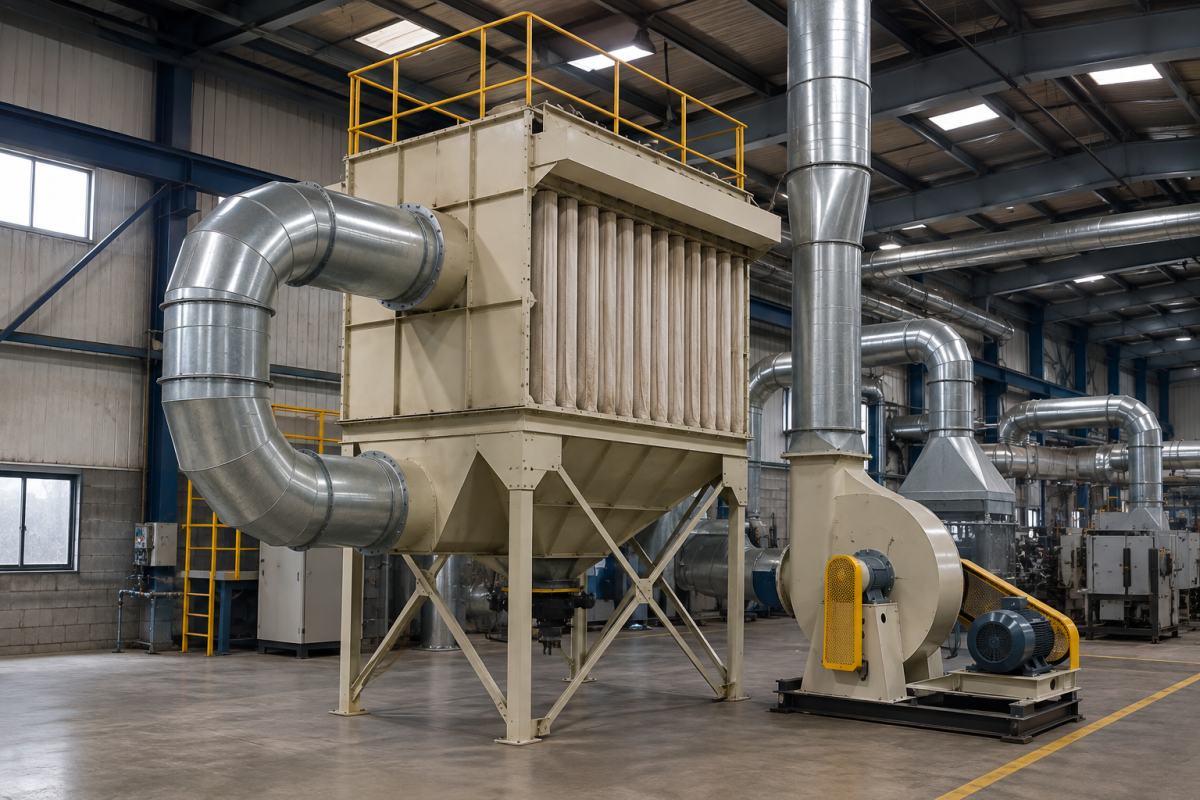
An effective dust collection system design captures dust as close as possible to the point of generation and transports it through a properly engineered extraction network to a filtration system. The performance of the complete system depends not only on the dust collector itself, but also on hood design, airflow, ductwork, static pressure, filtration, and dust discharge.

A properly engineered industrial dust extraction system can therefore provide substantially better results than simply installing a high-capacity dust collector and connecting it to existing ductwork.

For manufacturing facilities, the objective should be to design a complete factory dust control system around the actual processes, dust characteristics, operating conditions, and future production requirements.

Key Takeaways

  1. Effective dust collection begins with source capture.
  2. Dust collector capacity should be determined from airflow and static-pressure requirements.
  3. Hood and duct design are just as important as the filtration unit.
  4. Different manufacturing processes require different extraction strategies.
  5. Proper system balancing ensures consistent airflow across multiple machines.
  6. A well-designed system reduces dust contamination, maintenance, and energy waste.

What Is Dust Collection System Design?

Dust collection system design is the engineering process of determining how airborne dust will be captured, transported, filtered, and discharged from a manufacturing facility.

A complete system generally consists of:

  1. Source-capture hoods
  2. Extraction ductwork
  3. Dampers and branches
  4. Dust collector
  5. Filtration media
  6. Exhaust blower
  7. Dust discharge system
  8. Electrical and control systems

Each component must work together.

A high-performance dust collector cannot compensate for poorly designed hoods, undersized ductwork, excessive pressure losses, or inadequate airflow.

Step 1: Identify the Dust Sources

The first stage is to identify every process generating airborne contaminants.

Common sources include:

  1. Grinding machines
  2. Cutting machines
  3. Sanding stations
  4. Polishing equipment
  5. CNC machining
  6. Mixing systems
  7. Crushing equipment
  8. Material transfer points
  9. Powder handling
  10. Packaging machinery

The design should document the location and operating conditions of each source.

Step 2: Understand the Dust Characteristics

Not all dust behaves the same way.

Before selecting an industrial dust extraction system, engineers should evaluate:

  1. Particle size
  2. Particle density
  3. Dust concentration
  4. Moisture content
  5. Temperature
  6. Abrasiveness
  7. Chemical properties
  8. Combustibility

Fine powder may require a different filtration strategy from coarse metal particles or abrasive mineral dust.

Step 3: Select the Right Capture Method

Source capture is generally the most effective approach because it removes dust before it disperses into the facility.

Depending on the process, capture may involve:

Enclosed Extraction

The machine or process is partially or completely enclosed.

This is often highly effective because the extraction system controls the contaminant within a defined area.

Extraction Hood

A hood is positioned close to the dust-generating operation.

Downdraft Extraction

Air is drawn downward through a work surface, capturing dust generated during operations such as grinding or finishing.

Side-Draft Extraction

Air is pulled horizontally across the process toward an extraction opening.

Canopy Hood

Used where contaminants rise naturally and where other source-capture arrangements are impractical.

The capture method should be selected based on the process rather than simply using the same hood configuration throughout the plant.

Step 4: Determine Required Airflow

Airflow is one of the most important parameters in dust collection system design.

The required airflow depends on:

  1. Hood dimensions
  2. Capture distance
  3. Process energy
  4. Dust characteristics
  5. Number of extraction points
  6. Simultaneous operation

Airflow is typically expressed in CFM (cubic feet per minute).

The system must provide sufficient airflow at each extraction point while also maintaining adequate transport velocity through the ductwork.

Simply choosing a collector with a high CFM rating does not guarantee effective extraction.

Step 5: Design the Ductwork

Ductwork connects individual extraction points to the central collector.

Poorly designed ductwork can result in:

  1. Excessive pressure loss
  2. Uneven airflow
  3. Dust settling
  4. Increased fan energy consumption
  5. Poor extraction at remote machines

The design should consider:

  1. Duct diameter
  2. Duct length
  3. Air velocity
  4. Number of branches
  5. Elbow configuration
  6. Transitions
  7. Dampers
  8. Main duct arrangement

Smooth, properly sized duct routing generally provides better system performance than unnecessarily complicated layouts.

Step 6: Calculate Static Pressure

A dust collection blower must overcome the resistance created by the entire system.

Pressure losses can occur through:

  1. Hoods
  2. Ductwork
  3. Elbows
  4. Branches
  5. Dampers
  6. Filters
  7. Cyclones
  8. Exhaust outlets

The blower therefore needs to be selected based on the required airflow at the system’s operating static pressure.

Selecting a fan based solely on its maximum CFM rating can result in inadequate performance once the system is installed.

Step 7: Select the Dust Collector

The filtration unit should be selected according to the dust and process conditions.

Common technologies include:

Cartridge Dust Collectors

Suitable for many fine, dry dust applications where a compact system and high filtration surface area are advantageous.

Baghouse Dust Collectors

Suitable for high dust loading, high airflow, and many heavy industrial applications.

Cyclone Pre-Separators

Often used to remove larger particles before they reach the primary filtration stage.

The appropriate technology depends on the application rather than simply the desired airflow.

Step 8: Consider Dust Discharge

Collected dust needs to be removed reliably from the system.

Possible arrangements include:

  1. Collection bins
  2. Hoppers
  3. Rotary airlocks
  4. Screw conveyors
  5. Continuous discharge systems
  6. Automated material handling

The discharge method should match the volume and characteristics of the collected dust.

Step 9: Design for Multiple Machines

Manufacturing facilities frequently require a centralized factory dust control system serving multiple machines.

For these systems, engineers must determine:

  1. Total airflow
  2. Individual branch airflow
  3. Simultaneous operation
  4. Diversity factor
  5. Main duct dimensions
  6. Branch balancing
  7. Fan capacity

For example, a facility may have ten machines connected to one collector, but not all ten may operate simultaneously.

Designing around actual production conditions can prevent unnecessary oversizing while maintaining adequate extraction.

Step 10: Balance the System

A centralized system must be balanced so that each extraction point receives the required airflow.

Without proper balancing, some machines may experience:

  1. Excessive suction
  2. Insufficient suction
  3. Uneven dust capture

Balancing dampers and properly designed branch ductwork can help distribute airflow appropriately.

Manufacturing Dust Ventilation vs Local Exhaust

General manufacturing dust ventilation and local exhaust serve different purposes.

General Ventilation

Controls overall room air conditions by replacing or diluting contaminated air.

Local Exhaust

Captures contaminants directly at their source.

For dust-generating manufacturing processes, local exhaust is generally the primary control strategy. General ventilation can complement source capture but should not be relied upon to remove concentrated dust emissions after they have dispersed.

Common Dust Collection Design Mistakes

Using the Collector CFM as the Only Design Parameter

A collector’s rated CFM does not describe the performance of the complete system.

Poor Hood Placement

If the hood is too far from the dust source, substantially more airflow may be required.

Undersized Ductwork

Small ducts can create excessive pressure losses and restrict airflow.

Excessive Duct Bends

Unnecessary elbows and complicated routing increase system resistance.

Ignoring Static Pressure

A blower must be capable of delivering the required airflow against the actual system resistance.

Designing Without Future Expansion

A system designed only for today’s production may become inadequate as new machines are added.

Designing for Energy Efficiency

An efficient dust collection system does not necessarily mean using the largest possible blower.

Energy consumption can be reduced through:

  1. Correctly sized ductwork
  2. Efficient hood design
  3. Proper system balancing
  4. Variable-frequency drives where appropriate
  5. Automatic dampers
  6. Filter monitoring
  7. Maintaining clean filtration media

The objective is to deliver the required airflow at the required pressure with minimum unnecessary resistance.

Designing for Future Expansion

Manufacturing facilities often expand over time.

A good dust collection system design should consider potential:

  1. Additional machines
  2. Increased production
  3. New extraction points
  4. Extended operating hours
  5. Process changes

Providing appropriate provisions for future expansion can be considerably more economical than replacing the entire system later.

Powertech’s Approach to Dust Collection System Design

Powertech approaches industrial dust extraction as a complete system rather than simply supplying a dust collector.

The design process considers:

  1. Dust-generating processes
  2. Dust characteristics
  3. Capture method
  4. Required airflow
  5. Ductwork configuration
  6. Static pressure
  7. Filtration technology
  8. Dust discharge
  9. Fan selection
  10. Plant layout
  11. Maintenance requirements
  12. Future expansion

This application-specific approach allows DustBag systems to be configured for the actual operating conditions of the manufacturing facility.

What is the most important factor in dust collection system design?

Effective source capture is one of the most important factors. Dust should ideally be captured as close as possible to where it is generated before it disperses into the workplace.

How is an industrial dust extraction system sized?

Sizing depends on required airflow, capture conditions, dust characteristics, number of extraction points, ductwork, static pressure, filtration requirements, and operating conditions.

Can one dust collector serve an entire factory?

Yes. Centralized systems can serve multiple machines and production areas when the collector, blower, ductwork, and controls are correctly engineered.

Is general factory ventilation enough for dust control?

Generally, no. General ventilation can supplement local extraction, but source capture is normally more effective for controlling concentrated dust emissions.

What happens if a dust collection system is undersized?

An undersized system may provide insufficient airflow, resulting in poor dust capture, dust accumulation, filter overload, increased maintenance, and reduced workplace air quality.

Should a dust collection system be designed for future expansion?

Yes. Where future production growth is expected, the system should be designed with appropriate capacity and provisions for additional extraction points.

Conclusion

Effective dust collection system design requires much more than selecting a dust collector with a suitable CFM rating. The complete industrial dust extraction system must integrate source capture, airflow, ductwork, static pressure, filtration, dust discharge, and fan selection into a coordinated system. For manufacturing facilities, a properly engineered factory dust control system provides more consistent dust capture, cleaner production areas, reduced equipment contamination, and better energy efficiency. General manufacturing dust ventilation can complement the system, but localized source extraction should remain the foundation for controlling dust generated by industrial processes. Powertech’s engineering-led approach to DustBag systems enables manufacturers to develop customized dust collection solutions based on their actual processes, operating conditions, and future production requirements.

Dust Collectors for Grinding and Finishing Operations

Introduction

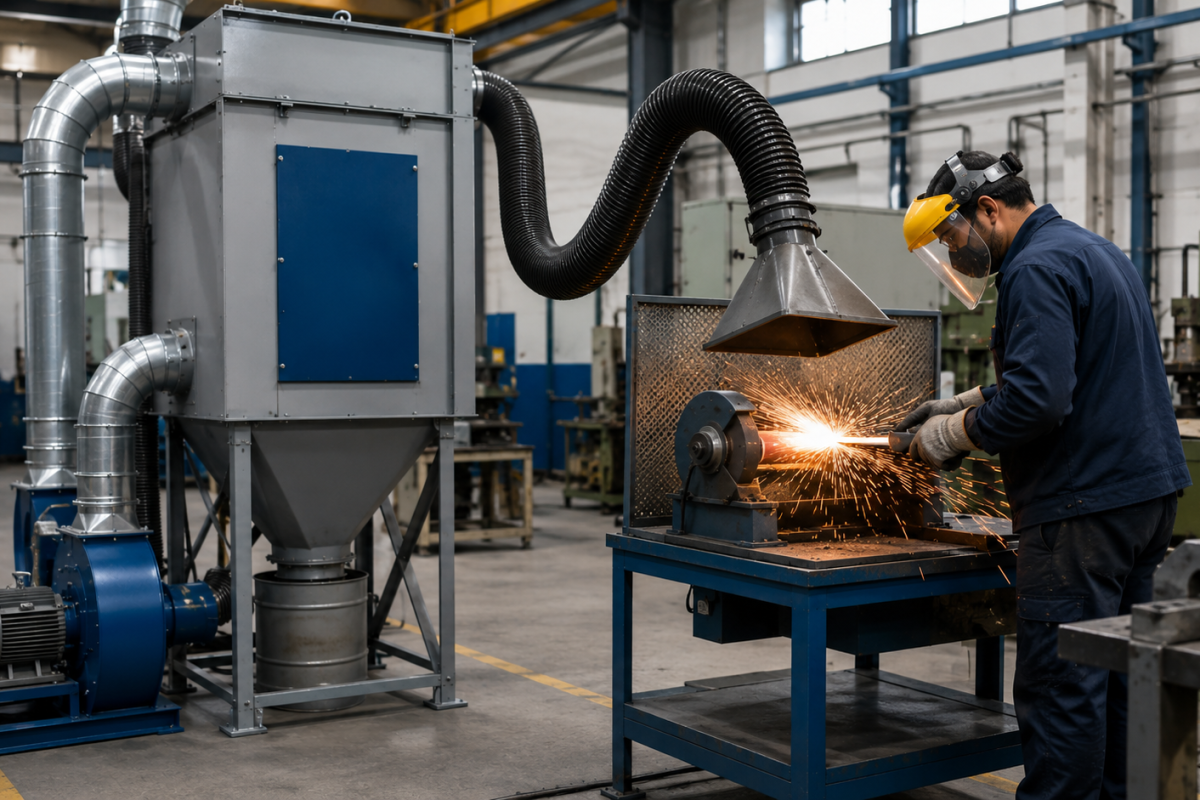
Grinding and finishing operations are among the most significant sources of airborne dust in industrial manufacturing. Processes such as surface grinding, deburring, polishing, buffing, and abrasive finishing generate large quantities of fine metal particles that can quickly disperse throughout a facility if not captured at the source. Installing an efficient dust collector for grinding is essential for maintaining clean air, protecting equipment, and improving overall manufacturing efficiency.

An engineered grinding dust extraction system removes airborne contaminants before they spread across the workshop. Effective metal grinding ventilation not only improves workplace air quality but also minimizes dust accumulation on machinery, electrical equipment, and finished products. Combined with high-performance industrial dust filtration, these systems help manufacturers create cleaner, safer, and more productive working environments.

With over 30 years of experience in industrial air pollution control, Powertech designs DustBag industrial dust collection systems specifically engineered for demanding grinding and finishing applications across a wide range of manufacturing industries.

Key Takeaways

  1. Grinding operations generate large quantities of fine airborne dust.
  2. Source-capture dust collectors are more effective than general ventilation.
  3. Proper grinding dust extraction protects machinery and improves air quality.
  4. Industrial dust filtration reduces maintenance and housekeeping costs.
  5. Engineered dust collection systems improve productivity and workplace safety.

Why Grinding Operations Generate Large Amounts of Dust

Grinding removes material through high-speed abrasion. As grinding wheels contact the workpiece, microscopic particles are released into the air.

The amount of dust generated depends on several factors, including:

  1. Material being processed
  2. Grinding wheel speed
  3. Feed rate
  4. Abrasive type
  5. Surface finishing requirements

Without proper extraction, these particles remain suspended in the workplace before settling on equipment and surrounding surfaces.

Common Grinding and Finishing Applications

Industrial dust collectors are commonly used for:

Surface Grinding

Produces continuous fine metallic dust.

Belt Grinding

Generates airborne particles during material removal.

Deburring

Removes sharp edges while creating fine dust.

Polishing

Produces extremely fine particulate matter.

Buffing

Creates airborne polishing compounds and metal particles.

Abrasive Finishing

Generates dust from both abrasive media and processed materials.

Challenges of Grinding Dust

Poor Air Quality

Fine particles remain airborne for extended periods, reducing overall workplace cleanliness.

Equipment Contamination

Dust accumulates on:

  1. CNC machines
  2. Electrical cabinets
  3. Automation systems
  4. Precision instruments

Product Contamination

Airborne dust may settle on finished components before packaging or assembly.

Increased Housekeeping

Dust accumulation requires frequent cleaning of machines, floors, and production areas.

Higher Maintenance Costs

Contaminated equipment often requires more frequent servicing and maintenance.

How a Dust Collector for Grinding Works

Step 1: Source Capture

Extraction hoods capture dust directly from grinding equipment.

Step 2: Air Conveyance

Dust-laden air is transported through engineered ductwork.

Step 3: Industrial Dust Filtration

High-efficiency filter media separate airborne particles from the airflow.

Step 4: Dust Collection

Collected dust is stored in hoppers or collection bins for disposal or recycling.

Step 5: Clean Air Discharge

Filtered air is safely discharged or recirculated according to plant requirements.

Benefits of Grinding Dust Extraction

Cleaner Work Environment

Source capture significantly reduces airborne dust.

Improved Equipment Reliability

Cleaner machinery experiences lower contamination and maintenance requirements.

Better Product Quality

Reduced airborne dust minimizes contamination during finishing operations.

Lower Operating Costs

Efficient dust extraction decreases housekeeping and maintenance expenses.

Improved Productivity

Cleaner facilities support smoother production and improved operator efficiency.

Metal Grinding Ventilation Best Practices

To maximize performance:

  1. Capture dust as close to the grinding point as possible.
  2. Maintain sufficient airflow throughout the duct system.
  3. Inspect filters regularly.
  4. Prevent air leaks in ductwork.
  5. Schedule preventive maintenance.
  6. Select the correct dust collector capacity for each application.

General building ventilation should never replace localized dust extraction for grinding operations.

Choosing the Right Industrial Dust Filtration System

The ideal system depends on:

  1. Dust particle size
  2. Material being processed
  3. Dust loading
  4. Airflow requirements
  5. Number of grinding stations
  6. Plant layout
  7. Future expansion requirements

An engineered assessment ensures optimal system performance.

Powertech DustBag for Grinding Applications

Powertech’s DustBag industrial dust collectors are designed to handle demanding grinding and finishing operations.

Key Features

  1. High-efficiency cartridge or bag filtration
  2. Continuous-duty operation
  3. Modular construction
  4. Low maintenance
  5. High airflow capacity
  6. Durable industrial design
  7. Custom-engineered solutions

DustBag systems can be configured for individual grinding stations or centralized extraction systems serving multiple work areas.

Expert Insight

From Powertech’s experience, one of the most common mistakes is relying on general shop ventilation instead of capturing grinding dust directly at the source.

The closer the extraction point is to the grinding operation, the higher the collection efficiency. Facilities that implement properly designed source-capture systems consistently report cleaner equipment, reduced maintenance, lower housekeeping costs, and improved overall production efficiency.

Why is a dust collector needed for grinding operations?

Grinding produces fine airborne particles that can spread throughout the facility. A dust collector captures these contaminants before they affect equipment and workplace air quality.

What is grinding dust extraction?

Grinding dust extraction is the process of capturing airborne dust generated during grinding, polishing, and finishing operations using localized extraction systems.

How does metal grinding ventilation improve manufacturing?

It removes airborne dust at the source, protecting workers, machinery, and finished products while improving overall workplace cleanliness.

Which industries require industrial dust filtration?

Metal fabrication, foundries, automotive manufacturing, aerospace, precision engineering, tool rooms, and general manufacturing all benefit from industrial dust filtration systems.

Can one dust collector serve multiple grinding stations?

Yes. Centralized dust collection systems can efficiently extract dust from multiple grinding and finishing stations.

How do I choose the right dust collector for grinding?

Selection depends on the type of material, dust characteristics, airflow requirements, production volume, and facility layout. An engineered system design provides the most effective solution.

Conclusion

Installing a properly engineered dust collector for grinding is essential for controlling airborne contaminants generated during grinding and finishing operations. By implementing effective grinding dust extraction, optimizing metal grinding ventilation, and using high-performance industrial dust filtration, manufacturers can significantly improve workplace cleanliness, protect equipment, and reduce operating costs. With decades of expertise in industrial air pollution control, Powertech’s DustBag dust collection systems deliver reliable, high-efficiency dust extraction solutions tailored to the demanding requirements of modern manufacturing facilities.

Dust Collection Systems for Food Processing Plants

Introduction

Food processing facilities handle a wide variety of dry ingredients such as flour, sugar, starch, spices, cocoa, milk powder, seasonings, and additives. During conveying, mixing, grinding, sieving, packaging, and material transfer, these ingredients generate airborne dust that can spread throughout the production environment if not properly controlled. An efficient food industry dust collector is essential for maintaining clean production areas, protecting equipment, and supporting consistent product quality.

A properly engineered food processing dust control system captures airborne particles directly at the source before they contaminate surrounding work areas. Effective industrial dust extraction for food plants not only improves workplace cleanliness but also minimizes product loss, reduces housekeeping requirements, and enhances production efficiency. Whether processing flour, spices, dairy powders, or food additives, reliable powder dust collection systems are an integral part of modern food manufacturing.

With nearly three decades of expertise in industrial air pollution control, Powertech designs DustBag dust collection systems that deliver hygienic, efficient, and reliable dust extraction solutions tailored to the unique requirements of food processing facilities.

Key Takeaways

  1. Food processing generates airborne dust during multiple production stages.
  2. Source-capture dust collection improves cleanliness and product quality.
  3. Proper dust extraction minimizes housekeeping and equipment contamination.
  4. Engineered systems support hygienic manufacturing environments.
  5. Customized dust collection improves operational efficiency and reliability.

Why Dust Control Is Important in Food Processing

Many food ingredients become airborne when handled, transferred, blended, or packaged.

Without proper dust extraction, facilities may experience:

  1. Dust accumulation on production equipment
  2. Product contamination
  3. Reduced indoor air quality
  4. Increased housekeeping
  5. Equipment fouling
  6. Reduced production efficiency

Capturing dust at the source significantly improves manufacturing conditions.

Common Sources of Dust in Food Plants

Flour Handling

Bulk flour transfer and mixing generate significant airborne particulates.

Sugar Processing

Fine sugar particles become airborne during conveying and packaging.

Spice Blending

Grinding and mixing spices produce lightweight dust that spreads quickly.

Milk Powder Processing

Dry dairy ingredients generate fine airborne powder during handling.

Cocoa Processing

Powder transfer and mixing release fine cocoa dust into production areas.

Food Additives

Premixes, starches, seasonings, and powdered ingredients all require effective dust control.

How a Food Industry Dust Collector Works

Step 1: Source Capture

Extraction hoods capture airborne powder directly from production equipment.

Step 2: Air Conveyance

A blower transports dust-laden air through engineered ductwork.

Step 3: Industrial Dust Filtration

High-efficiency cartridge or bag filters separate dust from the airflow.

Step 4: Powder Collection

Collected material is stored in hoppers or collection containers for safe disposal or recovery where appropriate.

Step 5: Clean Air Return

Filtered air is discharged or recirculated according to plant design and applicable food processing standards.

Benefits of Food Processing Dust Control

Cleaner Production Areas

Source capture significantly reduces airborne powder.

Improved Product Quality

Lower airborne contamination helps maintain cleaner production environments.

Reduced Equipment Cleaning

Dust accumulation on machinery and packaging equipment is minimized.

Lower Housekeeping Costs

Effective extraction reduces manual cleaning requirements.

Improved Equipment Reliability

Cleaner equipment experiences less contamination and maintenance.

Better Workplace Air Quality

Efficient dust collection contributes to a cleaner and more comfortable production environment.

Powder Dust Collection Applications

Industrial dust extraction systems are widely used for:

  1. Flour mills
  2. Bakeries
  3. Dairy processing plants
  4. Spice manufacturing
  5. Beverage powder production
  6. Snack food manufacturing
  7. Chocolate and cocoa processing
  8. Ingredient blending plants
  9. Food packaging lines
  10. Nutritional supplement manufacturing

Design Considerations for Industrial Dust Extraction in Food Plants

Every food processing application has unique requirements.

System design should consider:

  1. Powder characteristics
  2. Particle size
  3. Airflow requirements
  4. Hygienic equipment design
  5. Ease of cleaning
  6. Process layout
  7. Number of extraction points
  8. Future production expansion

A customized engineering approach ensures reliable long-term performance.

Powertech DustBag Dust Collection Systems

Powertech’s DustBag dust collectors are designed for demanding food manufacturing environments.

Key Features

  1. High-efficiency filtration
  2. Hygienic industrial design
  3. Continuous-duty operation
  4. Modular construction
  5. Optimized airflow
  6. Low maintenance
  7. Custom-engineered configurations

DustBag systems can be designed for individual machines or centralized extraction serving multiple production areas.

Expert Insight

From Powertech’s experience, many food manufacturers initially focus on cleaning production areas after dust settles. However, preventing dust from becoming airborne is far more effective.

Properly engineered source-capture systems improve housekeeping, reduce product loss, protect equipment, and support consistent production quality. Well-designed dust collection systems also simplify routine plant maintenance and improve overall operational efficiency.

What is a food industry dust collector?

A food industry dust collector is an industrial filtration system that captures airborne food powders generated during processing, mixing, conveying, and packaging operations.

Why is food processing dust control important?

It helps maintain cleaner production environments, reduces equipment contamination, minimizes housekeeping, and supports consistent product quality.

Which food ingredients generate the most dust?

Flour, sugar, starch, cocoa, milk powder, spices, seasoning blends, and nutritional powders commonly generate airborne dust.

Can dust collection systems recover valuable product?

In certain applications, collected powder can be recovered depending on the process design and applicable food safety requirements.

Are centralized dust collection systems suitable for food plants?

Yes. Large food processing facilities often use centralized dust collection systems serving multiple production lines.

How do I choose the right dust collector for a food processing plant?

Selection depends on powder characteristics, airflow requirements, hygienic design considerations, process layout, and production capacity. A detailed engineering evaluation ensures the most suitable solution.

Conclusion

An efficient food industry dust collector is essential for maintaining hygienic, productive, and reliable food manufacturing operations. By implementing engineered food processing dust control, optimizing industrial dust extraction for food plants, and installing high-performance powder dust collection systems, manufacturers can improve workplace cleanliness, protect equipment, reduce maintenance, and support consistent product quality. With decades of expertise in industrial air pollution control, Powertech’s DustBag dust collection systems provide customized, high-efficiency solutions designed to meet the demanding requirements of modern food processing facilities.